Shaming distracted drivers: A blog we need

They could kill my children.

That’s what I think when I’m driving or walking alone and dodging the drivers around me. Yesterday a lady drove at medium speed through a Stop sign and right through the intersection where I was jogging — or rather, where I stopped jogging and jumped out of her way. She was looking only left (I was on her right, other cars straight ahead). And, of course, she was talking on her cell phone — the modern way, by holding the iPhone away from the ear in Speakerphone mode.

The thought that they could kill my children makes me mad, swinging mad, fighting mad. I am a “liberal” (meaning libertarian). But their freedom stops when my children’s security is threatened.

Matt Richtel

Matt Richtel at The New York Times (who, incidentally, took over my teaching spot at Berkeley’s Graduate School of Journalism when I left) has done a great public service by running a series of articles on the subject to raise awareness. I salute him. I want more of them. Give Matt an award.

But we also have to admit that it has not stopped. They are still texting and yapping about their important things (“like, ohmigawd, he was soooo creepy….”) while driving their killing machines past my children.

Dangerous misconceptions are spreading:

  • That “hands-free” (Bluetooth) technology makes any difference whatsoever (it does not)
  • That talking is OK, even if texting is not (it is not)
  • That others should not do it, even though I can control myself (I cannot.)

The reality is that merely talking on a phone in the car (“hands-free” or not) causes the same cognitive delay as drunk driving. Texting is several times worse.

A modest proposal

Eventually, they will pass laws, and those will be ineffective and late. (In the 70s, seat-belt laws were passed after spontaneous social change had already changed behavior. Politicians react to what voters believe already.)

So change must happen differently. How?

Through shame.

It’s a powerful emotion. We don’t like to be embarrassed, even in the face of complete strangers. They did studies (which I can’t find, so if you can, please share the link) that people wash their hands in a public toilet much more often when somebody else is there than when they are alone.

So, we must shame them. How?

I urge and plead with somebody who is reading this to start a blog devoted entirely to posting pictures and license plates of people yapping/texting while driving in flagrante.

Let them see themselves. Let them be googlable.

I promise my support.

Bookmark and Share

Pew and me, “imagining the internet”

The Pew Internet & American Life Project invited me to participate in the next iteration of their serial “expert” reports on the future evolution of the Internet.

The questions themselves were interesting and telling, and I thought I might share them with you and let you know how I answered. (I look forward to finding out what all the other participants said when “Future of the Internet” is published by Cambria Press.)

The questions were “tension pairs” of alternative scenarios around the following themes:

  • Human intelligence
  • Reading and writing skills
  • Social and human relationships
  • The Internet’s “end-to-end principle”
  • Desktop versus cloud computing
  • The next takeoff technologies

Human intelligence

Here is one tension pair (their words):

By 2020, people’s use of the internet has enhanced human intelligence; as people are allowed unprecedented access to more information, they become smarter and make better choices. Nicholas Carr was wrong: Google does not make us stupid.

Or:

By 2020, people’s use of the internet has not enhanced human intelligence and it could even be lowering the IQs of most people who use it a lot. Nicholas Carr was right: Google makes us stupid.

I chose alternative 1 and elaborated (my words):

What the internet (here subsumed tongue-in-cheek under “Google”) does is to support some parts of human intelligence, such as analysis, by replacing other parts, such as memory. Thus, people will be more intelligent about, say, the logistics of moving around a geography because “Google” will remember the facts and relationships of various locations on their behalf. People will be better able to compare the revolutions of 1848 and 1789 because “Google” will remind them of all the details as needed. This is the continuation ad infinitum of the process launched by abacuses and calculators: we have become more “stupid” by losing our arithmetic skills but more intelligent at evaluating numbers.

Reading skills

Here is another tension pair (their words):

By 2020, it will be clear that the internet has enhanced and improved reading, writing, and the rendering of knowledge.

Or:

By 2020, it will be clear that the internet has diminished and endangered reading, writing, and the intelligent rendering of knowledge.

Here, too, I chose alternative 2 but elaborated (my words):

We are currently transitioning from reading mainly on paper to reading mainly on screens. As we do so, most of us read more, in terms of quantity (word count), but also more promiscuously and in shorter intervals and with less dedication. As these habits take root, they corrupt our willingness to commit to long texts, as found in books or essays. We will be less patient and less able to concentrate on long-form texts. This will result in a resurgence of short-form texts and story-telling, in “Haiku-culture” replacing “book-culture”.

Friendship and intimacy

Here is another tension pair:

In 2020, when I look at the big picture and consider my personal friendships, marriage and other relationships, I see that the internet has mostly been a negative force on my social world. And this will only grow more true in the future.

Or:

In 2020, when I look at the big picture and consider my personal friendships, marriage and other relationships, I see that the internet has mostly been a positive force on my social world. And this will only grow more true in the future.

And again I chose alternative 2, but said:

The question presents a false dichotomy: Technology has no impact whatsoever in the long term on human relationships. What it does is to facilitate some aspects of it for a time (thoughts with letters, speech with telephony, updates with social networks, nearness-awareness with geo-location, etc) at the expense of outrunning the etiquette and courtesy protocols of the previous generation (disturbance during dinner time with telephony, privacy and discretion with social networks and geo-location, et cetera). Over time, etiquette catches up (or evolves), but efficiency advances elsewhere. But throughout, people remain responsible for their human connections–ie, the commitments in time and trust they make to others and their expectations of reciprocity.

Privacy and “sharing”

One more tension pair:

By 2020, members of Generation Y (today’s “digital natives”) will continue to be ambient broadcasters who disclose a great deal of personal information in order to stay connected and take advantage of social, economic, and political opportunities. Even as they mature, have families, and take on more significant responsibilities, their enthusiasm for widespread information sharing will carry forward.

Or:

By 2020, members of Generation Y (today’s “digital natives”) will have “grown out” of much of their use of social networks, multiplayer online games and other time-consuming, transparency-engendering online tools. As they age and find new interests and commitments, their enthusiasm for widespread information sharing will abate.

And again, I chose alternative 2 and elaborated:

The human maturation process does not change because of a new technology. Starting before we left the savannahs, the young members of Homo “Sapiens” have over-shared in order to make themselves socially interesting to the group and to potential mates, only to discover the enormous risks involved when shared information reaches malicious individuals or a group at large, at which point they have re-learned the discretion of their parents. Thus sharing on the internet will continue on its present trajectory: more will be shared by the young than the old, and as people mature they will share more banal and less intimate information.

The other topics didn’t interest me quite as much, although I gave my opinions. Regarding the question of “cloud computing” versus PC-based computing, I made my thinking quite clear when Apple’s support team gave me ample (in terms of time) opportunity to ponder it.

Can’t wait to hear what you guys think.

Bookmark and Share

Facebook flashes your trench coat open

Mark Zuckerberg

Facebook just “updated” its privacy settings, and I almost did not notice. That’s because I’m (Facebook founder) Mark Zuckerberg’s nightmare: I don’t “share” anything on Facebook to begin with, so my Facebook profile contains little to be private about.

But some of those who do share things on Facebook “came close to killing [their] account this week”, as Danny Sullivan did, when they paid attention to the details of the change.

A year ago I predicted in our (The Economist‘s) sister publication, The World in 2009, that this brave new culture of “sharing” would cause discontent. Maybe that point is now nigh. For me personally, it arrived long ago.

Because I used to cover the internet in my previous beat at The Economist, I had to be one of the first to try new things like Facebook, and I usually was. But from the start I made a pact with myself:

  • No pictures of, or (indexable, Googlable) information about, my loved ones.
  • No names, birthdays, diaper photos etc.
  • No drive-by shootings (photo, video, status update) of third parties

In particular, my wife and children should, in effect, not be on the internet at all unless they themselves later choose to put themselves there. You may have noticed that their names do not appear on The Hannibal Blog, even though I share my ideas here quite liberally. Yes, you may know me very intimately by now in an intellectual way–as I feel I know some of you quite intimately through your comments even though I only see your pseudonym and avatar. But you do not know me biographically beyond what I choose to divulge. I practice Platonic sharing.

So why am I Mark’s nightmare? Because getting people to share all that other sort of stuff–the biographical and, in particular, the intimate bits–is his mission, his strategy, his imperative, as he himself already told me two and a half years ago, before he was famous.

(Ironically, that was one of the hardest interviews I ever conducted, because Mark, well, would not share anything. In conversation, I mean. He gives short, linear, monosyllabic answers. Getting him to open up offline is like getting blood out of a stone.)

To make people feel secure enough to share more, Facebook subsequently introduced increasingly complex (“granular” was Mark’s word) privacy settings. By fiddling around with dials and such, you could determine how public/private your photos, updates, contact info etc were.

I never bothered, because I hate fiddling and, well, I had made that pact, so I didn’t care. There was nothing to keep private.

But I watched, with curiosity verging on shock, what information I began to see, in my peripheral Facebook vision, about my Facebook contacts. If I may generalize: The men shared thoughts and opinions, intended to be public, and the women shared baby photos and such that used to be considered intimate. (The differences between men and women on Facebook go a lot further.) I occasionally felt like a voyeur, and became bashful. Surely I was not meant to see all of this? Or perhaps I was? Perhaps I just belong to a different era, such as Hannibal’s.

But, based on my conversation with Mark all those (internet) eons ago, I always knew that Facebook was a pair of scissors that would sooner or later cut. The two blades are these:

  • For Facebook to stay interesting to its users, Mark needs people to share ever more of this stuff.
  • For Facebook to stay interesting to Mark and his investors, he needs to start doing things with that information, things that go beyond just showing the information to your friends.

A lot of people will be cut by the “transition tool” that Facebook is now providing as part of its privacy changes. Danny in his post went through it, so read his analysis there. Just one hint: Online, everything is about the “default” option, because that is the one most people will use. You notice that the default setting in the “tool” for who may see most kinds of information is ….

Everyone


Bookmark and Share

Stupid yoga, smart yoga, and life

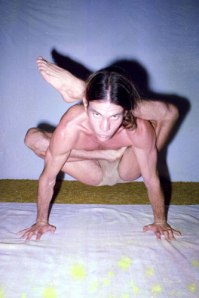
David Williams, 1970s

That’s David Williams, who went to India in the 1970s and met Pattabhi Jois, becoming the first non-Indian to learn Jois’ entire system of asanas (postures), now called Ashtanga.

Today he lives in Maui, halfway up to its spectacular volcanic crater, and that’s where my wife and I caught up with him a few years ago. We were in Maui and called him. He said ‘come over’. We went to his house. He showed us some pictures of himself in pretzel positions during the 1970s and 80s.

Then he chased out his three Bernese mountain dogs and we threw down our mats in his garage, where he taught us Ashtanga yoga for the next couple of hours. Later, we went to get some Vietnamese food and heard his yarns from yonder.

He told us a lot that day that my wife and I still talk about. With his thick Carolinian drawl, David is simultaneously wise and funny. One issue that he has strong opinions about is hurting yourself.

Western yogis today–the kind you see with tight Prana pants stretched around their firm buttocks, mat under one arm, Starbucks Venti Latte in the other–hurt themselves a lot. All the time, in fact. I have hurt myself.

‘Of course,’ you say. ‘Yoga is stretching, so sometimes you overdo it and hurt yourself.’

Wrong!

As David put it to us: If you went to a ‘real’ yogi on some Himalayan mountain top and told him that you had injured yourself, he would not understand. He would look at you as though you were crazy. It would sound as stupid to him as it would sound to your pastor if you told him that you had hurt yourself praying.

The dumbest and most dangerous “yogi” in the world

Which brings me to this article in the New York Times about “yoga competitions” and to a man named Bikram Choudhury. I wrote about Bikram in The Economist a few years ago, but that was in the Business section and I had to give it that kind of slant. Today, let’s talk about something more important.

Bikram is an extremely smart businessman–he has made Bikram, a specific series of asanas in a hot room, into a big brand.

He is also an unbelievably stupid and dangerous “yogi”. He’s not a Yogi at all, really. And you need look no further than this nonsense about ‘yoga competitions’, which–surprise!–was his idea. He and his wife want to make yoga an Olympic sport, in fact.

Introducing: Satya and Ahimsa

As regular readers of The Hannibal Blog may remember, yoga is really about stilling your mind, as Patanjali described it.

Yes, in order to do that, you might want to prepare yourself physically–ie, with asanas–because, as the Roman poet Juvenal said, mens sana in corpore sano, a healthy mind in a healthy body. But you want to spend just as much time and effort on the other seven of the eight limbs (= Asht-anga) of yoga.

The first, and most urgent, of these limbs is yama, or ethical guidelines. And two of these are:

  • satya, truthfulness, and
  • ahimsa, non-violence.

Now let me explain to you what, for most people, happens in the first five minutes in a Western yoga studio:

  1. They look around at all the other, fitter, slimmer, lither bodies and get competitive. Their ego (one of the naughty things that Patanjali warned us about) flares up. They lie to themselves: ‘I can do what he can do; I can get into Lotus.’ By lying, they have already dropped satya, and are thus no longer eligible to move on to a higher limb such as asana. They should really leave the room.
  2. Having lied to themselves (and the others in the room), they now become violent toward their own bodies. They pull, push … and hurt. Thus they have dropped ahimsa as well. Now they really should leave the room. But they never do, because everyone else is doing the same thing.

Back to David…

So save yourself some time, money and above all hurt and ignore Bikram. Please.

Instead, find yourself a real yogi, such as David.

When my wife and I met David, he no longer looked like the dude in the 1970s picture above. He looks like a middle-aged guy with long hair–less boring but otherwise as physically imperfect as the average guy his age. And yet (why “yet”?), he loves yoga as much as ever. That’s because he decided years ago that stretching is not what yoga is about.

He wrote an open letter about it. He begins:

… First, and foremost, I hope you can learn from me that in your practice, “If it hurts, you are doing it wrong.”…

Eventually, he gets to this issue of competition (or even comparison):

…I am occasionally asked if someone is “good at Yoga.” I quickly respond that the best Yogi is not the one who is most flexible, but the one who is most focused on what he or she is doing… It is with some sadness that I have observed people “competing with their Yoga practice.”…

After all, he continues, what good is yoga is you only do it while you’re young and fit–ie, “good”–and then stop when you get older and stiffer?

… The key is being able to continue practicing Yoga for the rest of your life. … those who continue are the ones who are able to figure out how to make it enjoyable… The others, consciously, subconsciously, or unconsciously, quit practicing. It is my goal to do everything I can to inspire you to establish your Yoga practice not just for the few days we are together, but for the rest of your life….

…My goal is to convey the idea that the greatest Yogi is the one who enjoys his or her Yoga practice the most, not the one who can achieve the ultimate pretzel position… what is really important is what is invisible to the observer, what is within each of you….

… and onward to life

Now take everything that David and I have said above and replace the word yoga with … whatever you please.

How about sex? Do you ruin your enjoyment of it by competing or comparing yourself? Do you sacrifice satya and ahimsa to pretend that you’re a superwoman/superman? Do you “quit”, or want to quit, when you get older and less responsive?

How about friendship? Are you competing with others and comparing yourself based on how popular you are? Are you investing in acquaintances merely to nurse your “network”, even at the expense of other, real, friendships?

How about… [insert whatever is on your mind]

If that sounds familiar, you have sacrificed satya and ahimsa and are not ready to move on to the higher stages of being alive (= yoga). When you rediscover satya and ahimsa, in a garage in Maui or wherever else, you remember what you’ve been missing.

Bookmark and Share

The author’s mind during Erholung

photo

By the way, if The Hannibal Blog‘s intellect has seemed to you a bit less incisive than usual in the past week, it’s because its author is on holiday. Really on holiday, for the first time in two years or so.

(Lately, I’ve taken “vacations” mainly to write my book, so they were not “real”.)

A German word comes to mind:

Erholung

It’s one of those words that have no direct translation. Er- is a syllable that can mean re-; holen means bring. So Erholen means something like bring back. It contains re-juvenation, re-laxation, re-generation and a few other re’s.

Usually, I restrict myself to an average of 30 minutes a day on this blog (writing and/or answering comments). But during this vacation I’ve cut that to 15 minutes a day, giving my wee’uns dibs on my time (or just staring at palms trees, which have a magical effect on me.)

My mind has become temporarily empty, as during deep sleep or coma. I choose to assume that this is prologue to a sort of rapid-eye-movement response as I re-emerge, and then to energetic, take-no-prisoners mental ferocity. 😉


Bookmark and Share

How crisis leads to progress (aka the Cloud)

[picapp src=”a/0/e/0/d5.jpg?adImageId=7132613&imageId=2039813″ width=”500″ height=”351″ /]

Here is an admittedly tiny and prosaic example of a big and poetic idea–the idea in Kipling’s If and in my book that disaster can be an impostor (as can triumph). The disaster in this case is more of a nuisance, but you will get the point.

1) The nuisance

My (youngish) Mac Book Pro has had a boo-boo. The screen started going black (why do “screens of death” have to be blue anyway?).

I happen to be in the Apple elite, equipped with all sorts of plastic cards (Apple Care, Pro Care….) that allegedly bestow privilege upon me. So I went to the Apple Store, itself famous for allegedly being at the cutting edge of retail savoir-faire, to get the laptop fixed. I brandished my cards and, after a stressful wait, succeeded in persuading a helpful staff member to …. schedule an appointment, two days hence, for me to come back and get my laptop fixed.

Two days later, I dutifully returned (traffic, parking garages….) to the famous store. Another stressful wait. Somebody took my laptop. The next day, they called to say that they needed another part (the RAM). They called again two days later to say that they needed yet another part (the logic board). Then they left a voice mail (Apple’s iPhone, which I also own, had not rung as it ought to when a call comes in) to say that it would be faster (sic) to send the laptop to a distant part of the country where logic boards are more plentiful, but that they needed my approval. I called back, but they had left for the day.

I called again the next day–at 10AM, when they start work–and gave my approval. The laptop, I was told, would now be en route “from 5 to 7 days”. This was 5 days after my original visit to the famous store with my fancy cards. My lap has been, and remains, untopped.

2) Why I expected this to be a big deal

I am a nomadic worker, and my laptop in effect is my yurt, or office, and thus one of the two West Coast Bureaus of The Economist (the other bureau being the laptop of Martin Giles in San Francisco, who replaced me in my previous beat). So I assumed that no laptop meant no bureau, no articles, no work. I assumed this because this was my experience in 2005, when another laptop of mine died.

300px-Cloud_computing

3) Why it’s not

But things have changed since 2005. Something called “cloud computing” has come along, diagrammed above. It’s an old idea newly implemented: that information and intelligence reside in the network, to be accessed by “appliances” or “terminals” which we nowadays call web browsers. If you use web mail, Facebook, WordPress, Flickr, YouTube etc etc then you are computing in the cloud. You are not longer storing and crunching data in the machine on your lap. Instead, you are doing it on the internet.

After my previous laptop disaster in 2005, I began to train myself (I am a technophobe by nature) to start using the internet instead of perishable machines. Gmail, Google Calendar (which I share with my wife and a few other people), Google Reader, Facebook, and so forth.

Slowly, I started migrating more and more activities into the cloud. This was slow because of inertia. But I kept at it. My phones (Skype and Google Voice) are now online, as are many of my photos.

So it occurred to me, before going back to the Apple Store, to complete this process. I put all of my current or important documents on Google Docs. This was surprisingly quick and easy. I had never understood why I was using Microsoft Office in the first place, since it was bursting with features that I never use and that confuse me.

Now, instead of emailing my editor a Word doc, I “share” a Google Doc with him.

So now my digital life is entirely in the cloud. As some of you have noticed, even though I have not had my laptop, I have been “on”. Nothing has changed. I use my wife’s laptop, or somebody else’s, or my iPhone, which is almost as good. I no longer really care about my laptop.

4) Progress = Bye bye, Steve, bye bye Bill

At some point, I may yet get my snazzy Mac Book Pro back from this famous Apple Store. Will I care? Enough to go to the store one more time to pick it up. Barely.

The truth is that this slight nuisance, this mini-crisis, nudged me to do what I should have done long ago. It forced me to liberate myself from Microsoft’s software and Apple’s hardware, neither of which I need any longer. Yes, there are some new vulnerabilities (there always are). But I am, if not free, a lot freer.

Bookmark and Share

Inspiration in a baton, a helmet, a sword …

445px-der_mann_mit_dem_goldhelm

In January I recommended to you a talk at Google’s Zeitgeist Conference that I had attended. It was by Itay Talgam, an Israeli conductor who asks us to see in the styles of the great conductors (Karajan, Kleiber, Muti, Bernstein…) the dos and don’ts of leadership, the ways to elicit or inhibit the creativity and collaboration of individuals in a group.

Talgam can make us see in a conductor’s manner of holding a baton our own experience as, or with, leaders.

He has now given essentially the same talk again at TED. (If I may observe: TED, Zeitgeist and Poptech, who are rivals, are essentially the same conference these days. As soon as a speaker does well in one, the other two pick him up too.)

So why would I recommend Talgam … again? Because his talk is so incredibly good! So watch all 20 minutes of it, below.

But I’d also like to make another point, one that might seem oblique. One thing I like about Talgam’s approach is that he draws from one area of life (orchestra music) and role (conductor) to inform another area of life (business) and role (boss).

In my very humble way, I try to do the same thing. When I think about writing, I like to think about painting–the way Rembrandt uses color so sparingly and thus effectively, for instance. I see in the highlights of a helmet the touches of good storytelling.

And in my forthcoming book, I take the story of Hannibal, Fabius and Scipio, whose role was commander and whose context was war–the sword, if you will–and I extend it to sex, science, business, sports, exploration, art, politics and intellect–and the ways we succeed and fail in them.

Sometimes, when I give my “elevator pitch” (ie, the book idea compressed into a sentence or two) I get blank stares. I imagine that Talgam does, too. But then I watch Talgam’s talk, and I leaf through my manuscript, and I realize that this … works!

Bookmark and Share

Schwarzenegger’s revanchist word game

[picapp src=”2/d/4/4/The_2009_Womens_8b22.jpg?adImageId=6962167&imageId=6924971″ width=”234″ height=”352″ /]

The following letter by Arnold Schwarzenegger, governor of California, to the State Assembly would not seem to make for exciting reading. But that’s if you read it conventionally–ie, horizontally.

What if you read vertically? Could it be that the gubernator, cigar-chomping cad and prankster that he is, has had a bit of fun?

Tim Redmond spotted the hidden code. See if you find it:

1027arnold

[picapp src=”1/6/d/7/Gov_Schwarzenegger_Addresses_4e56.jpg?adImageId=6962178&imageId=4919912″ width=”234″ height=”351″ /]

For background, AB 1176 was a bill by Tom Ammiano of San Francisco about infrastructure or something boring of that sort. The same Tom Ammiano recently did a reverse Joe Wilson and yelled “You lie” at Schwarzenegger, when the Republican governor had the audacity to drop in on a meeting of Democrats in a San Francsico ballroom. Ammiano then stormed out, yelling “Kiss my gay ass.”

So now Schwarzenegger is having a bit of revanchist fun. All in good humor, if you ask me. It is a sign of the unshophisticated mind to get squeamish about this sort of thing. Ammiano himself is probably laughing loudest.

If you have not already spotted it, here is the hint:

1027fu


Bookmark and Share

Beyond arousal and control: “Flow”

Flow

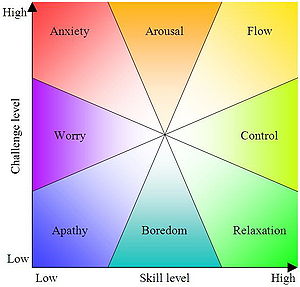
I really like this visual depiction of flow.

Some of you might remember that I am fascinated with the concept of flow, and the Positive Psychology that is based on it.

Flow is a state of effortless and complete absorption into whatever we are doing, a state in which we are and feel at our best and most creative, when we achieve harmony and mastery, when we forget time and feel good.

Flow does not come easily, of course. They say that it takes ten years of training at something–soccer, violin, writing, you name it–before you become able to slip into flow.

Which brings me to this diagram. It is by Mihaly Csikszentmihalyi, an unpronouncable Hungarian psychologist who might just belong into my growing pantheon of great thinkers. Indeed, quite a few people consider him a great thinker, and he has even received an award called Thinker of the Year.

You can view the diagram the following way:

Most of us spend most of our time hanging out somewhere near the bottom left:

  • We are apathetic because we are not challenged and have not applied ourselves to mastery of anything, or
  • we have taken up a challenge unprepared and are floundering, which causes us to worry, or
  • we are good at something but not challenged, so we become bored.

The way out is two sweep either clockwise or counterclockwise in the diagram:

  • Challenge yourself, by finding something you want to master. If your skill level is low, at least you will feel aroused, which is a good first step toward learning and flow.

Or:

  • Keep learning, practicing, mastering, refining. Even if you are not challenged yet, you will become relaxed and feel in control, which builds confidence and is also a great step toward flow.

This is, of course, nothing but the self-help manual of the Samurai and Zen disciples through the centuries.

It’s also a great reminder for us parents and teachers (especially those public-school bureaucrats in America): You must, you must, you must challenge a child to “educate” (ex-ducare = lead out) him or her from apathy.

Watch Csikszentmihalyi’s TED talk:


Bookmark and Share

Becoming a Mensch: “Self-actualization”

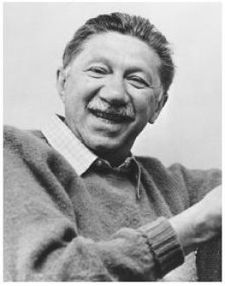
Abraham_maslow

Abe Maslow

The other day, I compared Abraham Maslow’s Hierarchy of Needs to the chakras in Indian philosophy, and I promised to expound a bit on the highest need/chakra, which we might call, to use Maslow’s word, self-actualization.

It’s an ugly term, born out of Esalen in the late sixties, when hyphens, Latin roots and the noun form of verbs were considered good things because they bestowed credibility in between naked massages in the Esalen hot tubs which I myself once had to endure as part of my journalistic research.

So let’s just call it something else. To self-actualize is–to use the technical Jewish-Buddhist term ;)–to be a Mensch. I consider it perhaps the highest form of success, and it thus becomes relevant in the penultimate chapter of my book. According to Maslow, only about 2% of the human population self-actualizes!

In the rest of this post, I want to flesh out what self-actualization might entail, with help from an excellent summary by Dr. C. George Boeree.

Needs you fill and forget & needs that grow as you fill them

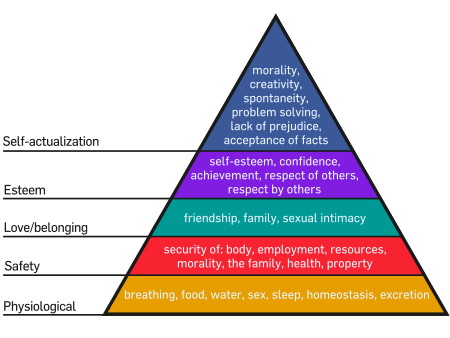
Take another look at Maslow’s famous pyramid, which I showed you in the previous post on the subject. There is one difference between the top of the pyramid and all the lower rungs. At the bottom (breathing, eating, feeling safe etc), we feel needs only when we lack something. We cease to feel them as soon as we have what we crave. So, if I am suffocating, all I care about is air. But once I have air again and can breathe, the obsession is gone. Maslow called these cravings deficit needs.

450px-Maslow's_Hierarchy_of_Needs.svg

Self-actualization is different. When we feel that we are fulfilling our potential–by being creative, for example–the need to self-actualize does not go away but grows. Fulfilling our potential makes us feel alive and satisfies us. So Maslow called these motivations being needs to distinguish them from the deficit needs.

Character sketch of a Mensch

So what kind of person reaches the highest stage and becomes a Mensch?

Maslow studied biographies.  (That happens also to be my approach in my forthcoming book; among the people Maslow studied are even some that are characters in my book.) From his studies Maslow concluded (we can debate whether he was right) that the Menschen shared certain traits that are actually quite rare. In this group of self-actualizers were:

  • Abraham Lincoln,
  • Thomas Jefferson,
  • Albert Einstein, (in my book)
  • Eleanor Roosevelt, (in my book)
  • Jane Adams,
  • William James,
  • Albert Schweitzer,
  • Benedict Spinoza,
  • Alduous Huxley, and
  • 12 unnamed people.

The traits they shared, according to Maslow, were the following. They:

  • were able to discriminate between what is fake and what is genuine,
  • were able to treat life’s challenges as problems demanding solutions rather than personal affronts to be angry or depressed about,
  • felt that the ends don’t necessarily justify the means, that the means could be ends themselves (this is the opposite of strategic thinking),
  • enjoyed solitude,
  • had deep and intimate bonds with a few people rather than shallow relationships with many people,
  • felt “autonomous” from society (I think this means that they were non-conformist),
  • had an unhostile sense of humor–preferring to joke at their own expense, or at the human condition, and never directing their humor at others (which comes close to my definition of irony),
  • accepted themselves and others, enjoying harmless flaws as personal quirks,
  • were spontaneous and simple,
  • respected other people and treasured ethnic and individual diversity,
  • were ethical and spiritual but not usually “religious”,
  • were able to feel wonderment,
  • were original, inventive and creative, and
  • tended to have “peak experiences“, which we might call episodes of rapture or ecstasy–mystical feelings of merging into an infinitely large and eternal whole.

Normally I don’t like lists (as opposed to one single and large insight), but in this case a sort of composite personality emerges, which becomes stronger when Maslow adds to these positive qualities a few flaws that he found common among self-actualizers. They:

  • often suffered from anxiety,
  • were often absent-minded,
  • were occasionally ruthless and cold.

In short, they were, as Walt Whitman might say, “large”: they contradicted themselves and were fine with that.

And so…

Frankly, Maslow is a lot of work, and I have been pondering whether it has been worth it. I can’t decide whether the character sketch, and even his hierarcy of needs, is too obvious and thus banal, or whether it is helpful. For now I lean toward the latter.

Since I began this meditation by comparing his thoughts to ancient Indian philosophy, let me also conclude that way. It does strike me that self-actualization is strikingly similar to some visions of what “enlightenment” might be like.

First, I happen to believe that the yoga taught by Patanjali and his contemporary, the Buddha, leads to fleeting instances of samadhi (enlightenment, ecstasy), rather as it overcame St Teresa, instead of lasting bliss. “Peak experiences,” in other words.

Second, the “method” is similar: The simplicity, love of solitude, humor (think of Zen monks), non-conformism, withdrawal and even the occasional coldness of the self-actualizers resembles that of the Eastern yogis and Zen masters. They are really Einsteins in the Lotus position.

In short, I think that Maslow’s contribution is to humanize “enlightenment” for us Westerners.

Bookmark and Share

PS: After reading these two posts on Abe Maslow, do you think he belongs into my pantheon of the world’s greatest thinkers?