Universal, timeless Rotkäppchen

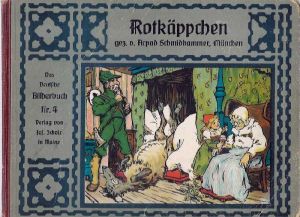
Arpad_Schmidhammer_-_Rotkäppchen-Verlag_Josef_Scholz,_Mainz_ca_1910

The Hannibal Blog has opined before on the universality of certain stories and story characters, the so-called archetypes, even citing the Grimm fairy tales as an example once.

This appears to be a hot topic of research. Jag Bhalla (to whom The Hannibal Blog increasingly outsources the more intensive research into matters linguistic and narrative ;)) now points us to new theories by anthropologists who have apparently constructed the equivalent of genealogical family trees for humanity’s oldest stories.

Jamie Tehrani

Jamie Tehrani

Dr Jamie Tehrani, a cultural anthropologist at Durham University, studied 35 versions of Little Red Riding Hood from around the world. Whilst the European version tells the story of a little girl who is tricked by a wolf masquerading as her grandmother, in the Chinese version a tiger replaces the wolf. In Iran, where it would be considered odd for a young girl to roam alone, the story features a little boy. Contrary to the view that the tale originated in France shortly before Charles Perrault produced the first written version in the 17th century, Dr Tehrani found that the varients shared a common ancestor dating back more than 2,600 years.

He said: “Over time these folk tales have been subtly changed and have evolved just like an biological organism.” …

Dr Tehrani … identified 70 variables in plot and characters between different versions of Little Red Riding Hood…. The original ancestor is thought to be similar to another tale, The Wolf and the Kids, in which a wolf pretends to be a nanny goat to gain entry to a house full of young goats. Stories in Africa are closely related to this original tale, whilst stories from Japan, Korea, China and Burma form a sister group. Tales told in Iran and Nigeria were the closest relations of the modern European version.

(And once again, permit me to add paranthetically but immodestly that I am attempting in my forthcoming book to narrate just such an archetypal storyline about success, failure & reversal in life.)

Bookmark and Share

About not confusing length with depth

Height_demonstration_diagram

A brief meditation on: length in writing, which is to say word count.

As a writer I am intensely aware of word count, throughout the entire process, even while I am still conceptualizing my story idea. What would be the natural length of this idea? What new idea would I have to add, or how would I have to expand the idea, to justify more word count? Could I deliver the same idea in fewer words?

At The Economist we have a very inflexible page layout. For example:

  • A lead note, in our jargon, is the first piece in a section, and should just turn a page, but within a prescribed line count. = 1,100 words
  • A note, which is a regular piece in a section, = 600 or 700 words.
  • A column–such as Lexington (US), Charlemagne (Europe), Banyan (Asia), Bagehot (Britain), Face Value (Business), Economics Focus (Finance), or Obituary–is a few words short of 1,000.
  • A box, ie a short and quirky sidebar, = 300 or 500. And so on.

I have learned to like writing for prescribed word counts. It is great discipline.

For example: When I write Face Values, I write 990 words, then cut six words to leave my piece one line short. Why? Because that way an editor can’t take anything out without putting it back in! 😉 It’s also my way of winking at my editor, and they, tending to be cavaliers, usually get it and wink back.

Even in these sloppy blog posts, I always look at the word count, out of interest. Did you know that the average blog post, and possibly also the ideal blog post, is about 250 words? That’s just about what our boxes are at The Economist. My average is above that, but that is beside the point. The point is that….

Length matters

Take the New Yorker. My former boss, Bill Emmott, once said that its writers tend to:

confuse length with depth.

I heard Bill say this when he was leaving The Economist and giving farewell interviews, in which he was explaining what was special about The Economist. Brevity, for one thing.

Of course I know where that reaching for length on the part of writers comes from. All my students (when I taught at a Journalism School) always wanted to write long pieces. There is more kudos in it. You don’t get awards for 300-word pieces.

Well, that is a scandal. You should get awards for 300-word pieces, and even for shorter pieces. Haikus! Limericks! Sonnets!

(Editor: ‘Nice piece, William, but, you know, could you make it longer? William: ‘Er, OK. How ’bout: Shall I compare thee to a summer’s day, in the sweltering and sultry heat, just after a really, really big downpour….’)

Why do people never listen to what the great writers say? That same William in the sonnet joke, for instance, said, via Polonius (in Hamlet, II, 2), that

brevity is the soul of wit.

Or take Mark Twain, his American equivalent:

I’m sorry I didn’t have time to write you a shorter letter.

Or take Ed Carr, one of my editors, who once, 10 years ago, told me to

crucify your darlings,

by which he meant that I should write and then find the phrases in my writing that I was most proud of (!) and just … cut them! For the heck of it. To prove to myself that I can. To stay humble and nimble. That phrase was my screen saver for three years.

Seeing negative shape
250px-Michelangelos_David

Well cut

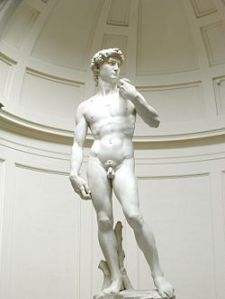
The skill in all the arts is to take away stuff, not to add stuff. When they asked Michelangelo once how he made such beautiful figures out of stupid blocks of marble, he said something like:

Easy. I visualize the figure inside, then I cut away the rest.

A lot of art goes wrong because the artist does not dare to do that. This is when a great and riveting Hollywood movie suddenly becomes unbearable — because instead of ending when it should, it goes on for another twenty minutes of moral summary and closure (in a courtroom, probably) just in case you didn’t get it.

Cutting into flesh

Michelangelo only cut marble fat, not marble flesh, of course. Over-cutting is just as bad as over-writing. This has also  happened to me.

Sometimes, I write something that demands space and expansion, but then news happens and our layout changes at the last minute and an editor has to cut my piece to fit. This can go wrong. Perhaps the piece was subtly humorous or ironic, and now the tiny signals and implied winks are missing and it falls flat. Or a logical connector gets cut and the piece seems like a non sequitur. Or something went from being simplified to oversimplified and is just plain wrong.

Or a writer might simply have a great subject that, by nature, wants to go on and be told as a story but instead dies a premature death.

But I’ve observed that writers overwhelmingly err to one side: they overwrite; they rarely overcut. And they suffer more when an editor cuts than when an editor asks for more. Even though, to improve, they should always consider both options, simultaneously.

All of this is simply to say: Every story, every thought, every joke, every movie, every poem has a natural (=optimal) length. A lot of good writing is simply intuiting that length and then writing to it, and not one word more or less. Unless you want to wink at your editor and leave it one line short.
Greek myths for 4-year-olds

koeln_wrm_1044

My daughter parks her head in my arm pit, gets under her covers and is ready. In German, I begin:

So Zeus told Prometheus to re-people the earth with human beings, because all the mortals had died in the big war that he, Zeus, had fought and won against the Titans. So Prometheus made people out of clay. But they were cold and dumb. So he asked Zeus for some fire from Mount Olympus.

‘Sorry, that’s just for gods,’ said Zeus.

‘Ok, sorry,’ said Prometheus. Then he stole the fire when Zeus wasn’t looking and gave it to the new human beings, who suddenly warmed up, started cooking, started thinking and building huts and tools.

Zeus noticed and got angry.

So the humans started sacrificing their animals to the gods to appease them. But Prometheus, who was on the humans’ side and saw how hungry they were, said ‘Hey, do it this way: Put the bones and crap on one side and wrap it in fat. Put the meat on the other side and throw some fur on it so that it looks like leftovers. Then let the gods choose one of the two piles.’

The gods chose, and gods can be dumb, so they chose the bones wrapped in fat, and for once the humans had enough to eat.

But Zeus again noticed and now got really, really mad. He had Prometheus chained to a rock where an eagle ate his liver which then grew back at night so that the eagle could rip it out again the next day, and the next and the next. Wonderful.

How a 4-year-old hears this

Too gruesome for a 4-year old? Oh, no.

My daughter loves the Greek myths and insists on a few every night as part of her bedtime ritual. And not only does she get these stories at some simple, deep, archetypal level, she extracts very interesting and quite sophisticated insights about life. Such as:

4-year old: But Prometheus only meant well. He did something good. Didn’t the gods know that?

Dad: Oh yes, they knew that. But they were still angry, because they were vain.

4-year old: Gods can do whatever they like.

Dad: That’s right. And they’re a silly as people, and that’s how the Greeks explained all the stuff that happens in the world.

She got it. And I felt great. A few days ago, I talked to a child psychologist about this, and she said that children connect to myths and folk tales such as Hansel and Gretel so well precisely because those stories are archetypal, even and especially when they strike us as gruesome. We don’t give kids enough credit. It’s a mistake to tell them only sweet nonsense that amounts to a lie about life and eventually bores them. All within reason, of course. The child shows the way.

Bookmark and Share

Writers, lose your notebooks

notebook

No, I don’t mean that all of you should literally throw them away right now. In fact, I keep all of my notebooks, going back years, officially for libel-defense purposes but really out of superstition. But that’s not what this post is about. It’s really about the following anecdote.

I happen to live next door to Michael Lewis, an author of several bestsellers (Liar’s Poker, Moneyball, The Blind Side, et cetera). He and I were walking down the hill once to get some lunch. We got to talking about the time that he came back from a big reporting trip for a book, only to discover …. that his notebook was gone!

“And it turned out….”, I began asking.

“Oh, much, much better,” he said.

And we both cracked up.

When my notebook lost me

Here is a brief description of my early years as a journalist, which is the experience that made me laugh at (ie, understand) Michael’s response.

When I started, I was so enthusiastic about observing every last detail and capturing every quote by everybody I met that I agonized over my note-taking. I could not write fast enough. In the evenings, I took a night course in shorthand (Teeline). I was the only guy; all the others seemed to be young ladies training to be secretaries (somebody should have told them that this wouldn’t prove so useful in their careers). But even that didn’t help. I never got fast enough.

So I had the quintessential writer’s predicament: Do you live, absorb, participate, think, see, hear, smell, act? Or do you stop life, and write it all down?

Recording interviews, with one of those little gadgets, didn’t help either. I didn’t like fiddling with them, and they usually intruded into the conversation, pointing at my interviewee like a dart that might be poisonous. Those things distracted me, and I threw them away.

Even so, I did capture quite a lot. I observe well, and I get “good quote” out of people. So, for a while, I was writing my articles quote to quote, detail to detail. Today, I believe that was the worst writing I have ever done.

At least close it

Around that time I heard John Micklethwait give somebody advice. The lady was having writer’s block, and John, the quintessential British cavalier, said, roughly:

“First, close your notebook. Then trust that it will come.”

(These days, John is The Economist‘s editor-in-chief–ie, my boss–so the trick must have worked for him. ;))

Relax and trust

Writing, and all storytelling, is necessarily a two-step process: 1) You live. 2) You pause, re-live and tell. You can’t merge the two artificially by writing everything down as it happens. If you try, you only interfere with Part 1).

Instead, good writers know how to relax. Only when the brain is relaxed does it make the lateral connections, the quirky associations that we call creativity. And only when you are relaxed can your interview partners relax as well.

Good writers then trust. They trust that ‘it’ comes back to them. And ‘it’ does. What is ‘it’? It is whatever comes back!

By the time it comes back, it is like water that has percolated through sediment and become pure and clean and potable. A writer’s memory is therefore like a filter, provided the writer lets it be that. What it filters is the entire overwhelming world of detail, so that only a few–the right ones–run onto the screen and become life-giving, texture-giving color.

Bookmark and Share

“Color” in writing

445px-der_mann_mit_dem_goldhelm

I think this is probably my favorite Rembrandt. More than that: it is a lesson! What makes this painting so good is the same thing that makes good writing good. It is the sparing use of color and light.

For two years, I taught at Berkeley’s journalism school (thanks to Orville Schell, the then-dean, who invited me). That was the first time that I had to think about (ie, analyze, intellectualize, verbalize) writing, as opposed to just doing it for a living. And one thing that struck me is that all my students, and quite a few of the teachers there, grotesquely overdid that thing writers call “color”.

Before I go any further, so that we are on the same page, let me give you a caricature of what I mean (this is made up! No real writers are being harmed or embarrassed!):

On a bright, sunny day, John Smith was striding into his corner office, with a view of the Hudson and pictures of his three sons (Jimmy, 12, Billy, 14, and Bobby, 18) on his desk, next to a pile of Wall Street Journals and a cup of Starbucks soy latte. “I love this view,” said Smith. The Fortune 500 executive then turned…..

How many New Yorker articles have you read that started with some variation of ‘On a recent Sunday afternoon…’ or “It was a dark, overcast day when John….”, only to discover on the third of the article’s fifteen pages that these details would almost certainly prove to be of no help whatsoever?

So there I was at the J-School, getting paid to read piece after piece by bright-eyed young journalism students who were so eager to prove that they had been there (wherever there happened to be), that they had actually interviewed some guy, that they had got the color, that they were ready for the New Yorker. It got extremely tedious.

Color and substance

Am I against colorful writing? You must be mad. Of course not. I love color. By the standards of The Economist, I am a “color” guy. No child has ever said to his parents, ‘mommy, I want to grow up and write really monochrome stories’. If you have ever felt the impulse to try your luck as a writer, it was because you loved color, whether or not you called it that yet.

The problem is that color without substance is just a paint bucket that tipped over. I’m not even talking about Rembrandt versus, say, Jackson Pollock. I’m talking about Pollock’s studio floor before he cleaned it up.

Color has to be in support of something. And that something has to be an idea, a thought, a story. The mistake many writers make is to list details. Lists are boring; we use them to go shopping. Details are boring, unless they illuminate some meaning. It does not have to be epic. It can be quirky, amusing, moving, insightful, whatever. But there has to be a there there.

So the trick is to find substance, and then to take away details so that only a few splashes of light and color remain, which then filter out the entire sensual world around the reader and deliver him to that one place that you, the writer, have in mind for him. In terms of thought process, it may be the opposite of what my students were doing, and what I used to do.

I can find no better illustration than Rembrandt, above. You are drawn deep into this man. If I asked you, you would say that there is so much color in this painting, so much light. Only then would you notice that most of the canvas is dark, that very little of it is … in color.

Bookmark and Share

The closing-Tube-door method of writing

800px-london_underground_tube_stock_1992

About ten years ago, when I was still living in London and already writing for The Economist, I got in the habit of visualizing a specific scene whenever I was preparing to write something (ie, most of the time). And I still do it today.

In this mental scene, I am saying goodbye to somebody I know and like, somebody who would not bullshit me–my wife, for instance. She has boarded her train in the London Tube (“subway”, to you New Yorkers), and just as that famous Tube voice says Mind the Gap and I pull back on the platform, she says: ‘Oh, and what’s your next piece about?’

As the doors close, I shout one single mouthful of words into the train. A few words. That’s all there is time for. Then I watch the train pull away, and I imagine her facial expression as she looks through the pane.

  • Intrigued? Good.
  • Thoughtful? Good.
  • Outraged? Good, if that’s the kind of story it is.
  • Smirking? Good, if that’s the kind of story it is.

But what if the reaction on her face is:

  • Ho-hum. Not good.
  • Bored. No go.
  • Squinting. Ouch, I must have shouted out a cliché.
  • Disgusted.

Often, I iterate story ideas in real conversations, of course. But there isn’t enough time to do that with the thousands of half-formed story ideas that teem inside my head at any given moment. And conversation has a drawback: You have time. Time to explain… and explain… and explain. The writer needs the opposite: to be constrained into one short phrase only.

So the big surprise is that this mental exercise alone usually does the trick. That ‘trick’ being:

To find something in the everything around me that is worth telling, because somebody will react to it.

Our nomenclature

At The Economist, we have a ‘flytitle’, ‘title’, and ‘rubric’ above every piece, and sometimes a ‘dateline’. In this article, for instance, these are:

The Filipina sisterhood [flytitle]

An anthropology of happiness [title]

Dec 20th 2001 | HONG KONG [dateline]

Out of misery, some extraordinary lessons [rubric]

ONCE a week, on Sundays, Hong Kong becomes a different city. Thousands of Filipina women throng into… [text]

I chose this example because it’s one that worked. Spoken through closing Tube doors, this trio of flytitle, title and rubric would have done the trick. I would know that I’m ready to start writing the pice.

The rubric, Out of misery, some extraordinary lessons, actually came from the editor of that piece, Ann Wroe (usually our Obituary writer, and one of our best). She had taken whatever phrase I had put there, probably a grammatically complete sentence, and chopped it into this open-ended, verbless and … inescapable line. (Notice the alluringly modest some)

So that’s what I do, day in and day out, I think of rubrics and titles. The world is full of things and events and people and sensual inputs. Those are not yet stories. To become stories, they have to fall into place in a way that is interesting. And an essence has to emerge out of them. That becomes the rubric.

The rubric is not a summary (that’s where I used to get it wrong for a long time). It can, but need not be, a thesis, bluntly put. It can be a question, inviting the reader to go on a journey of discovery. Or anything else. The best ones are Haikus, full of attitude. I thought this one, for instance, worked okay, although it bordered on gimmicky:

Google

What a lot of wheatgrass

Jun 30th 2005 | SAN FRANCISCO

Psst, there is news about Google, but don’t tell

IT IS hard to know whether to be impressed, suspicious or amused…..

Really, all it does is to inform you that I’m about to ‘take the piss’, as the Brits would say, on the general subject of Google. If you expect serious analysis after this, it’s your own fault.

Anyway. I happen to believe that this rubric-shouting through closing Tube doors works for all writing at all length. Short blog posts, long essays, even entire books. If you don’t know what that center of gravity is toward which you want your readers to be pulled, you’re not ready yet.

Which makes me wonder, of course, whether I have found the title and rubric of my forthcoming book (which I happen to care about more than about any article I’ve ever written.) You may recall that I recently sent the manuscript to my editor at Riverhead, and that for all sorts of reasons, having to do with the American marketplace, I do not yet know the title and subtitle. It will be determined by the editor, “in consultation” with me. And so I wait.

Lots of Tube doors opening and closing in my mind. Mind the Gap.

Bookmark and Share

One-sided thinker: Ayn Rand

ayn_rand1

I’ve been meaning for a while to respond to Jacob’s nomination of Ayn Rand as the greatest thinker ever. You notice that Rand did not make it into my roster of great thinkers, and I want to explain why.

First, you have to understand where I’m coming from. In my twenties, I had an extreme Objectivist phase. For me, as for many of her fans, her radical and uncompromising individualism had as much romance–yes, romance–as the diametrical opposite ethic, socialism, had for other young people. And that is what young people need above all in a philosophy: romance. The time for nuance is old age; the time for bold clarity is youth.

So there we were, the young’uns. Some had Che Guevara posters on their walls (sexy, romantic, idealistic). Others were curled up with Atlas Shrugged and pictured John Galt (sexy, romantic, idealistic). Oh, and yes, they stood for opposite ways of looking at the world. But we were all revolutionaries in our ways, and happily so.

My type went on to become libertarians (properly called liberals), which I am. We reveled in our individualism, as I did and do. It was a great party.

Later in life, when I got to Silicon Valley, I had flash-backs of nostalgia. A lot of the geeks there still call themselves Objectivists. I remember a fun conversation I had with Jimmy Wales, the co-founder of Wikipedia and a Rand enthusiast. Indeed, some of us are still at it.

So what’s the problem?

The problem is that Rand’s philosophy and, worse, her characters do not age. They are caricatures. Howard Roark, the über-architect in The Fountainhead, John Galt, the über-entrepreneur in Atlas Shrugged, are sketches of square-jawed action heroes as a girl who had escaped from Soviet Russia (ie, Rand) would draw them. They have no complexity, no nuance, no contradictions; they are, in short, not human. As you get older and put more life behind you, you lose interest.

Unfair? Not at all. Because Rand chose to deliver her philosophy through these characters, through narrative, through stories. And, as someone fascinated by storytelling, I think she got that part right. But her stories do not cut it.

I am still an invidualist today. But what Rand offered us was not individualism but atomism, the misguided and rather naive view that individuals exist discretely of one another and their surroundings and do not interact in patterns that reflect back on them.

She wrote at a time when Objectivism (the notion that there is one objective and observable reality) should already have been seen as untenable, given that Heisenberg had given us his uncertainty principle. Everything we have learned since should make us even more humble about our ability to observe reality. If I see red and the dog sees grey, thanks to the way photons form different patterns in his neurons and mine, what is the objective part?

Regarding individualism, it was always a distortion to deny collective patterns. Ask E.O. Wilson about his ants! Just as our cells do not run around bragging about their individualism but (usually) work together in our bodies, insects form colonies that come close to having their own consciousness.

If I were to nominate an individualist and libertarian for great thinker, it would not be Ayn Rand but Friedrich von Hayek, who thought about freedom and individuals holistically.

Finally, I cannot forgive Rand for making no allowance for humor. And don’t any of you Galtians pretend that there was any. Here, remind yourself:


Bookmark and Share

The monomyth inside Heidi

422px-heidi_titel

Quite a while ago in my ongoing thread on storytelling, I told you about a fascinating theory that all stories (or at least all good and lasting stories) are really at some deep level the same story, because that is how we humans seem to be wired. This meta-story is the so-called monomyth. The idea goes back to Carl Jung’s ideas about archetypes but was made popular by Joseph Campbell.

Well, I was just reading Heidi to my daughter, in the original (Swiss) German. Don’t think that you can ever get too old for good children’s stories. We both had moist eyes at the end, but mine were moister.

What struck me is that Johanna Spyri’s great and simple and timeless tale is really, you guessed it, another version of the monomyth. So indulge me, please, as I “translate” the plot and characters of Heidi into the nomenclature of the monomyth. (Archetypes are in italics.) Here goes:

  • Heidi is, obviously, the hero–ie, heroine. She is a different hero than, say, Achilles or Odysseus, of course. She is an orphan, and thus the archetype of the vulnerable part in each of us. Her less-than-warm aunt wants to get rid of her and drags her up an Alp to the hut where Heidi’s cranky grandfather, or Öhi, lives.
  • We stay with our hero just long enough to become part of the scene and characters so that we never want Heidi (or ourselves) to have to leave. Heidi befriends Peter and they have fun herding the goats. Heidi thaws Öhi’s heart and he falls in love with her. Heidi brightens the darkness of a blind woman nearby whom she calls grandmother. Even the goats are besotted. Oh please, we readers want to scream, let nothing ever change!
  • But the monomyth kicks in: There is a call to adventure, which Heidi, like many heroes, tries to refuse. But go she must. A rich family in Frankfurt has a sweet daughter in a wheelchair who needs a companion. Heidi’s nasty aunt, smelling money, has already sealed the deal.
  • As our hearts break along with everybody’s else’s (even the little orphan goat’s), Heidi sets off and crosses several thresholds. These are physical, such as the descent from her Alp, the arrival in Frankfurt and the crossing of her new home’s threshold. Thresholds are reminders of liminality. We are on edge.
  • Heidi has now, willy nilly, accepted her call to adventure. She meets other archetypes. There is Fräulein Rottenmeier, the annoying (and annoyed) spinster who looks after Heidi’s charge, and who seems to be the anima, ie the dangerous woman who must be overcome. Heidi meets her new friend Clara, her ally. She meets Clara’s father, the understanding, powerful and sympathetic Wise Old Man.
  • Heidi overcomes adversity and trials. To everybody’s surprise, she learns to read, thus obtaining a boon to society (in addition to the boon of her presence). She is lonely and so homesick that she sleepwalks at night.
  • With the help of the Wise Old Man (Clara’s father, once he understands that Heidi sleepwalks out of sadness), Heidi returns from her quest. She passes the thresholds (and her liminal state) again, in the other direction.
  • She arrives home, and brings the boon of her quest back, thus completing the monomythical definition of a hero. She makes life worth living again for Öhi, for grandmother (to whom is now able to read books aloud!), for Peter and the goats. Oh, and for us.

Simple, universal, powerful: great story-telling!

Bookmark and Share

Storytelling and the credit crisis

And another brief detour to The Hannibal Blog‘s older but ongoing thread on the art of story-telling.

I’ve already featured stories high and low, old and new, conventional and zany, but one insight emerging recently (when I highlighted the storytelling inside an ad), was that stories are ubiquitous and inescapable. It is how we humans make sense of stuff.

So look at this explanation, which is really a sort of story, of the credit crisis:

This is the product of Jonathan Jarvis, who did this as part of his graduate thesis at the Art Center College of Design in Pasadena, California. As Jonathan says,

The goal of giving form to a complex situation like the credit crisis is to quickly supply the essence of the situation to those unfamiliar and uninitiated.

So for him the story-telling principle of simplicity reigns supreme, although, as you can see, he also made sure to depict (subtly, cheekily and cartoonishly) character and scene and plot. As Ira Glass might say, right from the start, the viewer senses that

something is about to occurr, …. [that things are] heading in a direction …. raising and answering questions … [and that we] can’t get out.

Well done, Jonathan.

Bookmark and Share

In praise of wonderment

Amazing, isn't it?

Amazing, isn't it?

Cheri’s comment about my use of the word wonderment made me … wonder. And so, a brief paean.

Einstein (on page 387 of this biography), once said:

The most beautiful emotion we can experience is the mysterious. He to whom this emotion is a stranger, who can no longer wonder and stand rapt in awe, is as good as dead, a snuffed-out candle.

I’ve talked before about Einstein’s love of simplicity and his non-conformity as keys to his astonishing creativity. But I should have started with his famously child-like ability to wonder.

Wonderment is the origin of every creative act. The natural flow of Hmms leads to questions and inquiries that are usually never quite answered but become signposts on a great journey, a great story.

People sometimes ask journalists how we get our ideas for stories and I’ve never had a good answer. There is no shortcut, no ten-steps process, no secret vault. Instead, it always starts with simple–and yes, child-like–curiosity and wonderment.

An ability to wonder is of course also what the reader/listener/viewer of a story needs. If you don’t find your own life and its ups and downs somewhat mysterious, you probably won’t enjoy my book when it comes out.

So here’s to wonderment, and its official inclusion in our thread on story-telling. Every good story begins and ends with it.

Bookmark and Share