Steve Jobs as seen through his nemesis


(Credit: Matt Yohe)


As some of you know, I am fascinated by the complex character of Steve Jobs, who is one of the people featured in my forthcoming book (though not at all in his usual context).

So I enjoyed reading this interview with John Sculley, Jobs’ erstwhile nemesis (when Sculley pushed Jobs out of Apple in the 80s).

1)

The interview may be too geeky for some of you, but I like it, first, because of the noble tone in which Sculley speaks. He is not bitter; he does no underhand sniping; he does not furtively try to redeem himself or get even. Sculley simply moves on from what was an extremely painful episode in the two men’s lives to evaluate — and bow to — the genius of his enemy.

(Steve Jobs, from everything I hear, has never got himself to take that same step.)

Sculley speaks, in other words, as Hannibal would speak about Scipio, or Scipio about Hannibal. Great men and women are ennobled by their enemies. Kudos.

2)

Second, I like the interview for this glimpse into the nature of Jobs’ genius. Sculley:

What makes Steve’s methodology different from everyone else’s is that he always believed the most important decisions you make are not the things you do – but the things that you decide not to do. He’s a minimalist… He is constantly reducing things to their simplest level. It’s not simplistic. It’s simplified. Steve is a systems designer. He simplifies complexity.

Simplicity is, of course, a big thread here on The Hannibal Blog. It is interesting that Jobs also admires Einstein, as I do (he is another main character in my book), probably because Einstein had that same yearning for elegance and simplicity. As Sculley recalls:

I remember going into Steve’s house and he had almost no furniture in it. He just had a picture of Einstein, whom he admired greatly, and he had a Tiffany lamp and a chair and a bed. He just didn’t believe in having lots of things around but he was incredibly careful in what he selected.

(Compare this to Feng Shui.)

3)

Third, I like it for what I interpret as Steve Jobs’ instinctive nod to the Dunbar hypothesis.

Named after the anthropologist who came up with it, the thesis says that primates can form effective social groups only to the extent that their neocortex can compute the interactions among the group. The cognitive limit for human groups seems to be about 150. (I once worked with Facebook to find out whether technology might change that. Not hugely, it appears.)

Anyway, listen to Sculley:

Steve had a rule that there could never be more than one hundred people on the Mac team. So if you wanted to add someone you had to take someone out. And the thinking was a typical Steve Jobs observation: “I can’t remember more than a hundred first names so I only want to be around people that I know personally. So if it gets bigger than a hundred people, it will force us to go to a different organization structure where I can’t work that way.”

Steinbeck, grapes, wrath, success, writing

I) Grapes

Here I was the other day in California’s San Joaquin Valley, with a crop buddy, after a day of picking grapes. It was 105 Fahrenheit (40 Celsius). I was drenched in toxic pesticides, which I was unable to avoid while picking.

What on earth was I doing there?

Well, it’s part of a little literary project, something longer-term. Can’t say much more yet.

We happened to be standing a few hundred yards away from the location of a Depression-era government camp for migrant farm workers which became the basis of John Steinbeck’s fictional Weedpatch Camp in his unforgettable novel The Grapes of Wrath. This was the camp that took in the Joad family and gave them brief respite from their harsh existence.

Was my location a coincidence? Not entirely. Nor was it entirely planned. (Sometimes, “accidents” help in the creative process.)

In any event, I took the occasion to re-read The Grapes of Wrath and also to read a bit about Steinbeck’s writing of it.

II) Writing

In 1963 Steinbeck said:

I wrote The Grapes of Wrath in one hundred days, but many years of preparation preceded it. I take a hell of a long time to get started. The actual writing is the last process.

This fits my own experience: The actual writing (sadly) is almost an afterthought, the easiest and most pleasant and shortest part of conception.

(But Steinbeck wrote longhand, of course. His 200,000-word manuscript took up 165 handwritten pages of a lined ledger book.)

Steinbeck apparently wrote fast, paying little or no attention to spelling, punctuation, or paragraphing. All that was cleaned up later. That, too, fits my experience.

III) Anger

In a 1952 radio interview, Steinbeck also said something else:

When I wrote The Grapes of Wrath, I was filled . . . with certain angers . . . at people who were doing injustices to other people.

And six years later, he told a British interviewer:

Anger is a symbol of thought and evaluation and reaction: without it what have we got? . . . I think anger is the healthiest thing in the world.

I had to think about that for a minute. But then this also fit my experience as a writer. Anger is a great motivational spur. It focuses the mind and leads to energetic storytelling. And isn’t writing a wonderful channel for anger to be released? Way better than any alternative, methinks.

IV) Success

Also of obvious interest to me (given that I’m writing a book about success and failure being impostors) was what the mind-boggling success of The Grapes of Wrath did to Steinbeck.

Critics, agents, publishers — the whole world naturally wanted him, as one said,

to write The Grapes of Wrath over and over again.

(That reactive and retroactive instinct in publishing also strikes me as familiar.)

But Steinbeck refused, saying that

The process of writing a book is the process of outgrowing it… Disciplinary criticism comes too late. You aren’t going to write that one again anyway. When you start another—the horizons have receded and you are just as cold and frightened as you were with the first one.

In another interview, he said that

I have always wondered why no author has survived a best-seller. Now I know. The publicity and fan-fare are just as bad as they would be for a boxer. One gets self-conscious and that’s the end of one’s writing.

Here, of course, I have nothing to add (not having scored a best-selling success yet). But it does rhyme beautifully with what Amy Tan said on the same subject.

Below, by the way, you see my perspective as I was picking grapes: I was crouching below the vines, because the best bunches grow in the middle and underneath. (“Low-hanging” fruit are not necessarily “easily picked’ fruit, I discovered.) And that tractor constantly moves alongside you. Several times I almost had my feet run over, and it banged into my shins so often that I could barely walk at night.

The ability to sustain disappointment

Anything that you remember decades after the fact is noteworthy ipso facto. Even if you attached no particular importance to the event at the time, your memory somehow decides subsequently that it was important.

To my own surprise, for example, I regularly remember a moment that occurred about fifteen years ago. Somehow I had allowed myself to be hired out of a Masters program at the London School of Economics to one of the big American investment banks in London. To people who know me, this was funny then and remains funny now.

One reason I joined this bank may have been (who knows what I was thinking) that they claimed to have a good training program in New York. So they flew a bunch of us to New York for a few months.

All of this (save the night-time recreational activities in New York) was and remains entirely forgettable. I could not tell you a single thing I learned in that training program.

Except one thing that my memory later filtered out:

Once, one of the bank’s honchos came to address us, the trainees. He wanted to impart some wisdom to us about success at the bank and, presumably, in life.

The single biggest factor, he said, is an

ability to sustain disappointment.

Bookmark and Share

My 12-minute “book teaser”

If you’re taking a 12-minute cappuccino break, watch me give this “teaser” about my book at our (The Economist‘s) recent innovation conference in Berkeley.

(You’ll also find most of the other sessions on video now, including those with Arianna Huffington, Jared Diamond, Matt Mullenweg, et cetera.)

I’m not good at “teasers” or “elevator pitches”, especially since I tried to tell a story in my book that would keep you reading for 100,000 words. But I’m constantly being told that I now have to practice condensing that story into two seconds for some occasions (cocktail parties, elevators), two minutes for other occasions, 10 minutes for yet others, and so on.

So, er, I’m practicing. (Even while determined not to give too much away yet.)

Your feedback would be welcome. Do I snare your interest or do you say ‘so what’? Are there howling non sequiturs, or does it make sense? And so forth.

Bookmark and Share

Politicians & their fathers, continued

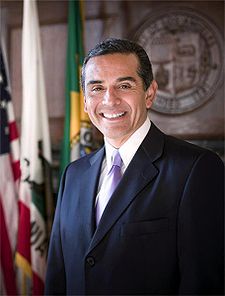
Antonio Villaraigosa

I met Los Angeles mayor Antonio Villaraigosa for the second time the other day, and he did something peculiar — also for the second time, thereby making it notable.

He brought up fathers.

You may recall that I’ve pondered the role of fathers in success when reflecting on Obama and McCain, or Bill Clinton and Gavin Newsom.

The theory, to remind, is that (male?) leaders often have absent fathers.

So here is what Villaraigosa did to make me think about that again:

First time

I first met him last summer, when he was still being talked about as a possible Democratic candidate for governor. He is the first Latino mayor of LA since the 19th century and a wily politician, so he was said to have a chance. On the other hand, he had a new sexy girlfriend who was not his wife and so forth, so perhaps not.

So I went into his office in City Hall. He looked tired, with bags under his eyes. I thought that his face was right out of The Godfather — in a good, soulful way — but his hands were small and soft.

He surprised me by insisting on first talking about me. I didn’t quite know how to handle that. But he wanted to know a whole lot about me — what schools, where from, etc. He said he liked the boots I was wearing. I realized that he was a people politician (in fact, I kept getting distracted by all the photos of him with famous and beautiful people), not an ideas politician.

So we started talking about what I talk about: ideas. I thought it was slow and plodding. Then I realized that he slowed down for me whenever he thought he was saying something sound-bitey, so that I might transcribe it more easily.

But then finally we found a topic that got him relaxed and enthusiastic. Ostensibly, it was his city, LA, which is so fantastic. But here’s the reason why it’s so fantastic:

People don’t care who your father is.

He said that several times. As in: In New York, you need to be from the right family, but here we only care about what you are today.

Or perhaps as in (I imagine his thought bubble): My father left my mom and me when I was young, so screw him.

He did, in fact, say that he had seen his father at most 25 times in his whole life, making it clear with a (perhaps exaggerated) gesture that he couldn’t care less about him.

Second time

I met him again a few weeks ago when my editor was visiting me and I took him around to see interesting people. This time, Villaraigosa looked much better. No bags under his eyes. He was no longer a candidate for governor, so now he was just enjoying himself as mayor (and in his private life).

Again, I got distracted by all the photos of him with famous and beautiful people — they were now on automatic slide show on a large electronic picture frame.

Again, the slow and deliberate sound bites about weighty topics. Again, name-dropping (he also knows some British politicians, and he wanted us to know that).

Then my editor and I said Thank You and left. We were already in the hallway, and Villaraigosa huddled with his handlers for the next meeting.

Suddenly, Villaraigosa ran out and after us, all but screaming:

You know what? Screw it. Let’s do a story on how great LA is. The greatest city in America.

He was beaming with excitement:

I mean, here nobody cares who your father is!

Bookmark and Share

Managing creativity: Let no side win

Ed Catmull

One of my favorite sessions at our “innovation summit” this week in Berkeley was a talk between Ed Catmull, the president of Pixar and Walt Disney Animation, and my friend and colleague Martin Giles, who took my former beat (“Silicon Valley”) a year ago.

Ed had a soulful, unpretentious, I-got-nothing-to-prove credibility, and Martin did a great job drawing him out but otherwise not interrupting or interfering (that, in essence, is a moderator’s job).

As in any real, good conversation, the chat meandered and is hard to summarize. But the heart of it was about how to “manage” creative types so that they stay creative. Managing creativity, of course, is sort of an oxymoron. But that’s what Pixar, with its unbroken record of box-office successes, seems to be doing.

So, how?

It comes down to many, many extremely subtle gestures and techniques. For example:

Commerce vs art

There is a tension between “commercial” success and “artistic” purity, and Catmull believes that the leader’s job is to ensure that “no side wins”. The tension, in other words, is part of the secret sauce.

Geniuses or teams?

Pixar tries to “protect each film-maker’s vision”, by putting the brain daddy of each project in charge of a team. But Catmull realizes that the notion of one single, over-arching genius idea is “a myth”, and that Pixar’s films are really thousands of ideas, and thousands of problems solved. For that, you need a team.

So everything depends on how well that team functions. Catmull sees one of his main roles as observing teams, and intervening when they are dysfunctional. If the leader loses the confidence of his team, Catmull replaces the leader. He would get rid of a genius, if that genius could not work in a team, he said.

Criticism and power

But even when a team does work, and the leader stays in charge, that director must get honest and hard feedback from his peers. How does one do that? (Finding tough but constructive criticism is also one of the hardest challenges for a writer.)

You put the director in meetings of his peers, but you ensure that nobody has more power than he does. In other words, people may suggest or critique, but cannot order him to make any changes. It is up to the director to absorb the comments and to incorporate or address them in the film. (Again, this is also, in my opinion, the way a writer should relate to his “editor”.)

If the group does this well, Catmull will invite others to make the meetings bigger, so that the newcomers can observe the good dynamic and spread it to other teams and Pixar’s wider culture.

However, he then pays extra attention to see if the original group of critics starts performing, which would kill the magic.

If the group critiques badly — which usually means that they are being too polite — Catmull will take individuals aside and confront them: Why did you not say what you really meant? He calls bullshit on them. So people know that their credibility is on the line.

From fear to context

There was no silver bullet, no single secret or list of “ten steps”. There never is in real life. Instead, the conversation offered a fascinating glimpse into our new, modern work culture.

In the past, workers clocked in and had managers look over them with the tools of power. Bosses ruled with fear, implicit or explicit.

In a creative economy — and Pixar, like The Economist, represents it in the extreme — that would never work. You cannot frighten or threaten people into creativity.

Instead, all you can do is choose people well — for their talent and their teamwork — and then set and maintain a certain context that allows their creativity to come out.

Bookmark and Share

Success vs popularity: genius or slut?

James Patterson

Using the example of James Patterson, an apparently über-successful author of whom I had never heard, Mark Hurst recently made me think once again about my definition of success.

To paraphrase and amplify Mark’s point, would you rather …

  • create something truly yucky — something that you’re secretly ashamed of because you have good taste and know better — which nonetheless becomes a blockbuster?
  • or something that you are proud of, something you consider sublime, even if relatively few people agree or even notice?

As Mark says, this dilemma could appear in any walk of life:

You could be creating websites or software, or writing books, or designing products, or teaching classes, or producing events, or seeing patients. Whatever the case, what would you rather result from that experience: to be popular, or to create something that you yourself would be happy to receive?

If you answer “I’d like to do both” you’re cheating. The conundrum presents itself to all creative types sooner or later precisely because they must, at least sometimes, choose between the two options.

How to sell 14 million books

Which brings us to Patterson, who sold 14 million (!) books last year, as this profile claims. He published 9 books last year, and will publish 9 more this year. In fact, he is a book machine, an assembly line, a conveyor belt.

Literally: He uses “co-authors” to do the actual writing and “manages” the process rather as the boss of, well, an assembly line does.

Patterson is no boor. He himself reads both light and heavy fare, including Joyce. But when it comes to his own books he takes the approach of an advertising man. In fact, he start as an ad man, at J. Walter Thompson. He personally wrote and produced the TV ads for his early books.

He takes a marketing approach to everything from the story and characters to the jacket design, which tends to be

shiny, with big type and bold, colorful lettering — and titles drawn from nursery rhymes (“Kiss the Girls,” “Pop Goes the Weasel,” “The Big Bad Wolf”), with their foreboding sense of innocence interrupted. “Jim was sensitive to the fact that books carry a kind of elitist persona, and he wanted his books to be enticing to people who might not have done so well in school and were inclined to look at books as a headache …  He wanted his jackets to say, ‘Buy me, read me, have fun — this isn’t “Moby Dick.” ’ ”

Take that, Melville.

Patterson also does scientific market research:

Instead of simply going to the biggest book-buying markets, he focused his early tours and advertising efforts on cities where his books were selling best: like a politician aspiring to higher office, he was shoring up his base. From there, he began reaching out to a wider audience, often through unconventional means. When sales figures showed that he and John Grisham were running nearly neck and neck on the East Coast but that Grisham had a big lead out West, Patterson set his second thriller series, “The Women’s Murder Club,” about a group of women who solve murder mysteries, in San Francisco.

In other words, he does not conceive a story and wait for an audience; he finds an audience and tailors a story for it.

In this way, he practically took over Little, Brown, once a respected literary publishing house, where he now has a dedicated staff that answers only to him. A former boss of Little, Brown

says she was continually surprised by the success of Patterson’s books. To her, they lacked the nuance and originality of other blockbuster genre writers …

Then again, she is the former boss.

Patterson’s style, you ask? The profile describes it as

light on atmospherics and heavy on action, conveyed by simple, colloquial sentences. “I don’t believe in showing off,” Patterson says of his writing. “Showing off can get in the way of a good story.” Patterson’s chapters are very short, which creates a lot of half-blank pages; his books are, in a very literal sense, page-turners. He avoids description, back story and scene setting whenever possible, preferring to hurl readers into the action and establish his characters with a minimum of telegraphic details.

Does Patterson mind that he is not considered, you know, literary?

“Thousands of people don’t like what I do,” Patterson told me, shrugging off his detractors. “Fortunately, millions do.” For all of his commercial success, though, Patterson seemed bothered by the fact that he has not been given his due — that unlike King or even Grisham, who have managed to transcend their genres, he continues to be dismissed as an airport author or, worse, a marketing genius who has cynically maneuvered his way to best-sellerdom by writing remedial novels that pander to the public’s basest instincts. “Caricature assassination,” Patterson called it.

How, then does he, explain his success? He makes his books

accessible and engaging. “A brand is just a connection between something and a bunch of people,” Patterson told me. “Crest toothpaste: I always used it, it tastes O.K., so I don’t have any particular reason to switch. Here the connection is that James Patterson writes books that bubble along with heroes I can get interested in. That’s it.”

Now, as a bonus for those of you who are not only reading a blog but writing your own:

“I have a saying,” Patterson told me. “If you want to write for yourself, get a diary. If you want to write for a few friends, get a blog. But if you want to write for a lot of people, think about them a little bit. What do they like? What are their needs? A lot of people in this country go through their days numb. They need to be entertained. They need to feel something.”

And isn’t that interesting? I once wrote that the first rule of good writing is not to care about your readers, but that it needs to be tempered with the second rule of good writing, which is to have empathy.

Patterson, it might seem, proves instead that empathy is all.

Oh, wait. That gets back to the dilemma. Are we talking about good writing or popular writing, and do we care?

Bookmark and Share

The 4th (and final?) coming of Steve Jobs

As you regular readers of The Hannibal Blog know, I am fascinated by Steve Jobs. He is a main character in one chapter of my forthcoming book.

He is a man who is hard to like, impossible to hate and easy to admire. Complex, in a word.

And he is a man who has both lived and reflected on Kipling’s two impostors — ie, triumph and disaster. Oh, what ups and downs Jobs has known.

Now he has unveiled what may be the fourth device in his career (the first being the 1984 Mac, the second the iPod, and the third the iPhone) that fundamentally changes the way we live. It’s called the iPad.

This is not a review

Every tech and media blogger and journalist is right now weighing in on the iPad as a device, so I will not. We put it on the cover of The Economist this week, and my colleague Tom Standage adds context on his blog.

So let me just add some disparate and quirky observations.

1. Nobody imagines (and thus inspires) as Steve Jobs does

My Chinese mother-in-law, who only gave up dial-up internet when it ceased being offered as an option, wrote my wife the following email:

Subject: iPad

Is this the one I’ve been waiting for?

Now this is the Confucian equivalent of a gyrating pole dance. Steve Jobs has hereby cleared the highest hurdle in the excitement-generation industry.

How does he do this?

Jobs has always known how to imagine on our behalf. The truth is that people don’t know what they want (hence Henry Ford’s famous quip that if he had asked his customers what they wanted, they would have said ‘A faster horse’.) Jobs has the arrogance to understand that and to believe that he knows, and he tends to be right.

2. Nobody feints as Steve Jobs does

Two years ago, when Amazon brought out its Kindle eBook reader, Steve Jobs dropped all sorts of disparaging comments in such a way that he could be sure journalists would repeat the narrative on his behalf. For example, he said that

It doesn’t matter how good or bad the product is, the fact is that people don’t read anymore. Forty percent of the people in the U.S. read one book or less last year. The whole conception is flawed at the top because people don’t read anymore.

It was catchy because it rang true and caused many of us literati to hyperventilate about this dreadful trend (ie, people no longer reading).

But some of us guessed even then that Jobs in fact believed the exact opposite. And now we know. At the time he said it, he was 80% of the way into developing … his own eBook reader! For that’s what the iPad is, in part. It is Steve Jobs’ stab at reinventing buying and reading books as he once reinvented buying and listening to music.

Let us all pay extra attention to whatever he disparages next.

3. Even Steve Jobs feels his mortality

The man has been facing death for years now. He had pancreatic cancer. He had a liver transplant. He looks gaunt.

Could it be that this notorious perfectionist broke his own rules and accelerated the release of the iPad, launching it before it is really ready so that he could still be there for its birth, not only as father but also as midwife?

At the moment, the iPad is really a large iPod Touch — you can use only one app at a time, for example. Its trajectory, of course, points toward a time when it will indeed become a new “interface” for day-to-day computing. But I feel there is something half-baked about the release as it stands, by Jobs’ previous standards.

I also could not help but notice that Apple’s promotional video for the iPad does something uncharacteristic: It does not feature Steve Jobs, but instead highlights his lieutenants. They have, of course, been there all along, as ingredients of Apple’s secret sauce. But Jobs has never really displayed them, lest anybody might get the idea that he were grooming successors. The corporate message used to be that Jobs was Apple, and Jobs was forever.

Put differently, this may have been the beginning of a Good Bye. Viewed thus, it is especially moving.

Bookmark and Share

Video of the debate (California = failure)

And here, as promised, is the video of Tuesday’s debate. (If you’re new to The Hannibal Blog, I’m talking about this debate.) I kick things off, followed by Gray Davis, and it gets both humorous and intense rather quickly.

Your arm-chair analysis in the comments is encouraged. And don’t be polite. 😉


Bookmark and Share

We won: California IS the first failed state

Here we are (I’m on the left, Bobby Shriver is in the middle, Sharon Waxman on the right), as the vote comes in, telling us that we “won” last night’s debate against Gray Davis, Lawrence O’Donnell and Van Jones.

The motion, as a reminder, was:

California is the first failed state

and we argued For.

We won because we moved more audience members in our favor.

Before the debate, 31% voted For the motion, 25% Against, and 44% were Undecided.

After the debate, 58% voted For, 37% Against, and only 5% were still Undecided.

I’ll be posting the full video here on Friday (Update: I have now posted the video), but just a few remarks.

First, it was great fun. As soon as the debate was over, we went to dinner together (“we’re living a Woody Allen movie,” somebody said as we descended into the quaint, subterranean New York restaurant) and had a great time. I talked for a long time to Gray Davis and his wife Sharon, and they were much more interested in discussing California (and that recall) than the debate proposition. I learned a lot.

Second, as you will have guessed already if you’re a regular reader of The Hannibal Blog, I was savoring the irony of the evening: I’ve been writing a lot about “good and bad conversations”, both here and in The Economist, and have argued that conversations in which one side tries to win are what Socrates considered “eristic” and thus “bad,” whereas conversations in which all participants are looking for the truth are “dialectic” and thus “good.”

Well, we were all trying to “win” last night, but now that it’s over it’s time to say that this was just a great, fun game. The real way to “win” was to edify and entertain the audience and ourselves, to spar and to learn, and we apparently did that. (If you were in the audience, feel free to agree or disagree below. ;))

So the goddess Eris was there, but she had her tongue in her cheek.

Second, and unrelated: What a difference a year makes! A bit over a year ago, I was telling you how I heroically resisted mile-high connectivity. Well, I’m posting this from the sky, in a Virgin America plane back home. And everybody around me is working on their laptops. We are all now Nomads, as I predicted. Don’t shrug because you’ve already done this, too. Don’t take it for granted yet. Join me, as Albert Einstein would, in wonderment.

I’ll have a thorough post-game analysis of the debate later this week.

Bookmark and Share