Tiger Woods and the two impostors

Tiger, Tiger, Tiger. You’re making me … re-write my manuscript.

My book, as a reminder, is about success and failure and how the two can be, as Kipling put it so poetically, impostors. The main character is Hannibal, and his story introduces the various themes that come up in the course of a life, each of which is then illuminated with other lives, ancient or modern.

Here is how I went about it:

  • Mainly I chose relatively obscure people for my characters studies, which is to say people who are interesting or known for a good reason but not ‘famous’.
  • When I did include somebody conventionally famous (and there had to be a good reason!) I focused on an obscure or non-obvious aspect of that person’s life.

Well, Tiger falls into that latter category. I examined one aspect (I won’t say which) that he shared with Hannibal, and one that he didn’t, both of which made him unbelievably successful.

And now… the babes. So many of them. They’ve started keeping a cheat sheet to keep track of them. Plus: Wives swinging golf clubs after mid-night car crashes; cable-TV know-it-alls pontificating about morality; coy mea culpas and a career inter- and perhaps dis-rupted.

What can I say? I notice that everybody suddenly has a strong opinion about this young and immature genius. Tragic hero? Victim of hubris? Pervert?

Somebody from Pakistan informs us that it is entirely normal to have lots of women if you can. Somebody else explains why black women are not mad at Tiger. And so on.

My own default position in these matters is to be cavalier. But Tiger’s self-immolation now looks to be epic in scale. And tragic if the flames sear his children.

Among athletes, Diego Maradona comes to mind–the best in his sport, only to waste it all in decadence. Among politicians (well, where do you start?), perhaps Eliot Spitzer.

Yes, they were successful. Yes, their success was an impostor, by goading them, psychologically, into self-destruction. Is it simply the old Greek theme of hubris? Was it a character flaw? More subtle?

One thing is clear: I have to adjust my manuscript.

And one other thing should not be forgotten: Kipling said triumph and disaster are impostors. Tiger is young, as is his wife (not to mention their kids). As a great advertisement featuring Tiger (before his fall) once put it:

It’s what you do next that counts.

Bookmark and Share

Disruptive innovation (1): Cézanne

Paul_Cezanne

I ended my post on Clay Christensen’s idea of disruptive innovation in business with a promise (threat?) to try to extend the concept to other spheres of life. The purpose of this little exercise–as with almost anything on The Hannibal Blog–is to test this idea. In other words: If Christensen’s idea is profound (as opposed to banal, as many of you seem to think, based your comments) it must be extensible, so let’s see whether it is.

Attempt Number 1: Context = Art; Example = Paul Cézanne

Here is how I would write a biography of Cézanne using (in green italics) concepts from Christensen’s theory:

I) The incumbent

The incumbent during the nineteenth century, especially in France, was the mostly neoclassical art establishment. Conservative, staid, rigid, it demanded high and traditionally-defined technical mastery from artists:

  • The improvement trajectory of art was to paint/sculpt the same old subjects (Rome/Greece, Virgin Mary etc, flower vases, hunts….) in the same style but with ever more skill.
  • The intended market was that of existing art connoisseurs (gallery goers, critics, the nobility).
  • If we were to choose an institution to represent this establishment, we would pick the Paris Salon, an exhibition by the Académie des beaux-arts whose gate-keepers were a jury of art snobs.

II) The disruptor

One group of hirsute and rebellious young men finally said the obvious: that this art establishment was boring and served only the twisted standards and tastes of a small circle of snobs. They told that establishment to go to Hell and painted in a different style. The incumbent considered it less technically accomplished and either ignored or insulted it, dubbing it, derisively, impressionism.

One man, so loosely affiliated with this “group” that he did not even consider himself to be part of it, was Paul Cézanne. Cézanne was not obviously gifted at painting in a technical sense (his best friend, Émile Zola, was far better at drawing, which was all the more infuriating since Zola did not even take this talent very seriously because he wanted to be, and became, a writer instead). But Cézanne pressed on:

  • He embarked on his own improvement trajectory, beginning with incredibly simple subjects–for example, the same house in the sun of Provence, over and over again–and gradually, over the course of an entire life time, became better.
  • His market, if he thought about it all, was that of non-consumers: all those people, from his friends to ordinary folks, who did not necessarily visit the Paris Salon, or any museum, who did not care whether this artist was technically superior to that artist, who just looked at something and said Ahhhh.
  • The incumbent, seeing that Cézanne was technically inferior, ignored him. Year after year, Cézanne submitted his canvases to the Paris Salon, and year after year the jury rejected him. Cézanne instead hung his paintings in the ironically-named Salon des Refusés.
  • Over time, however, Cézanne became good enough (technically speaking), while staying original and simple, so that, his market of previous non-consumers swelled and eventually embraced the market of previous consumers, ie those who had once paid attention only to the art sanctioned by the Paris Salon but now decided that Cézanne was worth a look.
  • At this point the disruption occurs. The Paris Salon belatedly recognizes Cézanne, but hardly anybody even cares any longer. A new generation of artists now looks to Cézanne, not Neoclassicism, for inspiration. Cézanne’s rebellion and authenticity become the “new normal” and a century of permanent revolution in art begins. Pablo Picasso calls Cézanne “the father of us all”. Cubism, Expressionism, and all their descendants acknowledge their debt to Cézanne.
  • Cézanne thus becomes the incumbent, even as Picasso and others are already beginning their new round of disruption.


Bookmark and Share

Success, then disruption, then failure

Clay Christensen

You can be too good at something, too successful, so that somebody else, an upstart, undercuts and topples you, turning your success into failure. That’s because of a fundamental asymmetry between your view of the world and your upstart’s. And it makes you vulnerable.

It should be immediately obvious how this notion relates to Kipling’s idea that triumph and disaster can be impostors, which is also the idea that my forthcoming book is based on.

But the idea comes not from the worlds of philosophy or psychology, but from the world of business, which I usually consider unbearably boring and banal. (If it surprises you that a correspondent for The Economist, who has written a lot about business, would say such a thing, well, there it is. I said it.)

That said, we have already discovered that conductors can teach us about leadership and that Rembrandt can teach us about good writing. So why shouldn’t a Harvard Business School professor have something to teach us about life?

The professor is Clay Christensen, and IMHO he is the only business writer who has ever written a book that is not painfully obvious and banal but simple and profound. He doesn’t quite make it into my pantheon of great thinkers, but almost.

Disruption

The term he coined in his most important book, The Innovator’s Dilemma, is disruptive innovation. He explains it in this video.

What Christensen observed in one industry after another is, first, an incumbent. That is the most successful company in the industry, the leader. This company improves, year after year, by adding features to its products and listening to its best customers and meeting their demands. At some point, however, this company’s products get so good that they are more than good enough for most people, and too complex or expensive for the least demanding consumers, or people who don’t even use the product at all yet.

Eventually, Christensen observed, a disruptor comes along. This is a scrappy new company, not worth the attention of the incumbent. It makes products that are clearly “inferior” to the incumbent’s products. They are more basic, simpler, cheaper.

For precisely those reasons, the disruptor will have different customers than the incumbent. The demanding customers stay with the incumbent, whereas people who never used the product at all, or who used it very little, will try out the disruptor’s products.

The incumbent will thus not only shrug at the disruptor but enjoy his presence. That is because the incumbent can now shed the low-value customers and serve only the most demanding customers, charging them more and making more profits. Things seem to be going better than ever.

The disruptor is also enjoying himself. He is not, at first, competing with the incumbent at all, but aiming at people the incumbent never served. He sees the world in a different way. A small new market, with tiny revenues, looks fantastic to the disruptor, whereas it would make the incumbent yawn. This is the asymmetry in worldview.

But something else is going on, unnoticed: All the while, the disruptor, too, is making improvements. And at some point the products of the disrupter become good enough for everybody. This is when the impostor drops his guise.

The high-end customers suddenly start wondering why they have been paying for all those strange features they never use anyway. They defect. The incumbent is toppled and falls. The disruptor takes its place. It becomes a new incumbent, until it, too, is disrupted.

An example

Christensen gives great examples from business history in his book, but let’s take one that, in a different context, The Hannibal Blog mentioned just the other day: cloud computing.

  • Incumbents: Microsoft (Windows + Word, Excel, Powerpoint); Apple (fancy, snazzy laptops and such)
  • Disruptor: Google and many smaller companies (WordPress included) that provide free or cheap services over the internet.

For years, Microsoft “improved” Word (to take just that example) by adding features, then made us pay more moolah to install a new version. Microsoft was listening to its most demanding customers–the ones who, say, pretended to need a multi-color, rotating, animated table in their letterhead.

The rest of us hated Word because we just wanted a clean white page that does not disappear every time a laptop breaks. Most of the rest of us (the young and indigent, the poor in Latin America, Asia and Africa) could not afford Word at all, and so we did not use it.

Along comes Cloud Computing. You can now type, save and share simple text documents on the internet, free. This has advantages: several of you, in different places, can work on the same document at the same time. You can access the document from any phone or computer. If your computer breaks, you no longer care.

It also has “disadvantages”: You cannot get that multi-color, rotating, animated table in your letterhead. (More seriously, I could not write my book on Google Docs because it does not support endnotes yet.)

But who cares? Almost nobody, it turns out. So, right now, the poor, the savvy, the un-demanding are the ones using Google Docs most. The suits are still using Word.

Wait a few more years (months?). Then Word as we know it will disappear.

Enough business, back to life!

That is the most I have ever talked about business in my private life, and I feel so yucky that I might have to take a shower. But I was just setting up a different point: Why should Christensen’s insight not apply to … art, science, sports, love and life?

As I write this, I am coming up with examples from all these spheres of life. In due course I will accost you with them. But in the mean time, please feel free to suggest your own in the comments.

Bookmark and Share

Original + unique = some failure

Neil Simon

Neil Simon

Interesting two-punch quotes about success and failure, the topic of my forthcoming book, in today’s New York Times.

The “quotation of the week” is by Neil Simon, one of the most successful playwrights, whose play Brighton Beach Memoirs nonetheless turned out to be one of the biggest flops in Broadway history and closed after one week:

I’m dumbfounded. After all these years, I still don’t get how Broadway works, or what to make of our culture.

Katzenberg

Jeffrey Katzenberg

Elsewhere in the paper, they interview Jeffrey Katzenberg, a very successful film producer, formerly at Walt Disney (Shrek, etc) and now at his own DreamWorks Animation:

In order to succeed at the high end of the movie business, you must be original and unique. Now if you were putting an equation up on the white board and you wrote “original + unique = what?” Then the answer would have to be “risky.” And if you said, “risky = what?” The answer would be “some failure.” It has to, by definition, just sort of in the most fundamental way.

Obviously, this applies not just to film-making or Broadway but also to (ahem) writing–a blog, an article in The Economist, a book. And to war (Hannibal and Scipio). And to love. And to science. And to …. life.

Kipling’s impostors are hiding in plain view, as it were.


Bookmark and Share

Inspiration in a baton, a helmet, a sword …

445px-der_mann_mit_dem_goldhelm

In January I recommended to you a talk at Google’s Zeitgeist Conference that I had attended. It was by Itay Talgam, an Israeli conductor who asks us to see in the styles of the great conductors (Karajan, Kleiber, Muti, Bernstein…) the dos and don’ts of leadership, the ways to elicit or inhibit the creativity and collaboration of individuals in a group.

Talgam can make us see in a conductor’s manner of holding a baton our own experience as, or with, leaders.

He has now given essentially the same talk again at TED. (If I may observe: TED, Zeitgeist and Poptech, who are rivals, are essentially the same conference these days. As soon as a speaker does well in one, the other two pick him up too.)

So why would I recommend Talgam … again? Because his talk is so incredibly good! So watch all 20 minutes of it, below.

But I’d also like to make another point, one that might seem oblique. One thing I like about Talgam’s approach is that he draws from one area of life (orchestra music) and role (conductor) to inform another area of life (business) and role (boss).

In my very humble way, I try to do the same thing. When I think about writing, I like to think about painting–the way Rembrandt uses color so sparingly and thus effectively, for instance. I see in the highlights of a helmet the touches of good storytelling.

And in my forthcoming book, I take the story of Hannibal, Fabius and Scipio, whose role was commander and whose context was war–the sword, if you will–and I extend it to sex, science, business, sports, exploration, art, politics and intellect–and the ways we succeed and fail in them.

Sometimes, when I give my “elevator pitch” (ie, the book idea compressed into a sentence or two) I get blank stares. I imagine that Talgam does, too. But then I watch Talgam’s talk, and I leaf through my manuscript, and I realize that this … works!

Bookmark and Share

Beyond arousal and control: “Flow”

Flow

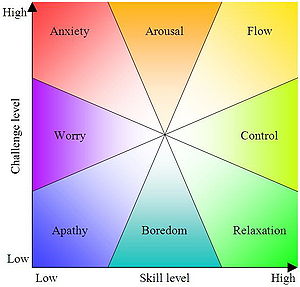
I really like this visual depiction of flow.

Some of you might remember that I am fascinated with the concept of flow, and the Positive Psychology that is based on it.

Flow is a state of effortless and complete absorption into whatever we are doing, a state in which we are and feel at our best and most creative, when we achieve harmony and mastery, when we forget time and feel good.

Flow does not come easily, of course. They say that it takes ten years of training at something–soccer, violin, writing, you name it–before you become able to slip into flow.

Which brings me to this diagram. It is by Mihaly Csikszentmihalyi, an unpronouncable Hungarian psychologist who might just belong into my growing pantheon of great thinkers. Indeed, quite a few people consider him a great thinker, and he has even received an award called Thinker of the Year.

You can view the diagram the following way:

Most of us spend most of our time hanging out somewhere near the bottom left:

  • We are apathetic because we are not challenged and have not applied ourselves to mastery of anything, or
  • we have taken up a challenge unprepared and are floundering, which causes us to worry, or
  • we are good at something but not challenged, so we become bored.

The way out is two sweep either clockwise or counterclockwise in the diagram:

  • Challenge yourself, by finding something you want to master. If your skill level is low, at least you will feel aroused, which is a good first step toward learning and flow.

Or:

  • Keep learning, practicing, mastering, refining. Even if you are not challenged yet, you will become relaxed and feel in control, which builds confidence and is also a great step toward flow.

This is, of course, nothing but the self-help manual of the Samurai and Zen disciples through the centuries.

It’s also a great reminder for us parents and teachers (especially those public-school bureaucrats in America): You must, you must, you must challenge a child to “educate” (ex-ducare = lead out) him or her from apathy.

Watch Csikszentmihalyi’s TED talk:


Bookmark and Share

Becoming a Mensch: “Self-actualization”

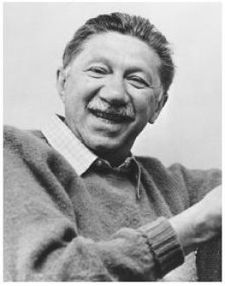
Abraham_maslow

Abe Maslow

The other day, I compared Abraham Maslow’s Hierarchy of Needs to the chakras in Indian philosophy, and I promised to expound a bit on the highest need/chakra, which we might call, to use Maslow’s word, self-actualization.

It’s an ugly term, born out of Esalen in the late sixties, when hyphens, Latin roots and the noun form of verbs were considered good things because they bestowed credibility in between naked massages in the Esalen hot tubs which I myself once had to endure as part of my journalistic research.

So let’s just call it something else. To self-actualize is–to use the technical Jewish-Buddhist term ;)–to be a Mensch. I consider it perhaps the highest form of success, and it thus becomes relevant in the penultimate chapter of my book. According to Maslow, only about 2% of the human population self-actualizes!

In the rest of this post, I want to flesh out what self-actualization might entail, with help from an excellent summary by Dr. C. George Boeree.

Needs you fill and forget & needs that grow as you fill them

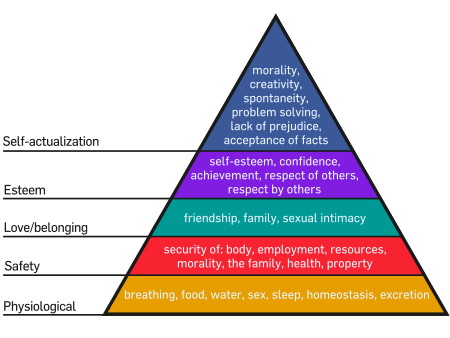
Take another look at Maslow’s famous pyramid, which I showed you in the previous post on the subject. There is one difference between the top of the pyramid and all the lower rungs. At the bottom (breathing, eating, feeling safe etc), we feel needs only when we lack something. We cease to feel them as soon as we have what we crave. So, if I am suffocating, all I care about is air. But once I have air again and can breathe, the obsession is gone. Maslow called these cravings deficit needs.

450px-Maslow's_Hierarchy_of_Needs.svg

Self-actualization is different. When we feel that we are fulfilling our potential–by being creative, for example–the need to self-actualize does not go away but grows. Fulfilling our potential makes us feel alive and satisfies us. So Maslow called these motivations being needs to distinguish them from the deficit needs.

Character sketch of a Mensch

So what kind of person reaches the highest stage and becomes a Mensch?

Maslow studied biographies.  (That happens also to be my approach in my forthcoming book; among the people Maslow studied are even some that are characters in my book.) From his studies Maslow concluded (we can debate whether he was right) that the Menschen shared certain traits that are actually quite rare. In this group of self-actualizers were:

  • Abraham Lincoln,
  • Thomas Jefferson,
  • Albert Einstein, (in my book)
  • Eleanor Roosevelt, (in my book)
  • Jane Adams,
  • William James,
  • Albert Schweitzer,
  • Benedict Spinoza,
  • Alduous Huxley, and
  • 12 unnamed people.

The traits they shared, according to Maslow, were the following. They:

  • were able to discriminate between what is fake and what is genuine,
  • were able to treat life’s challenges as problems demanding solutions rather than personal affronts to be angry or depressed about,
  • felt that the ends don’t necessarily justify the means, that the means could be ends themselves (this is the opposite of strategic thinking),
  • enjoyed solitude,
  • had deep and intimate bonds with a few people rather than shallow relationships with many people,
  • felt “autonomous” from society (I think this means that they were non-conformist),
  • had an unhostile sense of humor–preferring to joke at their own expense, or at the human condition, and never directing their humor at others (which comes close to my definition of irony),
  • accepted themselves and others, enjoying harmless flaws as personal quirks,
  • were spontaneous and simple,
  • respected other people and treasured ethnic and individual diversity,
  • were ethical and spiritual but not usually “religious”,
  • were able to feel wonderment,
  • were original, inventive and creative, and
  • tended to have “peak experiences“, which we might call episodes of rapture or ecstasy–mystical feelings of merging into an infinitely large and eternal whole.

Normally I don’t like lists (as opposed to one single and large insight), but in this case a sort of composite personality emerges, which becomes stronger when Maslow adds to these positive qualities a few flaws that he found common among self-actualizers. They:

  • often suffered from anxiety,
  • were often absent-minded,
  • were occasionally ruthless and cold.

In short, they were, as Walt Whitman might say, “large”: they contradicted themselves and were fine with that.

And so…

Frankly, Maslow is a lot of work, and I have been pondering whether it has been worth it. I can’t decide whether the character sketch, and even his hierarcy of needs, is too obvious and thus banal, or whether it is helpful. For now I lean toward the latter.

Since I began this meditation by comparing his thoughts to ancient Indian philosophy, let me also conclude that way. It does strike me that self-actualization is strikingly similar to some visions of what “enlightenment” might be like.

First, I happen to believe that the yoga taught by Patanjali and his contemporary, the Buddha, leads to fleeting instances of samadhi (enlightenment, ecstasy), rather as it overcame St Teresa, instead of lasting bliss. “Peak experiences,” in other words.

Second, the “method” is similar: The simplicity, love of solitude, humor (think of Zen monks), non-conformism, withdrawal and even the occasional coldness of the self-actualizers resembles that of the Eastern yogis and Zen masters. They are really Einsteins in the Lotus position.

In short, I think that Maslow’s contribution is to humanize “enlightenment” for us Westerners.

Bookmark and Share

PS: After reading these two posts on Abe Maslow, do you think he belongs into my pantheon of the world’s greatest thinkers?

Clinton, Newsom and their fathers

Newsom-lede

On Monday I found myself standing on a chair, peering over the baying pack of television crews to see Bill Clinton endorse Gavin Newsom for governor of California. For some odd reason (the PR handlers explained it to me, but it was too stupid to reproduce here) they chose the space between shelves in the library of a community college in Los Angeles for the occasion. My cheek was pressed into the sign 808.8, which seems to be children’s literature in the Dewey Decimal system. Go figure.

I have met Newsom several times before, and have experienced Clinton twice at conferences (TED and Google’s Zeitgeist). As I was observing these two men, I could not help but think of their fathers, as I will explain in a minute.

First, though, the reason my thoughts went that way: their (arguably endearing) vanity.

Bill Clinton, who was allegedly there to endorse (ie, make look good) Newsom, spoke for 22 minutes, mainly about green technology and so forth, before letting Newsom get in about 11 minutes of thanking and campaigning. This is par for the course. I remember somebody asking Clinton a purely rhetorical question at Zeitgeist, and Clinton dissecting the question into three parts, then delivering an exegesis worthy of a State of the Union on each. The man, God bless him, cannot help himself. He must hold forth.

So does Newsom. He admires Clinton and spent a good part of my first conversation with him, three years ago, talking about the political and rhetorical lessons he has drawn from Clinton.

Here is how that meeting, with my editor and myself and Newsom at a San Francisco cafe, went: Newsom came in and started talking about baseball. Realizing that neither my editor nor I seemed to have a clue about that sport, he switched effortlessly to … cricket. (The EconomistBrits…) Seeing that we knew nothing about that sport either and were geeky, wonky boffins, Newsom made another seamless transition and settled into … geeky, wonky politics arcana. He seemed liberated, as were we.

His eyes, I remember noticing, had bright circles of brown, yellow and green. He blushes very easily (as Clinton does). When there are women in the room, as there were when I met Newsom again a few months ago at the offices of Twitter, he preens very self-consciously, as if we were all at a high-school prom. The women notice this and like it.

In any case, both are very gifted and intelligent. Newsom, like many dyslexic people, has learned to overcompensate for his reading difficulties with other mental disciplines and is quick on his proverbial feet. He oozes Clintonian charm.

Their fathers made them

On to their fathers. Some of you may recall that, as part of my book research, I have been pondering the role of parents in the early stages of a young man’s (or woman’s) personality development. Obama and McCain both defined themselves against the (mostly abstract) idea of their fathers. Doug Wead, a presidential historian, has even put forth various theses that absenteeism by fathers somehow makes their sons more presidential.

Well, that’s what I was pondering as the 808.8 was jabbing into my cheek.

Clinton never knew his father, who died before Clinton was born. Clinton instead took the name of his stepfather, whom he recalls as an abusive drunk.

Newsom’s father separated from, and then divorced, Gavin’s mother when Gavin was a boy. His father was around, but the roles were apparently strained.

The quack psychologist in me would hypothesize that these father gaps left both men chronically insecure, permanently eager to win over and impress other people and to stay in their favor. In short, their fathers made them politicians.

Bookmark and Share

Strategic thinking: Coolidge v Cheshire Cat

DisneyCheshireCat225px-Calvin_Coolidge_photo_portrait_head_and_shouldersOne thread on The Hannibal Blog, as regular readers know, is strategy. That’s because strategy (as distinct from tactics, which is also important) is so important in achieving success. Genius tactics in service of the wrong strategy leads to disaster, as it did for the main character in my forthcoming book, Hannibal of Carthage.

Mark Hurst over at Good Experience has an amusing and insightful post on strategy as opposed to tactics. (Mark, by the way, also runs Gel, an ideas conference and a mini-TED, as it were.)

On one hand, Mark quotes Calvin Coolidge, our 30th (as well as 30th-most-impressive) president:

Nothing in this world can take the place of persistence. Talent will not; nothing is more common than unsuccessful people with talent. Genius will not; unrewarded genius is almost a proverb. Education will not; the world is full of educated derelicts. Persistence and determination alone are omnipotent.

If I may reflect on my guy, Hannibal: He had remarkable persistence: Leading an army of elephants over the Alps, defeating the Romans, staying undefeated in Italy for 16 years!!

The trouble with the Coolidge take on success is, as Mark points out, that the effectiveness of persistence

depends on having the right direction. Without that one little element, the entire effort is for naught.

So Mark wheels out the Cheshire Cat, a sort of feline Clausewitz. Alice asks which way she should go, and the Cheshire Cat answers:

“That depends a good deal on where you want to get to,” said the Cat.

“I don’t much care where,” said Alice.

“Then it doesn’t matter which way you go,” said the Cat.

To Mark that means that

you have to stop and take time to find the direction. You can’t run while you’re reading the map.

To me it means that Hannibal was a bit like Alice. Yes, he knew that he wanted to defeat Rome (which was like saying “I want to achieve success”–ie, vague). But he did not know where he wanted to go (ie, how to go about defeating Rome).

Bookmark and Share

Tall poppies, crabs and success

There for the lopping

There for the lopping

Since success and the ways of losing as well as gaining it are one half of the manuscript I’m currently re-writing, I found myself pondering the famous Tall Poppy Syndrome.

I always assumed that all English-speaking people used the term, which refers to the quasi-socialistic perversion–or egalitarian instinct, depending on how you look at it–of cutting down anybody who stands out for merit, success and achievement. But apparently it’s mainly a UK, Aussie and Kiwi thing. Nick Faldo, for instance, has been tall-poppied.

Americans instead have the crab mentality. I like that metaphor because it’s vivid: Crabs really do pull other crabs back down if one of them tries to claw himself out of a bucket.

Scandinavians apparently have the Jante Law, after a fictional town called Jante in which the rules were:

  1. Don’t think that you are special.
  2. Don’t think that you are of the same standing as us.
  3. Don’t think that you are smarter than us.
  4. Don’t fancy yourself as being better than us.
  5. Don’t think that you know more than us.
  6. Don’t think that you are more important than us.
  7. Don’t think that you are good at anything.
  8. Don’t laugh at us.
  9. Don’t think that anyone of us cares about you.
  10. Don’t think that you can teach us anything.

So why the metaphor tall poppy?

Surprisingly, it turns out that two of “my guys,” Aristotle and Livy, were involved.

Aristotle (Politics, V.10) has the following passage:

Periander [a tyrant of Corinth] advised Thrasybulus [a tyrant of Miletus and his friend] by cutting the tops of the tallest ears of corn, meaning that he must always put out of the way the citizens who overtop the rest.

This is probably where Livy got the idea for his passage in Book I, 54 about the Roman tyrant Tarquin, who was asked by his son for advice on how to rule:

The king [Tarquin senior] went into the palace-garden, deep in thought, his son’s messenger following him. As he walked along in silence it is said that he struck off the tallest poppy-heads with his stick. Tired of asking and waiting for an answer … the messenger returned to [the land the son was now ruling] and reported what he had said and seen, adding that the king, whether through temper or personal aversion or the arrogance which was natural to him, had not uttered a single word. When it had become clear to Sextus what his father meant him to understand by his mysterious silent action, he proceeded to get rid of the foremost men of the State by traducing some of them to the people, whilst others fell victims to their own unpopularity. Many were publicly executed, some against whom no plausible charges could be brought were secretly assassinated.

A purge, in other words.

So the meaning has evolved. Whereas it used to refer to the powerful cutting down potential rivals, it now refers to the envious cutting down those whom they consider uppity. Quite a big shift. Disgusting all the way through. Worth contemplating.

Bookmark and Share