The author’s mind during Erholung

photo

By the way, if The Hannibal Blog‘s intellect has seemed to you a bit less incisive than usual in the past week, it’s because its author is on holiday. Really on holiday, for the first time in two years or so.

(Lately, I’ve taken “vacations” mainly to write my book, so they were not “real”.)

A German word comes to mind:

Erholung

It’s one of those words that have no direct translation. Er- is a syllable that can mean re-; holen means bring. So Erholen means something like bring back. It contains re-juvenation, re-laxation, re-generation and a few other re’s.

Usually, I restrict myself to an average of 30 minutes a day on this blog (writing and/or answering comments). But during this vacation I’ve cut that to 15 minutes a day, giving my wee’uns dibs on my time (or just staring at palms trees, which have a magical effect on me.)

My mind has become temporarily empty, as during deep sleep or coma. I choose to assume that this is prologue to a sort of rapid-eye-movement response as I re-emerge, and then to energetic, take-no-prisoners mental ferocity. 😉


Bookmark and Share

Disruptive innovation (1): CĂ©zanne

Paul_Cezanne

I ended my post on Clay Christensen’s idea of disruptive innovation in business with a promise (threat?) to try to extend the concept to other spheres of life. The purpose of this little exercise–as with almost anything on The Hannibal Blog–is to test this idea. In other words: If Christensen’s idea is profound (as opposed to banal, as many of you seem to think, based your comments) it must be extensible, so let’s see whether it is.

Attempt Number 1: Context = Art; Example = Paul Cézanne

Here is how I would write a biography of CĂ©zanne using (in green italics) concepts from Christensen’s theory:

I) The incumbent

The incumbent during the nineteenth century, especially in France, was the mostly neoclassical art establishment. Conservative, staid, rigid, it demanded high and traditionally-defined technical mastery from artists:

  • The improvement trajectory of art was to paint/sculpt the same old subjects (Rome/Greece, Virgin Mary etc, flower vases, hunts….) in the same style but with ever more skill.
  • The intended market was that of existing art connoisseurs (gallery goers, critics, the nobility).
  • If we were to choose an institution to represent this establishment, we would pick the Paris Salon, an exhibition by the AcadĂ©mie des beaux-arts whose gate-keepers were a jury of art snobs.

II) The disruptor

One group of hirsute and rebellious young men finally said the obvious: that this art establishment was boring and served only the twisted standards and tastes of a small circle of snobs. They told that establishment to go to Hell and painted in a different style. The incumbent considered it less technically accomplished and either ignored or insulted it, dubbing it, derisively, impressionism.

One man, so loosely affiliated with this “group” that he did not even consider himself to be part of it, was Paul CĂ©zanne. CĂ©zanne was not obviously gifted at painting in a technical sense (his best friend, Émile Zola, was far better at drawing, which was all the more infuriating since Zola did not even take this talent very seriously because he wanted to be, and became, a writer instead). But CĂ©zanne pressed on:

  • He embarked on his own improvement trajectory, beginning with incredibly simple subjects–for example, the same house in the sun of Provence, over and over again–and gradually, over the course of an entire life time, became better.
  • His market, if he thought about it all, was that of non-consumers: all those people, from his friends to ordinary folks, who did not necessarily visit the Paris Salon, or any museum, who did not care whether this artist was technically superior to that artist, who just looked at something and said Ahhhh.
  • The incumbent, seeing that CĂ©zanne was technically inferior, ignored him. Year after year, CĂ©zanne submitted his canvases to the Paris Salon, and year after year the jury rejected him. CĂ©zanne instead hung his paintings in the ironically-named Salon des RefusĂ©s.
  • Over time, however, CĂ©zanne became good enough (technically speaking), while staying original and simple, so that, his market of previous non-consumers swelled and eventually embraced the market of previous consumers, ie those who had once paid attention only to the art sanctioned by the Paris Salon but now decided that CĂ©zanne was worth a look.
  • At this point the disruption occurs. The Paris Salon belatedly recognizes CĂ©zanne, but hardly anybody even cares any longer. A new generation of artists now looks to CĂ©zanne, not Neoclassicism, for inspiration. CĂ©zanne’s rebellion and authenticity become the “new normal” and a century of permanent revolution in art begins. Pablo Picasso calls CĂ©zanne “the father of us all”. Cubism, Expressionism, and all their descendants acknowledge their debt to CĂ©zanne.
  • CĂ©zanne thus becomes the incumbent, even as Picasso and others are already beginning their new round of disruption.


Bookmark and Share

250 words is the soul of wit

Polonius

Polonius

From time to time, I recall Matt Mullenweg’s casual aside that the

average number of words per post is almost always exactly 250.

That number is so small! My average post is perhaps 600 or 800 words long. Perhaps it’s habit: that is the length of most articles in The Economist.

Still, the fact that the average is so stable fascinates me–just as the remarkably stable number of members in the social groupings of primates fascinates me. It suggests that perhaps there is an optimal length for this medium (ie, blogging).

Readers of blogs don’t expect essays. They expect short, bite-sized nibbles, somewhere between the thought fragments on Twitter and the polished articles in a magazine.

Or perhaps 250 words is simply what fits onto one screen on most laptops and browsers, and blog readers don’t expect to have to scroll down.

In any event, I (who have written a 110,000-word book and think nothing of reading 500-page books) have discovered that I find it difficult to get through long blog posts. They tire me out. And I have noticed the irony that when I last opined on length, as opposed to depth, in writing, it took me 1,008 words to praise… brevity!

Polonius, the father of Ophelia and Laertes in Hamlet, did it better, of course:

brevity is the soul of wit,
And tediousness the limbs and outward flourishes.

So I’ll try to keep my posts shorter. This one, as you may have guessed, is exactly 250 words long.

Bookmark and Share

Success, then disruption, then failure

Clay Christensen

You can be too good at something, too successful, so that somebody else, an upstart, undercuts and topples you, turning your success into failure. That’s because of a fundamental asymmetry between your view of the world and your upstart’s. And it makes you vulnerable.

It should be immediately obvious how this notion relates to Kipling’s idea that triumph and disaster can be impostors, which is also the idea that my forthcoming book is based on.

But the idea comes not from the worlds of philosophy or psychology, but from the world of business, which I usually consider unbearably boring and banal. (If it surprises you that a correspondent for The Economist, who has written a lot about business, would say such a thing, well, there it is. I said it.)

That said, we have already discovered that conductors can teach us about leadership and that Rembrandt can teach us about good writing. So why shouldn’t a Harvard Business School professor have something to teach us about life?

The professor is Clay Christensen, and IMHO he is the only business writer who has ever written a book that is not painfully obvious and banal but simple and profound. He doesn’t quite make it into my pantheon of great thinkers, but almost.

Disruption

The term he coined in his most important book, The Innovator’s Dilemma, is disruptive innovation. He explains it in this video.

What Christensen observed in one industry after another is, first, an incumbent. That is the most successful company in the industry, the leader. This company improves, year after year, by adding features to its products and listening to its best customers and meeting their demands. At some point, however, this company’s products get so good that they are more than good enough for most people, and too complex or expensive for the least demanding consumers, or people who don’t even use the product at all yet.

Eventually, Christensen observed, a disruptor comes along. This is a scrappy new company, not worth the attention of the incumbent. It makes products that are clearly “inferior” to the incumbent’s products. They are more basic, simpler, cheaper.

For precisely those reasons, the disruptor will have different customers than the incumbent. The demanding customers stay with the incumbent, whereas people who never used the product at all, or who used it very little, will try out the disruptor’s products.

The incumbent will thus not only shrug at the disruptor but enjoy his presence. That is because the incumbent can now shed the low-value customers and serve only the most demanding customers, charging them more and making more profits. Things seem to be going better than ever.

The disruptor is also enjoying himself. He is not, at first, competing with the incumbent at all, but aiming at people the incumbent never served. He sees the world in a different way. A small new market, with tiny revenues, looks fantastic to the disruptor, whereas it would make the incumbent yawn. This is the asymmetry in worldview.

But something else is going on, unnoticed: All the while, the disruptor, too, is making improvements. And at some point the products of the disrupter become good enough for everybody. This is when the impostor drops his guise.

The high-end customers suddenly start wondering why they have been paying for all those strange features they never use anyway. They defect. The incumbent is toppled and falls. The disruptor takes its place. It becomes a new incumbent, until it, too, is disrupted.

An example

Christensen gives great examples from business history in his book, but let’s take one that, in a different context, The Hannibal Blog mentioned just the other day: cloud computing.

  • Incumbents: Microsoft (Windows + Word, Excel, Powerpoint); Apple (fancy, snazzy laptops and such)
  • Disruptor: Google and many smaller companies (WordPress included) that provide free or cheap services over the internet.

For years, Microsoft “improved” Word (to take just that example) by adding features, then made us pay more moolah to install a new version. Microsoft was listening to its most demanding customers–the ones who, say, pretended to need a multi-color, rotating, animated table in their letterhead.

The rest of us hated Word because we just wanted a clean white page that does not disappear every time a laptop breaks. Most of the rest of us (the young and indigent, the poor in Latin America, Asia and Africa) could not afford Word at all, and so we did not use it.

Along comes Cloud Computing. You can now type, save and share simple text documents on the internet, free. This has advantages: several of you, in different places, can work on the same document at the same time. You can access the document from any phone or computer. If your computer breaks, you no longer care.

It also has “disadvantages”: You cannot get that multi-color, rotating, animated table in your letterhead. (More seriously, I could not write my book on Google Docs because it does not support endnotes yet.)

But who cares? Almost nobody, it turns out. So, right now, the poor, the savvy, the un-demanding are the ones using Google Docs most. The suits are still using Word.

Wait a few more years (months?). Then Word as we know it will disappear.

Enough business, back to life!

That is the most I have ever talked about business in my private life, and I feel so yucky that I might have to take a shower. But I was just setting up a different point: Why should Christensen’s insight not apply to … art, science, sports, love and life?

As I write this, I am coming up with examples from all these spheres of life. In due course I will accost you with them. But in the mean time, please feel free to suggest your own in the comments.


Bookmark and Share

Original + unique = some failure

Neil Simon

Neil Simon

Interesting two-punch quotes about success and failure, the topic of my forthcoming book, in today’s New York Times.

The “quotation of the week” is by Neil Simon, one of the most successful playwrights, whose play Brighton Beach Memoirs nonetheless turned out to be one of the biggest flops in Broadway history and closed after one week:

I’m dumbfounded. After all these years, I still don’t get how Broadway works, or what to make of our culture.

Katzenberg

Jeffrey Katzenberg

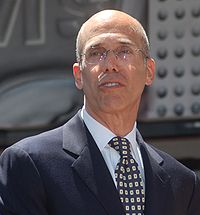
Elsewhere in the paper, they interview Jeffrey Katzenberg, a very successful film producer, formerly at Walt Disney (Shrek, etc) and now at his own DreamWorks Animation:

In order to succeed at the high end of the movie business, you must be original and unique. Now if you were putting an equation up on the white board and you wrote “original + unique = what?” Then the answer would have to be “risky.” And if you said, “risky = what?” The answer would be “some failure.” It has to, by definition, just sort of in the most fundamental way.

Obviously, this applies not just to film-making or Broadway but also to (ahem) writing–a blog, an article in The Economist, a book. And to war (Hannibal and Scipio). And to love. And to science. And to …. life.

Kipling’s impostors are hiding in plain view, as it were.


Bookmark and Share

How crisis leads to progress (aka the Cloud)

[picapp src=”a/0/e/0/d5.jpg?adImageId=7132613&imageId=2039813″ width=”500″ height=”351″ /]

Here is an admittedly tiny and prosaic example of a big and poetic idea–the idea in Kipling’s If and in my book that disaster can be an impostor (as can triumph). The disaster in this case is more of a nuisance, but you will get the point.

1) The nuisance

My (youngish) Mac Book Pro has had a boo-boo. The screen started going black (why do “screens of death” have to be blue anyway?).

I happen to be in the Apple elite, equipped with all sorts of plastic cards (Apple Care, Pro Care….) that allegedly bestow privilege upon me. So I went to the Apple Store, itself famous for allegedly being at the cutting edge of retail savoir-faire, to get the laptop fixed. I brandished my cards and, after a stressful wait, succeeded in persuading a helpful staff member to …. schedule an appointment, two days hence, for me to come back and get my laptop fixed.

Two days later, I dutifully returned (traffic, parking garages….) to the famous store. Another stressful wait. Somebody took my laptop. The next day, they called to say that they needed another part (the RAM). They called again two days later to say that they needed yet another part (the logic board). Then they left a voice mail (Apple’s iPhone, which I also own, had not rung as it ought to when a call comes in) to say that it would be faster (sic) to send the laptop to a distant part of the country where logic boards are more plentiful, but that they needed my approval. I called back, but they had left for the day.

I called again the next day–at 10AM, when they start work–and gave my approval. The laptop, I was told, would now be en route “from 5 to 7 days”. This was 5 days after my original visit to the famous store with my fancy cards. My lap has been, and remains, untopped.

2) Why I expected this to be a big deal

I am a nomadic worker, and my laptop in effect is my yurt, or office, and thus one of the two West Coast Bureaus of The Economist (the other bureau being the laptop of Martin Giles in San Francisco, who replaced me in my previous beat). So I assumed that no laptop meant no bureau, no articles, no work. I assumed this because this was my experience in 2005, when another laptop of mine died.

300px-Cloud_computing

3) Why it’s not

But things have changed since 2005. Something called “cloud computing” has come along, diagrammed above. It’s an old idea newly implemented: that information and intelligence reside in the network, to be accessed by “appliances” or “terminals” which we nowadays call web browsers. If you use web mail, Facebook, WordPress, Flickr, YouTube etc etc then you are computing in the cloud. You are not longer storing and crunching data in the machine on your lap. Instead, you are doing it on the internet.

After my previous laptop disaster in 2005, I began to train myself (I am a technophobe by nature) to start using the internet instead of perishable machines. Gmail, Google Calendar (which I share with my wife and a few other people), Google Reader, Facebook, and so forth.

Slowly, I started migrating more and more activities into the cloud. This was slow because of inertia. But I kept at it. My phones (Skype and Google Voice) are now online, as are many of my photos.

So it occurred to me, before going back to the Apple Store, to complete this process. I put all of my current or important documents on Google Docs. This was surprisingly quick and easy. I had never understood why I was using Microsoft Office in the first place, since it was bursting with features that I never use and that confuse me.

Now, instead of emailing my editor a Word doc, I “share” a Google Doc with him.

So now my digital life is entirely in the cloud. As some of you have noticed, even though I have not had my laptop, I have been “on”. Nothing has changed. I use my wife’s laptop, or somebody else’s, or my iPhone, which is almost as good. I no longer really care about my laptop.

4) Progress = Bye bye, Steve, bye bye Bill

At some point, I may yet get my snazzy Mac Book Pro back from this famous Apple Store. Will I care? Enough to go to the store one more time to pick it up. Barely.

The truth is that this slight nuisance, this mini-crisis, nudged me to do what I should have done long ago. It forced me to liberate myself from Microsoft’s software and Apple’s hardware, neither of which I need any longer. Yes, there are some new vulnerabilities (there always are). But I am, if not free, a lot freer.

Bookmark and Share

The “heart” of the Western Tradition: Dante

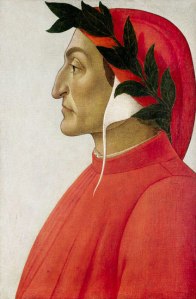
Dante

Nudged by Cheri, I’m re-reading Dante’s Inferno right now on my Kindle. Reading Dante is always a good idea.

The Inferno, or Hell, is the most gripping of the three parts of Dante’s epic Divine Comedy–the more boring parts being Purgatory and Paradise. (And isn’t that interesting, by the way: As every journalist and writer knows, the awful makes for an infinitely better story than the hunky-dory.)

But in this post I want to make a different, more historical, point about Dante: He may just be the single best illustration of a metaphor I told you about last year to explain–really, really explain–the entire Western Tradition.

To recap that post very briefly: You can think of “Western culture” as a human body.

  • The left leg is ancient Athens and Rome, Socrates and Aristotle;
  • the right leg is Jerusalem and the Bible, Moses and Jesus;
  • the crotch is the end of the Roman empire when the two “legs” met;
  • the torso is the Middle Ages, when the two traditions became one;
  • the left arm is the Renaissance;
  • the right arm is the Reformation;
  • the neck is the Enlightenment; and
  • the head is us, ie modernity.

(The metaphor, which comes from Professor Phillip Cary, is more subtle, so please read the older post.)

So where does Dante fit in?

Well, he was a product of the Middle Ages, located in the “torso” just below the left arm pit, where the Renaissance was to begin. The Renaissance, or “left arm”, in this analogy, was to be Petrarch, a fellow Tuscan and co-founder, with Dante, of the “Italian” language.

You see this all through the Inferno: the surprising and constant mixture of Athens/Rome and Jerusalem, of the (pagan) classics and the Judeo-Christian, Bible-thumping fire and brimstone, so that the two legacies merge to form a new and distinct tradition, as two haploid gametes unite to make a new, diploid human being.

The overall structure, both narrative and psychological, is, of course, Biblical: We are in Hell, after all. (The ancients did not have Hell, a place where we are punished for our sins. They only had a boring and gloomy place named Hades.)

But look who guides Dante through this Hell: It is Virgil, the greatest of the Roman poets, who told of brave Aeneas surviving the sack of Troy and founding the Roman nation. Dante can think of no one nobler, and yet Virgil is a pagan, so Dante meets him, along with Homer, Horace and the other ancient greats, in the first circle of Hell. Relatively un-dreadful, this circle is the limbo where those hang out who were unlucky enough to live before there was a Christianity to be baptized into.

Together, Virgil and Dante then descend deeper and deeper, from one circle to the next, to witness the torments of the sinners increasing with the vileness of their sin. But again, look whom they encounter:

  • Cerberus, the three-headed dog who guarded Hades (although Dante describes him slightly differently),
  • Charon, the ferryman who brought the dead souls across the river Styx for their final destination in Hades,
  • Centaurs, half men and half horses, who caused mischief in the Greek myths,
  • even historical characters such as Alexander the Great, whom we meet boiling in a river of blood in return for the blood that he spilled. (Hannibal must have been floating nearby.)

On and on. Virgil and Dante casually discuss things such as “your ethics”, which is assumed to mean Aristotle’s Ethics (the only text on ethics that the medievals had recourse too).

This, then, was the torso just before Petrarch emphasized its left (humanist, classical) side, thus launching the Renaissance and eventually provoking others to raise the right (Protestant, then counter-Reformationist) arm.

Located just below the left arm pit of the Western Tradition, Dante was thus … its heart!

Bookmark and Share

Inspiration in a baton, a helmet, a sword …

445px-der_mann_mit_dem_goldhelm

In January I recommended to you a talk at Google’s Zeitgeist Conference that I had attended. It was by Itay Talgam, an Israeli conductor who asks us to see in the styles of the great conductors (Karajan, Kleiber, Muti, Bernstein…) the dos and don’ts of leadership, the ways to elicit or inhibit the creativity and collaboration of individuals in a group.

Talgam can make us see in a conductor’s manner of holding a baton our own experience as, or with, leaders.

He has now given essentially the same talk again at TED. (If I may observe: TED, Zeitgeist and Poptech, who are rivals, are essentially the same conference these days. As soon as a speaker does well in one, the other two pick him up too.)

So why would I recommend Talgam … again? Because his talk is so incredibly good! So watch all 20 minutes of it, below.

But I’d also like to make another point, one that might seem oblique. One thing I like about Talgam’s approach is that he draws from one area of life (orchestra music) and role (conductor) to inform another area of life (business) and role (boss).

In my very humble way, I try to do the same thing. When I think about writing, I like to think about painting–the way Rembrandt uses color so sparingly and thus effectively, for instance. I see in the highlights of a helmet the touches of good storytelling.

And in my forthcoming book, I take the story of Hannibal, Fabius and Scipio, whose role was commander and whose context was war–the sword, if you will–and I extend it to sex, science, business, sports, exploration, art, politics and intellect–and the ways we succeed and fail in them.

Sometimes, when I give my “elevator pitch” (ie, the book idea compressed into a sentence or two) I get blank stares. I imagine that Talgam does, too. But then I watch Talgam’s talk, and I leaf through my manuscript, and I realize that this … works!

Bookmark and Share

Hayek on healthcare: Don’t be serfs, Americans!

Hayek

Hayek

I’ve only mentioned Friedrich von Hayek tangentially on The Hannibal Blog so far, although he probably deserves his own post in my great-thinker series quite soon. Hayek was one of the great liberals, properly defined. He was close intellectually and personally to my great-uncle Ludwig Erhard. His book The Road to Serfdom should be required reading.

So I was glad to see Andrew Sullivan revisit The Road to Serfdom to see whether Hayek addressed the topic of health care that so captivates America these days. Hayek did, it turns out, and I had forgotten.

(Recall that I, also with classical liberal instincts, concluded, in my amateurish way, that health care is different enough from other industries to warrant one of two clean and equally acceptable solutions: universal private insurance or universal government–ie, “single-payer” insurance. Anything, in short, but America’s current, fragmented, employer-government-individual hodgepodge.)

Here is Hayek, from Chapter 9 of The Road to Serfdom, via Andrew:

Nor is there any reason why the state should not assist the individuals in providing for those common hazards of life against which, because of their uncertainty, few individuals can make adequate provision…. Where, as in the case of sickness and accident, neither the desire to avoid such calamities nor the efforts to overcome their consequences are as a rule weakened by the provision of assistance – where, in short, we deal with genuinely insurable risks – the case for the state’s helping to organize a comprehensive system of social insurance is very strong… Wherever communal action can mitigate disasters against which the individual can neither attempt to guard himself nor make the provision for the consequences, such communal action should undoubtedly be taken.


Bookmark and Share

Schwarzenegger’s revanchist word game

[picapp src=”2/d/4/4/The_2009_Womens_8b22.jpg?adImageId=6962167&imageId=6924971″ width=”234″ height=”352″ /]

The following letter by Arnold Schwarzenegger, governor of California, to the State Assembly would not seem to make for exciting reading. But that’s if you read it conventionally–ie, horizontally.

What if you read vertically? Could it be that the gubernator, cigar-chomping cad and prankster that he is, has had a bit of fun?

Tim Redmond spotted the hidden code. See if you find it:

1027arnold

[picapp src=”1/6/d/7/Gov_Schwarzenegger_Addresses_4e56.jpg?adImageId=6962178&imageId=4919912″ width=”234″ height=”351″ /]

For background, AB 1176 was a bill by Tom Ammiano of San Francisco about infrastructure or something boring of that sort. The same Tom Ammiano recently did a reverse Joe Wilson and yelled “You lie” at Schwarzenegger, when the Republican governor had the audacity to drop in on a meeting of Democrats in a San Francsico ballroom. Ammiano then stormed out, yelling “Kiss my gay ass.”

So now Schwarzenegger is having a bit of revanchist fun. All in good humor, if you ask me. It is a sign of the unshophisticated mind to get squeamish about this sort of thing. Ammiano himself is probably laughing loudest.

If you have not already spotted it, here is the hint:

1027fu


Bookmark and Share