The veil of ignorance: great thought experiment

John Rawls

John Rawls

What if we could get together to form a new kind of society … and we did not even know who we would be in that society?

This is a famous thought experiment, proposed by the Harvard philosopher John Rawls in his 1971 book, Theory of Justice.

Rawls was trying to justify democracy as fair as opposed to merely utilitarian (ie, “the greatest good of the greatest number”). How would we go about deciding what is fair? By imagining a situation that has never existed, and indeed can never exist.

Rawls called that situation the “original position”:

No one knows his place in society, his class position or social status, nor does anyone know his fortune in the distribution of natural assets and abilities, his intelligence, strength, and the like. I shall even assume that the parties do not know their conceptions of the good or their special psychological propensities. The principles of justice are chosen behind a veil of ignorance.

You have probably already grasped the power of the experiment. Normally, we think of justice with ourselves in mind. A single black mom in a public-housing project will have a very different view than a start-up entrepreneur in Silicon Valley or a trustafarian in prep school or a prisoner or …. you get the point.

But if we don’t know whether we will be tall or short, male or female, smart or dumb, lazy or ambitious and all the rest of it, we have to test every principle against the possibility that we might be the least advantaged member of society with respect to it.

A simple example: Slavery in 19th-century America.

Slave owners considered America free and fair and were prepared to go to war for that “freedom”. That’s because the slave owners assumed that they were, well, slave owners. Using purely utilitarian reasoning, they might have concluded that slavery produced the maximum pleasure of the greatest number of people (ie, the white majority) and was therefore right.

But if they had played Rawls’ thought experiment, they would have had to imagine that they might instead be slaves. Suddenly, slavery no longer looks so good.

Getting liberté, egalité, fraternité onto one flag

756px-eugene_delacroix_-_la_liberte_guidant_le_peuple

Now, some of you might remember that, back in April, I tried to figure out whether freedom and equality could ever coexist, as the naked-boobed Marianne (pictured) was clearly hoping. In that post, I was thinking about biology. But perhaps the answer lies in Rawls’ thought experiment.

As we imagine a society without knowing what role we have in it, we will certainly agree that it should be free, and that we should not sacrifice that freedom by forcing everybody to be equal.

But that leaves us having to imagine inequality, and, thanks to our veil of ignorance, we might be the ones ending up with the least (wealth, opportunity, beauty, power…). So how can we agree to inequality that is fair?

The answer is

  • First, that inequality must benefit even the least advantaged member of society (though obviously not in the same proportion). So we do not mind that the Sergey and Larry at Google get astronomically rich because even a single black mom in a public-housing project can now google where to get her baby a flu shot.
  • Second, that the cushy positions in society must be open to all.

Intelligence and talent, for those playing the thought experiment rigorously, would thus cease being mere boons for the individuals that are lucky to have them and instead become social resources that help even those who don’t have them.

I can immediately think of lots of things that we still would not agree on–inheritance taxes, say. But Rawls’ thought experiment definitely introduces even a certain amount of fraternité into the equation. Marianne would love him. For the power of this experiment, I’m hereby including Rawls in my pantheon of great thinkers.
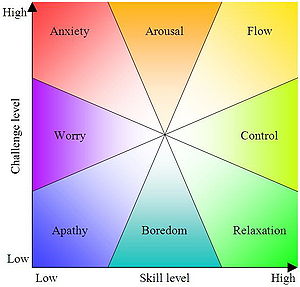
Beyond arousal and control: “Flow”

Flow

I really like this visual depiction of flow.

Some of you might remember that I am fascinated with the concept of flow, and the Positive Psychology that is based on it.

Flow is a state of effortless and complete absorption into whatever we are doing, a state in which we are and feel at our best and most creative, when we achieve harmony and mastery, when we forget time and feel good.

Flow does not come easily, of course. They say that it takes ten years of training at something–soccer, violin, writing, you name it–before you become able to slip into flow.

Which brings me to this diagram. It is by Mihaly Csikszentmihalyi, an unpronouncable Hungarian psychologist who might just belong into my growing pantheon of great thinkers. Indeed, quite a few people consider him a great thinker, and he has even received an award called Thinker of the Year.

You can view the diagram the following way:

Most of us spend most of our time hanging out somewhere near the bottom left:

  • We are apathetic because we are not challenged and have not applied ourselves to mastery of anything, or
  • we have taken up a challenge unprepared and are floundering, which causes us to worry, or
  • we are good at something but not challenged, so we become bored.

The way out is two sweep either clockwise or counterclockwise in the diagram:

  • Challenge yourself, by finding something you want to master. If your skill level is low, at least you will feel aroused, which is a good first step toward learning and flow.

Or:

  • Keep learning, practicing, mastering, refining. Even if you are not challenged yet, you will become relaxed and feel in control, which builds confidence and is also a great step toward flow.

This is, of course, nothing but the self-help manual of the Samurai and Zen disciples through the centuries.

It’s also a great reminder for us parents and teachers (especially those public-school bureaucrats in America): You must, you must, you must challenge a child to “educate” (ex-ducare = lead out) him or her from apathy.

Watch Csikszentmihalyi’s TED talk:


Bookmark and Share

The Economist: bland, trite and worthy?

I have been pondering a recent comment by Phillipp S Phogg to the effect that, if I may amplify it, what I write on the Hannibal Blog is sometimes more fun than what I write in The Economist. Or, as he put it:

the very opposite of the blandness (and dare I say, triteness?) which permeates some (but not all, I hasten to add!!) of the Economist’s erudite and worthy pages.

  • Bland
  • Trite
  • Worthy

Ouch. No publication, writer or editor would want to be caught anywhere near those adjectives–especially the devastatingly faint-praising worthy.

Well, one of the minor purposes of this blog (besides the main one, which is to talk about my book once it comes out) is to let those of you who are fans/foes of The Economist speak truth to power in a safe setting.

Furthermore, this is the time for me to admit that I myself occasionally feel as Phillip Phogg does. And that frustrates and saddens me.

It also makes me think deeply about such evergreen writerly topics as style, voice, tone, and storytelling, because that’s what this seems to be about.

The Economist appears to succeed in part because it promises and delivers to its readers analysis that is:

  • disciplined, not florid;
  • terse but deep;
  • occasionally quirky but not self-indulgent.

Permit me to contrast that with, say, The New Yorker, which promises, and mostly delivers, storytelling that is

What that means for me as a writer for The Economist is that I usually do the same research as writers for the New Yorker but then leave most, or even all, the “fun stuff” on the cutting floor to maintain the discipline of, say, a 600-word note.

This is frustrating. As a writer, I often know that I could spin a thrilling yarn out of my experiences during research but as a correspondent for The Economist I know that much of it is inadmissible. (There are exceptions, such a piece I have written about Socrates for our upcoming Christmas issue, which arose out of a thread here on the Hannibal Blog and is almost pure, unadulterated fun.)

One device that writers for the New Yorker (just to stay with that example) have but that we lack is the First Person, ie the “I”. I have said before that I consider the First Person “treacherous” for young writers because it subverts discipline. It is a good idea to learn to write without using “I” and “me”. That said, I have also discovered, on this blog and in my book manuscript, that the First Person makes certain things easier. One of those things is authenticity. Another is fun.

But it goes beyond the First Person and into storytelling. Occasionally, we do great storytelling in the pages of The Economist. But often we don’t, because that is not always the main objective.

I still love Ira Glass’s analysis of good storytelling. It requires, he said:

  • humanity
  • suspense
  • surprise
  • momentum (or “direction”)

But implicit in those elements is detail, also known as color. I have said before that color can be excessive and is best used sparingly, as in a good Rembrandt painting. But sparing does not mean monochrome.

Perhaps, when we fall short at The Economist it is because we overdo the sparing. Perhaps we should do more First Person narrating (which does not necessarily require us to give up our anonymity). Perhaps we should paint in more color.

In the next post, let me try to illustrate what I’ve been talking about in this post by looking at the back story behind one of my pieces in the current issue of The Economist.

Bookmark and Share

The Economist’s coequal humo(u)r

From time to time, I like to regale you with tiny anecdotes from our daily routine at The Economist, especially when they display our quirky side.

For instance, an editor might remark, as she anglicizes an acronym I use, that a word “either has to look odd to us [Brits] or odd to them [Yanks], and we opt for them.”

Well, this week I woke up on Monday to get a message from our editor-in-chief that he would quite like a three-page (3,000-word) Briefing on California’s water wars, since the piece that was meant for that slot was not ready to run this week. Due to the inhumanely inconvenient times zone I am in (ie, California, when my bosses are in London), this meant I had to deliver the piece the following day (Tuesday) for London to be able to wake up to it on Wednesday and publish it on Thursday, ie today. This is the piece.

So I wrote the piece in quite a hurry and sent it. Then, on Wednesday, I worked with the fact-checker and map guy, Phil Kenny. He came up with a great map, the clearest depiction of California’s water infrastructure I have yet seen:

CA Water map

The editors are then supposed to send me the “subbed” (jargon for edited) “copy” (jargon for text) and, this being The Economist, forgot to do so. So I went to a yoga class. By the time I came back, it was late at night in London.

In our process, a correspondent sends his article to a section editor, who subs the piece and then sends it on to the editor-in-chief or a deputy, who then sends it through to a “night editor“.

I had heard that our night editor last night was Johnny Grimmond, the author of our style guide. Johnny guards our quaint British usage as Cerberus, the three-headed dog of the underworld, watches over Hades. You can call him, as you can call me, a pedant, and we would be proud of it.

I immediately knew that Johnny would pounce on one particular phrase of linguistic interest. The water legislation currently being negotiated in California contains a very important phrase that is also ugly and stupid in a characteristically American way. Which is to say that, in the same way that Americans gave the Anglophone world the word proactive (why not active?), the legislators in Sacramento now want to impose on the state’s environmentalists, farmers and urban water users

co-equal goals.

While doing my interviews for this story, I had kept a straight face every time the phrase came up, because I am keen not to appear, you know, loony or snippy. In my article I refrained from any overt pedantry. But I knew that Johnny, in the safety of his London office in the wee hours, would not. His cursor, I was sure, would find the pompous American redundancy faster than you can swat a greasy Hamburger with a cricket bat.

And so I asked a colleague with access to the system to send me the copy. My eyes skipped over the paragraphs until they alit on the one in question. I started grinning even before I read the new sentence:

The details of the legislation negotiated so far are complex, but its main feature is a phrase, “coequal goals”—though how coequal goals differ from equal ones is not clear.


Bookmark and Share

Uniting the two kinds of enlightenment

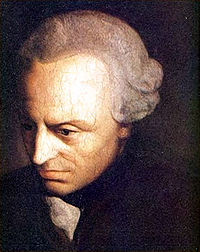
Kant clarified

Kant clarified

The English word enlightenment can have two quite different contexts:

  1. The (Western) Enlightenment of the 18th century. You know: Kant, Voltaire, Hume, reason, the American and French Revolutions and all that.
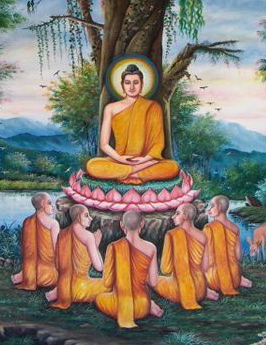
  2. The (Eastern) Enlightenment that the Buddha, Patanjali, and various Zen masters and bodhisattvas have achieved through meditation and Yoga. Samadhi, nirvana, satori and all that.
Buddha illuminated

Buddha illuminated

The two are completely different, of course. The former is largely a collective phenomenon, one in which ideas elevated all of society. The latter is largely an individual phenomenon in which one person, through sudden insight (Zen) or hard and prolonged work (Ashtanga Yoga), achieves inner peace and freedom.

In fact, the same exact difference came up when I talked about freedom: There is:

  1. the (Western) Enlightenment view of freedom: Latin liberLiberalism, Liberty, and
  2. the Existentialist and Eastern views of freedom (moksha in Sanskrit).

Anyway, what this means is mainly that the limitation lies in the English word Enlightenment. German, for instance, has two separate words:

  1. The Western Enlightenment is called Aufklärung. The term was coined by Kant and means literally clarification (Auf-klär-ung = Up-clear-ing, for you fellow linguists. Incidentally, it can also refer to a young person learning about the birds and bees).
  2. The Eastern Enlightenment is called Erleuchtung, which means illumination, often symbolized with the halo (ie, ring of light) on the crown chakra of the Buddha or Jesus.

Why I bring this up

That difference between Aufklärung and Erleuchtung came up in 2007 when I was talking with Michael Murphy, one of the two founders of the New Age retreat Esalen. I was interviewing him for a profile of Esalen in the Christmas Issue of The Economist that year. Murphy is now in his seventies and lives in Sausalito, so I went there to see him. We sat by the waterfront and talked about absolutely everything except what we were supposed to talk about. For instance, he was the first person other than my agent, parents or wife whom I told about my book idea, and that really got him going. It was the best kind of conversation.

Anyway, so Murphy and I talked about the two kinds of Enlightenment, and to my surprise this Irish-American aging Hippie delves into German etymology. But it was appropriate. An oversimplified summary of his life work–at Esalen and in his books–is that he tried to unite Aufklärung and Erleuchtung, West and East, in an effort to liberate our full “human potential”. Hence the Human Potential Movement, which he helped to found at Esalen in the 60s, when folks like Abe Maslow were teaching there.

Instinctively, that is what I also aspire to: Uniting the two kinds of Enlightenment in my life. You see it when I call Diogenes a “Greek Buddha” or Abe Maslow a “Jewish Buddha,” or when I draw parallels between the Second Law of Thermodynamics and Feng Shui.

Somewhere between East and West (though perhaps not in the “middle East”)–somewhere between reflection and science, eternity and progress, mythos and logos–there must be something worth finding. I’m sure of it.

Bookmark and Share

Through the eye of Hannibal

hannibal barca

I’ve mentioned that Hannibal lost one eye to some sort of infection as he crossed an Etruscan (= Tuscan) swamp in 217 BCE. For four days and nights his army waded through the fetid sewage, men and beasts excreting into it as they progressed, unable to sleep for lack of a dry spot to lie on except when the mules died and they could pile the carcasses into a mound and climb on top for a brief nap.

In any case, Hannibal must therefore be pictured one-eyed. Which means that my tagline for this blog has been wrong. Until today it read:

A blog about a book: Thoughts deep and shallow about triumph and disaster in life, through the eyes of Hannibal the Carthaginian

Fortunately, Paul H. pointed out the flaw, an inexcusable one for somebody like me who fancies himself a wordsmith.

Paul H., you get today’s fistbump.

Look up and see the tagline changed. 😉

Bookmark and Share

The danger of the single story

Adichie

Adichie

A big theme in my thread on storytelling, and a premise of my forthcoming book, is that certain stories are universal and timeless–or, as Carl Jung might say, archetypal.

But as with everything, there is a way to misunderstand that insight. Yes, there are elements that are common to Homer’s Odyssey and Iliad, to the Grimm stories and to Heidi–elements such as a hero who goes on a quest and meets a wise old man and so forth….

But that does not mean that one single story can summarize a life, a person, a place or a country. The opposite is the case. There must be an infinite number of stories, even if they all have something in common.

The attractive Nigerian novelist Chimamanda Ngozi Adichie gave a great TED talk (below) about exactly this. As a girl in Nigeria she read and loved British and American books and stories and began to write stories herself at the age of 7. But her stories were about … white, blue-eyed girls who played in the snow and ate apples and talked about the weather and whether it might turn nice. Even though she had never left Nigeria!

She eventually realized

how impressionable and vulnerable we are in the face of a story.

Stories had overpowered her own perception of the world. She assumed that stories could not be about brown people eating mangoes in the sun but had to be about white people eating apples in the rain.

Emancipation occurred when she realized that

people like me … could also exist in literature

But that was only the beginning. She understood that many people have only one single story about Africa (= catastrophe), and that she did not fit into that story. She realized that she herself had only one story about Mexico (= illegal immigrants) which proved woefully inadequate. She realized that some people, such as her American college roommate, had only a single story about her, Adichie from Nigeria (= exotic tribal woman), and that she herself simultaneously had only one single story about her own family servant (= pitiful poor boy), which also proved incomplete. She understood that

power is the ability not just to tell the story of another person but to make it the definitive story of that person,

and that

the single story creates stereotypes, and the problem with stereotypes is not that they are untrue but that they are incomplete… It robs people of their dignity.

So consider this a refinement of my views on storytelling. We must be open to many, many, many stories even as we see the common, universal humanity that runs through all of them. Now take 18 minutes and watch:


Bookmark and Share

Einstein’s unfinished thought experiment

Mark Anderson

Mark Anderson

As you know, I am fascinated by many aspects of Albert Einstein, and one of them is his habit of doing thought experiments. We don’t do those enough!

In Einstein’s case, he mused (picture him day dreaming) about things such as elevators falling through space and painters inside of them, about two-dimensional beetles crawling around three-dimensional wires, and so on.

But his most famous thought experiment has always bothered me. So I was delighted that Mark Anderson, a physicist who writes the Strategic News Service, which offers trend-spotting analysis, echoes my frustration in a recent newsletter. Here he goes:

The most famous scientific anecdote of all time remains half-done, unfinished, although countless authors have told the story of Albert Einstein as though it makes sense. Here is how the “thought experiment” goes: when he was 16 or so, Einstein decided that he needed to travel alongside light to understand its nature. (Drum roll.) In this way, he came to understand Special Relativity, a bit later in life. Wow.

There’s only one problem with this apocryphal story: Special (and General) Relativity talk about time and space. They don’t say a word about light, except as it responds to gravitational force.

So, none of us knows what Einstein saw (or did not see) of the light itself, as he (illegally) screamed along at the speed of light, looking sideways…

Well, I have been doing this thought experiment for a while now, without success. (That is not surprising since I opted out of physics as soon as I could in high school.) Here, by the way, is a cool illustration of it.

It always seemed to me that if I were looking sideways at a wave-like quantum of light going at the same speed, it should not even “exist”. Mark seems to think the same thing:

Waves, at their deepest origins, are relative. If you stand at the shore, in they come. But if you fly along with one, like a seagull – say, at the crest of a traveling wave – there is no motion at all; there is no wave.

Having said that, I remind myself, through the haze of my confusion about such matters, that Einstein’s Relativity ended up being about time as much as space.

So perhaps what happens to a light-beam rider is that time … stops. Which is, ironically, exactly what happened when I opened my email inbox this morning.

Bookmark and Share

Book writers’ advice: book writing sucks

It’s amazing how many book authors are volunteering advice and/or satire about how bad it was for them, or is likely to be for you, to write a book.

Ellis Weiner in the New Yorker lampoons the “marketing department” at publishing houses which are so notorious among writers for not existing per se.

Mark Hurst claims to divulge “secrets of book publishing I wish I had known,” sounding just a tad bitter imho. Publishers hate/don’t get originality, and so forth.

Seth Godin, in a slightly older post, gives “advice to authors” which amounts to “lower your expectations” and somehow ends, in a non sequitur, with: “You should write one.”

Well, I am writing one. Once it’s published, will I post, right here, some advice and/or satire about how bad it was to write a book?

Bookmark and Share

Becoming a Mensch: “Self-actualization”

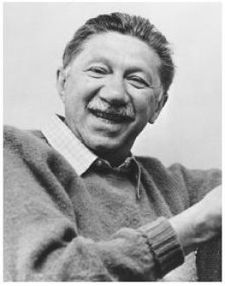
Abraham_maslow

Abe Maslow

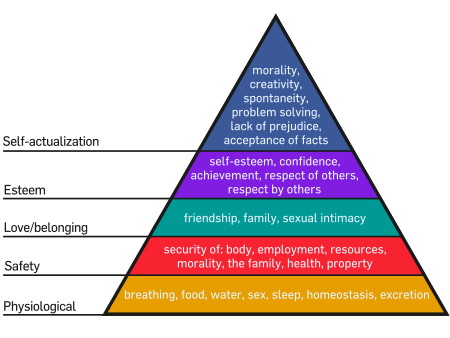
The other day, I compared Abraham Maslow’s Hierarchy of Needs to the chakras in Indian philosophy, and I promised to expound a bit on the highest need/chakra, which we might call, to use Maslow’s word, self-actualization.

It’s an ugly term, born out of Esalen in the late sixties, when hyphens, Latin roots and the noun form of verbs were considered good things because they bestowed credibility in between naked massages in the Esalen hot tubs which I myself once had to endure as part of my journalistic research.

So let’s just call it something else. To self-actualize is–to use the technical Jewish-Buddhist term ;)–to be a Mensch. I consider it perhaps the highest form of success, and it thus becomes relevant in the penultimate chapter of my book. According to Maslow, only about 2% of the human population self-actualizes!

In the rest of this post, I want to flesh out what self-actualization might entail, with help from an excellent summary by Dr. C. George Boeree.

Needs you fill and forget & needs that grow as you fill them

Take another look at Maslow’s famous pyramid, which I showed you in the previous post on the subject. There is one difference between the top of the pyramid and all the lower rungs. At the bottom (breathing, eating, feeling safe etc), we feel needs only when we lack something. We cease to feel them as soon as we have what we crave. So, if I am suffocating, all I care about is air. But once I have air again and can breathe, the obsession is gone. Maslow called these cravings deficit needs.

450px-Maslow's_Hierarchy_of_Needs.svg

Self-actualization is different. When we feel that we are fulfilling our potential–by being creative, for example–the need to self-actualize does not go away but grows. Fulfilling our potential makes us feel alive and satisfies us. So Maslow called these motivations being needs to distinguish them from the deficit needs.

Character sketch of a Mensch

So what kind of person reaches the highest stage and becomes a Mensch?

Maslow studied biographies.  (That happens also to be my approach in my forthcoming book; among the people Maslow studied are even some that are characters in my book.) From his studies Maslow concluded (we can debate whether he was right) that the Menschen shared certain traits that are actually quite rare. In this group of self-actualizers were:

  • Abraham Lincoln,
  • Thomas Jefferson,
  • Albert Einstein, (in my book)
  • Eleanor Roosevelt, (in my book)
  • Jane Adams,
  • William James,
  • Albert Schweitzer,
  • Benedict Spinoza,
  • Alduous Huxley, and
  • 12 unnamed people.

The traits they shared, according to Maslow, were the following. They:

  • were able to discriminate between what is fake and what is genuine,
  • were able to treat life’s challenges as problems demanding solutions rather than personal affronts to be angry or depressed about,
  • felt that the ends don’t necessarily justify the means, that the means could be ends themselves (this is the opposite of strategic thinking),
  • enjoyed solitude,
  • had deep and intimate bonds with a few people rather than shallow relationships with many people,
  • felt “autonomous” from society (I think this means that they were non-conformist),
  • had an unhostile sense of humor–preferring to joke at their own expense, or at the human condition, and never directing their humor at others (which comes close to my definition of irony),
  • accepted themselves and others, enjoying harmless flaws as personal quirks,
  • were spontaneous and simple,
  • respected other people and treasured ethnic and individual diversity,
  • were ethical and spiritual but not usually “religious”,
  • were able to feel wonderment,
  • were original, inventive and creative, and
  • tended to have “peak experiences“, which we might call episodes of rapture or ecstasy–mystical feelings of merging into an infinitely large and eternal whole.

Normally I don’t like lists (as opposed to one single and large insight), but in this case a sort of composite personality emerges, which becomes stronger when Maslow adds to these positive qualities a few flaws that he found common among self-actualizers. They:

  • often suffered from anxiety,
  • were often absent-minded,
  • were occasionally ruthless and cold.

In short, they were, as Walt Whitman might say, “large”: they contradicted themselves and were fine with that.

And so…

Frankly, Maslow is a lot of work, and I have been pondering whether it has been worth it. I can’t decide whether the character sketch, and even his hierarcy of needs, is too obvious and thus banal, or whether it is helpful. For now I lean toward the latter.

Since I began this meditation by comparing his thoughts to ancient Indian philosophy, let me also conclude that way. It does strike me that self-actualization is strikingly similar to some visions of what “enlightenment” might be like.

First, I happen to believe that the yoga taught by Patanjali and his contemporary, the Buddha, leads to fleeting instances of samadhi (enlightenment, ecstasy), rather as it overcame St Teresa, instead of lasting bliss. “Peak experiences,” in other words.

Second, the “method” is similar: The simplicity, love of solitude, humor (think of Zen monks), non-conformism, withdrawal and even the occasional coldness of the self-actualizers resembles that of the Eastern yogis and Zen masters. They are really Einsteins in the Lotus position.

In short, I think that Maslow’s contribution is to humanize “enlightenment” for us Westerners.

Bookmark and Share

PS: After reading these two posts on Abe Maslow, do you think he belongs into my pantheon of the world’s greatest thinkers?