A learning revolution: Khan Academy

Where have I been, you may have been wondering. Well, this chart above shows you where I’ve been. I used to take my coffee breaks blogging, but for the past month I’ve been taking them (ie, a couple of 10-minute breaks a day) at the Khan Academy, which is the subject of this post.

The chart shows my time logged watching chemistry-lesson videos during the past month. (Notice that I’ve earned some meteorite badges, and even a moon and an earth badge. 🙂 This boy — his name is Sal Khan — knows how to motivate kids of all sizes.)

Now, you too should care about this (ie, the Khan Academy), and I am about to tell you why. But first…

1) Credits

I don’t know how it’s possibly that I only discovered the Khan Academy last month, but that’s what happened. And I discovered it because Dafna, a frequent commenter here on The Hannibal Blog, mentioned it in passing, apropos of something else, and I clicked through and was hooked.

Dafna: You get more than a fist bump, you get a chest bump or body flop. Now…

2) “Revolution”: definition and polemic

I used the word revolution in the title of this post, so please indulge me in another brief tangent, concerning that word.

I can’t tell you how sick I am of it. And the verb, to revolutionize, is even uglier. Practically every PR pitch I get in my inbox (and I get many) announces that something or other is being “revolutionized”. How yucky. And how ludicrous.

By definition, revolutions are extremely rare in human history. I myself have, as a journalist, proclaimed precisely one revolution in fourteen years (and that was the ongoing media revolution, which I put on a par with the Gutenberg printing press.)

So I don’t use the word lightly. But I think there is a revolution underway, and it is in learning. So now I might have your attention.

3) What is Khan Academy?

I was tempted to summarize it here, but why would I distract from Sal Khan explaining it personally? So watch this talk below, and then come back here to read the rest of the post:

4) Revolution or rotation? How Sal flips education

Now that you know what Khan Academy is, you’re ready to contemplate what makes it (or things like it, such as future iTunes U courses et cetera) revolutionary.

A revolution is technically a circumnavigation of something (as that of our planet around the sun). But we usually think of it, in human affairs (the French Revolution, say), as a rotation, a turning upside down of something.

This is what Sal thinks Khan Academy can do to education as it is traditionally practiced in schools.

In this piece in the Wall Street Journal, he argues that Khan Academy can

“flip” the traditional classroom: Students can hear lectures at home and spend their time at school doing “homework”—that is, working on problems. It allows them to advance at their own pace, gaining real mastery, and it lets teachers spend more time giving one-to-one instruction.

Ponder this for a while. And then you see why this might be revolutionary.

On a personal note: Sal, with his approach, epitomizes a lot of my own worldview. He:

  • loves — clearly adores — learning for its own sake;
  • takes the pomposity out of it; and
  • makes learning playful and intimate.

In due course, you will hear more, much more, from me on this subject.

The human brain while driving and …

It was only a matter of time, I suppose, until I had to advance from venting about the evils of distracted driving here on The Hannibal Blog to doing so in The Economist. So here it is. My rubric says it all:

Distracted driving is the new drunk driving.

The research and writing process had the usual frustrations (usual for The Economist, I mean): I talked to lots of people, read many tens of thousands of words of academic research, took more than 10,000 words of notes, and then…. reduced it all to 700 words.

Oh well. Out went a whole lot of nuance.

If you ask me to name the most interesting concept from the article, and about the whole topic, it is this:

The human brain cannot process communication (oral or written) with a person who is not physically present without drastically reallocating attention and thus compromising driving safety. This is a biological fact. All those who claim that they can call/text and drive are the modern equivalents of the people you might (if you’re older) recall bragging that “I can hold my liquor” before that started sounding ridiculous.

As Satoshi Kanazawa, an evolutionary biologist and a delightfully belligerent blogger, puts it:

Any communication with parties who are not immediately present is evolutionarily novel, and the human brain is likely to find it cognitively difficult to handle.

Steering a large metal weapon at lethal speeds through crowded surroundings, of course, is also “evolutionarily novel”. So we have a double whammy. Homo sapiens just didn’t do this stuff in the savannah.

And yes, this means that bluetooth (“hands-free”) does zero to reduce the risk.

Anyhoo, here is just a tiny sample of some of the research that, sadly, got little or no exposure in my article for lack of space:

Murphy’s Law of radioactivity measurement

If you’re like me, you’ve been following with great concern the latest radioactivity measurements in various places, from Japan to the US West Coast. What an utterly hopeless task:

  • sieverts
  • grays
  • rads
  • rems
  • Roentgens
  • becquerels

Is this a joke? How are you supposed to understand anything at all from this gibberish?

Well, yes it is a joke, of course, in the same way the entire universe is a joke (and a rather sick one!), as the apocryphal sage Murphy first observed:

Anything that can go wrong, will go wrong.

I once saw a booklet of addenda to Murphy’s Law. This week, I suddenly remembered one that seems germane:

Measurements will always be given in the least useful unit: Thus speed will be given as furlongs per fortnight.

Fortunately we have Mr Crotchety, who sent me this chart which, if correct, puts it all in some perspective.

At which end good writing turns bad

I) Amateurs: lose the top

Amateur writers often make the mistake of not cutting out their own “throat-clearing” in the first couple of paragraphs.

What is throat-clearing? It is what we in the biz sometimes call the verbiage that most ordinary people seem to consider necessary prologue before they say anything of consequence. “Laying the ground”, “setting the scene,” and so forth.

90% of the time, any piece of amateur writing can therefore be improved simply by lopping off — wholesale and mercilessly — the beginning. Somewhere in the text, the writer does have a point to make, and that‘s the place to start.

(Somehow, the amateur writer himself usually cannot find that place.)

II) Pros: lose the bottom

Professional writers might have the opposite problem: they often don’t know when to stop. Or perhaps they do know when to stop, but someone or something forces them to go on just a bit longer. And thus they ruin fantastic texts with banal or ridiculous “conclusions”, “summaries”, “recommendations” or other thought detritus.

David Greenberg

David Greenberg, a professor of history and journalism at Rutgers University, makes this point in an amusing essay by using lots of famous books as examples.

How often, he says, some weighty, riveting, stirring text (we are mainly talking about socially or politically aware non-fiction) comes to ruin in its last chapter because

no matter how shrewd or rich its survey of the question at hand, [it] finishes with an obligatory prescription that is utopian, banal, unhelpful or out of tune with the rest of the book… [No] one, it seems, has an exit strategy… [and] hard-headed criticism yield[s] suddenly to unwarranted optimism…

When politicians, whether aspiring or recovering, produce such drivel, we might not be surprised. Of course somebody like Al Gore might develop a good argument that evidence and logic have been driven from public debate (The Assault on Reason), and then conclude that

I feel more confident than ever before that democracy will prevail.

But when real writers do this sort of thing, it is a genuine pity. So why do they do it?

Greenberg thinks that

One reason is that editors expect them. The journalist Michelle Goldberg conceived her first book, “Kingdom Coming: The Rise of Christian Nationalism” (2006), as a work of reportage on a subculture of growing political influence. She hardly felt qualified to lay out an agenda for curbing the power of the religious right, but “one of my editors insisted I do it,” she recalled in a recent interview. Inevitably, reviewers called her on it…

In other cases, he thinks

authors have themselves to blame. Having immersed themselves in a subject, almost all succumb to the hubristic idea that they can find new and unique ideas for solving intractable problems. …

And me? Some of you may recall the little game I played for about two years with my own editor at Riverhead. He kept pressing me to add a final chapter of “lessons”. I kept demurring.

In the end, he won. Ie, I did add a chapter of lessons. As it happens, I surprised myself by liking that chapter. (It’s instead my second chapter that I like least and worry about most.) Who knows. I might already have fallen prey to Greenberg’s hubris. Fortunately, the book will be out soon, and all sorts of reviewers will volunteer their honesty with the requisite brutality.

Thoughts on human nature after Japan

They form orderly lines. They throw no tantrums. They do not loot or take advantage of their fellow sufferers. They bear what fate has presented them, even after watching loved ones swept away in brown sludge, even as radioactive clouds snow on them. They do so because of who they are, as individuals and as Japanese, and because they understand that however bad it gets, they must avoid making it even worse through their own actions.

Some 50 of them even stayed in the reactors until commanded to return, like modern samurai, fighting the splitting atoms so that less death may issue forth, knowing that they will suffer and die because of it. Radiation, too, is a divine wind, a kamikaze. In form less Homeric, more insidious, it yet demands the same of the samurai.

They are individuals, yes. But they are also members of a culture, and there is a shape to their response. Isn’t there always? People behaved differently in Port-au-Prince. And again in New Orleans. And in Christchurch.

I once happened to find myself living in Hong Kong during the SARS outbreak. It was a fascinating time. (This was one of the articles I wrote.) The virus largely hit the different “regions” of China — Hong Kong, Taiwan, Singapore and the mainland. And each place revealed itself to be not only “Chinese” but unique, in ways that surprised even those living there.

I recall (what not everybody there may perhaps now choose to remember) that in some of the Taiwanese hospitals, some (not all) of the nurses and staff fled the virus, yielding to their fear, abandoning those who had come there in need. For them, the individual and the family was all there was. There was no community, no neighborliness, no society. Yes, they were aware that they were thus making the situation worse, by spreading the virus. But worse-for-others did not count.

The Singaporeans responded as expected: with ruthless and relentless efficiency, cordoning off and quarantining with no regard for those being separated from loved ones, whether they were confirmed infected or not. The rules were draconian, but nobody broke them, nobody pleaded special treatment. The individual was entirely subordinated to the group, and Singapore suffered least as a result.

The mainlanders also showed their ruthless side. Uniformed cadres barricaded entire towns, cutting them off from the world as in an Albert Camus novel. But the un-uniformed mainlanders did not respect these rules as the Singaporeans accepted those of their government. Individually, many (though not all) tried to escape, evade, be the exception. Whereas the Singaporean authorities chose merciless truth to gain and keep credibility, by reporting every case, the mainland Chinese defaulted to their customary secrecy, and nobody believed anything at all. Singapore was harsh but trustworthy, the mainland simply harsh. And the mainland suffered the most as a result.

And then there were the Chinese of Hong Kong. How surprised we, the expats, were by their response. How surprised even the Hong Kong Chinese were. Each nurse and doctor and customs official and neighbor, it seemed, did his duty. And they, too, chose unforgiving truth, reporting every turn for the worse so that we believed them when they finally announced the turn for the better.

And yet the Hong Kong Chinese were not like the Singaporeans. In Hong Kong, they did make exceptions in their quarantines, they did wait before cordoning off housing blocks, because they balanced the suffering of the individuals inside against the interests of the society outside. Was it civic values picked up, unwittingly, from the former colonial master? Was it something else? Something made them different. Hong Kong suffered more than Singapore, but less than Taiwan and the mainland. And when it was over, everyone in Hong Kong was proud.

Last year, we debated the topic of heroism here on The Hannibal Blog. As usual when intellectuals debate anything, the subject recedes until everybody wishes it had never been forced into hiding. And yet we all intuited all along that you know heroism when you see it.

My Elephantine mistake

Copyright: Shoshani and Tassy 2004

I’ve been telling you something very wrong about Hannibal’s elephants all this time. Not deliberately, mind you.

Almost three years ago, when I wrote my post “about Hannibal’s elephants“, I was really just kidding around, as I was in the early stages of research for my book. The levity, I thought, was abundantly obvious from my treatment of the subject. I did not mean to imply that I had any idea of what I was talking about (although I sort of do now).

I was, you see, a blogger! (Ie, I was more interested in thinking out loud, and getting readers to correct me, than in pontificating authoritatively.)

To my surprise, that particular blog post keeps getting a lot of traffic. In fact, its traffic is increasing. I have no idea why, so I must guess that the Google gods are sending people its way (which should cast aspersions on Google’s algorithms, not on my post). Those of you who blog may have made the same discovery: those posts you think are most valuable are not at all the ones that attract the eyeballs, and vice versa.

So I will set the record straight in this post. But first, I’m delighted what the earlier post has already done: It has brought me many of my readers (mostly the silent, non-commenting type). One of you has even (hush, hush) hinted that you might write a children’s book about Hannibal’s elephants — and I have voluteered my own kids and me as the first readers.

Now: The first question is how many elephants Hannibal brought with him when he left Iberia to cross the Alps and attack Rome. I’ve read the number 37, but Serge Lancel, the late French historian who seems to know best, says 27 (on page 63 of his book). So I’m going with that. Personally, I don’t really care about the real number. It changes nothing in the story and the drama.

The second question — and the one I answered wrong — is: which kind of elephant?

The correct answer is the African Forest Elephant, or Loxodonta cyclotis:

Click for attribution

As it happens, we very recently (last year) discovered that these elephants were an entirely different species (as opposed to just a sub-species) of elephant. So you should imagine the (older) genealogical tree at the top with another twig on the third branch from the right, as this blog post explains.

The discovery comes via DNA analysis from Nadine Rohland, David Reich, Swapan Mallick, Matthias Meyer, Richard Green, et al., who summarize their findings here:

Our data establish that the Asian elephant is the closest living relative of the extinct mammoth… We also find that savanna and forest elephants, which some have argued are the same species, are as or more divergent in the nuclear genome as mammoths and Asian elephants, which are considered to be distinct genera… The divergence of African savanna and forest elephants—which some have argued to be two populations of the same species—is about as ancient as the divergence of Asian elephants and mammoths…

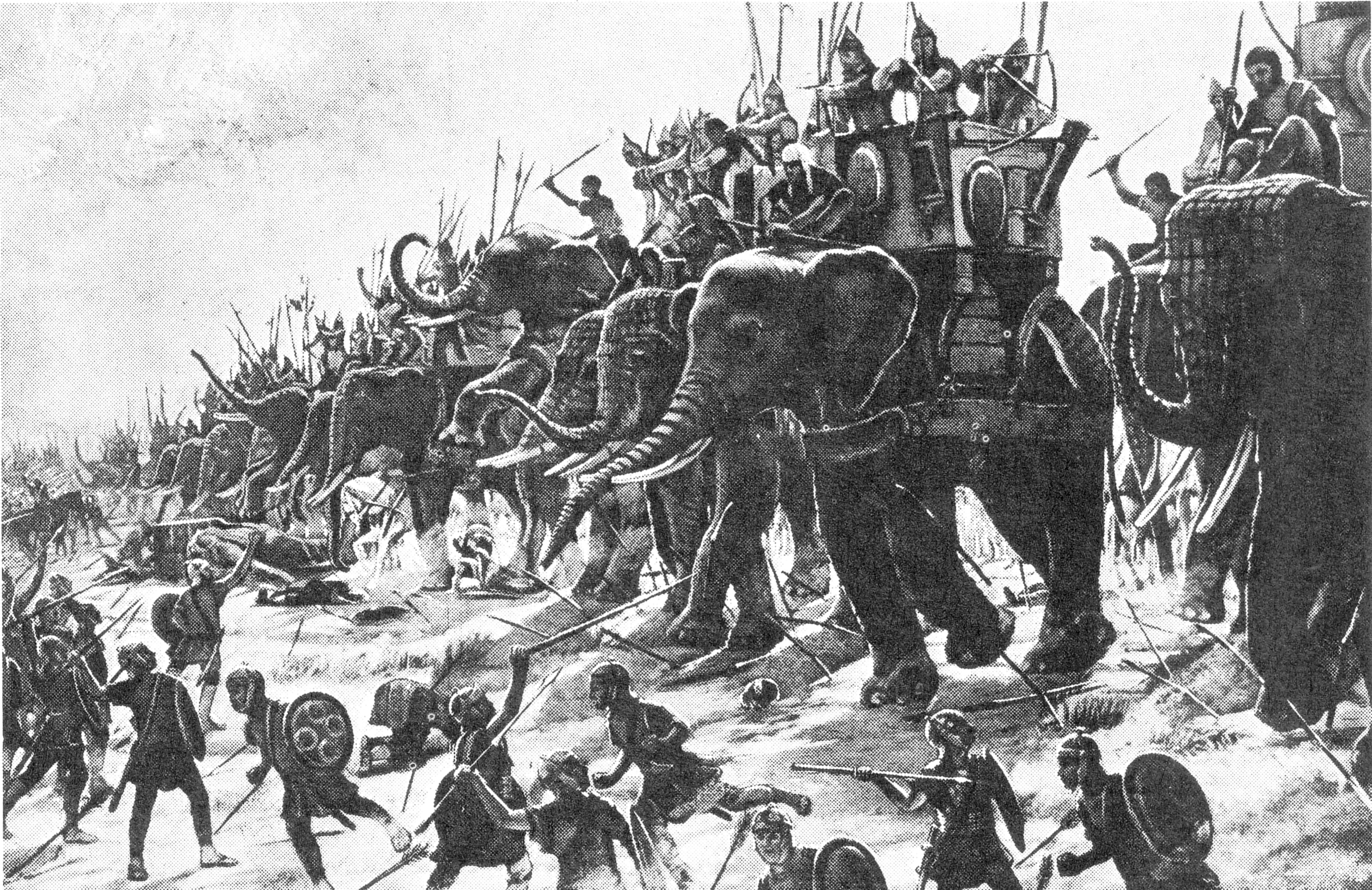
So it is those forest elephants that Hannibal brought with him. They were quite a bit smaller than the savanna elephants of Africa. So artists have, for millennia, exaggerated their size.

Or have they? Generations of boys reading about Hannibal must have imagined them just as the young Roman legionaries perceived them, which is roughly thus:

Responding to my cold reader

At this (quite advanced) stage in the book-publishing process, there is suddenly a lot to do, always urgently and usually without prior notice.

For instance, another dead-tree copy of the manuscript just landed on my desk, marked up in old-fashioned ink. Apparently, the cold reader had had his go.

The cold reader? Who knew? I normally prefer my readers warm.

It appears that Riverhead has sent the manuscript to someone who is anonymous to me (“cold”, I suppose) for perusal. His or her comments were not “large” (about the sweep of the story, or the logic of an argument, say), but very detailed queries about language.

All regular readers of The Hannibal Blog know me as a pedant (or word-lover, to be generous). I am rarely caught out in word matters. But it does happen, and I find that fun.

So here are a few things the cold reader pointed out, and then a few instances in which I overruled him/her.

  1. If something “ascends up to,” it actually simply “ascends to”.
  2. “Aquiline faces” are actually faces with “aquiline noses.”
  3. A “crevice” is not a “crevasse”, and Hannibal in the Alps better have passed the latter, or we would be mighty bored.
  4. “Projecting a perception of invincibility” is simply “projecting invincibility”. (Can’t believe that one happened to me!)
  5. A line of soldiers marching “only a couple of men deep” is actually marching “a couple of men wide.” Duh.
  6. Scipio could not have stood there, “his posture erect and lithe.” No, he stood there, “his posture erect, his body lithe.”
  7. If Scipio and Cato (or whoever) “mixed like oil and water”, then they did not mix, like oil and water.
  8. Being “suspicious” is not the same as being “suspect”. (Duh. Must have been late at night.)
  9. Do I really need to spend hours going through my books to find out whether Lucius was Scipio’s only brother? Oh yes, because, that determines whether it is “his brother Lucius” or “his brother, Lucius”.

Here are a few of the comments I overruled (getting a little frisson out of the STET every time):

  1. No, Meriwether Lewis’s father was not fighting “Native American” tribes. He was fighting “Indian” tribes. It’s about context.
  2. Hannibal might have contemplated a “bold evacuation of Italy.” But he could not have contemplated a “bold evacuation of his troops from Italy.” Why would he want to rip out the innards of his own soldiers?

😉

The threat of the other story

Ferdinand von Schirach

It is extremely difficult — well-nigh impossible — to hate, condemn, or dismiss other people after hearing — really, really hearing — their stories.

This might be one way of summarizing Verbrechen (Crime), a fantastic book I recently finished reading. (It took me only a couple of hours to read, that’s how good it is.)

The author is Ferdinand von Schirach, a criminal-defense lawyer in Berlin who has seen every sort of perversion and gore and weirdness there is. (I read the German version; the English translation is here.)

I won’t go into the stories he tells in his book. They’re short, full of suspense and wonder, and you might want to read the book and be surprised. Suffice it to say that I love this man’s voice. It is masculine and sparse, empathetic, slyly humorous at the right moments, forgiving but not indulgent.

But back to my opening sentence: This post is really about storytelling per se.

Well over a year ago, we discussed “the danger of the single story” — that danger being that incomplete storytelling about a person (ie, stereotyping) robs that person of his dignity.

But it occurred to me that there is also “the danger of the other story“.

That other story is the one that

  • challenges our worldview,
  • shakes our certainty about something,
  • makes us feel uncomfortable.

If we’re suing somebody, it’s that other person’s story. If we’re a certain kind of Turk, it’s the Armenian story. If we’re a rape victim, it’s the story of the one we (wrongly) accused of the rape to feel better. If we are…. (The list of examples goes on forever.)

What’s so “dangerous” about these stories? They destablize us. Once we’ve heard the other story, we have to revisit something, something that we do not want to revisit. Perhaps we have to withdraw a judgment. Perhaps we have to share empathy with somebody, when we really wanted it all to ourselves.

Consider my recent story about an extended family of illegal immigrants from Mexico. Somewhere in the middle of that longish piece, there were a few lines about a trailer that one of the families lived in,

… a trailer in Watsonville, just outside Steinbeck’s home town of Salinas. The trailer is dilapidated, but Ms Vega tends to it lovingly. By the door hangs a picture of the Virgin of Guadalupe, Mexico’s patron saint. There is even a small television set. But the trailer has no air conditioning or heating. On this day, after a downpour, it smells musty….

Then one of the comments caught my eye. The commenter was upset by this detail of the trailer. Why? Because it was the other story. You see, he (or she) does want to talk about trailers. But it has to be his trailer story:

When poor native born Americans are forced to live in trailers, they are dismissed/ignored as trailer park trash. When poor illegals cross into the country to have babies and live in trailers, we write up their sob stories and talk about human suffering. If the author bothers to look, he’d see the tens of millions of wretched poor we already have in the US, living in urban ghettos, trailer parks, rural areas, reservations, their cars, even homeless. Where are their sob stories?

He didn’t actually mean “where are their sob stories?”. For those are everywhere, and the author (ie, me) has “bothered to look.” No, this commenter was really saying: “Why is the other story here instead?” Seeing this story makes it harder to maintain the identity he built on his story. He wanted the circle of empathy, the focus of storytelling, drawn around a tighter group. And so the other story is a threat. He would much prefer it not be told.

Risqué extension to politics and society

We can expand this discussion to reach for a more general insight. The difference between the two dangers — ie, the danger of the single story and the danger of the other story — has something to do with whom each threatens.

  • The single story, by stereotyping, threatens individual dignity. (Even if you stereotype a group, it is its individual members who suffer.)
  • The other story threatens group cohesion.

Now recall my own, personal and amateurish diagram of the political spectrum (which is no more than a doodle to comfort me in my confusion):

Concern for the individual is, on balance, a liberal instinct (if you use the correct definition of liberal).

Conservatives (in the classical, Burkian sense) are more concerned about group cohesion.

Now, based on my experience, there is a natural spectrum among people:

  • Some tend t0 emphasize the danger in the other story, and they tend to be conservative.
  • Others emphasize the danger in the single story, and they tend to be liberal.

The single story is more likely to be what Nietzsche would have called Apollonian: sanitized, reassuring, heroic, morally clear. It might involve flag-waving, or a triumph of the justice system, or our own fight against some outrageous wrong.

The other story is more likely to be messy, dark, weird, morally complicated. It might involve exceptions, outsiders, a failure of the justice system, or our own shortcomings.

(Obviously, nobody is exclusively in one camp or the other. But it is quite rare that a storyteller might give equal emphasis to the single and the other story, as Clint Eastwood did with his double take, one and two, of the battle of Iwo Jima.)

One interesting upshot to contemplate: This might explain why conservatives tend to win propaganda wars against liberals. (In America, for instance, Fox trounces whatever rivals pose as its left-wing analogue.) The reason is that the conservatives pick one single story and rally around it, telling and retelling it until the audience is numb. The liberals try, but fail, to agree on a single story to tell. They cannot help themselves and tell many, many other stories. The conservatives thus rally their troops around a single story; the liberals can’t even get anybody to stand in an orderly line for the battle.

This brings us back to my older thread about Socrates, and in particular why the Athenians felt they had to kill him. In this post, I reflected on how Socrates might have behaved in the famous Asch experiments (about conformism): he would have told the truth every time, thus compromising the coherence of the group. (Here is my somewhat dumbed-down piece in The Economist about this tension.)

In a nutshell: Conservative Athens could tolerate Socrates, who really personified the other story, as long as it was a stable polis. But once the polis came under threat (after losing the war against Sparta and the putsches by Spartan sympathizers), the emphasis shifted to group cohesion and other stories were deemed too dangerous.

If you want to expand your perspective even further, you might contemplate all of Western intellectual history as an awkward tension between the single and the other story: as you recall from this anatomical analogy, one side of the “body” is devoted to each.

Whatever you think about this, don’t jump to the conclusion that I worship one and condemn the other. The truth is that there is a certain masochism in telling other stories.

Which reminds me of something that Ferdinand von Schirach says in the prologue to his great book (and I translate):

I had an uncle who was a judge… [His stories] always began with him saying that “most things are complicated, and guilt is quite a thing.”

One day, after a long life, that uncle went to the woods and blasted his head off with a shotgun.

I have them: title, subtitle & cover

It’s official. Riverhead today sent me the jacket, ie cover, of my book. This is a big moment for a first-time author.

Alas, my editor pleaded with me not to share it with you yet. A big sales conference is about to happen and a catalogue is being made up, and apparently this sort of thing must be sprung upon certain people as a surprise.

But I will blast it out right here as soon as I get the green light.

In the meantime, you might be asking me whether I am happy with the result. I’m almost surprised to say Yes, even on the first go.

I admit that when I first opened the PDF file, I had whiplash. It was not at all what I had expected.

But then my focus groups went to work: wife, parents, agent, agent’s office colleagues….

And I had to agree with them. The cover — think of it as an aesthetic package of words and visuals — is:

  • simple (a prerequisite in my worldview),
  • bold (some people will love it, others will hate it, which is a good thing),
  • playful and tongue-in-cheek (which is important, because it’s an intellectual book, which might turn some readers off).

As my editor said when we discussed it (I made him expound on every single visual element), it comines “vibrant and subtle,” and is Riverhead’s way of saying “big idea.”

As I said to him in return: I was in charge of providing subtlety and nuance and texture between the covers; so I always knew I couldn’t be the one to deliver the direct, right-hook punch on the cover.

___

PS: Does anybody have any views on which WordPress themes are particularly elegant for book authors?

The making of corny subtitles

The Malcolm Gladwell Book Generator may not be uproariously funny, but after clicking through a few iterations I had to concede that it is at least moderately amusing.

The Generator is, of course, a spoof. You start with the cover of Gladwell’s The Tipping Point and then click on Generate New Bestseller. With each new cover, you realize how tritely manipulative the formula is.

Did I say “formula”? Oops. But yes, that’s essentially what it seems to be: the marketing department‘s (as opposed to the author’s) idea of a catchy title and subtitle. As the Generator puts it in one iteration (pictured above):

Subtitles: How Secondary Titles Inflate a Sense of Importance

Now, as it happens, I have been meditating on this subject in recent weeks because I am, right now, in the process of finalizing a title and subtitle for my own forthcoming book.

We seem to have decided on a title (which I will announce as soon as it is official), but we’re still bouncing subtitles back and forth.

Who is “we”?  Well, we includes me, of course, and my agent, and my editor at Riverhead, and the marketing and publicity departments at Penguin (which owns Riverhead), and possibly lots of other people. Lots of folks in lots of meetings, in other words. Meetings that I don’t get to sit in.

The result is quite interesting. Each “faction”, if I may call it that, seems to have a very different sense of linguistic aesthetics. Or possibly a different sense of strategic objective.

For the record, I am not slagging off the marketing folks — they’re bringing a vital perspective to this, and their suggestions have been good. But authors and marketers do appear to perceive the effects of word combinations in different ways.

So one might speculate, while browsing a book store, which side prevailed in which Title/Subtitle decision on display. There are fantastic titles and subtitles out there. And there are the others.

_____

Click on the links below* for my other posts on: