What Mendel tells us about thinking

Find quietude. Observe whatever is around you. If it seems banal, discover it to be fascinating and mysterious. Ignore distractions, otherwise known as ‘everybody else’. Ask simple questions that puzzle you. Be patient in pondering them.

That is how I imagine Gregor Mendel might answer us today if we asked him: How  — I mean how! — did you achieve your stunning intellectual breakthroughs, on which we today base our understanding of biology?

Put differently: Let’s pretend that Gregor Mendel were alive today instead of in the 19th century, and that he were not an Augustinian monk in the former Austrian Empire but a wired and connected, über-productive modern man with an iPhone, a Twitter account, cable television, a job with bosses who email him on the weekend, etc etc.

Would this modern Mendel be able to achieve his own breakthrough in those circumstances?

So far in my rather long-running thread about the greatest thinkers in history, I’ve featured mostly philosophers and historians, with the odd scientist and even one yogi. But it occurred to me that Mendel belongs into that pantheon — not only for his thought but also for his thinking. I think he offers us a timely life-style lesson, an insight that fits the Zeitgeist of our hectic age.

So: First, a brief recap of his breakthrough. Then my interpretation how his life style and thought process made that breakthrough possible (and why ours might make such breakthroughs harder).

1) Mendelian genetics

Mendel was an Augustinian monk in what used to the Austrian Empire (and what is now the Czech Republic). He had an open and inquisitive mind and, as a monk, wasn’t all that busy, so he had plenty of spare time. He liked to breed bees. Then he began breeding peas. That’s right. Peas.

Peas intrigued him. (Would they intrigue you? What else does not intrigue you?) He found peas interesting because they had flowers that were either white or purple and never anything else. (Would you find that interesting?)

Mendel contemplated what peas could therefore teach him about how parents pass on traits to their offspring, ie what we would call genetics.

At the time, conventional wisdom held that the traits of parents are somehow mixed in their children. If parents were paint buckets, say, then a yellow dad and a blue mom would make a green baby bucket, and so on. (It’s interesting that nobody spotted how implausible this was: After several generations every bucket, ie every living thing, would have to end up mud-brown. Every creature would look the same. Instead, nature is constantly getting more colorfol, more diverse, with more and stranger new species.)

So Mendel, in the late 1850s and early 1860s, started playing with his peas. Pea plants fertilize themselves, so Mendel cut off the stamens of some so that they could no longer do that. Then he used a little brush and fertilized the castrated pea plant with pollen from some other pea plant. He thereby had total control over who was dad and who was mom.

He was now able to cross-breed the peas with purple flowers and the peas with white flowers. So he did. Then he waited.

Surprise #1:

Already in the next generation, Mendel could rule out the prevailing “paint-bucket-mixing” theory. No baby pea plants had lighter purple (or striped or dotted) flowers. Instead they all had purple flowers.

So he took those new purple-flowered pea plants and cross-bred them again. And again, he waited.

Surprise #2:

In the next generation, most pea plants again had purple flowers. But some now had white flowers. Wow! How did that happen?

Moreover, the ratio in this generation between purple and white flowers was exactly 3:1. Hmm.

Mendel kept doing these experiments, and kept thinking, and then inferred the simple but shocking conclusion:

  1. Each parent had to be contributing its version of a given trait (white vs purple, say) to the offspring.
  2. Each baby thus had to have both versions of every trait, but showed in its own appearance only one version, which had to be dominant.
  3. The other (“recessive“) version, however, did not go away, and when these pea plants had sex again, they shuffled the two versions and randomly passed one on to their offspring (with the other coming from the other parent), so that their baby again had two versions.

This looks as follows:

In the second generation, every pea plant has a purple (red, in this picture) and a white version, one from each parent, but since the purple is dominant, every flower looks purple.

In the next generation,

  • one fourth will have a purple from dad and a purple from mom (and look purple),
  • one fourth will have a purple from dad and a white from mom (and still look purple),
  • one fourth will have a white from dad and a purple from mom (and still look purple), and
  • one fourth will have a white from dad and a white from mom (and look white).

The rest, you might say, is history. With all our amazing breakthroughs in biology in the 20th century, we merely elaborated on his insights, in the process explaining the mechanism of evolution (Darwin, coming up with that idea at the same exact time, had no knowledge of Mendel’s breakthrough.)

In today’s language, Mendel

  • showed the difference between genotype and phenotype. (Your genotype might be white/purple, for example, but your phenotype would be purple.)
  • understood the basic idea of meiosis (the division of a cell into two haploid gametes — a sperm cell or egg with half of the mother cell’s chromosomes, randomly chosen),
  • described how two gametes then merge sexually to form a diploid zygote (ie, a cell with all chromosome paired up again, one member of each pair coming from each parent),
  • explained how some versions of the gene pairs, called alleles (such as purple or white), are expressed and some not, even as those not expressed can re-emerge in the phenotype in the next generation.

DNA, RNA, ribosomes and all that were merely detail.

2) How was it possible?

Let’s make ourselves aware, first, of what it must have been like for Mendel during these years (this is purely conjecture):

  • He got up.
  • He prayed.
  • Had breakfast.
  • Went into the garden.
  • Looked at the pea flowers for a long time.
  • Watered them.
  • Took a break.
  • Watched the peas some more.
  • Thought about them.
  • Dozed off for a nap.
  • Woke up and had an idea, still inchoate in his mind.
  • Went to bed.
  • Thought about it some more….

You get the idea. Not exactly stressful. Few interruptions. Lots of waiting (how long is one generation of peas anyway?).

He was, we would say, switched off. He was not multi-tasking, he did not have adrenaline coursing through his veins as he answered a text message while watching a video stream while writing a Powerpoint …

Compare his time with his pea plants to Einstein‘s time at the Bern patent office, where he was utterly underemployed and could easily have been bored, but instead did thought experiments and had his “miracle year”.

Or compare it to Isaac Newton‘s time after had to leave the action of Cambridge (because plague broke out) and returned to the isolation of his family farm with nothing to do except watch apples drop from trees….

Or compare it to the time when Gautama Siddhartha (aka the Buddha) withdrew from all action and sat, just sat, under a tree, with the birds pooping on his head until there was a pile of guano on his hair, with his flesh melting from his bones because he was too deep in concentration to eat…..

Lesson #1:

Good stuff can happen during downtime (even if you didn’t volunteer for it).

Corollary: Can good stuff happen during uptime? You may have to take time out to be creative.

Lesson #2:

Be amazed.

Corollary: Don’t assume the things and people in your daily life are boring.

Lesson #3:

Turn the devices off.

Corollary: Distraction not only kills people, it also kills thought.

Lesson #4:

Be patient.

Corollary: You can’t breed peas in internet time. Nor novels, scripts, songs, paintings…

Lesson #5:

Look for the simple.

Corollary: The more bewildering the complexity observed, the simpler the solution.

(See also: Gordian knot.)

Lesson #6:

It doesn’t have to be complete to be original.

Corollary: It took us a century to explain the process Mendel grasped; an idea is good even if it “merely” starts something.

(See also: Incompleteness theorem. Mr Crotchety’s favorite — need I say more?)

Lesson #7:

Don’t expect the world to get it right away.

Corollary: If it took us a century to understand Mendel’s breakthrough, we might take a while even for yours. 😉

The natural-length revolution in books

Short text, tablet edition

I”ve long been predicting that the main effect of the digital revolution on writing and reading has to do with word count. Put differently, it has to do with the length of texts.

Yesterday, I saw my vision starting to become reality.

But first let me explain why word count/length are so important to literary culture, and why length is at present often distorted.

As music went….

In this post, I’ve ruminated on the imperative of writing to the optimal word count — that is, writing neither too long nor too short.

To use the imperfect analogy of music: Beethoven shouldn’t have been forced to shorten his Fifth to the length of the Rolling Stones’s Brown Sugar, nor the Stones to lengthen Brown Sugar to equal the duration of the Fifth. Each work of art has to be true to itself, which means that each has its own optimal length.

For many years, that presented a packaging problem in music. It made no sense for an orchestra and an audience to gather for only a few minutes. And it made little sense to manufacture and sell vinyl discs that contained only a few minutes of music. So the emphasis was on longer forms of music, or on collections of short pieces — albums, not singles.

But as soon as music migrated from analog to digital media, that packaging distortion disappeared. So now music has been “liberated”. Each artist can compose at optimal length. (Where the medium is still analog, as in a live performance, there is still a preference for greater length.)

… so will text

Text has been far behind the curve. Yes, the digital media have already resuscitated ancient short-form traditions such as haikus, sonnets and aphorisms, in the form of Tweets and blogs. But the dominant medium for the written word is still the printed book. And analog books present the ultimate packaging problem.

Hence the pernicious and pervasive bias toward unnecessary length.

An adult book, especially non-fiction, that is as thin as a baby book looks stupid. No self-respecting publisher, and no author, would touch it. Hence publishers demand that authors pad their ideas to reach a minimum word count. A 30,000-word idea has to be packaged as an 80,000-word book.

This

  • delays the process of writing and publishing and
  • means that most readers only read a small part of most (non-fiction) books.

Bookshelves everywhere are groaning under the weight of unread words. What a waste.

Enter the Kindle Single

Digital books (on Kindles, iPads, iPhones etc.) will change all that. Suddenly, a “book” (shall we still call it that?) no longer looks stupid if it is short. As many Kindle readers have pointed out, one has no sense of length on a Kindle anyway.

And thus Amazon, shrewdly, has launched Kindle Singles, in direct allusion to the music analogy above. As music was liberated from length distortions, so text will be.

This really sank in yesterday when I got an email from Chris Anderson, the “curator” (a title I find a tad pompous) of TED. (That’s an upmarket conference that would like to be a social network. I’ve attended, hence I’m on the email list.) In it, Anderson announced that “TED Books” are now being sold as Kindle Singles. I just bought my first one.

TED Books, he writes, are

to Books as TED Talks are to lectures. They’re short, pithy, riveting. They’re designed to express a single big idea in a way that can be absorbed in a single sitting. A typical 18-minute TED Talk might be around 2000 words. A typical traditional book is at least 60,000 words. TED Books nicely fill the gap in between. They come in at 10,000-20,000 words. So they can be read and absorbed in an hour or two.

So there you have it: the length distortion has disappeared. More interesting is how Anderson talked about that distortion:

Many people are hungry to learn, but have limited time to read full-length books. TED Books offer an exciting new alternative. And it also will allow many brilliant thinkers who don’t have a spare year to author a full-length book (and another year to wait while that book gets published) to nonetheless get their ideas out in the world….

I highlighted that phrase because, as you may remember, I took about one year to write my book, and have been waiting almost two years now for the publication process to kick off in earnest. (It has indeed kicked off: publication is slated for the fall, and my publisher is suddenly very busy.)

My point is that this process, which all publishers today share, makes no sense to a logical alien visiting earth, or to anybody under thirty. This is why the publishing industry will (not might, but will) be disrupted.

As TED’s Anderson puts it,

the world of serious reading is undergoing a revolution. Suddenly it’s possible to carry around a whole library in your coat-pocket. Suddenly, books don’t have to be 200 or 300 pages long so that they feel substantial in printed form. Any length is possible. And that was the breakthrough for us. We’ve seen from TED Talks the power of giving speakers a time constraint. It’s been an amazing instance of “less is more”…

You are what you speak

Apropos of my previous post about corrupting language to fake a sense of community: A colleague of mine at The Economist, Lane Greene, is about to publish a book (on March 8th), which goes much deeper into this subject.

Lane emailed me that You are What you Speak is

a lot about the role language (the creation of modern standard languages) plays in imagining communities…

More formally, his book flap says:

Beginning with literal myths, from the Tower of Babel to the bloody origins of the word “shibboleth,” Greene shows how language “experts” went from myth-making to rule-making and from building cohesive communities to building modern nations. From the notion of one language’s superiority to the common perception that phrases like “It’s me” are “bad English,” linguistic beliefs too often define “us” and distance “them,” supporting class, ethnic, or national prejudices. In short: What we hear about language is often really about the politics of identity…

The flap goes on. Lane then emailed me:

… boiled down, how’s this? “We believe a lot of myths about language, and we’ll learn to love our languages even better when we learn where those myths come from, and get past them…”

I think that sounds pretty damn fascinating, so I’ve pre-ordered the book.

And of course I’m smirking because all this “versioning anxiety” between flap texts and nut grafs (I had asked him for one) and elevator pitches will soon overwhelm and torment me, as I prepare to publish my own book in the fall.

Society masquerading as community

The word community is in danger of overuse by the politically correct jargon crowd.

(It thus joins a long and growing list of words that were once beautiful and powerful but have now been neutered. See: passionate and sustainable.)

This has consequences. The resulting loss of meaning certainly reflects but might even exacerbate the common modern feeling of alienation.

First, here is what our (The Economist‘s) Style Guide says about the word:

Community is a useful word [in some contexts] but in many others it jars. Not only is it often unnecessary, it purports to convey a sense of togetherness that may well not exist. The black community means blacks, the business community means businessmen (who are supposed to be competing, not colluding), the homosexual community means homosexuals, or gays, the intelligence community means spies…. the international community, if it means anything, means other countries [or] aid agencies … What the global community means is a mystery….

I would go even further. A real community is an almost-biological thing: human beings living together closely and with a shared fate that binds them, whether they love one another or not. For context, you might rank human groupings in this order:

  1. Family
  2. Clan
  3. Community

I’ve posted, in other contexts, about Robin Dunbar’s hypothesis that there is a cognitive limit to the size of primate communities, which for our species is about 150. I think that’s just about right.

Beyond that, you don’t have communities. At best you have societies. That’s when humans agree to cohabit a physical or abstract space with other people, most of whom are total strangers, by agreeing to certain rules.

Because people typically are not happy living as unconnected atoms in such a society (ie, because they feel alienated), they will be psychologically tempted to fudge.

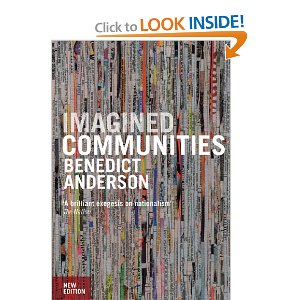
They will, in the famous words of Benedict Anderson in this classic of International Relations, imagine communities where none exists. (Perhaps project is a better word.) This is often called

nationalism.

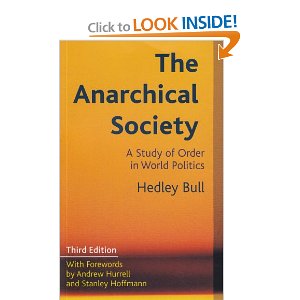
Beyond such national or ethnic societies, you might merely have systems, as in the international system. That is the witty meaning built into the title of another classic of International Relations, Hedley Bull’s The Anarchical Society.

Within a nation (unless it is a failed state), somebody has a monopoly on legitimate violence, in order to enforce rules, and that provides order. In the absence of such a monopoly (as in the international system), you get anarchy, so you need a different way of achieving order (a balance of powers, for example).

In any case, I can’t help but wonder whether all these mentions of communities that I constantly hear might not reflect a profound and unsatisfied yearning. We yearn for that sense of togetherness which is so often just not there.

John and Hannibal, respective favorites

There on the left you see John. He baptized people.
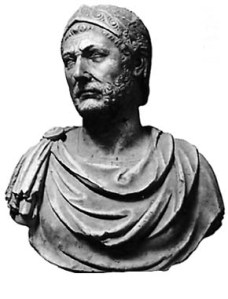
And on the right you see Hannibal. He vanquished Romans.

John is not in my book, whereas Hannibal is its main character, but that’s neither here nor there.

I just figured out a rather exciting linguistic connection between their names. (“Exciting”, that is, if you’re a language geek.)

Background:

John comes, via Indo-European Greek and Latin, from either the (Semitic) Hebrew Yochanan or the (equally Semitic) Aramaic Youhanna. That origin is clearer in some other European languages, such as German Johann/Johannes.

And Hannibal is our transliteration of HNB’L, a Punic word. Punic was a Roman mispronunciation of Phoenician. It was the language of Carthage and of Phoenicia, and thus also Semitic.

I’ve already posted about the close family connections between Punic, Hebrew, Arabic, Aramaic and other Semitic languages, by using Hannibal’s family name, Barca, as the example. The relationship is as close as that between, say, Dutch, German and Danish, or between Spanish, Italian and Rumanian.

Favor and the gods

Now to the meaning of the two names:

According to Luke 1, 13, the angel Gabriel visited Zechariah and told him that his old and infertile wife would bear him a son and that “you shall name him John” (ie, Youhanna).

The footnote in my bible says:

The name means “Yahweh has shown favor,” an indication of John’s role in salvation history.

So:

Ba'al

YOU ≡ Yahweh

and

HANNA ≡ Favor

As in: Yahweh’s favor.

In Hannibal’s case,

HANN(I) ≡ Favor

and

BAL ≡ Baal

That’s Baal (or Ba’al) as in the god that Yahweh is so jealous of in the Old Testament, because he’s one of those Semitic deities so popular in Canaan, where both Phoenicians and Jews lived.

So John was favored by one, Hannibal by the other. Name is destiny. 😉

Attack as response to failure

Instantly notorious

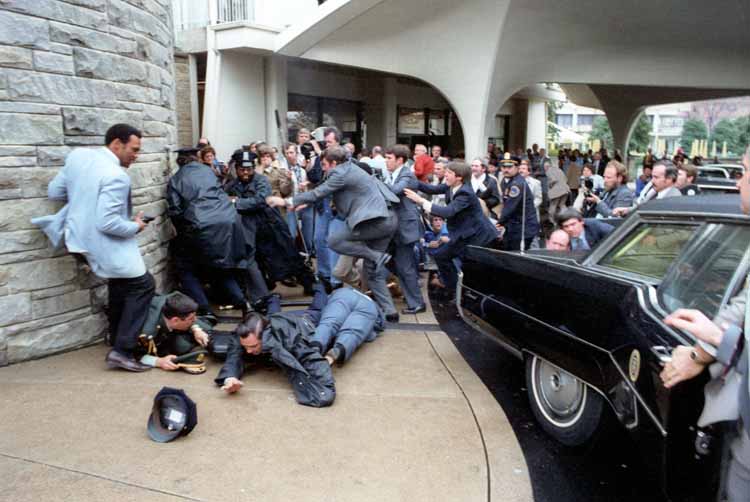
Jared Loughner may not be “crazy” or irrational at all. He might instead be utterly typical of people who attack politicians: For most of them, the notoriety that comes with such an attack, whether it ends in assassination or not, is a perceived solution to a specific psychological problem.

And that problem is the feeling of invisibility or anonymity that often follows failure.

This, at least, is the upshot of this story on NPR, which in turn refers to this study from 1999 in the Journal of Forensic Sciences. (Lainey, in a comment under the previous post, linked to a Wired article quoting the same report.)

That study examined the 83 people who had attacked public officials between 1949 and 1999, and found that the attackers

  • almost never had political reasons
  • had often experienced a big failure or reversal in the year before the attack,
  • often felt invisible as a result,
  • didn’t want to be “non-entities” or “nobodies”,
  • and saw the notoriety of being an assassin as the solution.

As one would expect from such a profile, the attackers often did not target one particular politician (as an attacker with political motives would), but first decided to attack, then searched for a target. To quote from the report,

assassins are basically murderers in search of a cause

Failure is, of course, one of the twin topics of my forthcoming book, the other twin being success. This, I must say, is a response to failure that had never occurred to me before. The more one learns about the human psyche, the more mysterious it becomes in its nether depths.

Gabrielle Giffords, American Gracchus

Gaius Gracchus

The Roman republic was 375 years old — more than 1½ times as old as the American republic is today — when, in 133 BCE, something unprecedented and indeed hitherto unimaginable occurred: domestic political violence.

A populist politician had got himself elected tribune by the citizens of Rome, in exactly the sort of democratic process that Rome was proud of. His name was Tiberius Gracchus, and he was ambitious, idealistic and perhaps somewhat naive. (He was also the grandson of my hero, Scipio Africanus, the nemesis of Hannibal.) This elder Gracchus — he had a younger brother named Gaius — then proposed reforms to improve the lot of the people. Many patricians in the Roman Senate did not like that.

It had never, up to this point, mattered that Senators and Tribunes, plebeians and patricians, Optimates and Populares (those were the names of Rome’s political factions) disagreed on matters of policy.

Of course they disagreed! Peaceful disagreement, in which the more persuasive arguments prevailed over time, was what the Roman republic was about. It was the reason Romans loved Rome.

Rome had withstood existential threats — a sack by the Gauls, near-extinction by Hannibal — without ever sacrificing its founding ideals: inside the city walls, there was no place for violence in politics.

But on that day in 133 BCE, a group of senators and their supporters made their way toward a popular assembly in progress. They beat Tiberius Gracchus and his supporters to death.

Yes, Rome was shocked. Of course it was. This incident had to be an outlier. The exception that proved the rule.

But it seems that a taboo had been broken, a precedent set. Something unthinkable had become thinkable: Political violence.

A decade after Tiberius’s murder, Gaius Gracchus (pictured above) followed in his brother’s footsteps. He, too, got himself elected tribune. He, too, intended to launch reforms.

And again, a mob of senators and their supporters came for him. Gaius fled to a grove and killed himself, as the attackers murdered his supporters.

Another outlier, they told themselves. An exception. Never to be repeated.

And yet, it was repeated. Over the next century the Romans — a people always well-armed, often for the right reasons — began flashing blades to intimidate other Romans in any disagreement. The tone of debate changed. The incidents of political violence became more frequent, and worse.

A taboo once toppled is difficult to re-erect.

Marius, Sulla, Pompey, the Caesars….

Violence, or the threat of it, now prevailed in Rome.

Rome would remain a superpower for much longer. But no longer a republic. Not the Rome that the likes of Scipio Africanus had ever fought for. Not the Rome they considered worth preserving and defending.