Original + unique = some failure

Neil Simon

Neil Simon

Interesting two-punch quotes about success and failure, the topic of my forthcoming book, in today’s New York Times.

The “quotation of the week” is by Neil Simon, one of the most successful playwrights, whose play Brighton Beach Memoirs nonetheless turned out to be one of the biggest flops in Broadway history and closed after one week:

I’m dumbfounded. After all these years, I still don’t get how Broadway works, or what to make of our culture.

Katzenberg

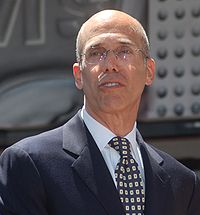
Jeffrey Katzenberg

Elsewhere in the paper, they interview Jeffrey Katzenberg, a very successful film producer, formerly at Walt Disney (Shrek, etc) and now at his own DreamWorks Animation:

In order to succeed at the high end of the movie business, you must be original and unique. Now if you were putting an equation up on the white board and you wrote “original + unique = what?” Then the answer would have to be “risky.” And if you said, “risky = what?” The answer would be “some failure.” It has to, by definition, just sort of in the most fundamental way.

Obviously, this applies not just to film-making or Broadway but also to (ahem) writing–a blog, an article in The Economist, a book. And to war (Hannibal and Scipio). And to love. And to science. And to …. life.

Kipling’s impostors are hiding in plain view, as it were.


Bookmark and Share

How crisis leads to progress (aka the Cloud)

[picapp src=”a/0/e/0/d5.jpg?adImageId=7132613&imageId=2039813″ width=”500″ height=”351″ /]

Here is an admittedly tiny and prosaic example of a big and poetic idea–the idea in Kipling’s If and in my book that disaster can be an impostor (as can triumph). The disaster in this case is more of a nuisance, but you will get the point.

1) The nuisance

My (youngish) Mac Book Pro has had a boo-boo. The screen started going black (why do “screens of death” have to be blue anyway?).

I happen to be in the Apple elite, equipped with all sorts of plastic cards (Apple Care, Pro Care….) that allegedly bestow privilege upon me. So I went to the Apple Store, itself famous for allegedly being at the cutting edge of retail savoir-faire, to get the laptop fixed. I brandished my cards and, after a stressful wait, succeeded in persuading a helpful staff member to …. schedule an appointment, two days hence, for me to come back and get my laptop fixed.

Two days later, I dutifully returned (traffic, parking garages….) to the famous store. Another stressful wait. Somebody took my laptop. The next day, they called to say that they needed another part (the RAM). They called again two days later to say that they needed yet another part (the logic board). Then they left a voice mail (Apple’s iPhone, which I also own, had not rung as it ought to when a call comes in) to say that it would be faster (sic) to send the laptop to a distant part of the country where logic boards are more plentiful, but that they needed my approval. I called back, but they had left for the day.

I called again the next day–at 10AM, when they start work–and gave my approval. The laptop, I was told, would now be en route “from 5 to 7 days”. This was 5 days after my original visit to the famous store with my fancy cards. My lap has been, and remains, untopped.

2) Why I expected this to be a big deal

I am a nomadic worker, and my laptop in effect is my yurt, or office, and thus one of the two West Coast Bureaus of The Economist (the other bureau being the laptop of Martin Giles in San Francisco, who replaced me in my previous beat). So I assumed that no laptop meant no bureau, no articles, no work. I assumed this because this was my experience in 2005, when another laptop of mine died.

300px-Cloud_computing

3) Why it’s not

But things have changed since 2005. Something called “cloud computing” has come along, diagrammed above. It’s an old idea newly implemented: that information and intelligence reside in the network, to be accessed by “appliances” or “terminals” which we nowadays call web browsers. If you use web mail, Facebook, WordPress, Flickr, YouTube etc etc then you are computing in the cloud. You are not longer storing and crunching data in the machine on your lap. Instead, you are doing it on the internet.

After my previous laptop disaster in 2005, I began to train myself (I am a technophobe by nature) to start using the internet instead of perishable machines. Gmail, Google Calendar (which I share with my wife and a few other people), Google Reader, Facebook, and so forth.

Slowly, I started migrating more and more activities into the cloud. This was slow because of inertia. But I kept at it. My phones (Skype and Google Voice) are now online, as are many of my photos.

So it occurred to me, before going back to the Apple Store, to complete this process. I put all of my current or important documents on Google Docs. This was surprisingly quick and easy. I had never understood why I was using Microsoft Office in the first place, since it was bursting with features that I never use and that confuse me.

Now, instead of emailing my editor a Word doc, I “share” a Google Doc with him.

So now my digital life is entirely in the cloud. As some of you have noticed, even though I have not had my laptop, I have been “on”. Nothing has changed. I use my wife’s laptop, or somebody else’s, or my iPhone, which is almost as good. I no longer really care about my laptop.

4) Progress = Bye bye, Steve, bye bye Bill

At some point, I may yet get my snazzy Mac Book Pro back from this famous Apple Store. Will I care? Enough to go to the store one more time to pick it up. Barely.

The truth is that this slight nuisance, this mini-crisis, nudged me to do what I should have done long ago. It forced me to liberate myself from Microsoft’s software and Apple’s hardware, neither of which I need any longer. Yes, there are some new vulnerabilities (there always are). But I am, if not free, a lot freer.

Bookmark and Share

The “heart” of the Western Tradition: Dante

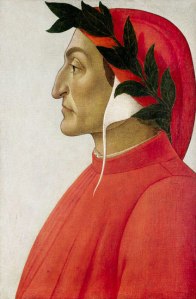
Dante

Nudged by Cheri, I’m re-reading Dante’s Inferno right now on my Kindle. Reading Dante is always a good idea.

The Inferno, or Hell, is the most gripping of the three parts of Dante’s epic Divine Comedy–the more boring parts being Purgatory and Paradise. (And isn’t that interesting, by the way: As every journalist and writer knows, the awful makes for an infinitely better story than the hunky-dory.)

But in this post I want to make a different, more historical, point about Dante: He may just be the single best illustration of a metaphor I told you about last year to explain–really, really explain–the entire Western Tradition.

To recap that post very briefly: You can think of “Western culture” as a human body.

  • The left leg is ancient Athens and Rome, Socrates and Aristotle;
  • the right leg is Jerusalem and the Bible, Moses and Jesus;
  • the crotch is the end of the Roman empire when the two “legs” met;
  • the torso is the Middle Ages, when the two traditions became one;
  • the left arm is the Renaissance;
  • the right arm is the Reformation;
  • the neck is the Enlightenment; and
  • the head is us, ie modernity.

(The metaphor, which comes from Professor Phillip Cary, is more subtle, so please read the older post.)

So where does Dante fit in?

Well, he was a product of the Middle Ages, located in the “torso” just below the left arm pit, where the Renaissance was to begin. The Renaissance, or “left arm”, in this analogy, was to be Petrarch, a fellow Tuscan and co-founder, with Dante, of the “Italian” language.

You see this all through the Inferno: the surprising and constant mixture of Athens/Rome and Jerusalem, of the (pagan) classics and the Judeo-Christian, Bible-thumping fire and brimstone, so that the two legacies merge to form a new and distinct tradition, as two haploid gametes unite to make a new, diploid human being.

The overall structure, both narrative and psychological, is, of course, Biblical: We are in Hell, after all. (The ancients did not have Hell, a place where we are punished for our sins. They only had a boring and gloomy place named Hades.)

But look who guides Dante through this Hell: It is Virgil, the greatest of the Roman poets, who told of brave Aeneas surviving the sack of Troy and founding the Roman nation. Dante can think of no one nobler, and yet Virgil is a pagan, so Dante meets him, along with Homer, Horace and the other ancient greats, in the first circle of Hell. Relatively un-dreadful, this circle is the limbo where those hang out who were unlucky enough to live before there was a Christianity to be baptized into.

Together, Virgil and Dante then descend deeper and deeper, from one circle to the next, to witness the torments of the sinners increasing with the vileness of their sin. But again, look whom they encounter:

  • Cerberus, the three-headed dog who guarded Hades (although Dante describes him slightly differently),
  • Charon, the ferryman who brought the dead souls across the river Styx for their final destination in Hades,
  • Centaurs, half men and half horses, who caused mischief in the Greek myths,
  • even historical characters such as Alexander the Great, whom we meet boiling in a river of blood in return for the blood that he spilled. (Hannibal must have been floating nearby.)

On and on. Virgil and Dante casually discuss things such as “your ethics”, which is assumed to mean Aristotle’s Ethics (the only text on ethics that the medievals had recourse too).

This, then, was the torso just before Petrarch emphasized its left (humanist, classical) side, thus launching the Renaissance and eventually provoking others to raise the right (Protestant, then counter-Reformationist) arm.

Located just below the left arm pit of the Western Tradition, Dante was thus … its heart!

Bookmark and Share

Inspiration in a baton, a helmet, a sword …

445px-der_mann_mit_dem_goldhelm

In January I recommended to you a talk at Google’s Zeitgeist Conference that I had attended. It was by Itay Talgam, an Israeli conductor who asks us to see in the styles of the great conductors (Karajan, Kleiber, Muti, Bernstein…) the dos and don’ts of leadership, the ways to elicit or inhibit the creativity and collaboration of individuals in a group.

Talgam can make us see in a conductor’s manner of holding a baton our own experience as, or with, leaders.

He has now given essentially the same talk again at TED. (If I may observe: TED, Zeitgeist and Poptech, who are rivals, are essentially the same conference these days. As soon as a speaker does well in one, the other two pick him up too.)

So why would I recommend Talgam … again? Because his talk is so incredibly good! So watch all 20 minutes of it, below.

But I’d also like to make another point, one that might seem oblique. One thing I like about Talgam’s approach is that he draws from one area of life (orchestra music) and role (conductor) to inform another area of life (business) and role (boss).

In my very humble way, I try to do the same thing. When I think about writing, I like to think about painting–the way Rembrandt uses color so sparingly and thus effectively, for instance. I see in the highlights of a helmet the touches of good storytelling.

And in my forthcoming book, I take the story of Hannibal, Fabius and Scipio, whose role was commander and whose context was war–the sword, if you will–and I extend it to sex, science, business, sports, exploration, art, politics and intellect–and the ways we succeed and fail in them.

Sometimes, when I give my “elevator pitch” (ie, the book idea compressed into a sentence or two) I get blank stares. I imagine that Talgam does, too. But then I watch Talgam’s talk, and I leaf through my manuscript, and I realize that this … works!

Bookmark and Share

Hayek on healthcare: Don’t be serfs, Americans!

Hayek

Hayek

I’ve only mentioned Friedrich von Hayek tangentially on The Hannibal Blog so far, although he probably deserves his own post in my great-thinker series quite soon. Hayek was one of the great liberals, properly defined. He was close intellectually and personally to my great-uncle Ludwig Erhard. His book The Road to Serfdom should be required reading.

So I was glad to see Andrew Sullivan revisit The Road to Serfdom to see whether Hayek addressed the topic of health care that so captivates America these days. Hayek did, it turns out, and I had forgotten.

(Recall that I, also with classical liberal instincts, concluded, in my amateurish way, that health care is different enough from other industries to warrant one of two clean and equally acceptable solutions: universal private insurance or universal government–ie, “single-payer” insurance. Anything, in short, but America’s current, fragmented, employer-government-individual hodgepodge.)

Here is Hayek, from Chapter 9 of The Road to Serfdom, via Andrew:

Nor is there any reason why the state should not assist the individuals in providing for those common hazards of life against which, because of their uncertainty, few individuals can make adequate provision…. Where, as in the case of sickness and accident, neither the desire to avoid such calamities nor the efforts to overcome their consequences are as a rule weakened by the provision of assistance – where, in short, we deal with genuinely insurable risks – the case for the state’s helping to organize a comprehensive system of social insurance is very strong… Wherever communal action can mitigate disasters against which the individual can neither attempt to guard himself nor make the provision for the consequences, such communal action should undoubtedly be taken.


Bookmark and Share

Schwarzenegger’s revanchist word game

[picapp src=”2/d/4/4/The_2009_Womens_8b22.jpg?adImageId=6962167&imageId=6924971″ width=”234″ height=”352″ /]

The following letter by Arnold Schwarzenegger, governor of California, to the State Assembly would not seem to make for exciting reading. But that’s if you read it conventionally–ie, horizontally.

What if you read vertically? Could it be that the gubernator, cigar-chomping cad and prankster that he is, has had a bit of fun?

Tim Redmond spotted the hidden code. See if you find it:

1027arnold

[picapp src=”1/6/d/7/Gov_Schwarzenegger_Addresses_4e56.jpg?adImageId=6962178&imageId=4919912″ width=”234″ height=”351″ /]

For background, AB 1176 was a bill by Tom Ammiano of San Francisco about infrastructure or something boring of that sort. The same Tom Ammiano recently did a reverse Joe Wilson and yelled “You lie” at Schwarzenegger, when the Republican governor had the audacity to drop in on a meeting of Democrats in a San Francsico ballroom. Ammiano then stormed out, yelling “Kiss my gay ass.”

So now Schwarzenegger is having a bit of revanchist fun. All in good humor, if you ask me. It is a sign of the unshophisticated mind to get squeamish about this sort of thing. Ammiano himself is probably laughing loudest.

If you have not already spotted it, here is the hint:

1027fu


Bookmark and Share

The veil of ignorance: great thought experiment

John Rawls

John Rawls

What if we could get together to form a new kind of society … and we did not even know who we would be in that society?

This is a famous thought experiment, proposed by the Harvard philosopher John Rawls in his 1971 book, Theory of Justice.

Rawls was trying to justify democracy as fair as opposed to merely utilitarian (ie, “the greatest good of the greatest number”). How would we go about deciding what is fair? By imagining a situation that has never existed, and indeed can never exist.

Rawls called that situation the “original position”:

No one knows his place in society, his class position or social status, nor does anyone know his fortune in the distribution of natural assets and abilities, his intelligence, strength, and the like. I shall even assume that the parties do not know their conceptions of the good or their special psychological propensities. The principles of justice are chosen behind a veil of ignorance.

You have probably already grasped the power of the experiment. Normally, we think of justice with ourselves in mind. A single black mom in a public-housing project will have a very different view than a start-up entrepreneur in Silicon Valley or a trustafarian in prep school or a prisoner or …. you get the point.

But if we don’t know whether we will be tall or short, male or female, smart or dumb, lazy or ambitious and all the rest of it, we have to test every principle against the possibility that we might be the least advantaged member of society with respect to it.

A simple example: Slavery in 19th-century America.

Slave owners considered America free and fair and were prepared to go to war for that “freedom”. That’s because the slave owners assumed that they were, well, slave owners. Using purely utilitarian reasoning, they might have concluded that slavery produced the maximum pleasure of the greatest number of people (ie, the white majority) and was therefore right.

But if they had played Rawls’ thought experiment, they would have had to imagine that they might instead be slaves. Suddenly, slavery no longer looks so good.

Getting liberté, egalité, fraternité onto one flag

756px-eugene_delacroix_-_la_liberte_guidant_le_peuple

Now, some of you might remember that, back in April, I tried to figure out whether freedom and equality could ever coexist, as the naked-boobed Marianne (pictured) was clearly hoping. In that post, I was thinking about biology. But perhaps the answer lies in Rawls’ thought experiment.

As we imagine a society without knowing what role we have in it, we will certainly agree that it should be free, and that we should not sacrifice that freedom by forcing everybody to be equal.

But that leaves us having to imagine inequality, and, thanks to our veil of ignorance, we might be the ones ending up with the least (wealth, opportunity, beauty, power…). So how can we agree to inequality that is fair?

The answer is

  • First, that inequality must benefit even the least advantaged member of society (though obviously not in the same proportion). So we do not mind that the Sergey and Larry at Google get astronomically rich because even a single black mom in a public-housing project can now google where to get her baby a flu shot.
  • Second, that the cushy positions in society must be open to all.

Intelligence and talent, for those playing the thought experiment rigorously, would thus cease being mere boons for the individuals that are lucky to have them and instead become social resources that help even those who don’t have them.

I can immediately think of lots of things that we still would not agree on–inheritance taxes, say. But Rawls’ thought experiment definitely introduces even a certain amount of fraternité into the equation. Marianne would love him. For the power of this experiment, I’m hereby including Rawls in my pantheon of great thinkers.

Beyond arousal and control: “Flow”

Flow

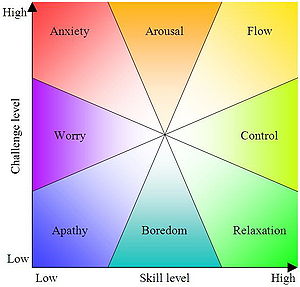
I really like this visual depiction of flow.

Some of you might remember that I am fascinated with the concept of flow, and the Positive Psychology that is based on it.

Flow is a state of effortless and complete absorption into whatever we are doing, a state in which we are and feel at our best and most creative, when we achieve harmony and mastery, when we forget time and feel good.

Flow does not come easily, of course. They say that it takes ten years of training at something–soccer, violin, writing, you name it–before you become able to slip into flow.

Which brings me to this diagram. It is by Mihaly Csikszentmihalyi, an unpronouncable Hungarian psychologist who might just belong into my growing pantheon of great thinkers. Indeed, quite a few people consider him a great thinker, and he has even received an award called Thinker of the Year.

You can view the diagram the following way:

Most of us spend most of our time hanging out somewhere near the bottom left:

  • We are apathetic because we are not challenged and have not applied ourselves to mastery of anything, or
  • we have taken up a challenge unprepared and are floundering, which causes us to worry, or
  • we are good at something but not challenged, so we become bored.

The way out is two sweep either clockwise or counterclockwise in the diagram:

  • Challenge yourself, by finding something you want to master. If your skill level is low, at least you will feel aroused, which is a good first step toward learning and flow.

Or:

  • Keep learning, practicing, mastering, refining. Even if you are not challenged yet, you will become relaxed and feel in control, which builds confidence and is also a great step toward flow.

This is, of course, nothing but the self-help manual of the Samurai and Zen disciples through the centuries.

It’s also a great reminder for us parents and teachers (especially those public-school bureaucrats in America): You must, you must, you must challenge a child to “educate” (ex-ducare = lead out) him or her from apathy.

Watch Csikszentmihalyi’s TED talk:


Bookmark and Share

The Economist: bland, trite and worthy?

I have been pondering a recent comment by Phillipp S Phogg to the effect that, if I may amplify it, what I write on the Hannibal Blog is sometimes more fun than what I write in The Economist. Or, as he put it:

the very opposite of the blandness (and dare I say, triteness?) which permeates some (but not all, I hasten to add!!) of the Economist’s erudite and worthy pages.

  • Bland
  • Trite
  • Worthy

Ouch. No publication, writer or editor would want to be caught anywhere near those adjectives–especially the devastatingly faint-praising worthy.

Well, one of the minor purposes of this blog (besides the main one, which is to talk about my book once it comes out) is to let those of you who are fans/foes of The Economist speak truth to power in a safe setting.

Furthermore, this is the time for me to admit that I myself occasionally feel as Phillip Phogg does. And that frustrates and saddens me.

It also makes me think deeply about such evergreen writerly topics as style, voice, tone, and storytelling, because that’s what this seems to be about.

The Economist appears to succeed in part because it promises and delivers to its readers analysis that is:

  • disciplined, not florid;
  • terse but deep;
  • occasionally quirky but not self-indulgent.

Permit me to contrast that with, say, The New Yorker, which promises, and mostly delivers, storytelling that is

What that means for me as a writer for The Economist is that I usually do the same research as writers for the New Yorker but then leave most, or even all, the “fun stuff” on the cutting floor to maintain the discipline of, say, a 600-word note.

This is frustrating. As a writer, I often know that I could spin a thrilling yarn out of my experiences during research but as a correspondent for The Economist I know that much of it is inadmissible. (There are exceptions, such a piece I have written about Socrates for our upcoming Christmas issue, which arose out of a thread here on the Hannibal Blog and is almost pure, unadulterated fun.)

One device that writers for the New Yorker (just to stay with that example) have but that we lack is the First Person, ie the “I”. I have said before that I consider the First Person “treacherous” for young writers because it subverts discipline. It is a good idea to learn to write without using “I” and “me”. That said, I have also discovered, on this blog and in my book manuscript, that the First Person makes certain things easier. One of those things is authenticity. Another is fun.

But it goes beyond the First Person and into storytelling. Occasionally, we do great storytelling in the pages of The Economist. But often we don’t, because that is not always the main objective.

I still love Ira Glass’s analysis of good storytelling. It requires, he said:

  • humanity
  • suspense
  • surprise
  • momentum (or “direction”)

But implicit in those elements is detail, also known as color. I have said before that color can be excessive and is best used sparingly, as in a good Rembrandt painting. But sparing does not mean monochrome.

Perhaps, when we fall short at The Economist it is because we overdo the sparing. Perhaps we should do more First Person narrating (which does not necessarily require us to give up our anonymity). Perhaps we should paint in more color.

In the next post, let me try to illustrate what I’ve been talking about in this post by looking at the back story behind one of my pieces in the current issue of The Economist.

Bookmark and Share

The Economist’s coequal humo(u)r

From time to time, I like to regale you with tiny anecdotes from our daily routine at The Economist, especially when they display our quirky side.

For instance, an editor might remark, as she anglicizes an acronym I use, that a word “either has to look odd to us [Brits] or odd to them [Yanks], and we opt for them.”

Well, this week I woke up on Monday to get a message from our editor-in-chief that he would quite like a three-page (3,000-word) Briefing on California’s water wars, since the piece that was meant for that slot was not ready to run this week. Due to the inhumanely inconvenient times zone I am in (ie, California, when my bosses are in London), this meant I had to deliver the piece the following day (Tuesday) for London to be able to wake up to it on Wednesday and publish it on Thursday, ie today. This is the piece.

So I wrote the piece in quite a hurry and sent it. Then, on Wednesday, I worked with the fact-checker and map guy, Phil Kenny. He came up with a great map, the clearest depiction of California’s water infrastructure I have yet seen:

CA Water map

The editors are then supposed to send me the “subbed” (jargon for edited) “copy” (jargon for text) and, this being The Economist, forgot to do so. So I went to a yoga class. By the time I came back, it was late at night in London.

In our process, a correspondent sends his article to a section editor, who subs the piece and then sends it on to the editor-in-chief or a deputy, who then sends it through to a “night editor“.

I had heard that our night editor last night was Johnny Grimmond, the author of our style guide. Johnny guards our quaint British usage as Cerberus, the three-headed dog of the underworld, watches over Hades. You can call him, as you can call me, a pedant, and we would be proud of it.

I immediately knew that Johnny would pounce on one particular phrase of linguistic interest. The water legislation currently being negotiated in California contains a very important phrase that is also ugly and stupid in a characteristically American way. Which is to say that, in the same way that Americans gave the Anglophone world the word proactive (why not active?), the legislators in Sacramento now want to impose on the state’s environmentalists, farmers and urban water users

co-equal goals.

While doing my interviews for this story, I had kept a straight face every time the phrase came up, because I am keen not to appear, you know, loony or snippy. In my article I refrained from any overt pedantry. But I knew that Johnny, in the safety of his London office in the wee hours, would not. His cursor, I was sure, would find the pompous American redundancy faster than you can swat a greasy Hamburger with a cricket bat.

And so I asked a colleague with access to the system to send me the copy. My eyes skipped over the paragraphs until they alit on the one in question. I started grinning even before I read the new sentence:

The details of the legislation negotiated so far are complex, but its main feature is a phrase, “coequal goals”—though how coequal goals differ from equal ones is not clear.


Bookmark and Share