Going deeper: strategy, tactics, operations

If you’re still into this emerging little sub-series on strategy and Clausewitz, read Kenneth Payne’s rebuttal to my posts and our discussion in the comments.

Kenneth challenges my view that Truman and MacArthur can be seen as archetypes for strategy and tactics, and frames them instead in the perennial tension between civilian and military leadership. In the comments, he then refines that into the idea of operational versus non-operational war-making.

This immediately reminded me, obliquely, of a great (incisive and entertaining) TED talk by Thomas Barnett, a great strategist. His thesis is precisely about how strategy affects operations–ie, the ‘boring’ bits of the Pentagon and State Department.

In a nutshell: The strategic situation of the United States today is one of

catastrophic successes

Sound familiar?

In this context, Barnett means that our military is so strong that nobody is willing to fight us in the “ordinary” way anymore. So what do we do with all our power?

The pattern (Iraq, etc) is this: We kick ass in war, then fail in peace. Because we are bad at the transition. What we have, according to Barnett, is

A Leviathan force.

What we now need to add is a

sysadmin (system administration) force … or  a “Department of Something Else” between war and peace

to manage the messes we create. Speaking like a true strategist–indeed, as I believe Clausewitz would have spoken–Barnett says:

Don’t plan for the war unless you plan to win the peace

So, to me, this is still all about ends and means, strategy and tactics. Here is the talk:


Bookmark and Share

Patanjali’s Yoga Tweets

You know already that I consider Patanjali the greatest thinker ever, and that I have amused myself by pondering the resemblance between his medium, sutras, and the one you’re reading right now, blogging.

Now I come across this witty refinement of the idea. Patanjali, it turns out, was … a Tweeter!

I may yet have to eat my words about Twitter.

Bookmark and Share

Tactics vs Strategy: MacArthur vs Truman

Tactician

Tactician

  • Knowing means from ends
  • Knowing tactics from strategy
  • Understanding why the first must always be subordinate to the second

These, as I argued in the previous post, are the greatest and most enduring lessons of Carl von Clausewitz, and the reason why I include him in my pantheon of great minds.

Where I have most fun in my forthcoming book is in fleshing out his ideas in contexts other than war, to show that strategy applies to all areas of life. But today I want to make his ideas a bit more concrete in the obvious context: war.

So allow me to introduce the two archetypes:

  1. Douglas MacArthur and
  2. Harry Truman
Strategist

Strategist

Here is their story (from one of the best biographies ever written):

Nuke to win, nuke to lose

In June of 1950, Communist forces from North Korea poured south across the 38th parallel in an all-out attack on South Korea. Harry Truman, having come to power late in life, was the American commander-in-chief and had already made history by dropping the first and only two atomic bombs on Asian cities just five years earlier. He knew immediately and instinctively that this Communist attack had to be reversed or contained. And there to execute this purpose, in theory, was Douglas MacArthur, the commander of the United Nations forces in the region, as well as a certified American Hero from World War II and a notorious prima donna.

MacArthur began true to form, with a swashbuckling landing at Inchon in South Korea. He took the enemy by surprise, liberated Seoul in eleven days and, by October 1st of 1950, brought UN forces—primarily composed of Americans—back to the 38th parallel that the North Koreans had crossed. MacArthur now wanted a “hot pursuit” , and Truman authorized him to cross the 38th parallel.

Truman, however, added a crucial strategic condition: Do not to provoke the Chinese to enter the war, lest that should spark World War III and possible nuclear Armageddon!

Right around then, things began going wrong, not only in the war effort but also in the relationship between MacArthur and Truman.

When the two men met–for the only physical meeting of their lives–on  a tiny coral islet in the Pacific, MacArthur tellingly greeted his commander-in-chief but failed to salute. The two men then met alone, before inviting others to join them. Truman made clear his overarching concern, one that Clausewitz would have approved of: to keep this a “limited” war,  meaning a war to meet one single objective—rebuffing Communist aggression in Korea—without risking an escalation into what Clausewitz would have called an “absolute” war.

But the following month, Truman’s fears came true and the Communist Chinese attacked with huge force. Suddenly, MacArthur, who had been dreaming of another glorious military victory, was trying to avoid a humiliating defeat. He demanded:

  • huge reinforcements,
  • a wholesale naval blockade of all of China and
  • immediate bombing of the Chinese mainland.

MacArthur wanted to broaden the war and to burst any remaining “limits” on it. For MacArthur, there was only one objective: victory. At all costs!

Truman thought the exact opposite. His first fear had already come true, and he now worried that the Chinese were the advance guard of a Soviet Russian intervention, what he called “a gigantic booby trap”  that could lead to the explosion of World War III.

Truman and MacArthur started issuing competing press releases. MacArthur began publicly blaming Washington for everything that was going wrong. He disobeyed specific orders. He called on Truman

  • to drop thirty to fifty atomic bombs on the cities of China (!) and
  • to “sever” Korea from China by laying down a field of radioactive waste all along the Yalu River.

MacArthur appeared to have lost his mind. He even issued his own ultimatum to the Chinese government, as if he were president.

Big Man vs Little Man

At last, Truman took the inevitable measure and fired MacArthur. This was an obvious step, but not an easy one. MacArthur, to ordinary Americans, was still a war hero, whereas Truman’s approval was at an all-time low of 26%. (Hard to remember today, but true.) Time Magazine wrote that “Douglas MacArthur was the personification of the big man” whereas “Harry Truman was almost a professional little man.”  In a poll, 69% of the country backed MacArthur. There were calls to impeach Truman. (Never underestimate the capacity of a democracy, whether Athenian or American, to run amok!)

In time, minds cleared. Truman settled for a stalemate in Korea that continues to this day and is as tense and unsatisfactory this week as ever. He chose a “defeat” of sorts that has brought lasting peace. Communism would be contained for another four decades and then crumble, leaving American as the only superpower. Parts of East Asia, like Western Europe, would prosper in relative safety.

Had MacArthur prevailed, America might well have achieved “victory”, at the cost of another world war, nuclear annihilation of millions, and perhaps nuclear counterstrikes on America from the Soviets, who were fast catching up to the Americans in the technology. It would have been the ultimate impostor of a triumph, with nobody left to march in the victory parade through the radioactive planet.

Bookmark and Share

Clausewitz and you: Life strategy

Clausewitz

Clausewitz

It’s time to talk about tactics as opposed to strategy in life, because knowing the difference is crucial to achieving success, and avoiding disaster. And that, of course, is the topic of my book.

The person to know about in this matter (besides Hannibal and Scipio, of course) is Carl von Clausewitz, a Prussian (and later Russian) officer on the losing side against Napoleon. He also witnessed Napoleon’s disastrous retreat from Russia, which made a deep impression on him. Think of him as the equivalent of an adviser to Scipio or Fabius, the Romans on the losing side against my main character, Hannibal.

Clausewitz is without any doubt one of the great thinkers in world history, even though he is enigmatic and still confuses people to this day. The main reason for that is that he spent his career taking notes–hundreds and hundreds of pages worth–which he meant to consolidate into a coherent whole. But then he died of cholera, at the age of fifty-one. So his great treatise, Vom Kriege, “On War”, was not coherent. Even so, it is now considered the most profound work on strategy ever, thanks to the thoughtful analysis of people such as Kenneth Payne, Patrick Porter and David Betz at King’s College in London.

Let’s look at his most famous and controversial quote:

War is nothing but the continuation of politics (or policy) with other means.

Lots of mediocre minds have, over the years, worked themselves into a fury over the alleged cynicism of this quote, entirely missing its point and getting the meaning backward. Clausewitz was not saying that all politics is potentially like war, but that all war must remain subservient to political/policy objectives. This is subtle.

Elsewhere he had set up the basic tension in war: War can in theory be:

  1. absolute, or
  2. limited

In practice, all wars must be limited but simultaneously “want to” escalate. And here we get into Clausewitz’s wisdom:

Means vs ends

A tactical mind always and only wants to win the battle–whatever battle is being waged. (Remember Pyrrhus?) This is the mind that wants to escalate any war toward its absolute extreme. In future posts I will give some devastating examples of what this can lead to.

A strategic mind wants to win “the war” or, better yet, “the peace”! Battles are simply a means to an end. So it makes perfect sense to adjust your battle tactics not to the goal of victory but to the goal of achieving the kind of peace you ultimately want. This almost always introduces moderation and limitation into your tactics.

As with so many bits of profound wisdom, this is deceptively easy to shrug off. But consider how earth-shattering it was in its time. There was, for instance, a pompous strategist named Heinrich von Bülow, who defined tactics as “the science of military movement in the presence of the enemy,” whereas strategy was “the science of military movements beyond the range of cannon-shot of either side.” What banal and trivial drivel!

Now consider how earth-shattering Clausewitz’s insight can be for your own life: “The object of war,” he said, and I will add emphasis in bold:

as of all creative activity, is the employment of the available means for the predetermined end.

And here you see why I include Clausewitz in my pantheon of great thinkers: Simple, profound and specific, and yet expandable to other areas of life.

Have you ever “won” a fight with your lover only to feel that you’ve lost something far greater? “Won” a promotion only to feel that you’ve lost something? “Won” in a bout of office politics only to feel that you should not have entered battle to begin with?

Are you, in your life, confusing tactics with strategy, means with ends? You need some Clausewitz.

Bookmark and Share

The hip, swinging world of lexicography

Erin McKean

Erin McKean

Words are alive, says Erin McKean in this TED talk below. She is a lexicographer, shares my geeky infatuation with words and will make equally gratuitous use of the bizarre ones.

Here she deplores the dictionary industry, which has been frozen in time. As a dictionary editor she no longer wants to be a

traffic cop

who “lets in the good words and keeps out the bad words.” Instead, she would rather be a

fisherman

who casts his net into the ocean of English to find what is there.

In another talk, she points out how worldview affects our relationship to language. Noah Webster–the Webster–apparently thought that all languages derive from Chaldean, since Noah–the Noah–spoke Chaldean and, well, he was the only one who survived the flood, wasn’t he?

(Also in that talk: Why “ass hat” is a great word, but not one that will make it into her dictionary. Defined as: Somebody who behaves as though he were wearing his ass as a hat.)

Herewith, the TED talk:


Bookmark and Share

Your pinko, Commie snob

Well, things change when you take a new beat, as I recently did (and as we regularly do at The Economist). In this case, I switched from a rather geeky beat–Silicon Valley–to a more general beat–politics and society in the Western states. Mostly, I’m thrilled about this new, and much bigger, hunting ground. But it comes with, shall we say, rather different reader letters.

Our reader letters at The Economist can be witty but tend to be flamingly, aggressively, rantingly, lividly hostile. What varies is the level of sophistication. Some readers really know what they are talking about, and really know The Economist, and eviscerate us effectively and brutally.

Others are, well, just plain amusing.

Here is one of the dozen or so I am perusing this morning, all informing me of my wanton and despicable ignorance and depravity. This particular letter writer reminds me that one of my recent articles

once again shows the elite arrogance and display of socialist bias on the part of The Economist.

Elite arrogance. Hmmm. Socialist bias. Hmmm.

That’s a classical liberal/libertarian from a classical liberal family writing for the world’s oldest classical liberal magazine, displaying a consistently elitist and socialist bias. Gotta love our readers. Can’t wait to read the next batch.

Bookmark and Share

The “rabbit” in a marathon (and healthcare)

321_marathon_runners

I was talking yesterday to Eron Ferreira, a former marathon runner. Eron is Brazilian, grew up poor and could not afford shoes, so he ran barefoot, as many Kenyans do. Later, when he was able to afford shoes he realized that they were soft, mushy and pointless, so he kept running barefoot. But he still had to make a living, and in the 1990s he did that by being a “rabbit“.

Now bear with me: As Eron was telling me about his time as a rabbit, I suddenly understood why Obama’s health care plan, which includes a controversial public-sector insurance option alongside private plans, is correct.

In the context of marathons, Eron explained to me, a rabbit is somebody whom the event organizer pays to run quite fast for the first half of the race. It is understood that the rabbit wears himself out this way, and he can stop running in the second half.

Now, why would the event organizer do such a silly thing–ie, pay somebody … to run fast in a running race? (!)

Apparently, because without such a pace setter, the other runners would hang back tactically and not run fast. It would be boring for the spectators. It would be bad sport. In any other industry, including health care, we would call this a market failure. In theory, it should not happen, but in practice, it does.

1) Success for Eron

In Eron’s case, this once led to his big break in life. One day, during a marathon in France, he was being a rabbit and running quite fast for the first half. He felt great that day, and it occurred to him that he did not technically need to stop, or even to slow down, at all. All the other runners knew he was “just the rabbit”, so they had allowed him to get ahead a bit. Eron looked back, saw that they were far behind him, and just kept going till … he won!

2) Success for health care

And what does this have to do with Obama’s health care proposals? Well, you may have heard that the health care industry and Republicans are preparing to gun down his plan because it will have a new, public insurance option alongside private health insurers. How un-American! How unfair for the private insurers! How socialist!

(For my general thoughts about health care, look here.)

Need I say more? In theory, all the private health insurers should be running fast to win the marathon and make spectators happy. In practice, they are all hanging back tactically. What this sport needs …. is a rabbit!
Bookmark and Share

Life in the taxi to Treasure Island

“If you absolutely need to put it in the GPS, please pull over,” I said from the back seat. “You’ll kill us if you do it while getting on the highway. Besides, I’ll guide you all the way.”

“Sorry, you’re right,” he said with a polite and embarrassed voice. “It’s just that I’m new to driving a taxi, and I feel more confident if she guides me.”

After an endless and grueling travel day, with tight meetings and rental cars and wrong on-ramps and security checks and delays and an unexplained nose bleed at the most inopportune moment, I had finally landed and was on my way home to wife and kids. Only minutes separated me from them now. I wanted to speed it up.

But I couldn’t help noticing the taxi driver. He looked Middle-Eastern, twenty-something, intelligent and curious, tastefully dressed, out of place outside the empty, dark Oakland airport terminal.

“I’ll show you the shortcut to the Berkeley hills,” I said from my back seat, talking to his rear view mirror. “It’ll come in handy for future rides.”

“Thanks. That would be nice,” he said, smiling back into the mirror.

“If you’re new to driving a taxi, what were you doing before?” I asked.

I had just finished The Grapes of Wrath on the plane, that classic about suffering and dignity in Great-Depression California. Was this–the life I saw in the rear view mirror–such a tale in the making?

“I moved here from Minnesota to take the bar exam,” he said. “But I failed. 55% failed. I was one of them.”

“Try again,” I said.

“I will,” he said. “The next one is in July. That’s why I took this job. It doesn’t pay much. But I spend so much time sitting in front of the airport that I get to study and read.”

“Can you pay your bills?”

“Not at the moment. They told me that Oakland canceled half its flights. And there are so many of us driving cabs these days. Plus, there is this cab monopoly in Oakland. You lease the car from them; they get paid no matter what. There’s nothing left over after expenses.”

The missed exit

“Shit,” I said. “I was so absorbed in our conversation that I missed the exit I was going to show you. We’re already in the port.”

“I’m so sorry,” he said. “I’m turning off the meter. This was my fault. I’m really sorry.”

“Don’t touch the meter,” I said. “I said I was going to guide you. There is one other exit we can take. I should have … There! Take that exit now…”

We were already in the chevrons of the exit. He would have one split second to decide whether to swerve out. He stayed the course. We went past it.

“I’m so sorry,” he said. “Now I’m turning off the meter. I feel terrible. This is embarrassing. I’m not good at this job yet.”

“Looks like we’re going over the bridge to San Francisco,” I said.

Philosophy between exits

For a few moments, as the car wound down the lonely turnpike through a dark and dangerous-looking Oakland port, we sat there silent. He felt terrible and did not want to be here, neither in the big sense–driving a taxi for a living–nor in the small sense–going to the wrong city with the meter off.

In the backseat, I felt annoyance rising. I had prepared mentally to be home now, kissing my children in their sleep. It would take a lot longer now. I had a headache and chapped lips. I did not want to be here.

Then I had a clarifying thought. This might well get a lot worse. My driver was terrified with embarrassment. We had, together, already compounded one mistake with a second–although he had saved us from something far worse by not swerving. If he remained mortified and I annoyed, we were likely to make several more mistakes now.

I thought of several of the characters in my book who met with disaster in life. Often, things had first taken a turn for the barely-noticeably worse, which they had found intolerable and made much, much worse, unnecessarily worse, irreversibly worse.

“You did the right thing back there,” I said. “You kept your cool. That was good driving.”

“I still feel terrible,” he said. “I’m paying the toll.”

“Never mind the toll,” I said, pressing a bill into his hand. “I know the flat rate between Oakland and my house. I’m paying that and a tip. Now let’s concentrate on not making this worse.”

He started fiddling with his GPS. “I’d feel better if I heard her talking to us.”

“There might be a way we could cut this short,” I said. “There is this little island, Yerba Buena or Treasure Island or whatever, between Oakland and San Francisco. I’ve never got off that exit, but I’m sure we could get around to the lower deck and head back to Oakland.”

“OK, if you think so.”

Silently, we took the exit onto the island.

The foggy windshield

“Thanks for being cool about this,” he said as we turned into a dimly lit hairpin turn. There was a cop car pulling somebody over. Otherwise, everything was black and empty now.

“I’ve done far worse in new jobs in my time,” I said.

We kept going. We had no idea where we were. He was leaning forward, hyper-alert, with all his adrenalin glands open. He was scared to take his eyes off the road. I noticed that our windows were fogging up and we could barely see. Would I humiliate and stress him by saying something?

“Is that our turn?” he asked.

“No idea,” I said. “Doesn’t look like a real street.”

Now we were down by the water. Everything was empty, except for a few people having some sort of get-together. Some boys, some girls. Tacky clothes. A stretch limo. Jewelry on the men. I looked in the rear view mirror and saw that my driver was scared.

“We missed it,” he said. “I’m doing a U-turn.”

“Sounds good,” I said.

We went back. The on-ramp to Oakland was closed and barricaded.

He stopped the car. We were all alone, under the bridge. I was scared now, because I could see that he was really agitated. I decided that I had a role in this. I would calm him and give him confidence, because he had to drive me home.

“Never mind,” I said. “Let’s go back again to the water and ask. Maybe we can find the treasure on the island.”

He gave me a nervous smile in the mirror, backed up and went back to the water.

“I’ll ask one of these guys,” I said. “No, I should probably do that,” he said. “Sure,” I said. He had dignity and I liked it.

I watched him exchange a few words outside, then he jumped back in.

“We can only go to San Francisco,” he said.

“That’s where we should have gone in the first place,” I said. “My mistake for taking the exit. By the way, your windshield is fogged up.”

“Oh, yes. Thank you.” He blasted the hot air onto the window and we moved off.

Finding the right turn

Soon we were back on the bridge, going to San Francisco. Away from our destination but relieved. It would take a while longer now, and I could see that he was afraid of making yet more mistakes, afraid that this night would never end.

“Let’s shut up completely and just concentrate on the road and the next turn,” I said.

“Yes. Thanks.”

Thanks? He really seemed grateful. I could see him relax. Perhaps he felt that I was taking the pressure off.

We stayed silent for a long time.

“I know the San Francisco exit like the back of my hand,” I said, “but I think you’d feel better hearing her.”

He smiled into the rear view mirror and then typed some Oakland address into his GPS from the device’s memory. That universal female voice that soothes all male drivers and never criticizes said “Prepare to exit on the right.”

Before long we were at last heading in the right direction. “You did great,” I said. “You kept your cool. There were actually about ten or twenty worse mistakes we could have made.”

“Thanks for saying that.”

“Why did you leave Minnesota?” I asked. “Is the recession even worse there?”

“I just thought there would be more opportunity here. I’m interested in immigration law and bankruptcy. I’m on file with all the temp agencies, but there are no legal jobs at all right now.”

“I can get out here,” I said in the Berkeley hills. I shoved a few bills into his hand, rolled together so that he could not count them right away. “A receipt please.”

He gave me receipt but did not fill it out.

“Good luck with the exam in July. You’ll be a good lawyer,” I said.

“Thank you so much,” he said. “So much.” He waved as I went up the hill.

Bookmark and Share

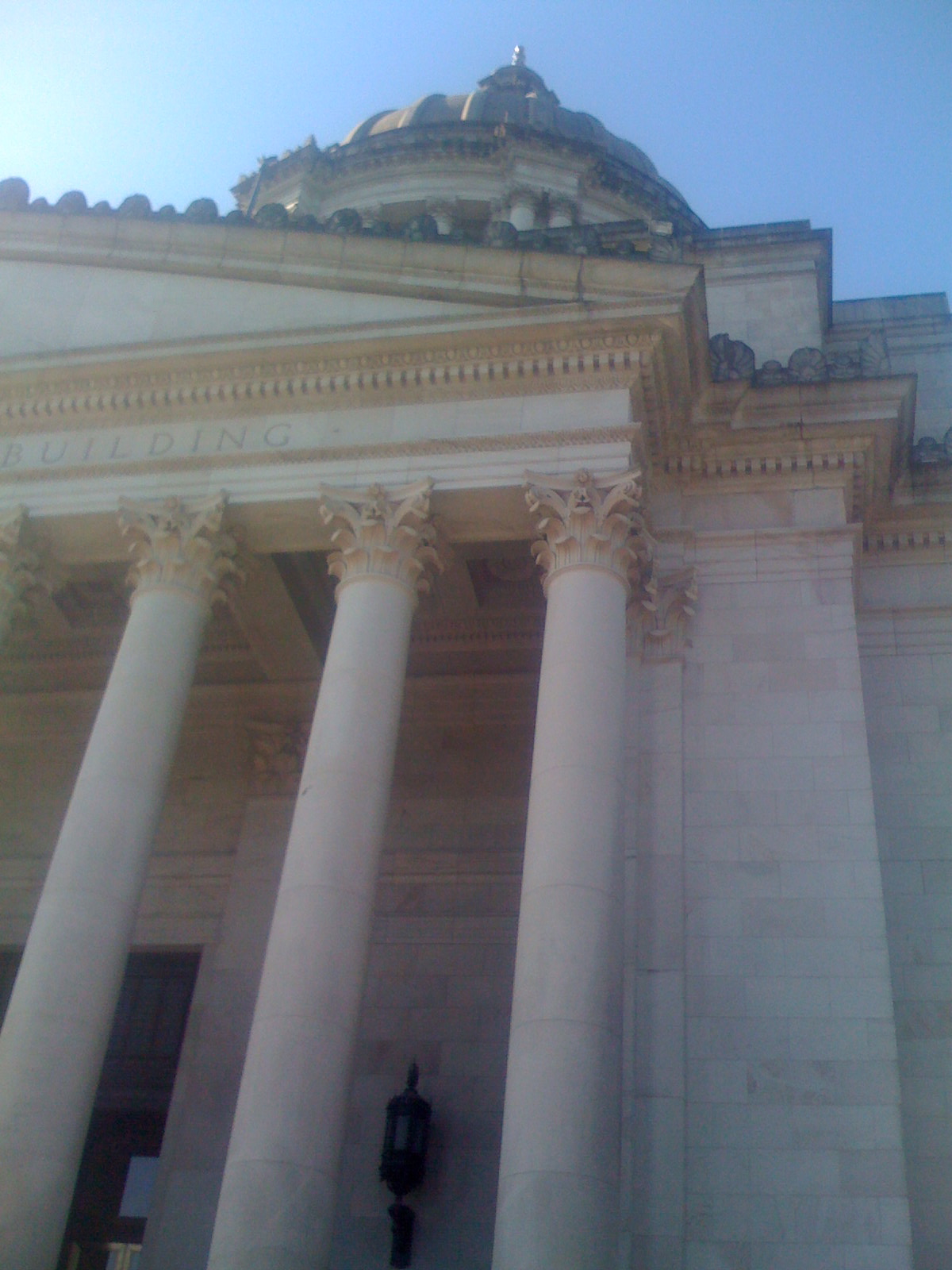
Postcard from (yet another) Mount Olymp

This is where I am at the moment.

In Rome, you ask? The home of Scipio, one of the two heroes in my coming book? The place that Hannibal almost took, almost destroyed, but not quite, and which, as a direct result, took over the world–our modern world–instead?

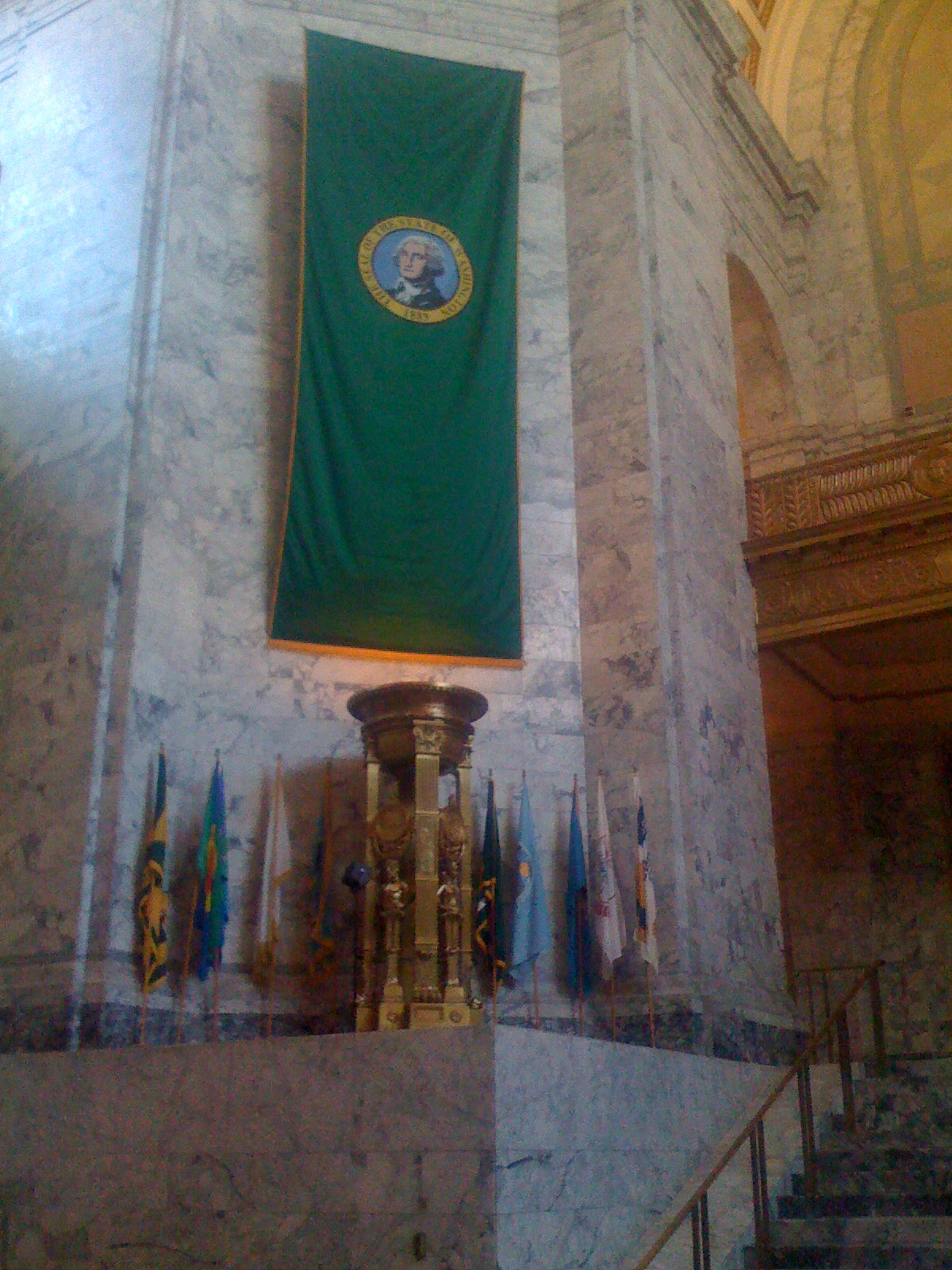
No, actually. I’m in a sleepy little state capital called Olympia. That’s Olympia, as in the abode of the Greco-Roman gods, the place my four-year-old could tell you all about.

Some of the people that I’ve been talking to in these buildings are very aware indeed of the heritage that their architects intended to remind them of, each and every time they walk in and out of their offices. Sam Reed, Washington’s erudite secretary of state (and apparently a direct descendant of Charles Sumner) could go toe to toe with me on Polybius.

Others here look at me blankly when I opine that it must have been quite a controversy to decide between … Doric, Ionic and Corinthian. (But even then they inform me proudly, as three people have now done, that Olympia’s Capitol has the fourth largest masonry dome in the world.)

In any case, I quite savor these improbable links–visual, symbolic, cultural–to our common Western heritage, and to the world of my imagination, peopled as it is with the likes of Fabius, Scipio, Hannibal, Polybius and all the others who are in my book and in our world.

Bookmark and Share

Traveling: Light posting, but pondering Clausewitz…

Yes, Clausewitz. You might have heard of him or not. I intend to convince you that he is relevant to your life….

Stay tuned.