When success ends in suicide

Thanks to Stephanie for suggesting that I look into David Foster Wallace, a literary wunderkind who just hanged himself.

There might be the obvious angle of a very successful person … killing himself.

Then there is the genre of suicide in general–Hannibal poisoned himself, besides lots and lots of other interesting people.

Stephanie, were you thinking of a specific angle that might fit my book that I haven’t noticed yet? I will look into his life story a bit more….

Bookmark and Share

Finding my third voice

My first follow-up to my recent brainstorm on the pros and cons of blogging would be to list one clear benefit: It has already helped me to find my “voice”.

What is voice? I’m not talking about anything to do with my vocal cords. I’m talking about that subtle quality of tone that a writer has and needs.

I suppose it was inevitable that, after eleven years at The Economist, I would internalize its voice and default to writing in it. Cosmopolitan and British in spelling, humor, irony and worldview. Witty, incisive and subtle at its best; snide-sounding when it goes awry. Not necessarily my voice, but by habit and daily routine my first voice.

When I wrote my book proposal, that turned out to be inadequate. That first voice was only masquerading as my authentic voice, which in fact I still had to find, or re-discover, in order to take the reader through my 200 pages. I had assumed that it would be a matter of snapping my metaphorical finger and, voilà, suddenly I’m writing in my own voice. Instead, it took a while longer to sound genuinely like myself and nobody else.

Where does the blog come in? I haven’t been blogging long. But already I’ve noticed that a blogger’s voice is by default ultra-casual, ultra-personal, occasionally sloppy, but always from the gut. It is not the right voice for an entire book. But it represents an antipode to my usual pole, The Economist. It is a natural second voice.

So sometimes I’m using that second voice as a sort of hooligan to rough up my first voice, a sort of Jeeves butler who needs to loosen up a bit, in order to find my third voice, which is the ideal tone for a book. After a day of writing for The Economist, I might unwind with a blog post, then forget about it and settle into a pleasant evening of writing in a tone that is genuine and relaxed but still disciplined and clean. In short, what I’ve wanted all along.
Bookmark and Share

A lot about fathers

So I’m staring at the two books that have just dropped from the pile (a tall one) onto the floor, and they are titled: Faith of My Fathers (left) and Dreams from My Father (right).

“This boy is really doing his civic homework during an important election,” you may be saying. Actually, no. I’m doing research for (no surprises) my book.

You see, these two–Obama and McCain–made me think of my main characters, Hannibal and Scipio. No, it’s not because Obama is half African (I’ve explained here why I don’t think that Hannibal was “African” in that sense). No, it’s not because McCain has “something Roman about him”, as a friend of mine said, referring to McCain’s martial honor code. And it’s only a little bit because both pairs were formidable rivals and opponents.

It’s because Hannibal and Scipio, if they had written books, might well have given them the exact same titles.

Hannibal lived his life as he did, one could argue, because he inherited a “dream from his father,” Hamilcar. Hamilcar had fought the Romans in the First Punic War, and felt humiliated when Rome won, and wanted revenge. He even made Hannibal, when the boy was nine, swear an oath to keep the “faith of his father”. (100falcons has a nice write-up of it here.)

Scipio could have said the same. He had the same name as his father, Publius Cornelius Scipio, and fought in his father’s army against Hannibal, when Hannibal seemed invincible. His father and uncle later died in battle against Hannibal’s brothers, Hasdrubal and Mago. Scipio, too, was keeping the “faith of his fathers” when he rose at a precocious age to become Rome’s leader and last hope.

So, fathers clearly matter. Or perhaps only for sons? For Amy Tan, it seems to have been her mother who was the important early influencer.

Lots to ponder. Lots to ponder. The role of background in life choices, goal-setting, Success, failure….


Bookmark and Share

It’s the cliché, stupid

Here at The Economist, we correspondents have just received an order from above:

… a formal ban on “It’s the XXXX, stupid” … I think the phrase has been overdone, especially in election stories.

Can we also try, wherever possible, to avoid using “top”, as in “top officials say” or “America’s top companies”: “leading” is much better.

This is great advice for everybody, not just us. It’s one of those constant updates to Orwell’s first rule of good writing.


Bookmark and Share

The schizophrenic blogger

That’s me, at least for the time being. Which is to say, I’m in two minds about blogging about my book, depending on whom I’ve asked for advice last.

The “pros”:

On one side, there is an army of tech-savvy, media-savvy, modern, sophisticated, worldly people who say to me: Blog! Bloooog! For book authors, obscurity is the enemy, not piracy, theft or plagiarism. So blog, build a community, learn from that community, and then let the community help you when the time comes to launch.

One person whose example sticks out in my mind, as I’ve mentioned before, is Chris Anderson. His first book, The Long Tail, began as an article in Wired (of which Chris is the editor), then became a book-deal, then a blog, and then, well, the book.

I ran into Chris the other day and asked him if he had any regrets at all, and Chris said Nope, blogging about the book has been entirely for the better. He’s actually learned a lot from his blog’s audience (“crowdsourcing” is the fancy new term for that), and it built buzz for the book’s launch.

Intellectually, Chris has also thought about giving entire books away, free, on blogs or otherwise, and this is becoming something of a micro-trend.

The book, it should be said, did rather well. On the other hand, I should also say that I personally, having read the original article and the blog (and finding Chris’s idea profound and spot-on), did feel that I didn’t need to read the book when it came out. I was comfortable that I already knew the ideas behind it very well.

Chris has a lot of support. Tim Sullivan, who is not my editor but an editor of books, at Basic Books as of this week, told me that:

I’m all for divulging in blog-length entries. You can really work through some issues, and I think that it encourages sales rather than depressing them (in most cases). I also think you end up with a better book, in the end, if you can generate involvement from a group of interested outsiders

Charlene Li and Josh Bernoff (left) wrote their new book, Groundswell, using the blog to test and refine ideas and seem to have loved the process.

Jeff Howe (right) has been blogging his book Crowdsourcing, and using the blog in part, well, to crowdsource. (Meaning: to make “open calls” on the anonymous audience to contribute knowledge, in the hope that the best-qualified people may be hiding in the crowd.)

The “cons”:

My mom is a con. Now, it’s no fair poking fun at moms–they are the people whose intentions toward us are purest. So I won’t. I take her concerns seriously. And she has support: Virtually all of the, ahem, “older” people I know react with dread: Are you crazy? Somebody will steal your best ideas! You undermine the element of surprise! Don’t do it! If you must blog, don’t give anything good away.

Then, there is…

Everybody else:

That category, obviously, includes a lot of people. I’m in it myself. Among my colleagues at The Economist, for instance, there is Tom Standage, author of several books, the latest of which is A History of the World in Six Glasses (right). He is one of the most tech-savvy and media-savvy people in the world, and yet he resides slightly toward my mom’s end of the spectrum. He puts up a “teaser” about his book and some updates about the process–launch, book tour and such–but otherwise leaves it to the book itself to make the splash. I take his advice very seriously, especially since his genre of book and style of writing is much closer to mine than the tech-centered books above.

There is also Edward Lucas, who had a blog for many years before he sold his idea for a book on Russia, the New Cold War (left).

Ed says that yes, he did crowdsource. Exactly once, in fact. He had to fact-check a detail during pre-launch production, and put it out there. Within an hour, several people got back to him with the answer.

But beyond that, he says he did not give away much from the book on the blog, which he uses mainly as a personalized and running anthology of The Economist’s Russia coverage. When he tried to have discussion boards on individual chapters, the results were disappointing–“mostly Russians posting obscenities.” He thought about putting the introduction online, and maybe a few chapters, but then decided against it. “The book must promise that it gives you something you can get nowhere else,” he said to me.

And on and on. Everybody has a different view. Basically, nobody knows.

And that leaves me… schizophrenic. Which is not a good thing for a blogger. It’s like blogging with one arm tied behind your back–possible, but tedious.

Within the coming weeks, I will sort out my thoughts on this and decide one way or the other. You’ll know when that happens, because the blog will show it.


Bookmark and Share

Reading by deleting

In the old days, I would have researched my book by going to a library and pulling journals and books from dusty stacks, then reading them and writing down, on index cards, the passages that I might want to quote, or perhaps photocopying the pages.

These days, I’m finding a lot of journal articles and book passages–especially the classics–online. And in the past year, I’ve increasingly found myself doing something very different (without even consciously deciding to do so):

I download the PDF of some 100-page journal article, copy and paste it into a word document, and then read the article while simultaneously deleting everything I know I won’t need.

I know this sounds bizarre, but I really like it:

  • it makes me read much more actively, since I’m deciding for every paragraph and sentence how it does or does not fit into my themes. So I actually absorb the passages that I’m deleting, as well as those that I’m keeping.
  • it gives me this wonderful sense of progress. I watch the document’s word count go down, and down, and down, and I know I must be doing well.
  • and finally, I end up with exactly the same passages that, in the past, I would have typed in for citation at a later point. So I’ve reversed the process.

It reminds me of what I read somewhere about Michelangelo (I think): Somebody asked him how he sculpts these beautiful statues. Easy, he said: I look at the block of marble, see the statue inside, and then just chip away all the rest.


Bookmark and Share

The trouble with titles, continued

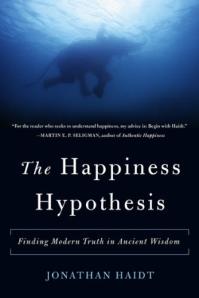
I’m just finishing Jonathan Haidt’s The Happiness Hypothesis, which Baltimore Bookworm already does a great job of summarizing.

Naturally, I’m especially interested in what Haidt has to say, for instance, about the uses of adversity in life (he gives an entire chapter to it), since that fits one of the impostors in my book.

But, since I can’t help but think about book titles these days, which you may have noticed here and here, I found myself lamenting the title that Haidt’s publishers forced on him. The book is not just about happiness, and hypothesis, no doubt meant to sound mysterious, is too academic to hit me in the gut. Instead, it occurred to me, there is a much more obvious title that Haidt’s publisher, Basic Books, could have chosen.

Haidt gives us, above all, a great extended metaphor for our psyche as consisting of a huge elephant  and a little rider on top. Hence the cover image you see here. The elephant is that part of our brain/mind that we’re hardly aware of but that is actually in charge most of the time. The little rider is our intellectual brain/mind, which evolved much later and which does its best to drive the elephant but most often just ends up having to go where the beast goes. In all those cases, the rider’s main skill is to confabulate (Haidt’s word) a story to explain to himself why he, the rider, really wanted to go where the elephant went. You see, he couldn’t possibly admit to himself that he, as mahout, is not in control. In other words, we are great at fooling ourselves. We do things for reasons we barely understand, and then retroactively concoct a logic that makes the action sound plausible, to ourselves and society.

So, if the metaphor was good enough for the cover image, why not for the title? In my opinion, the book should have been called:

The elephant and his rider: What really drives you, and why you lie to yourself about it.

(And, because this is the Hannibal Blog, one more reason why I like the cover image: This is how you must imagine Hannibal’s mahouts riding their elephants across the mighty Rhone river, while under attack from Gauls on the far side. Most of the mahouts drowned. But the elephants, natural  snorkelers that they are, made it across. Having crossed the stream thus, Hannibal was able to take them onwards to the Alps, and then…. well, you know. More about his elephants here.)
Bookmark and Share

Good writing, II: Orwell vs. academia

In the interests of cross-cultural diversity, I thought I should just update my post on George Orwell’s six rules for good writing with the French academic counterpart.

I wouldn’t single out French academia–without any doubt, academic writers in all countries will applaud me–except that I happen to be re-reading Serge Lancel’s impressively researched biography of Hannibal. And, well, I did spend three summers in France, trying to read their books.

Here goes:

George Orwell
French Academia
Never use a metaphor, simile or other figure of speech which you are used to seeing in print. Only use phrases that tenured professors or famous dead scholars have already used
Never use a long word where a short one will do. There are short words?
If it is possible to cut out a word, always cut it out. Say the same thing over and over again until you hit your wordcount
Never use the passive where you can use the active. Only use the passive; anything else is for amateur lightweights
Never use a foreign phrase, a scientific word or a jargon word if you can think of an everyday English equivalent. Use utilize Greek, Latin or Sanskrit terms. The more banal your thought, the more exotic the word.
Break any of these rules sooner than say anything outright barbarous. Never break these rules. They are rules.

Bookmark and Share

The suffering of Frida Kahlo

Frida Kahlo and Diego Rivera. Photograph by Carl Van Vechten at Wikimedia Commons

Kahlo and Rivera. Photo by Carl Van Vechten, via Wikimedia Commons

I popped into the Frida Kahlo exhibition currently at the San Francisco MOMA. Mainly, to see her piercing paintings–and boy, do they pierce–but also, at least in part, as research for my book.

A friend of ours, Erika Lessey Chen, had suggested Kahlo to me a year ago as a possible life-story to look into. I had told Erika that I’m interested in people whose success (triumph) somehow turned into failure (disaster), or whose failure somehow turned into success, à la Kipling’s impostors.

Does Kahlo fit my story-line? Mostly, I’m looking at characters such as Hannibal’s enemy and nemesis Scipio to illustrate how disaster at the right moment in a life can liberate a person–set free his or her imagination and creativity, and thus initiate a much bigger triumph in the future. People such as J.K. Rowling and Steve Jobs.

But disaster can have other effects, of course. There is the strength that comes from overcoming it. I’ve mentioned Joe Biden and Demosthenes in that context. Among the main characters in my book, the person who would personify that is Fabius, the old Roman senator who was the only one not to despair after Hannibal’s crushing victories.

And Kahlo? As I walked through the exhibition and looked at her absolutely harrowing self-portraits, I realized that she had done something else again with her own disasters: She had made the disasters themselves the success.

Here she was on a hospital bed in Detroit, her body writhing and bleeding, with a uterus and a fetus torn out of her. She painted it after yet another miscarriage. The people in the exhibition became very quiet in front of that one.

There she was bound in a steel corset with a broken spinal column, her entire body pierced with nails. In this painting, she is all pain and frustrated sexual desire.

Over there she is sitting in a double-self-portrait, after her marriage to Diego Rivera had failed. She is holding hands with herself, and simultaneously tries and fails to stop the bleeding of her heart. (All these paintings seem to be copyrighted, so I don’t want to show them here.)

What were her disasters? The first was polio, which she caught at age six, and which left her right leg atrophied. The second was a bus accident when she was eighteen. She broke her spine, her pelvis, and lots of other bones, and an iron handrail pierced her uterus, leaving her infertile. The third, arguably, was falling in love with Diego Rivera, whom she adored but who was never faithful to her.

In short: pain, infertility, loneliness. And to deal with it, she painted. And the painting made her into the most “successful” Mexican artist ever.


Bookmark and Share

George Orwell, Blogger

Perhaps it was too obvious until now. What, you mean .. publish the diaries of the great writers, thinkers and statesmen of the past? Just like that? For all to see?

And now it is obvious. They’re publishing George Orwell’s diaries, one entry at a time, as if he were a blogger today. Genius!

For a blogger, the first reason to read them is the sheer relief that comes from seeing that even the great Orwell occasionally posted entries that are, well, banal. See, it’s no shame.

The other reason, of course, is that he is still Orwell, the same Orwell who, among other things, penned Politics and the English Language, probably the most incisive essay ever written on language as such.

This is probably for another post, but suffice it to say now that our own style guide at The Economist begins with Orwell’s six cardinal rules for writing:

  1. Never use a metaphor, simile or other figure of speech which you are used to seeing in print.
  2. Never use a long word where a short one will do.
  3. If it is possible to cut out a word, always cut it out.
  4. Never use the passive where you can use the active.
  5. Never use a foreign phrase, a scientific word or a jargon word if you can think of an everyday English equivalent.
  6. Break any of these rules sooner than say anything outright barbarous.

(Notice that the sixth rule is very British, meaning subtly ironic.)

And now: Could every custodian of every great person of the past who left behind diaries and letters please, pretty please, blog them? It would be a boon to mankind.


Bookmark and Share