Into a Golden Age of story-telling

Indulge me for a moment as I take a quick detour away from the book and book-writing as such, and zoom out to story-telling in general, with one interesting anecdote.

I was having lunch with Andrew Haeg, a radio journalist at American Public Media who is now doing research at Stanford about the future of journalism. We were sitting there at Chez Panisse (tough life, I know), brainstorming about citizen journalism, audience participation, media fragmentation, the blogosphere and the “mainstream” media, and so on. I’ve been thinking on and off about these things since I wrote a big report (starting here) in The Economist about it, over two years ago. Andrew will be thinking full-time about it for the next year.

A minor epiphany occurred when Andrew began a sentence saying something like: “Yeah, but the best story on the sub-prime crisis….”

I interrupted him to complete his thought: “…. was that episode in This American Life, right?” Why, yes, said Andrew, that’s what I was about to say.

Now, I had not even listened to the episode at that point! But my wife had recommended it to me a few days earlier. And in one instant, using old-fashioned (offline) social networking, I had saved myself hours of hard work and boring reading, because I knew that I was going to go home and listen to that particular episode. If two people in my social circle independently recommend the same story-teller, I would be crazy not to take the hint.

Insight Nr 1): Great stories well told eventually find their audience.

How? Through the recommendation network of our social networks, just as in the past.

The “new media”, from Facebook to blogs, by expanding our social recommendation circles from the merely offline to the off-and-online, make these introductions between story-tellers and audiences even more fluid.

Case in point: I noticed a status update from my friend Michael Fitzgerald on his Facebook page about how he was reading Norse myths to his spellbound kids. I immediately badgered him for which particular story-teller he was reading from, and now I am ordering the book.  No sense wasting my time with the bad version.

The new media, in other words, not only do not hurt traditional story-tellers, but they positively help them, provided that ….

Insight Nr 2) … provided that the story-telling is actually good.

What did I find when I got home and listened to that episode in This American Life? Everything that Ira Glass, the show’s host, and his team are so good at:

  • The complex made simple.
  • Character! Colorful, richly painted individuals who found themselves involved in a global financial disaster.
  • Scene. Sound-painted place and context to reinforce the characters.
  • Plot. A story-line that connected this unlikely combination of individuals and thereby–effortlessly, en passant–explained a fiendishly complex subject.
  • Humor and, yes, irony (see my earlier thoughts on irony here)
  • Empathy (rather than judgment) for the characters
  • Suspense

In short, I found what great story-tellers have always provided. No change.

Insight Nr… Hypothesis: New media disrupt short-form but not long-form story-telling

YouTube has forever changed the genre of short video clips. Blogs have forever changed the genre of short text news and opinion. If you were a traditional story-teller producing short video clips or short news or opinion articles, you need to change and enter the great, gushing Haiku stream of the new media.

But longer stories? We all gladly exit the stream, get cosy, and enjoy a long story well told. A two-hour film, a 200-page book, a one-hour podcast. It’s not the medium (text, audio, video) that matters, but the experience. Lean-forward versus lean-back. Eager to be interrupted versus eager to be immersed.

As the short-form media improve the introductions between story-tellers and audiences, the golden age of story-telling seems to have just begun.


Bookmark and Share

Biden and Demosthenes: A tale of two stammerers

As I was watching Beau Biden (video below) and his father Joe at the Democratic Convention today, I was struck by a stunning parallel between Senator Biden’s remarkable life story and that of the ancient Greek orator Demosthenes.

Both were stammerers in their youth. Both were taunted for it with cutting nicknames–“dash” for Biden, since he left his words hanging with a dash; batalus for Demosthenes, which meant both asshole and stammerer.

But both defined themselves by overcoming this impediment, and thus turning their greatest weakness–speaking–into their greatest strength–oratory. Demosthenes went on to become the single greatest orator not only in Greece but in all of history. Statesmen from Cicero to Disraeli and Churchill looked to him for lessons in how to move a political audience with speech. Joe Biden, too, became an effective–and, if anything, a garrulous–senator and may now become vice president.

As always, it is how they overcame that is the story. Joe Biden’s story is all over the news this week. But you may not know Demosthenes’ story. Here is the brief version, as Plutarch tells it:

Once, after Demosthenes was once again laughed out of the forum of Athens for his slobbering, panting attempts at speech, he was walking in dejection around the port. An actor followed him and caught up. He asked Demosthenes to recite passages from Euripides and Sophocles. Demosthenes recited them. As soon as he stopped, the actor would deliver the same passage, but with full force and feeling, with gesture and emotion.

Demosthenes was so inspired that he built himself a sort of cave underground where he hid for months at a time, just practicing his speech. He shaved one half of his head, then the other, so that he would be too ashamed to come out. With laser-like focus, he stayed in that dungeon and worked on his tongue, his vocal cords, his gestures, his cadence, his logic.

Eventually he came out of his cave and set his hurdles higher. He recited speeches while running up hills. He went to the shore and orated against and over the breaking waves. When even that became easy, he put pebbles under his tongue and then enunciated over the roaring surf. Here he is, as the painter Jean Lecomte du Nouÿ imagined him:

In time, he became the greatest orator, and then the greatest statesman, of his country and time, Athens in the fourth century BCE. It would be Demosthenes who roused the Athenians against the menace of Philip of Macedon, the father of Alexander the Great.

Were the early failures, setbacks and shortcomings of Joe Biden and Demosthenes impostors, in Kipling‘s sense? Do they belong in my book, which is about how the two impostors, triumph and disaster, work? Stammering, for Biden or Demosthenes, was not a liberating event, as failure was for Steve Jobs, J.K. Rowling, or Hannibal’s nemesis, the great Scipio. Their stammer was more like a gauntlet that life threw before their soul. Success in life can be about picking such gauntlets up and then going deep, way deep, to find the strength.


Bookmark and Share

Hannibal’s life in eight minutes

Well-made YouTube video (meaning: hewing closely to Polybius and Livy) about Hannibal’s life, by Wolfshead:

Interesting moment of interpretation: why Hannibal, in this version, chose not to take Rome itself, which was the single biggest decision of his life. “We are not animals,” he says here.

(Also: did I detect stirrups on the cavalry? Maybe not. There weren’t any in those days.)


Bookmark and Share

A moratorium on blurbs

Let’s all give our whole-hearted support to Eric Simonoff, a literary agent at Janklow & Nesbit Associates, who recently told the New York Times Book Review that “we should impose a moratorium on blurb-hunting.”

What are blurbs? Why, those phrase snippets on the back of books that allegedly make you crave the product but usually sound gushingly, ridiculously banal or over-the-top.

I have myself blurbed one book, been asked to blurb a few others, and will, no doubt, have to grovel for blurbs on the back of my own book whenever it comes out. Oh how I dread the thought already. Simonoff’s proposal is so on target because everybody–writers, authors, probably even readers (secretly)–hate this blurbing thing. As the article says:

Caveat lector! The endorsements on books aren’t entirely impartial. Unbeknownst to the average reader, blurbs are more often than not from the writer’s best friends, colleagues or teachers, or from authors who share the same editor, publisher or agent. They represent a tangled mass of friendships, rivalries, favors traded and debts repaid, not always in good faith…

For writers, to blurb or not to blurb can be a tricky matter. Blurb too little and you’ll have a hard time drumming up the requisite superlatives when your turn comes. Blurb too often, or include too many blurbs on your book, and you might get called a blurb whore.

Quite so. A moritorium then! Let’s do without blurbs for a while and see whether or not we’ll miss them.


Bookmark and Share

Carthaginians and “Libyans”

Great research by Mathilda about ancient Libyans here. In a nutshell, the ancients apparently considered “whites” living in Africa to be “Libyans”, in contrast to “black” Africans, who were called “Ethiopians.”

This fits my previous description of Hannibal and the Carthaginians, according to which Denzel would not be the most historically correct choice of actor.

Hannibal’s mercenary army, incidentally, contained lots of “Libyans”, alongside lots of “Numidians”, who were the most feared horsemen of their day, and “Iberians”, “Celto-Iberians” and Gauls. Then there were assorted other types, such as the renowned slingers from the Balearic islands (Mallorca, Menorca and Ibiza), who apparently trained by shooting birds out of the sky with their slingshots. I’m trying to find out more about all these ancient tribal and ethnic categories. More to come.


Bookmark and Share

Which Bhagavad Gita?

“With no desire for success, no anxiety about failure, indifferent to results, he burns up his actions in the fire of wisdom. Surrendering all thoughts of outcome, unperturbed, self-reliant, he does nothing at all, even when fully engaged in actions.

There is nothing that he expects, nothing that he fears. Serene, free from possessions, untainted, acting with the body alone, content with whatever happens, unattached to pleasure or pain, success or failure, he acts and is never bound by his action.” (BG, 4.19-26)

Boom. Could anybody say it better? Who do you think did say it? Rudyard Kipling, whose two impostors are the seed of my entire book?

Actually, it was Krishna, in conversation with Arjuna, on the eve of an 18-day battle that would kill about four million (!) and which only eleven men would survive. Here are Arjuna and Krishna, his charioteer, in between the opposing armies just before the battle, as Krishna reveals to Arjuna the two crucial secrets to our lives: how to know and do your duty, and how to live.

I’m talking, of course, about one of the greatest poems (books, texts) ever written, the Bhagavad Gita, or “song of God”. It is a relatively short song inserted into a huge (!) epic story, the Mahabharata, which is several times the length of the Bible, or of the Iliad and Odyssey combined.

I’ve been re-reading the Gita in several translations while researching one chapter in my book. Why? Because Hannibal faced the same dilemma that Arjuna faced, when he broke down sobbing before the great battle, a battle that he suddenly did not want to fight at all, but which, as Krishna made him realize, he could not not fight. So Arjuna faced the same conundrum that Hannibal and Scipio faced: how to get into the right frame of mind to live life.

Oh, wait a minute. Did I say that Hannibal was in the same situation as Arjuna? I meant, that we all are in the same situation as both Arjuna and Hannibal. That is the point of the Gita, and also (more humbly) of my book.

Now, for those of you who love the Gita, I thought I’d do a quick review of the three translations and commentaries I’ve recently re-read. That way, maybe, I can help you choose the one that’s right for you.

The Gita is a poem in the original Sanskrit, and the translation that best preserves the beautiful, easy, fluid feel of a poem is the Bhagavad Gita by Stephen Mitchell (Three Rivers Press). The opening quote above comes from his translation.

A slightly less beautiful but perhaps more helpful and accessible translation is The Bhagavad Gita: A Walkthrough for Westerners by Jack Hawley (New World Library). The title sounds as if it were a sort of “For Dummies” version, but it’s not. It’s intelligent, and editorializes a bit whenever the words in the poem mean something very different from the same words in our ordinary language.

Then, of course, there is the intimidating two-volume brick God Talks with Arjuna: The Bhagavad Gita by Paramahansa Yogananda (Self-Realization Fellowship). That is the kosher version among yogis, because it’s academically and intellectually thorough. I’ve tried several times to get through it and failed. If it’s beauty, ease and enjoyment you’re looking for, don’t pick this one. But….

do pick this one if you have even the slightest interest in a deeper understanding of the Gita. For example, the thing to get about the poem is that there are two battles going on: the external one involving four million warriors and elephants and chariots; and the internal one that we all wage every day. Paramahansa Yogananda is great at the genealogy of all the people in the war, so that you realize, for example, that Arjuna and his four brothers are the intelligent and higher parts of our mind, who are fighting 100 cousins, who are the powerful but lower parts of our mind, such as anger, desire, greed, and so forth.

Enjoy.


Bookmark and Share

The map of Hannibal’s march and life

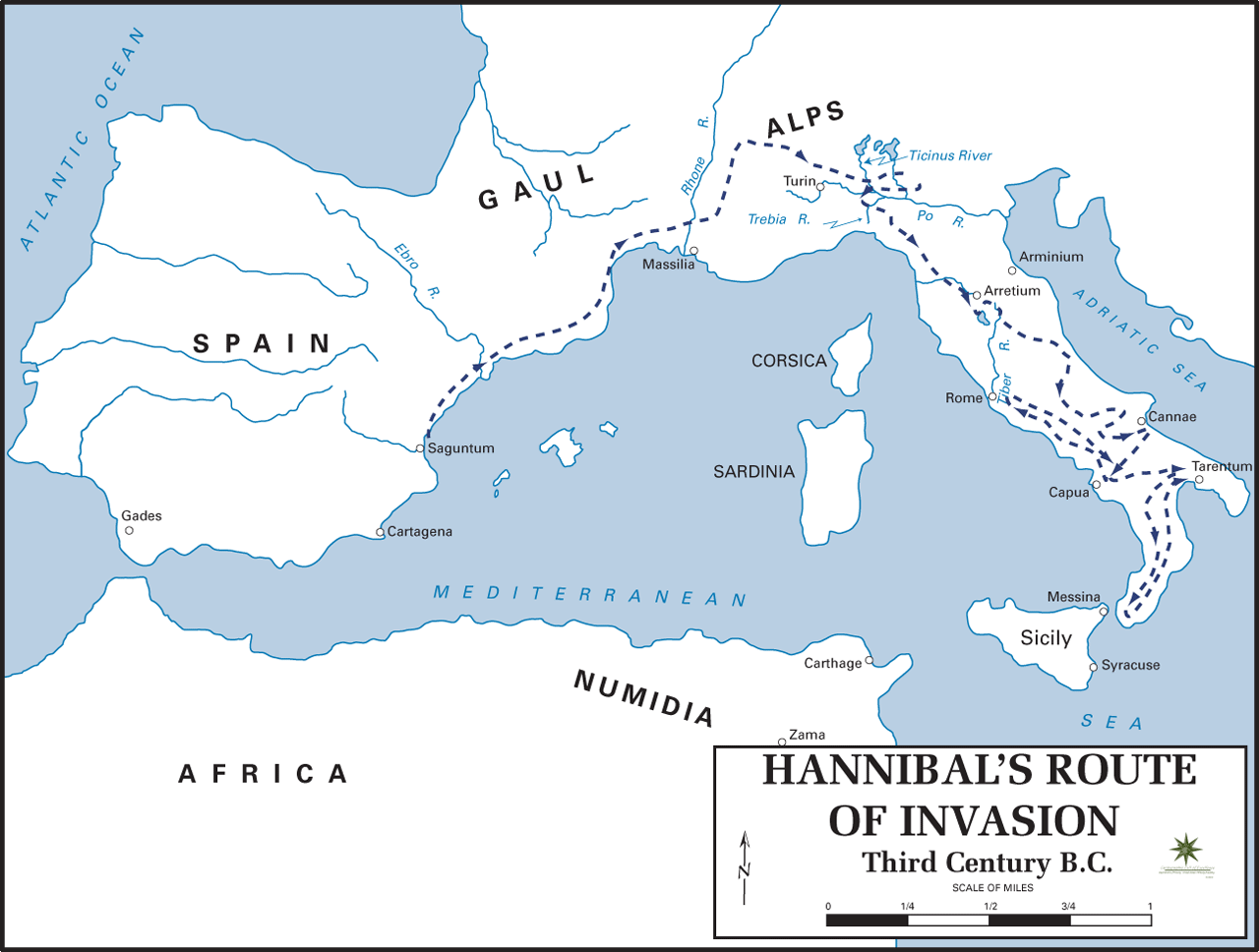
Join me for a moment in having fun with this map below.

It comes to us, via the Wikimedia Commons, from Frank Martini, a cartographer in the Department of History at the United States Military Academy.

There are two ways of looking at this map–one obvious and one surprising and cheeky–and I will avail myself of both. Bear with me. First the map, and the obvious:

What we see here, obviously, is the western Mediterranean at the time of the Second Punic War (the “Hannibalic War”). Notice Carthage at the tip of northern Africa (in today’s Tunisia); Cartagena or “Little Carthage” in Spain, which I mentioned in an earlier post; Gades, which is today’s Cadiz; Saguntum (Sagunto), which was ethnically Greek; Massilia (today’s Marseilles), also ethnically Greek; Turin (Torino) which was not yet party of “Italy” but part of Gaul; and Ariminum (Rimini), the Roman colony at the edge of their frontier with the Gauls.

Now look at Hannibal’s march itself. In 218 BCE he crossed the Pyrenees and into Gaul. The line casually crosses the Rhone, even though this involved one of the most colorful operations in history (of which more in a later post–think elephants on rafts), and then, equally casually, crosses the Alps (of which much, much more in later posts).

You then see where Hannibal won his famous victories, at the Ticinus (more of a skirmish), at the Trebia, at Lake Trasimene and at Cannae. And then you see the line of his path getting…. confusing!

Now the less obvious way of looking at this map: Squint! As you squint, look only at the line of the march. It is a fitting life trajectory for Hannibal himself. It rises early and steeply, peaks, then declines and loses itself completely in a confused and erratic hairball.

How would you draw the map if it were proportionate to time, rather than distance? The entire stretch from Cartagena to Cannae, his greatest victory, took a little over two years. All the twists and turns after Cannae (there were actually far too many to draw on a map) took…. fourteen years!

After those fourteen years, Hannibal lived another nineteen years until he committed suicide, but most of that took place on a different map, in the eastern Mediterranean.

And yet, if you read the existing histories, you would think that 90% of Hannibal’s life took place in those initial two years.

Those years are the impostor years. The next thirty-three are the story of how and why he realized that his triumphs had been impostors. And this, in my book, is where his life becomes universal and directly relevant for our own lives today.

Now, let’s have even more fun and turn the map around:

Now you have, more or less, the life trajectory of the Romans, in particular Fabius and Scipio, my two other main characters.

Kipling’s impostors, you see, visited with them in mirror image.

Why and how did all this happen over all those decades? In exactly the same way as it happens to most of us in our much smaller(-seeming) lives, it turns out. That’s why I’m writing a book about it.


Bookmark and Share

More on Shakespeare’s “Like you like it”

So you’ve heard me nag, nag, nag about the issue of like/as, first and foremost here, and then here.

Turns out that Paul Yeager and Sherry Coven have fired at the same target, in their wonderful blog for language lovers.

I see that I’m in good company….


Bookmark and Share

On irony

Having a sense of irony can be an isolating and lonely experience if you find yourself living in America. I should know.

While contemplating a post on irony, I pinged a former colleague of mine, Gideon Rachman (who is now a columnist and blogger at the Financial Times).

Gideon Rachman

Gideon Rachman

That is because Gideon, as a Brit in the lovably dysfunctional family that is The Economist, has a great sense of irony. We teem with ironic Brits at The Economist.

I had a reason for molesting Gideon. He is the only one of us who dared make himself our Irony Correspondent. He did this in the Christmas Issue of 1999, with this piece on the role of irony in British diplomacy. Clearly, he must be the expert.

And what did I get in return? “I think you are turning into a bit of a hippy” (sic), he chastized me in his email. All this living in California cannot be good for my writing, he stipulates, because

English irony, with its self-deprecation and use of understatement is almost the opposite of what I see as the Californian tone of voice – earnest and gushing.

Earnest and gushing. Spot on. If there is such a thing as a quintessentially American “voice”, it is earnest and gushing. Often indignant. Occasionally sarcastic. Sporadically narcissistic. Don’t get me wrong. American writing can be moving, powerful and … good. But it is rarely ironic.

Irony: Definition & eulogy

Irony is not only the highest form of humor (whereas sarcasm is the lowest), it is a sure sign of a civilized mind. I define it as

the non-aggressive savoring of contradictions in life and people (others and yourself) and of turns of phrase that are slightly and adroitly off-key and thus meaningfully surprising.

So irony is not merely saying the opposite of what you mean. Examples:

Oh, that’s so cool!, when it’s clearly not, is sarcastic and a knee-slapper around the Neanderthal campfire.

Protesting that rumors of your death are wildly exaggerated, as Mark Twain, an ironic Yank (they exist), did, is ironic. (The irony is entirely in the word exaggerated.)

Irony is not about punch lines. It’s not about jokes that bring the house down. It is about seeing the world in a certain way. That way is worldly and cavalier (another British concept). In this world view, it is unseemly to be outraged all the time, as Americans seem to be. Rather, one is expected to be shocked-shocked!, which is subtly different. The insanity of “it all” becomes your backdrop. It may amuse you; it may cause you pain; but it also produces the raw material for your irony. You do not use it to lash out against others (that’s sarcasm’s job). You use it to commune with some others, those who share your sense of irony.

Put differently, you could almost say that irony is Buddhist humor: Wit borne out of compassion, since we’re all in this mess together, whatever that mess happens to be.

How I write

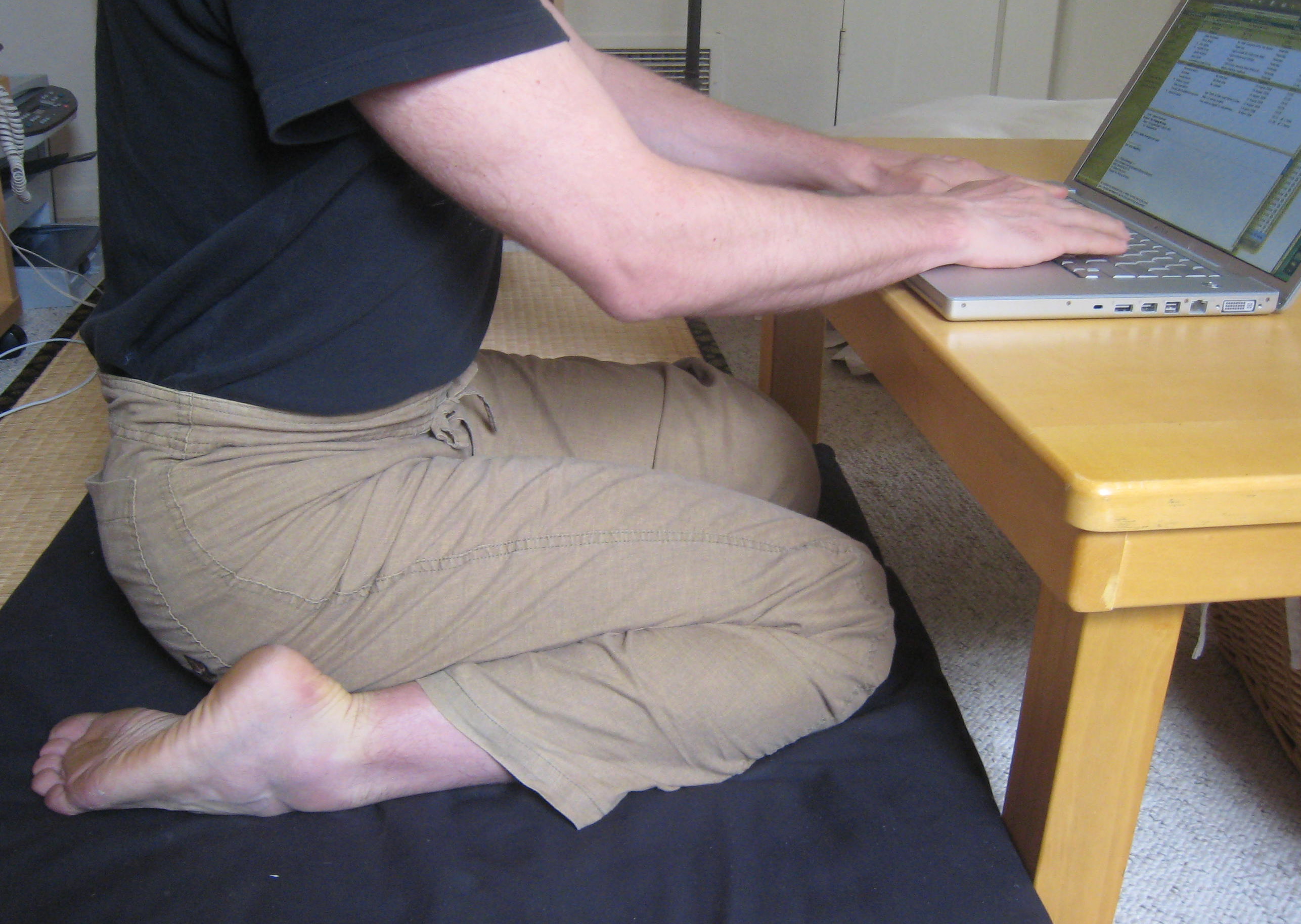
I meant that title tongue-in-cheek, and quite literally. Here is how I write: On my tatami mat in front of my laptop, sitting either in Lotus (Padmasana in Sanskrit) ….

… or in Hero Pose (Virasana in Sanskrit). Which is to say, with my butt between my heels, as below. (For the etymologists among you, the vira, or hero, in the pose’s name is the root, via Latin, of our virtue, virility, triumvirate, et cetera.)

Having said that, when I first get into my “office” in the morning, and I’m still stiff and cold, I usually warm up a bit first. So, for a while I might sit in half-Lotus, with one leg on top of the other. Or I might kneel, Japanese-style. Or sit in cobbler’s pose.

But… why? Why would I do such a thing? Can I not afford a chair?

I can. I just decided a few years ago to “ditch my chair,” for the reasons I described in this Yoga Journal article. Call me eccentric. It’s allowed.


Bookmark and Share