Hannibal, Aikido and Casanova

Bear with me, please. I’m trying, right now, to analyze Hannibal’s phenomenal skill at winning battles. And I’m trying to find parallels in other areas of life.

It occurs to me that Hannibal had some things in common with this Aikido Black Belt:

It further occurs to me that Hannibal had his way with the Romans rather as Casanova had his way with about 120 women.

You use the force of the opponent, rather than your own, to win. That seems to be the trick. This may or may not be obvious when looking at battle diagrams of Hannibal’s great victories, such as this one at Cannae:

I’m desperately looking for other examples or refinements of this idea. Any hints will be gratefully received. If you think I’ve gone bananas, please suggest remedies.


Bookmark and Share

Goldsworthy on The Punic Wars

And back again to the bibliography for my book.

We’re still in the “history” section, as opposed to the “biography” section, but we’ve mostly dealth with the ancient sources (Polybius, Livy and Plutarch). So now I’ll move into the modern writers.

Adrian Goldsworthy

Adrian Goldsworthy

If I had to choose just one book to give you a fun but thorough overview of Hannibal, it would be Adrian Goldsworthy’s The Punic Wars.

It’s actually a good idea to read the story of all three Punic Wars in one, because you can’t understand Hannibal’s war (the Second Punic War) without the other two. It would be as though a history student two-thousand years from now were trying to understand World War II without knowing anything about World War I or the Cold War.

Goldsworthy does a good job of minimizing the clutter (footnotes, parenthetical interruptions aimed at other academics and such) that usually makes academic books unreadable. He gives you great context. For instance, it’s probably not immediately obvious why sieges almost never worked in the ancient world (which is important, since Hannibal, at the crucial moment, decided not to lay siege to Rome). So Goldsworthy describes what it was like to attack and defend a city–all the tunneling and ramming and laddering and sulphur-smeared-javelin-hurling and so forth.

Being British, Goldsworthy also lets his sense of irony peek through on occasion, which brings relief. (Asked what his philosophy of life is, he tells his interlocutor here that “I’m English, so obviously do not have a philosophy.” That’s the sort of thing I mean.)

His more recent book is a biography of Julius Caesar, which I’ve also read and loved. But I’m forcing myself to leave Caesar out of my book because, as my wife has informed me, there are enough ancient dudes in it as it is.


Bookmark and Share

More on Hannibal’s elephants

Thanks to James Allen over at Electrical Wall for helping me reframe my understanding about Hannibal and his elephants. I now see that my own take missed the more existential connections the man had with his elephants.


Bookmark and Share

The father of biography

Plutarch

Plutarch

Let’s get back to the bibliography for my book.

Right now–while we’re still dealing with the ancient sources–I’m going through the texts in chronological order. And after Polybius and Livy, that brings me to Plutarch.

You recall that Herodotus was the father of history. Well, Plutarch must be the father of biography. Like Herodotus, Thucydides and Polybius, he was Greek. But Plutarch lived much later, in the first and second century AD–three centuries after Hannibal and Scipio. So I don’t use Plutarch because I think he has any scoops over Polybius, or more accurate information. Why, then, do I use (and love) Plutarch?

Because he was the first to take an interest in character. That’s what he wanted to capture: the characters of the great Greeks and Romans. For that he used the big events and deeds in their lives and, just as much, the tiniest but telling details. Occasionally, he may have stretched the facts a bit, but, hey, let’s relax about that and just enjoy.

In that respect, of course, Plutarch does exactly what I aspire to do in my book. I too want to capture how characters respond to success and failure, ups and downs.

Plutarch’s main work was his Parallel Lives (which we usually read in the John Dryden translation), in which he paired one great Greek with one great Roman. Alexander the Great, for instance, is paired with Julius Caesar, and so on.

Hannibal was neither Greek nor Roman, so we don’t have a Life with his name as title. But Hannibal, who is my main character, features prominently in several of Plutarch’s Lives: Fabius (who also plays a big role in my book), Marcellus (a Roman consul killed by Hannibal), Cato the Elder, Flamininus (conqueror/liberator of the Greeks and the man who finally hounded Hannibal into suicide).

Plutarch’s life of Pyrrhus, which I’ve quoted from, is one of my favorites, by the way.

The tragedy is that many of his lives are lost. And the loss that hurts most is, of course, the Life of Scipio, my other main character.


Bookmark and Share

More on parents and success

Thanks to Freda Zietlow for pointing me to this piece in the Wall Street Journal on the dysfunctional families of future presidents.

As you guys already know, in one chapter of my book I’m looking into the subtle and unsubtle ways that parents influence the future success and failure of their children. Hamilcar played a huge role in the life of his son Hannibal (my main character), and not just while Hamilcar was alive.

Now, the Journal‘s Sue Shellenbarger has this to say about US presidents and their parents:

The families that have produced U.S. presidents … show a striking tendency to be deeply flawed. The childhoods of past presidents have been marked to an unusual degree by absent fathers, mothers so overinvolved that they could easily have been the original helicopter parents, and in some cases outright dysfunction…

Childhood events that would destroy most children seem somehow to spark greatness in leaders-to-be, says Doug Wead, author of two books on presidents’ families. As two candidates with highly unusual family backgrounds vie for the presidency, Mr. Wead even sees Sen. McCain and Sen. Obama — to different degrees and in starkly different ways — fitting a pattern he describes as “Mama’s boys with absent fathers who were perceived by the sons as high achievers,” he says….

Some presidents’ families have been famously dysfunctional. Thomas Lincoln abandoned 9-year-old Abraham and his sister, 12, for several months in their frontier cabin right after the death of their mother, while he went to find a new wife, says Doris Kearns Goodwin, a Pulitzer Prize-winning historian and author most recently of “Team of Rivals,” a book about Lincoln. When Thomas finally returned with their new stepmother, Sarah Bush Johnston, the couple found them “wild — ragged and dirty,” seeming barely human, the stepmother later wrote…

In another notably troubled family, Bill Clinton’s father died before Bill was born; his stepfather was a womanizer and an alcoholic who beat his mother, Virginia, according to biographer David Maraniss. Although Virginia, a warm, nurturing woman, made her son the adored centerpiece of the family, President Clinton said later that he often pined for his birth father…

Even the McCain family, with its tradition of distinguished military service, fits the pattern of an absent father and an overinvolved mother who fills the gap, Mr. Wead says. Sen. McCain’s father was a respected four-star Navy admiral and commander of Pacific forces in the Vietnam war, but he was mostly absent from home during Sen. McCain’s childhood. Sen. McCain reflects pride in his father and was taught to regard his long absences “not as a deprivation, but as an honor.”…


Bookmark and Share

Hannibal’s Y chromosome

Click on this map and read about the latest in this fantastic research effort called the “genographic project“. The dots show the areas of the Mediterranean with the highest frequency of the Phoenician haplotype.

They swabbed the cheeks of men from Syria and Cyprus to Malta and Morocco to have a closer look at the Y chromosome of these guys. (The Y chromosome is passed from father to son, and so a good marker of paternal descent. Mitochondrial DNA, inherited only from the mother, does the same trick for maternal descent.)

The result, as the New York Times article puts it, is that

as many as 1 in 17 men living today on the coasts of North Africa and southern Europe may have a Phoenician direct male-line ancestor…

These men were found to retain identifiable genetic signatures from the nearly 1,000 years the Phoenicians were a dominant seafaring commercial power in the Mediterranean basin, until their conquest by Rome in the 2nd century B.C.

Now, why is this exciting for the Hannibal Blog? Because Hannibal was a Phoenician, as I explained here when arguing that Denzel Washington, as much as I love that man, would not be the most ethnically correct choice of actor for this “African hero”.

Carthage, to remind, began as a Phoenician colony. The Roman word for Phoenician was Punic, hence the Punic Wars between Rome and Carthage. In Punic itself, the name Phoenicia means “land of purple”, because they loved that color and exported its dye.

Carthage’s mercenaries came from the other peoples of northern Africa at that time, the Numidians and the Libyans. The Numidians, as I said here, were the ancestors of today’s Berbers, and you might as well picture them looking like Zidane. The Libyans, as I said here, were not today’s Libyans, but “white” Mediterraneans. The Arabs, of course, showed up fully 900 years after Hannibal.


Bookmark and Share

Livy

I left off my series on the bibliography for my book with a long post on Polybius. Polybius, as I said, was one of the greatest historians ever, but most of his books were lost. This means that for the history of Hannibal’s war against Rome we have to rely heavily on another ancient source. And that is Titus Livius, or Livy in English.

There are big problems with Livy. He lived a century and a half after Hannibal’s war. Polybius had interviewed eye witnesses and traveled Hannibal’s route, but Livy did not even attempt any such research. Instead, he merrily plagiarized Polybius (and mentions him only once, by my count). At least we can take comfort from knowing that he had all of Polybius available to him, as well as other sources lost to us, such as Roman documents.

The next problem is that Livy had an agenda other than telling the best and purest history. Like his contemporary Virgil, Livy was writing under the reign of the emperor Augustus, who “restored” Rome’s republic after the long civil wars by replacing it with a monarchy in all but name.

Virgil responded by writing an epic poem, the Aeneid, placing Augustus in the context of a noble unfolding of destiny. A literary masterwork, but somewhat close to brown-nosing the great emperor. Livy sort of did the same, only in prose. So he starts his “history” with Aeneas’ flight from Troy, his journey to Italy, Romulus and Remus and so forth.

Aeneas flees burning Troy

Aeneas flees burning Troy

In general, Livy always makes the Romans look good and their enemies look bad. So the Gauls are unreliable and lazy brutes. The Greeks are savvy but slimy know-it-alls. The Carthaginians are either cruel or cunning or miserly or deceitful. Much of Livy is propaganda. Awfully entertaining propaganda, as it happens.

So if Polybius clearly emulated his fellow Greek Thucydides in trying to stay close to facts and analysis, Livy takes Herodotus as his example and embellishes and invents freely for the sake of a cracking good read. At that, he succeeds.

When the Europeans woke up at the end of the Middle Ages and rediscovered the classics, Livy became one of their favorites.

Personally, I couldn’t care less about Livy’s shortcomings. I’m in it for the stories, the characters, the scenes that I need to tell the story that I want to tell, which involves so many other people. More to come soon.


Bookmark and Share

Polybius

First off in this series of posts about the bibliography for my book–in the category of ancient sources–is, of course, Polybius. His life is one of the most fascinating ever lived, and his importance to us–especially to us Americans, as I will explain in the follow-up post–is enormous.

Let me lead up to Polybius in three short steps:

Herodotus

Herodotus

1) The first “historian” in history was a Greek writer named Herodotus. He lived during the fifth century BCE, the golden age of classical Greece, and wrote what he called “enquiries”, or histories in Greek. So that’s where we got the word! The main matter he was “enquiring” into was the glorious victory of the Greeks over the Persians, which forever changed world history.

In style, Herodotus was a genius story-teller, and I love him for that. But he was, shall we say, liberal with the facts and the truth. He tells us that Ethiopians have black semen, and so forth. He did not lie, but he embellished. But what the heck! He was the first.

Thucydides

Thucydides

2) Next up, one generation after Herodotus, was another Greek (it’s pretty much all Greeks from here on for a few centuries), named Thucydides. He was critical of Herodotus’ methods and wanted to bring a more factual, rigorous and scholarly style to history-writing. And I love him for that just as much as I love Herodotus! Together, Herodotus and Thucydides gave us history, my passion, just as Plato and Aristotle, another pair of Greeks one generation apart, gave us philosophy.

Thucydides had another war as his subject, as important to world history as the Greco-Persian wars. He wrote about the Peloponnesian war between Athens and her allies and Sparta and her allies. As the the Greek victories over the Persians had made the Greeks (even though there was no country called Greece) preeminent in the known world, the fratricidal war among the Greeks prepared their political decline. It was a tragedy.

In the process of describing this tragedy, Thucydides brought an analysis to bear that is also considered the foundation of all International Relations, and in particular of Realism in world politics (think Kissinger). That was my subject in graduate school, in case you care.

3) Next up were several other Greeks, including Xenophon, who would be giants in their own right were they not wedged between Thucydides and our guy, Polybius. So, because this is along post already, we will skip over them.

4) And now: Polybius.

He was a Greek. No surprise. In style he took clearly after Thucydides rather than Herodotus, which is to say that he believed in facts, research, cross-examination of eye witnesses, and above all in travel. Polybius  personally traced the route of Hannibal in order to write about his war.

Polybius was born about two centuries after Thucydides died, so the Mediterranean had changed completely. The Greek city states had declined in power after the tragedy that Thucydides described and then been swallowed up by Macedonia and Alexander the Great. Then Alexander died and his generals carved up the eastern Mediterranean into huge monarchies. In the western Mediterranean, Carthage was still the superpower.

But–and this is the phenomenon that Polybius tried to explain in his Histories–all that changed during his life time. Rome survived its war against Hannibal and Carthage by a hair. Then it turned east toward the Greek world until it dominated the whole Mediterranean. Polybius wanted to explain how and why Rome was able to do all that.

The circumstances in which he did his research would make a thriller all by themselves. He was a Greek aristocrat and when the Romans got around to his part of Greece they decided to send 1,000 hostages back to Rome just to keep the Greeks well-behaved. Polybius was one of them. He went to Rome as a prisoner for sixteen years!

But the Romans had a very nuanced and complex relationship towards Greeks. They dominated them politically and militarily but they admired and envied them culturally. A big historical thesis is that Rome was both captor (militarily) and captive (culturally).

Polybius’ fate shows that. He wasn’t thrown into a dungeon in Rome but became the guest and teacher in the household of the great Scipiones. Yes, that’s the family of great Scipio, Hannibal’s nemesis. So he had access to all the family archives. He and the younger Scipiones became very close, and some scholars say that this may have biased him towards their role in the Hannibalic war. Personally, I don’t care.

Polybius also stood next to a Scipio (the adopted grandson of Scipio the Great) when the Romans finally burnt and razed Carthage to the ground.

As a practical matter, Polybius then had to tell the story of all three wars between Rome and Carthage leading up to this moment. And for that, he talked to people who had known Hannibal, to veterans on both sides, crossed the Alps and so forth. This is why he is my, and everybody’s, first and best source.

Now, there is only one huge problem with Polybius. It is this: Most of his writing was lost. You may have other things to worry about in life, but I actually cringe when I think of what that means.

In practical terms, it means that we need a few other sources. Next, After the follow-up: Livy.


Bookmark and Share

My bibliography

Before I start, a snapshot of the overall structure of my bibliography: It’s the same as the structure of the book. That is to say, there is one overarching story–that of Hannibal and Scipio–and then each chapter introduces other lives from other times that fit what was happening in Hannibal’s life in this chapter.

This means that I have in effect two bibliographies: One, a classic library on ancient history–specifically, the Punic Wars. The other, an eclectic and perhaps unfathomable collection of biographies, psychology and philosophy to illustrate certain themes.

Stay tuned.

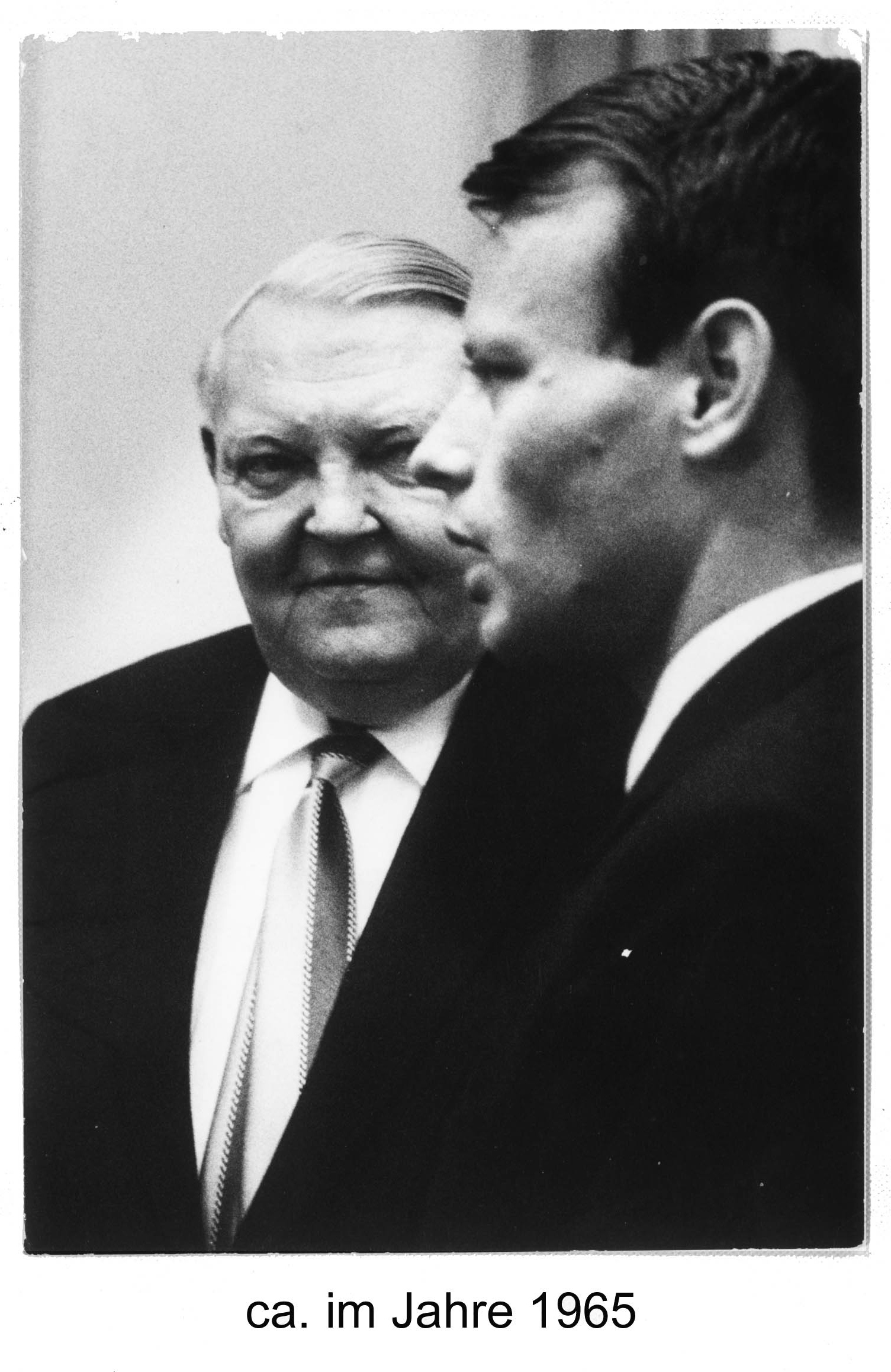
Uncle Lulu

That guy with the cigar on this West German stamp from 1987 is my great-uncle, Ludwig Erhard, or “Onkel Lulu” in our family.

Why is he on this blog?

Newspaper cutting of my dad and his uncle

Newspaper cutting of my dad and his uncle

Because is life is one of those I trace in my book, to show that that what happened to Hannibal and Scipio happens to all of us, one way or another.

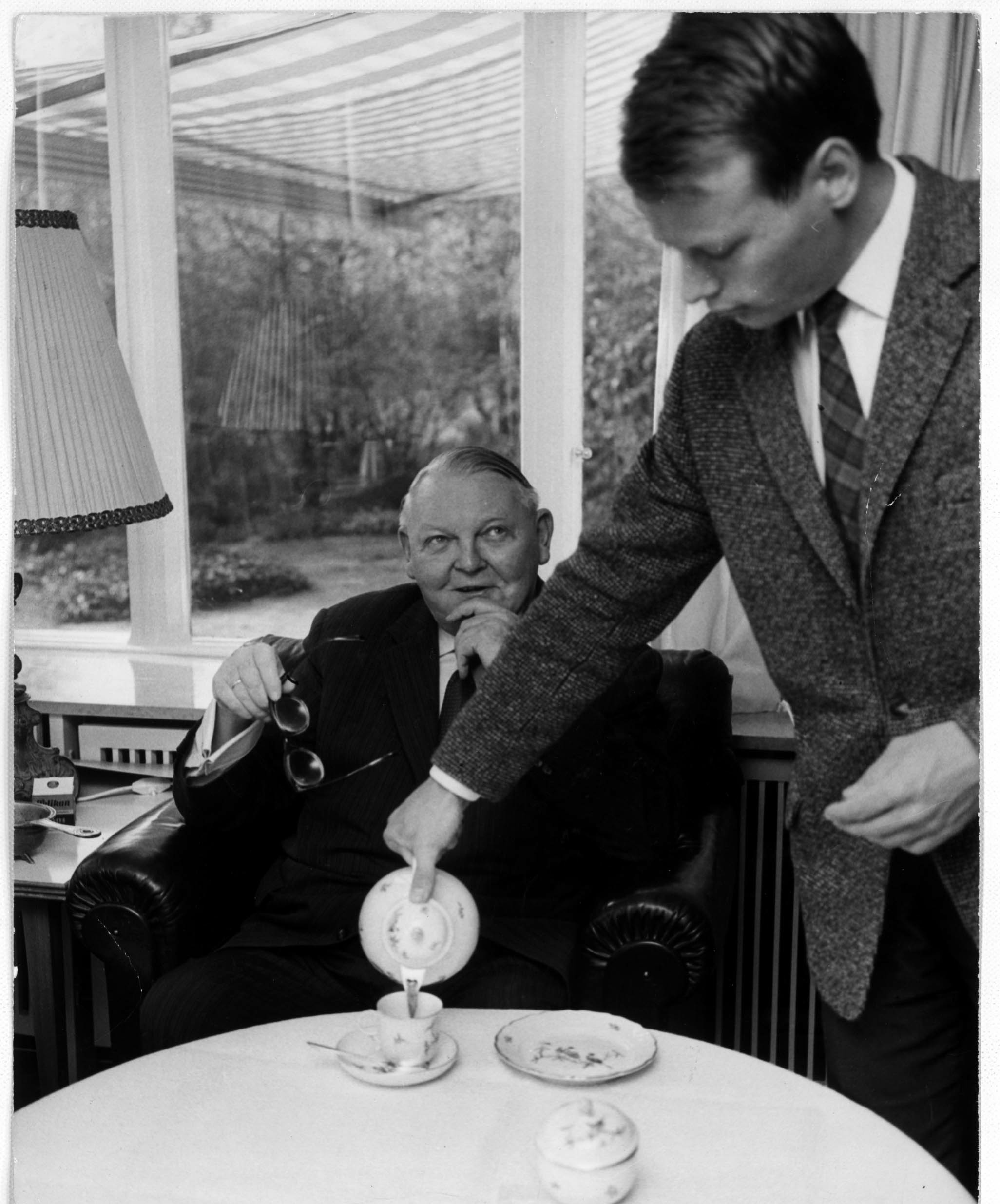
My dad pouring tea for his uncle, the chancellor, in the 60s

My dad pouring tea for his uncle, the chancellor, in the 60s

In Germany and continental Europe, Ludwig Erhard is a household name. In America, he is not, but should be. He is famous for being a founding father of post-war (West) Germany, its first economics minister, the father of its currency (the Deutsche Mark), and then its second chancellor (ie, prime minister). He is credited with causing the stunning economic growth of the 1950s, sometimes called (but not by him) an “economic miracle”. And he is probably the most steadfast proponent of freedom, tolerance and open and fair markets in German history.

Dad and Lulu again

As my father’s uncle and godfather, he practically raised my father after my grandfather died. I only met Lulu when I was very small (he died in 1977). He liked to hide Easter eggs for me in his steep hillside garden by the Tegernsee, an Alpine lake south of Munich. His influence lives on, in Germany, in our family, and now in my book.

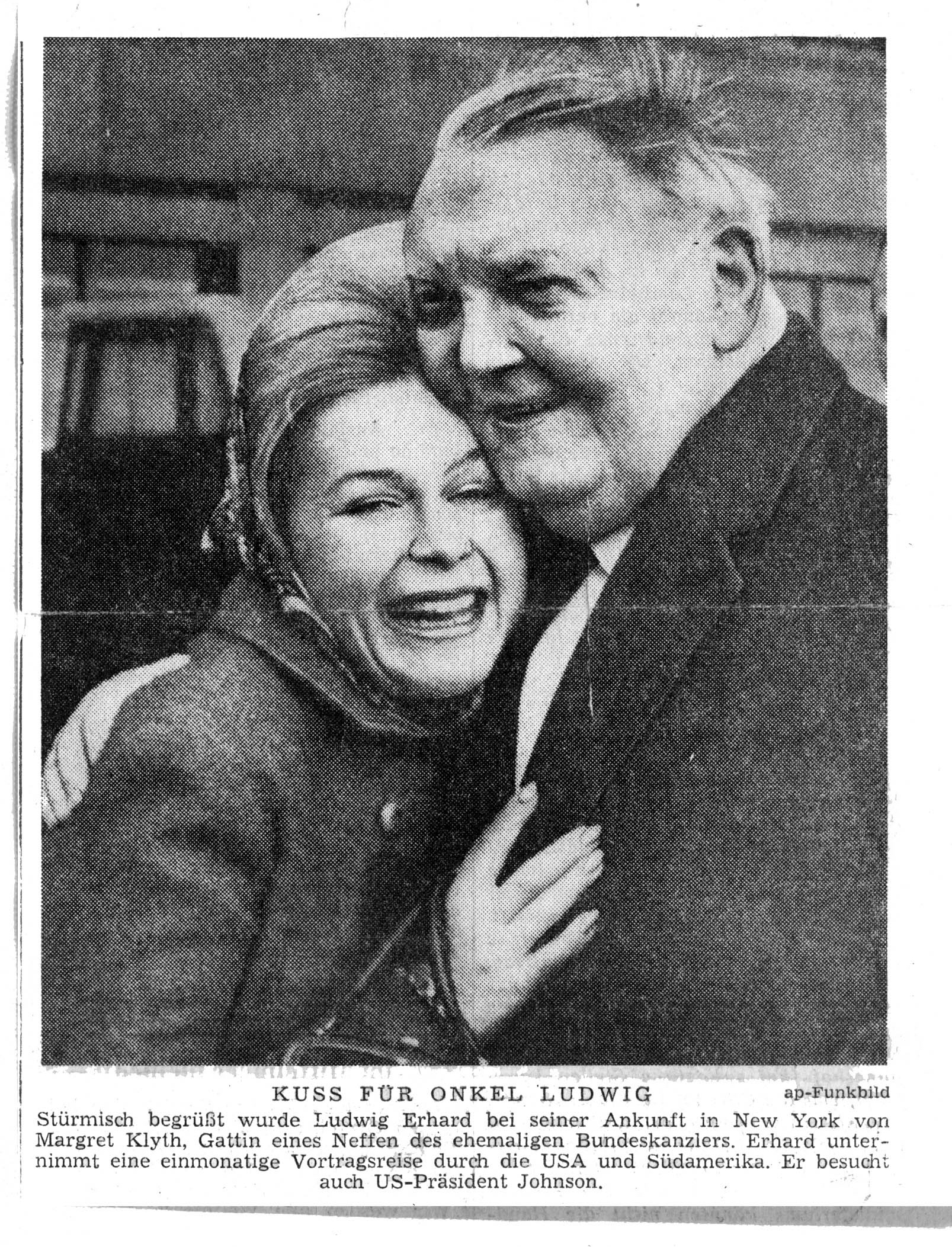
My mom with Lulu in New York, where I was born

My mom with Lulu in New York, where I was born