The father of biography

Plutarch

Plutarch

Let’s get back to the bibliography for my book.

Right now–while we’re still dealing with the ancient sources–I’m going through the texts in chronological order. And after Polybius and Livy, that brings me to Plutarch.

You recall that Herodotus was the father of history. Well, Plutarch must be the father of biography. Like Herodotus, Thucydides and Polybius, he was Greek. But Plutarch lived much later, in the first and second century AD–three centuries after Hannibal and Scipio. So I don’t use Plutarch because I think he has any scoops over Polybius, or more accurate information. Why, then, do I use (and love) Plutarch?

Because he was the first to take an interest in character. That’s what he wanted to capture: the characters of the great Greeks and Romans. For that he used the big events and deeds in their lives and, just as much, the tiniest but telling details. Occasionally, he may have stretched the facts a bit, but, hey, let’s relax about that and just enjoy.

In that respect, of course, Plutarch does exactly what I aspire to do in my book. I too want to capture how characters respond to success and failure, ups and downs.

Plutarch’s main work was his Parallel Lives (which we usually read in the John Dryden translation), in which he paired one great Greek with one great Roman. Alexander the Great, for instance, is paired with Julius Caesar, and so on.

Hannibal was neither Greek nor Roman, so we don’t have a Life with his name as title. But Hannibal, who is my main character, features prominently in several of Plutarch’s Lives: Fabius (who also plays a big role in my book), Marcellus (a Roman consul killed by Hannibal), Cato the Elder, Flamininus (conqueror/liberator of the Greeks and the man who finally hounded Hannibal into suicide).

Plutarch’s life of Pyrrhus, which I’ve quoted from, is one of my favorites, by the way.

The tragedy is that many of his lives are lost. And the loss that hurts most is, of course, the Life of Scipio, my other main character.


Bookmark and Share

Livy

I left off my series on the bibliography for my book with a long post on Polybius. Polybius, as I said, was one of the greatest historians ever, but most of his books were lost. This means that for the history of Hannibal’s war against Rome we have to rely heavily on another ancient source. And that is Titus Livius, or Livy in English.

There are big problems with Livy. He lived a century and a half after Hannibal’s war. Polybius had interviewed eye witnesses and traveled Hannibal’s route, but Livy did not even attempt any such research. Instead, he merrily plagiarized Polybius (and mentions him only once, by my count). At least we can take comfort from knowing that he had all of Polybius available to him, as well as other sources lost to us, such as Roman documents.

The next problem is that Livy had an agenda other than telling the best and purest history. Like his contemporary Virgil, Livy was writing under the reign of the emperor Augustus, who “restored” Rome’s republic after the long civil wars by replacing it with a monarchy in all but name.

Virgil responded by writing an epic poem, the Aeneid, placing Augustus in the context of a noble unfolding of destiny. A literary masterwork, but somewhat close to brown-nosing the great emperor. Livy sort of did the same, only in prose. So he starts his “history” with Aeneas’ flight from Troy, his journey to Italy, Romulus and Remus and so forth.

Aeneas flees burning Troy

Aeneas flees burning Troy

In general, Livy always makes the Romans look good and their enemies look bad. So the Gauls are unreliable and lazy brutes. The Greeks are savvy but slimy know-it-alls. The Carthaginians are either cruel or cunning or miserly or deceitful. Much of Livy is propaganda. Awfully entertaining propaganda, as it happens.

So if Polybius clearly emulated his fellow Greek Thucydides in trying to stay close to facts and analysis, Livy takes Herodotus as his example and embellishes and invents freely for the sake of a cracking good read. At that, he succeeds.

When the Europeans woke up at the end of the Middle Ages and rediscovered the classics, Livy became one of their favorites.

Personally, I couldn’t care less about Livy’s shortcomings. I’m in it for the stories, the characters, the scenes that I need to tell the story that I want to tell, which involves so many other people. More to come soon.


Bookmark and Share

America as the new Rome: Polybius and us

Anybody seen Polybius?

Anybody seen Polybius?

In my previous post on Polybius, I promised to tell you why he is so important to us Americans in particular. Here is why:

His ultimate explanation for Rome’s greatness was that Rome had a constitution that was uniquely and perfectly balanced between the three types of government: monarchy, aristocracy, and democracy.

An excess of any of the three, Polybius thought, was bad. Monarchy led to tyranny, aristocracy to oligarchy, and democracy to mob rule. (Worth pondering, you anti-elitist Palinistas out there.)

But Rome achieved balance: the consuls were the monarchical element, the senate the aristocratic, and the popular assemblies the democratic.

Our founding fathers agreed with Polybius completely. And so they set out to create that same, perfectly-balanced constitution. Arguably, they succeeded. So we are the modern Rome of Polybius!

(I can tell you what the American analogs to the consuls, senate and assemblies are, but I’ll let you guess first.)


Bookmark and Share

Polybius

First off in this series of posts about the bibliography for my book–in the category of ancient sources–is, of course, Polybius. His life is one of the most fascinating ever lived, and his importance to us–especially to us Americans, as I will explain in the follow-up post–is enormous.

Let me lead up to Polybius in three short steps:

Herodotus

Herodotus

1) The first “historian” in history was a Greek writer named Herodotus. He lived during the fifth century BCE, the golden age of classical Greece, and wrote what he called “enquiries”, or histories in Greek. So that’s where we got the word! The main matter he was “enquiring” into was the glorious victory of the Greeks over the Persians, which forever changed world history.

In style, Herodotus was a genius story-teller, and I love him for that. But he was, shall we say, liberal with the facts and the truth. He tells us that Ethiopians have black semen, and so forth. He did not lie, but he embellished. But what the heck! He was the first.

Thucydides

Thucydides

2) Next up, one generation after Herodotus, was another Greek (it’s pretty much all Greeks from here on for a few centuries), named Thucydides. He was critical of Herodotus’ methods and wanted to bring a more factual, rigorous and scholarly style to history-writing. And I love him for that just as much as I love Herodotus! Together, Herodotus and Thucydides gave us history, my passion, just as Plato and Aristotle, another pair of Greeks one generation apart, gave us philosophy.

Thucydides had another war as his subject, as important to world history as the Greco-Persian wars. He wrote about the Peloponnesian war between Athens and her allies and Sparta and her allies. As the the Greek victories over the Persians had made the Greeks (even though there was no country called Greece) preeminent in the known world, the fratricidal war among the Greeks prepared their political decline. It was a tragedy.

In the process of describing this tragedy, Thucydides brought an analysis to bear that is also considered the foundation of all International Relations, and in particular of Realism in world politics (think Kissinger). That was my subject in graduate school, in case you care.

3) Next up were several other Greeks, including Xenophon, who would be giants in their own right were they not wedged between Thucydides and our guy, Polybius. So, because this is along post already, we will skip over them.

4) And now: Polybius.

He was a Greek. No surprise. In style he took clearly after Thucydides rather than Herodotus, which is to say that he believed in facts, research, cross-examination of eye witnesses, and above all in travel. Polybius  personally traced the route of Hannibal in order to write about his war.

Polybius was born about two centuries after Thucydides died, so the Mediterranean had changed completely. The Greek city states had declined in power after the tragedy that Thucydides described and then been swallowed up by Macedonia and Alexander the Great. Then Alexander died and his generals carved up the eastern Mediterranean into huge monarchies. In the western Mediterranean, Carthage was still the superpower.

But–and this is the phenomenon that Polybius tried to explain in his Histories–all that changed during his life time. Rome survived its war against Hannibal and Carthage by a hair. Then it turned east toward the Greek world until it dominated the whole Mediterranean. Polybius wanted to explain how and why Rome was able to do all that.

The circumstances in which he did his research would make a thriller all by themselves. He was a Greek aristocrat and when the Romans got around to his part of Greece they decided to send 1,000 hostages back to Rome just to keep the Greeks well-behaved. Polybius was one of them. He went to Rome as a prisoner for sixteen years!

But the Romans had a very nuanced and complex relationship towards Greeks. They dominated them politically and militarily but they admired and envied them culturally. A big historical thesis is that Rome was both captor (militarily) and captive (culturally).

Polybius’ fate shows that. He wasn’t thrown into a dungeon in Rome but became the guest and teacher in the household of the great Scipiones. Yes, that’s the family of great Scipio, Hannibal’s nemesis. So he had access to all the family archives. He and the younger Scipiones became very close, and some scholars say that this may have biased him towards their role in the Hannibalic war. Personally, I don’t care.

Polybius also stood next to a Scipio (the adopted grandson of Scipio the Great) when the Romans finally burnt and razed Carthage to the ground.

As a practical matter, Polybius then had to tell the story of all three wars between Rome and Carthage leading up to this moment. And for that, he talked to people who had known Hannibal, to veterans on both sides, crossed the Alps and so forth. This is why he is my, and everybody’s, first and best source.

Now, there is only one huge problem with Polybius. It is this: Most of his writing was lost. You may have other things to worry about in life, but I actually cringe when I think of what that means.

In practical terms, it means that we need a few other sources. Next, After the follow-up: Livy.


Bookmark and Share

Sarah Palin: barracuda borealis

Maureen Dowd

Maureen Dowd

I’m trying to figure out how I feel about Maureen Dowd’s column in the New York Times today, half of which she writes … in mock Latin!!! That’s right. The language of Cicero and Caesar–and, of course, of my guys, Fabius and Scipio–to analyze Ioannes McCainus and Sara Palina.

You loyal readers will know that I am all for the classics, for various reasons including this one and this one. Perhaps Dowd’s column helps. Still, how close to a gimmick she comes, from a writer’s point of view. I get it, but I studied Latin for four years.


Bookmark and Share

Hannibal’s brother and … Mayonnaise!

Every now and then I convince myself that that I know quite a bit about ancient history, and then I stumble across something not just new but whiplashingly new. Did you know that the word mayonnaise is named after Hannibal’s youngest brother?

According to Livius, it came about as follows: Hannibal’s brother was named Mago (a common Carthaginian/Punic name), and he

… lives on in a most surprising way. On Menorca, he had founded the city that is still called Port Mahon. The typical local egg sauce that has conquered the world is known as mayonnaise.

And while we’re on the subject of Hannibal’s brothers:

Hasdrubal Barca's head, before the Romans got it

Hasdrubal's head (before Roman cosmetic intervention)

Hasdrubal, who was younger than Hannibal but older than Mago, died valiantly in battle against the Romans as he tried to bring a second invasion army to Italy to support Hannibal.

The Romans cut off his head. Then they marched it to the other end of Italy and catapulted it into Hannibal’s camp. Hannibal, who still did not even know that Hasdrubal had arrived in Italy, last saw his brother’s face …. as it rolled toward him.

So it goes, as Vonnegut would say. But those Romans sure had a way of doing things.


Bookmark and Share

Pyrrhic victories

Heard about my victory?

Heard about my victory?

You’ve heard of Pyrrhic Victories, which are defeats disguised as triumphs–in other words, Kipling-esque impostors of the sort that I will be describing in my book. But do you know why they are called that?

It’s thanks to Pyrrhus, who is well worth five minutes of your time.

Pyrrhus was the ancient world’s equivalent of a dumb jock whom all the girls loved, who bashed the equivalent of Budweiser cans on his forehead and beat up the enemy football team but never quite figured it all out.

Put differently, he was the King of Epirus in northern Greece, and wanted to be like Alexander the Great, who died a couple of generations before him. (Pyrrhus in turn died a generation before Hannibal was born.) He wanted to be a hero and to conquer. Basically, that’s all there was to it. And he was great at it–brave, courageous, strong. Plutarch says that once, when he was thought dead on the battlefield, he just got up and cleft an enemy soldier in two pieces with one blow of his sword.

One day, an opportunity came up: Tarentum, a Greek city in southern Italy that was fighting the Romans, invited Pyrrhus to come over and fight Rome on their behalf. Pyrrhus was thrilled. As he was preparing to leave for Italy with his army and his war elephants (sounds a lot like Hannibal, doesn’t it?), he had a conversation with the wise Cineas. This is one of my favorite exchanges in antiquity. Here is Plutarch’s version:

Cineas: If we beat the Romans, what should we do next?

Pyrrhus: Why, then we’ll be masters of all Italy.

Cineas: “And having subdued Italy, what shall we do next?”

Pyrrhus: “Sicily.”

Cineas: “But will the possession of Sicily put an end to the war?”

Pyrrhus: “We will use that as the forerunners of greater things” such as Libya and Carthage. Would anybody resist us after that?

Cineas: “None,” for then we can take Macedon and even all of Greece. “And when all these are in our power what shall we do then?”

Pyrrhus: “We will live at our ease, my dear friend, and drink all day, and divert ourselves with pleasant conversation.”

Cineas: “And what hinders us now, sir,” from doing exactly that?

At this Pyrrhus was nonplussed. But left for Italy anyway!

Next, he had his Pyrrhic victories. He beat the Romans, but each time he lost so many men and gained so little that once, when congratulated on yet another victory, he sighed: “Another such victory over the Romans and we are undone.”

Eventually, as he was wont, he got distracted. There was another opportunity for glory in Sicily, so he sailed around a bit there and bashed a few heads. You can see on that map what that trip (dare I say his life?) looked like.

Courtesy PIOM, via Wikimedia Commons

Courtesy PIOM, via Wikimedia Commons

In any event, Sicily also failed to make him happy, so eventually he made his way back to Greece.

Once home, he kept fighting wars here and there. I mean, it’s a hard habit to kick! His end came as it had to come (irony alert): He was in the middle of some vicious street fighting in a Greek city, when an old woman on a rooftop dropped a tile, which landed on his heroic pate and knocked him dead. So it goes, as Vonnegut would say.

Have you ever been a Pyrrhus in your life? Do you know any Pyrrhuses?
Bookmark and Share

Hannibal’s life in eight minutes

Well-made YouTube video (meaning: hewing closely to Polybius and Livy) about Hannibal’s life, by Wolfshead:

Interesting moment of interpretation: why Hannibal, in this version, chose not to take Rome itself, which was the single biggest decision of his life. “We are not animals,” he says here.

(Also: did I detect stirrups on the cavalry? Maybe not. There weren’t any in those days.)


Bookmark and Share

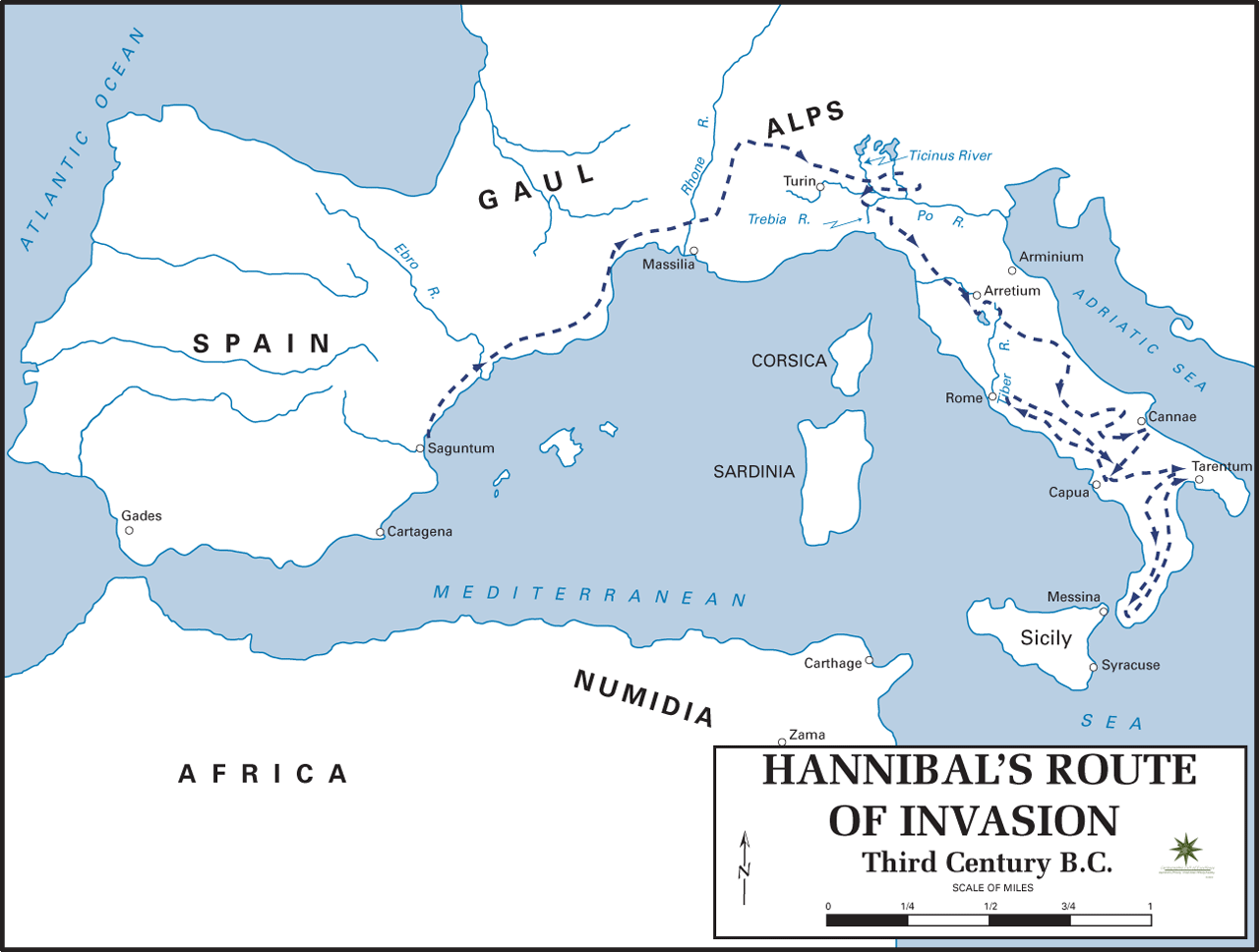
The map of Hannibal’s march and life

Join me for a moment in having fun with this map below.

It comes to us, via the Wikimedia Commons, from Frank Martini, a cartographer in the Department of History at the United States Military Academy.

There are two ways of looking at this map–one obvious and one surprising and cheeky–and I will avail myself of both. Bear with me. First the map, and the obvious:

What we see here, obviously, is the western Mediterranean at the time of the Second Punic War (the “Hannibalic War”). Notice Carthage at the tip of northern Africa (in today’s Tunisia); Cartagena or “Little Carthage” in Spain, which I mentioned in an earlier post; Gades, which is today’s Cadiz; Saguntum (Sagunto), which was ethnically Greek; Massilia (today’s Marseilles), also ethnically Greek; Turin (Torino) which was not yet party of “Italy” but part of Gaul; and Ariminum (Rimini), the Roman colony at the edge of their frontier with the Gauls.

Now look at Hannibal’s march itself. In 218 BCE he crossed the Pyrenees and into Gaul. The line casually crosses the Rhone, even though this involved one of the most colorful operations in history (of which more in a later post–think elephants on rafts), and then, equally casually, crosses the Alps (of which much, much more in later posts).

You then see where Hannibal won his famous victories, at the Ticinus (more of a skirmish), at the Trebia, at Lake Trasimene and at Cannae. And then you see the line of his path getting…. confusing!

Now the less obvious way of looking at this map: Squint! As you squint, look only at the line of the march. It is a fitting life trajectory for Hannibal himself. It rises early and steeply, peaks, then declines and loses itself completely in a confused and erratic hairball.

How would you draw the map if it were proportionate to time, rather than distance? The entire stretch from Cartagena to Cannae, his greatest victory, took a little over two years. All the twists and turns after Cannae (there were actually far too many to draw on a map) took…. fourteen years!

After those fourteen years, Hannibal lived another nineteen years until he committed suicide, but most of that took place on a different map, in the eastern Mediterranean.

And yet, if you read the existing histories, you would think that 90% of Hannibal’s life took place in those initial two years.

Those years are the impostor years. The next thirty-three are the story of how and why he realized that his triumphs had been impostors. And this, in my book, is where his life becomes universal and directly relevant for our own lives today.

Now, let’s have even more fun and turn the map around:

Now you have, more or less, the life trajectory of the Romans, in particular Fabius and Scipio, my two other main characters.

Kipling’s impostors, you see, visited with them in mirror image.

Why and how did all this happen over all those decades? In exactly the same way as it happens to most of us in our much smaller(-seeming) lives, it turns out. That’s why I’m writing a book about it.


Bookmark and Share