Good writing, II: Orwell vs. academia

In the interests of cross-cultural diversity, I thought I should just update my post on George Orwell’s six rules for good writing with the French academic counterpart.

I wouldn’t single out French academia–without any doubt, academic writers in all countries will applaud me–except that I happen to be re-reading Serge Lancel’s impressively researched biography of Hannibal. And, well, I did spend three summers in France, trying to read their books.

Here goes:

George Orwell
French Academia
Never use a metaphor, simile or other figure of speech which you are used to seeing in print. Only use phrases that tenured professors or famous dead scholars have already used
Never use a long word where a short one will do. There are short words?
If it is possible to cut out a word, always cut it out. Say the same thing over and over again until you hit your wordcount
Never use the passive where you can use the active. Only use the passive; anything else is for amateur lightweights
Never use a foreign phrase, a scientific word or a jargon word if you can think of an everyday English equivalent. Use utilize Greek, Latin or Sanskrit terms. The more banal your thought, the more exotic the word.
Break any of these rules sooner than say anything outright barbarous. Never break these rules. They are rules.

Bookmark and Share

George Orwell, Blogger

Perhaps it was too obvious until now. What, you mean .. publish the diaries of the great writers, thinkers and statesmen of the past? Just like that? For all to see?

And now it is obvious. They’re publishing George Orwell’s diaries, one entry at a time, as if he were a blogger today. Genius!

For a blogger, the first reason to read them is the sheer relief that comes from seeing that even the great Orwell occasionally posted entries that are, well, banal. See, it’s no shame.

The other reason, of course, is that he is still Orwell, the same Orwell who, among other things, penned Politics and the English Language, probably the most incisive essay ever written on language as such.

This is probably for another post, but suffice it to say now that our own style guide at The Economist begins with Orwell’s six cardinal rules for writing:

  1. Never use a metaphor, simile or other figure of speech which you are used to seeing in print.
  2. Never use a long word where a short one will do.
  3. If it is possible to cut out a word, always cut it out.
  4. Never use the passive where you can use the active.
  5. Never use a foreign phrase, a scientific word or a jargon word if you can think of an everyday English equivalent.
  6. Break any of these rules sooner than say anything outright barbarous.

(Notice that the sixth rule is very British, meaning subtly ironic.)

And now: Could every custodian of every great person of the past who left behind diaries and letters please, pretty please, blog them? It would be a boon to mankind.


Bookmark and Share

Into a Golden Age of story-telling

Indulge me for a moment as I take a quick detour away from the book and book-writing as such, and zoom out to story-telling in general, with one interesting anecdote.

I was having lunch with Andrew Haeg, a radio journalist at American Public Media who is now doing research at Stanford about the future of journalism. We were sitting there at Chez Panisse (tough life, I know), brainstorming about citizen journalism, audience participation, media fragmentation, the blogosphere and the “mainstream” media, and so on. I’ve been thinking on and off about these things since I wrote a big report (starting here) in The Economist about it, over two years ago. Andrew will be thinking full-time about it for the next year.

A minor epiphany occurred when Andrew began a sentence saying something like: “Yeah, but the best story on the sub-prime crisis….”

I interrupted him to complete his thought: “…. was that episode in This American Life, right?” Why, yes, said Andrew, that’s what I was about to say.

Now, I had not even listened to the episode at that point! But my wife had recommended it to me a few days earlier. And in one instant, using old-fashioned (offline) social networking, I had saved myself hours of hard work and boring reading, because I knew that I was going to go home and listen to that particular episode. If two people in my social circle independently recommend the same story-teller, I would be crazy not to take the hint.

Insight Nr 1): Great stories well told eventually find their audience.

How? Through the recommendation network of our social networks, just as in the past.

The “new media”, from Facebook to blogs, by expanding our social recommendation circles from the merely offline to the off-and-online, make these introductions between story-tellers and audiences even more fluid.

Case in point: I noticed a status update from my friend Michael Fitzgerald on his Facebook page about how he was reading Norse myths to his spellbound kids. I immediately badgered him for which particular story-teller he was reading from, and now I am ordering the book.  No sense wasting my time with the bad version.

The new media, in other words, not only do not hurt traditional story-tellers, but they positively help them, provided that ….

Insight Nr 2) … provided that the story-telling is actually good.

What did I find when I got home and listened to that episode in This American Life? Everything that Ira Glass, the show’s host, and his team are so good at:

  • The complex made simple.
  • Character! Colorful, richly painted individuals who found themselves involved in a global financial disaster.
  • Scene. Sound-painted place and context to reinforce the characters.
  • Plot. A story-line that connected this unlikely combination of individuals and thereby–effortlessly, en passant–explained a fiendishly complex subject.
  • Humor and, yes, irony (see my earlier thoughts on irony here)
  • Empathy (rather than judgment) for the characters
  • Suspense

In short, I found what great story-tellers have always provided. No change.

Insight Nr… Hypothesis: New media disrupt short-form but not long-form story-telling

YouTube has forever changed the genre of short video clips. Blogs have forever changed the genre of short text news and opinion. If you were a traditional story-teller producing short video clips or short news or opinion articles, you need to change and enter the great, gushing Haiku stream of the new media.

But longer stories? We all gladly exit the stream, get cosy, and enjoy a long story well told. A two-hour film, a 200-page book, a one-hour podcast. It’s not the medium (text, audio, video) that matters, but the experience. Lean-forward versus lean-back. Eager to be interrupted versus eager to be immersed.

As the short-form media improve the introductions between story-tellers and audiences, the golden age of story-telling seems to have just begun.


Bookmark and Share

A moratorium on blurbs

Let’s all give our whole-hearted support to Eric Simonoff, a literary agent at Janklow & Nesbit Associates, who recently told the New York Times Book Review that “we should impose a moratorium on blurb-hunting.”

What are blurbs? Why, those phrase snippets on the back of books that allegedly make you crave the product but usually sound gushingly, ridiculously banal or over-the-top.

I have myself blurbed one book, been asked to blurb a few others, and will, no doubt, have to grovel for blurbs on the back of my own book whenever it comes out. Oh how I dread the thought already. Simonoff’s proposal is so on target because everybody–writers, authors, probably even readers (secretly)–hate this blurbing thing. As the article says:

Caveat lector! The endorsements on books aren’t entirely impartial. Unbeknownst to the average reader, blurbs are more often than not from the writer’s best friends, colleagues or teachers, or from authors who share the same editor, publisher or agent. They represent a tangled mass of friendships, rivalries, favors traded and debts repaid, not always in good faith…

For writers, to blurb or not to blurb can be a tricky matter. Blurb too little and you’ll have a hard time drumming up the requisite superlatives when your turn comes. Blurb too often, or include too many blurbs on your book, and you might get called a blurb whore.

Quite so. A moritorium then! Let’s do without blurbs for a while and see whether or not we’ll miss them.


Bookmark and Share

More on Shakespeare’s “Like you like it”

So you’ve heard me nag, nag, nag about the issue of like/as, first and foremost here, and then here.

Turns out that Paul Yeager and Sherry Coven have fired at the same target, in their wonderful blog for language lovers.

I see that I’m in good company….


Bookmark and Share

On irony

Having a sense of irony can be an isolating and lonely experience if you find yourself living in America. I should know.

While contemplating a post on irony, I pinged a former colleague of mine, Gideon Rachman (who is now a columnist and blogger at the Financial Times).

Gideon Rachman

Gideon Rachman

That is because Gideon, as a Brit in the lovably dysfunctional family that is The Economist, has a great sense of irony. We teem with ironic Brits at The Economist.

I had a reason for molesting Gideon. He is the only one of us who dared make himself our Irony Correspondent. He did this in the Christmas Issue of 1999, with this piece on the role of irony in British diplomacy. Clearly, he must be the expert.

And what did I get in return? “I think you are turning into a bit of a hippy” (sic), he chastized me in his email. All this living in California cannot be good for my writing, he stipulates, because

English irony, with its self-deprecation and use of understatement is almost the opposite of what I see as the Californian tone of voice – earnest and gushing.

Earnest and gushing. Spot on. If there is such a thing as a quintessentially American “voice”, it is earnest and gushing. Often indignant. Occasionally sarcastic. Sporadically narcissistic. Don’t get me wrong. American writing can be moving, powerful and … good. But it is rarely ironic.

Irony: Definition & eulogy

Irony is not only the highest form of humor (whereas sarcasm is the lowest), it is a sure sign of a civilized mind. I define it as

the non-aggressive savoring of contradictions in life and people (others and yourself) and of turns of phrase that are slightly and adroitly off-key and thus meaningfully surprising.

So irony is not merely saying the opposite of what you mean. Examples:

Oh, that’s so cool!, when it’s clearly not, is sarcastic and a knee-slapper around the Neanderthal campfire.

Protesting that rumors of your death are wildly exaggerated, as Mark Twain, an ironic Yank (they exist), did, is ironic. (The irony is entirely in the word exaggerated.)

Irony is not about punch lines. It’s not about jokes that bring the house down. It is about seeing the world in a certain way. That way is worldly and cavalier (another British concept). In this world view, it is unseemly to be outraged all the time, as Americans seem to be. Rather, one is expected to be shocked-shocked!, which is subtly different. The insanity of “it all” becomes your backdrop. It may amuse you; it may cause you pain; but it also produces the raw material for your irony. You do not use it to lash out against others (that’s sarcasm’s job). You use it to commune with some others, those who share your sense of irony.

Put differently, you could almost say that irony is Buddhist humor: Wit borne out of compassion, since we’re all in this mess together, whatever that mess happens to be.

How I write

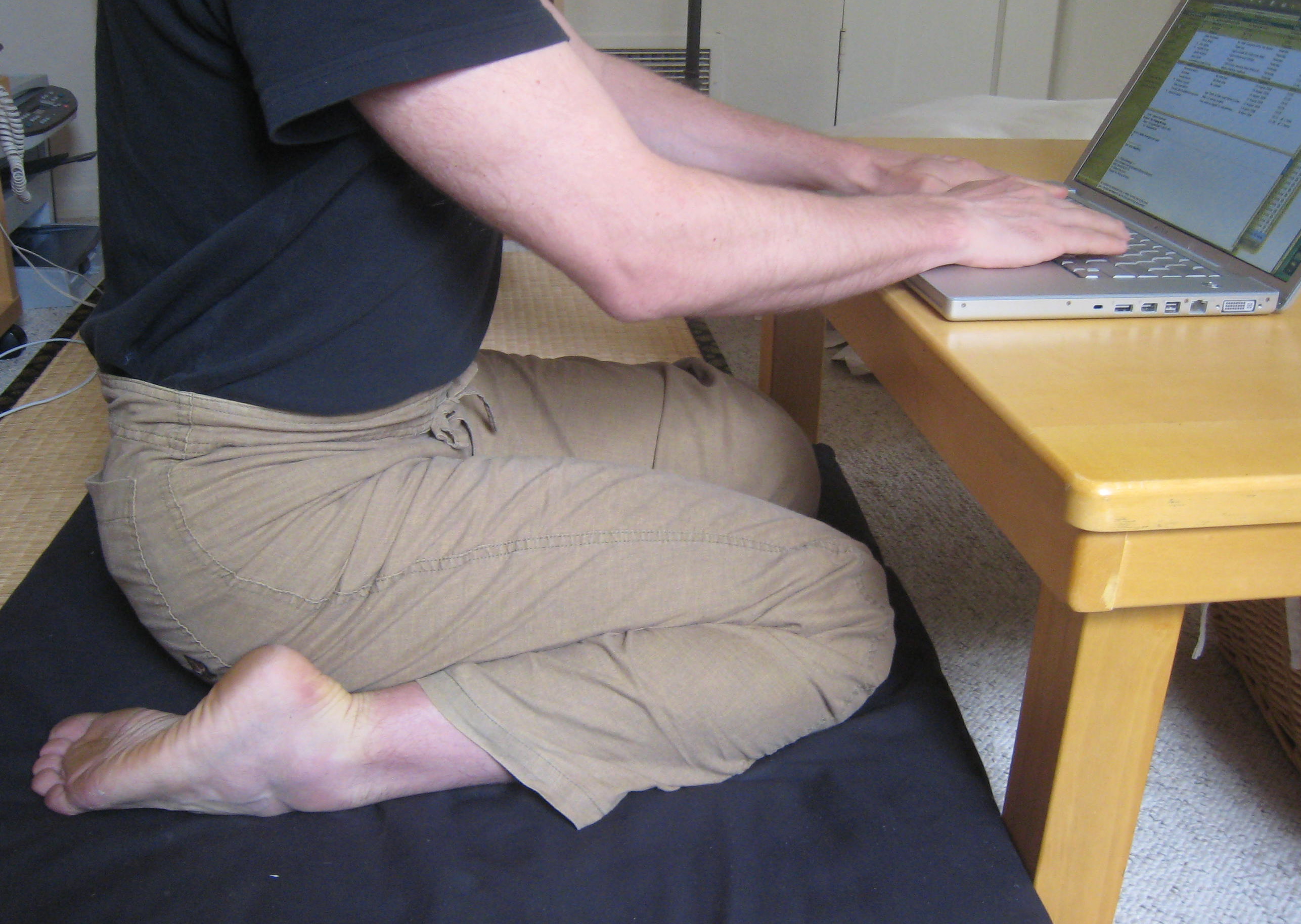
I meant that title tongue-in-cheek, and quite literally. Here is how I write: On my tatami mat in front of my laptop, sitting either in Lotus (Padmasana in Sanskrit) ….

… or in Hero Pose (Virasana in Sanskrit). Which is to say, with my butt between my heels, as below. (For the etymologists among you, the vira, or hero, in the pose’s name is the root, via Latin, of our virtue, virility, triumvirate, et cetera.)

Having said that, when I first get into my “office” in the morning, and I’m still stiff and cold, I usually warm up a bit first. So, for a while I might sit in half-Lotus, with one leg on top of the other. Or I might kneel, Japanese-style. Or sit in cobbler’s pose.

But… why? Why would I do such a thing? Can I not afford a chair?

I can. I just decided a few years ago to “ditch my chair,” for the reasons I described in this Yoga Journal article. Call me eccentric. It’s allowed.


Bookmark and Share

More Amy Tan, on creativity

Just following up on this weekend’s “writer’s Koan” by Amy Tan, best-selling author. For those of you who are interested, here is Amy speaking at the TED conference about the subject of creativity.

And for those of you who haven’t heard of the TED conference, it’s a sort of “cooler, hipper Davos,” traditionally held in Monterey, California, but now moving to L.A. I’ve gone once. Mind-blowing. A smorgasbord of intellectual stimuli from all fields of human endeavor–design, politics, philsophy, ideas, physics, environment, etc. And now it’s all online!

I digress. Here is Amy:


Bookmark and Share

Writer’s Koan of the day

Amy Tan, best-selling author, in today’s New York Times Magazine, when asked whether writing is a kind of performance, thus giving her anxiety:

No. It’s a meditation. It does not have to do with personal humiliation until after it gets done.

(Incidentally, she will feature in two of my chapters. I’m intrigued in the effect her mother had on her success and perceived failings, and of course whether any of it has been a Kiplingesque impostor. Amy, if you’re googling yourself, will you give me an interview?)


Bookmark and Share

The treacherous First Person

I’ve been meaning to share a tidbit of a conversation I recently had with my colleague at The Economist, Tom Standage, while we were having lunch at Zuni in San Francisco. Both of us are writing books, both of which are not traditional “histories” but have a strong element of history, and indeed assume a reader intellectually curious about history and open to seeing its timeless legacies in the world around us today. Tom’s is about food throughout history and to our own day. Mine is about life, specifically success and failure, throughout history and to our own day.

The interesting tidbit for writers, however, was our spontaneous and passionate agreement on a matter of literary fashion: the First Person. We were not entirely against it, but extremely skeptical.

American publishers tend to push writers into “personalizing” their non-fiction stories. Journalists, especially columnists, are increasingly doing the same thing. Personalizing can indeed be a good thing, in the sense that good stories need characters, and writers need to present them colorfully. The problem is that “I” tends to be the wrong character to put into the story.

If you are writing a book about an earth-shattering event, conspiracy, cover-up, war, disease or what have you, and you were genuinely a protagonist in that story, by all means, personalize away. Tell us what happened to you. That is the story.

But if you’re just telling a good story, and then looking for ways to use the word I, please stop. Why do we have entire paragraphs in The Atlantic (otherwise one of my favorite magazines) whose sole purpose is to say that so-and-so “told me” such-and-such, which was probably utterly banal? Well, because the writer wants to prove to us that he was there, you see. At The Economist, we believe that readers already assume that we were there and, besides, don’t much care either way, because they just want a cracking good story or analysis. So by I-ing and me-ing, you’re really just getting in the way of the story. You’re turning sophisticated readers off.

Once you try writing without the First Person, you may find it surprisingly difficult. Which is why it is such excellent discipline! Without the I, you can’t fake it. You can’t give us the three-paragraph “color” opening about how “I was walking into his office on a sunny March day” and so forth. You actually have to deliver a detail or observation that is telling. Much harder to do!

So I kept telling my students at Berkeley’s Graduate School of Journalism to try leaving the First Person out. They kept ignoring me. Through blogs and email and all those columns, it has seeped into our writing culture. It’s just so much easier.

The result is reams and reams of writing that is narcissistic. I could highlight one or two high-profile books and articles, but I know better. (Also, I admit that some of them do become best-sellers, which may be why publishers push the First Person so hard.) But next time you’re reading an I piece, try stripping out the First Person and seeing what content or substance is left. If a lot, good article. If not a lot, it was a narcissist.

But I did say that neither Tom nor I was* completely against the First Person. I’m using it in this blog, obviously. (Then again, a blog is by definition an ultra-personal medium.) And I’ve also, after agonizing about it, decided to use it in my book, which I am–yes–“personalizing.”

The challenge I see is to do this without being narcissistic and interrupting a cracking good story for the heck of it. In short, it is about finding an authentic voice or tone. That, of course, is true whether you’re using the First Person or not.

(*Bonus: did the was surprise you? Did you think it should be were? Nope, was is correct. More to come in future posts.)
Bookmark and Share