Observation, satire or snark?

Cintra Wilson

Cintra Wilson

Snooty, bitchy and arrogant? Or edgy, witty and incisive? In short, bad writing or good? That is the question.

That’s Cintra Wilson in the little mug shot above, and I would have absolutely no interest in, or knowledge of, her if she had not just re-inflamed some old kindling for all writers. Do not mistake this post as being about the content of the text I am about to refer to–I neither know nor care about fashion. In this post I care only about the issue of writer’s voice.

Background:

Cintra wrote a review in the New York Times of a J.C. Penney store that has opened in Manhattan. The review was, shall we say, scathing. Penney, she said, is a

dowdy Middle American entity

that, in essence, has no right to be on this island of skinny snobs. The clothing is full of polyester, the racks are full of sizes 10, 12 and 16, but not Cintra’s 2; and, perhaps most damningly, the store

has the most obese mannequins I have ever seen. They probably need special insulin-based epoxy injections just to make their limbs stay on.

Reaction:

Perhaps predictably, the country appears to have gone to war against Cintra. Bloggers are attacking her, for example herehere and here. Tenor: Cintra is an asshole; go shop at J.C. Penney just to spite her!

The New York Times, meanwhile, appears to have been receiving bags (gigabytes) of hate mail, decrying the newspaper’s

fat hatred, class bias and nasty humor.

The journalist, her editors, and the entire damn publication must be “smug”.

In response, Clark Hoyt, the Times‘ “public editor” or ombudsman (a bizarre and navel-gazing role, by the way) pens a characteristic mea culpa, oozing sudden humility on the newspaper’s behalf.

He does a great and succinct job of summarizing the eternal and underlying tension that is relevant for all writers when he asks:

What is the difference between edgy and objectionable? Or, as one reader … put it: How do writers “navigate the fine lines between observation, satire and snark.”

He even prompts the newspaper’s executive editor, Bill Keller, to say that

he wished it had not been published.

Wow. Cintra must be up there with Judith Miller and all those articles in the run-up to the Iraq War if she deserves editorial disavowal.

Cintra, meanwhile, has apologized on her blog and is back-peddling.

Exegesis:

So let’s contemplate Clark Hoyt’s question: How do we navigate that fine line?

Allow me to remind you that the publication that I happen to write for, The Economist, is accused of smugness on an hourly basis. And every time somebody calls us smug, somebody else is simultaneously calling us “refreshing” or “incisive” or something even more flattering.

Furthermore, I am right now trying to figure out just what my appropriate voice is in the book that I am writing.

So, just a few observations:

  1. Navigating that fine line is just one of the things that makes good writing so incredibly hard. Because yes, it really is hard, otherwise a lot more people would be doing it. So remember that, readers, when you write your angry (snarky!) hate mail to us journalists.
  2. Would you really–I mean really–prefer to shut up the Cintras out there, to sanitize them, to edit in the “on one hands” and “on the other hands”, to give 50% of the article to those who say that Iraq did have WMD and 50% to those who say it did not, because, you know, 50-50 is “balanced” and 10-90 might offend the heartland? You get my drift.
  3. Or would you prefer an authentic, damn-the-torpedoes, honest voice, one that tells it as its owner sees it and is prepared to explode with the torpedoes?
  4. Bill Keller: If you really do wish that Cintra’s piece had not been published, why did you not, as editor, nix it? Since you did not nix it, what the f*** are you doing now disavowing your writer?
  5. There is an easy way to address the reaction to pieces such as Cintra’s: Publish more pieces by other writers with an equally authentic but different voice. This would indeed be edifying for your readers. But do not dilute the copy that comes across your desk into the lukewarm bilge that would, at last, be the end of good writing.


Bookmark and Share

Writing better dialogue

Good at dialogue

Good between the lines

I don’t normally write dialogue in my day job at The Economist. Nor is dialogue a major part of my forthcoming book. But it is a small part of it, which is to say that I’ve inserted precisely one single dialogue between Hannibal and someone else that is not actually in the ancient sources (ie: Livy, Polybius, Cornelius Nepos, Appian, etc). This was necessary, as you guys will eventually see when I start blogging parts of the book.

The discovery that I made as a writer is that dialogue is

  1. very different from other prose, and
  2. difficult to do well, really well.

It should sound the way an actual conversation would sound, between real people, and between the specific people in their specific context in that particular dialogue. Not corny but meaningful, not overpolished but not sloppy.

In my first draft, the particular dialogue I am talking about was one of the weaker parts of the chapter it appears in. And that’s OK. I knew it at the time.

In this second draft that I am working on right now, I think I finally hit the sweet spot.

How? It helped that I practiced.

I wasn’t even aware that I was practicing when I wrote down–essentially transcribed–the conversation I had that night in a taxi cab when things went a bit wrong.

But then Cheri said in the comments that the dialogue reminded her of Hemingway’s A Clean Well-lighted Place. That was charitable of her, and it is not necessary to take her compliment too literally. But it did make me go and read that dialogue by Hemingway, and to my delight I think I understood what Cheri meant: There was a certain sparse, masculine, between-the-lines, staccato tone to the whole thing. It sounded the way a real dialogue between men sounds. Dialogues between women are very different.

And so I was able to transfer, not the content, but the tone of that dialogue into my second draft. It works. And so this is yet another way in which my dabbling in blogging has helped my craft as a writer.

Bookmark and Share

American attitudes toward prisons

My policy, as most of you know by now, is not to link to my pieces in The Economist week after week, unless there is a special reason, because that would be, well, tedious and annoying.

So why link to my piece in the new issue on California’s prison overcrowding?

To make two separate and unrelated points:

1) the importance of length, once again.

It always amazes me, after all these years, how short most of our pieces in The Economist are. The pieces inside the regular “sections” are called “notes” in our nomenclature. Because we have fixed (paper-issue) layouts that determine article length, most notes are either 500, 600 or 700 words. For this note, I asked for 700 words, was told to make it 600, and the final piece ended up at 520.

That’s in effect a blog entry. Most people don’t realize how much harder it is to write a short article than a large article. The folks at the New Yorker can blather on and on (“On an overcast Monday afternoon, I strode across Fifth Avenue to interview John Smith, ….”). We have to get to the point. There should be some nuance, some color, and we should cover the main bases, but all in … 500 words!

It’s friggin’ difficult. Then the readers show up in the mostly infantile comments section below the articles, invariably accusing us of utter ignorance, if not downright malice, because they know (or imagine) one little detail that was not in the 500 words.

Beyond that, of course, the brevity often hurts me, the writer. Invariably, I do research for every piece until I am satisfied that I know the subject well enough. I could easily then fill a few thousand words. So much therefore gets left on the cutting floor.

Which brings me to my second reason for linking to this week’s piece…

2) The shame, the horror of America’s prisons and Americans’ attitudes toward them

Among the things I left on the cutting floor were some of the numbers that Barry Krisberg at the National Council on Crime and Delinquency bounced around with me (mostly 2005 numbers):

  • Most people know that America has the highest incarceration rate in the world, but did you know just how much higher? America locks up 732 people out of every 100,000. The G7 countries, which should be the appropriate comparison for America, lock up 96 people for 100,000. The country in the world that comes closest to America is Russia, yes Russia, where the number is 607.
  • Was there ever a country for which we have numbers that surpass America’s current incarceration rate? Yes, says Barry, and it was …. the Soviet Union during the years of Stalin’s Gulag!!!
  • America has about 5% of the world’s population but 23% of its prisoners.
  • America also has by far the highest ratio of prisoner to each kind of crime. What that tells you is that there is not more crime in America that would justify more imprisonment.

And on and on. In short, Americans love locking people up. They do not see any irony at all in claiming, often loudly when in the company of Europeans, to be “the freest country in the world” while robbing more individuals than any other country does of their freedom, their dignity, their rights. (This distorted understanding of freedom is what I have been exploring in my thread on America.)

I should add at this point that I have rehearsed the inevitable “debate” that usually ensues enough times that I can confidently predict every objection.

Allow me to give you a sample of the most typical “conservative” opinion on the matter. It is a reasoned, Republican-mainstream opinion taken from one of California’s conservative blogs.

In it, we discover the underlying assumptions that nowadays make America the exception among comparable countries:

The demand by federal judges to provide civilized health care to prisoners is

…forcing us to provide better medical care to prisoners than most law abiding citizens receive…

This is ironic because this particular argument tends to come from people who object to providing health care to those law-abiding citizens as well. And it is telling because its sets the tenor for all subsequent arguments, summarized neatly in this passage:

The only danger [prisoners] face is from each other, really bad people, that is people who have no respect for themselves, their neighbors, or for the rules, can be difficult to live with, without question, but that cannot be avoided.  Prison is for bad people, to keep bad people away from good people so that the bad people cant hurt the good ones.

And here you have it in a nutshell. The conservative and prevailing American attitude toward incarceration is based on:

  • vengeance in the Old-Testament style, not on rehabilitation, which is the assumption that prisoners must at some point be brought back into society. In effect, prisoners become outcasts, with no hope of atoning and changing and playing a productive role in society. Result: the world’s higest recidivism rate, 70% in California.
  • Refusal to see nuance: Nobody, and I mean nobody, is arguing that there are no bad people, no crazy people, no dangerous people that must genuinely be kept out of our neighborhoods. But what about the people who are in there for stealing socks, for smoking dope, for all the many misdemeanors that have increasingly been prosecuted as felonies to please the “tough-on-crime” electorate? There are many non-violent people who have simply made a mistake and end up brutalized in prison.
  • Meanness, lack of compassion. Nuff said.

The reality is that prisons contain:

  • bad people
  • average people who have done bad things but can and want to change their ways
  • and even some good people who have got caught up in a fundamentally unjust system

But in our overcrowded and barbarous prisons, they are all thrown together, so that good people become bad and bad people become worse, and society loses by turning away from justice and civility.

Back to the sample opinion. If you approach the entire topic from the point of view that those in the system are all bad, that they deserve to be brutalized and do not deserve protection in prison, then, and only then, can you conclude, as this commentator does, that

There is nothing wrong with our prisons.


Bookmark and Share

The joy of re-writing (with the right editor)

Photo 8

Here I am, leafing through the manuscript as I write the second draft.

Somewhat to my own surprise, I’ve discovered that there is something beautifully visceral about seeing the actual, manual ink comments of my editor on paper, as opposed to the “track-changes” mark-up in a computer file. You can see when he started to comment, then changed his mind and crossed it out; when he doodled or drew arrows and vectors as thought exercises to link ideas; when he pressed hard or light, and many other non-linear, sensual clues to how he was experiencing my manuscript.

For my part, I am having a blast.

Editors are hugely important for me as a writer, both in my day job at The Economist (even though this degree of editorial intervention was unique) and in my new role as author.

  • A bad editor either does not get it or thrusts himself into a text, in the process “de-sophisticating” it.
  • A good editor gets the author and his idea and wants to amplify it.

I have been very, very lucky: I have found a great editor. Not only does he get it, he has made comments that I myself had already thought, and thus was needing to hear. That may sound strange, but it happens a lot to writers: We get caught up in our own words, have a sense of what needs to be changed but feel obstructed until somebody gives us the liberating nudge.

On an aside: It helps to be doing this in my new setting, after my recent move, while gazing at this scene below. It looks Greek but is Californian. Uncluttered. Nice blues.

Photo 7

Bad writing about white oral sex

A while ago, using George Orwell’s classic essay on language, I opined that:

Good writing = clear thinking + courage

with the implication that

Bad writing = confused thinking

or, more interestingly,

Bad writing = clear thinking + cowardice

Well, I was thinking about this today when reading a phenomenally badly written article in the Science section of the New York Times. It is a case study not only in writerly cowardice but its more petty form: squeamishness.

The article starts meekly enough with the headline that

Findings May Explain Gap in Cancer Survival

The background is a genuine conundrum, which is that

  1. cancers of the throat and neck have been increasing and
  2. whites survive more often than blacks.

The obvious question is: Why the difference? It could be late diagnosis for blacks, lack of access to health care by blacks, different treatment for blacks or something else.

Well, it’s something else! And this ought to be the big, screaming headline of the article, except that the article never says it! Since the article does not, I will write the simple, plain-English sentence that is missing:

Whites have more oral sex than blacks, and therefore get infected with a virus that causes more of them to have cancer, but of a less lethal sort.

There you have it: The two most explosive subjects in America, sex and race, both in the same sentence. Naturally, any editor of the New York Times will seek cover. I say: Cowardice! Squeamishness!

The result is some cryptic and off-putting verbiage that buries the central insight underneath impenetrable code. It is exactly the sort of intentionally obtuse language that George Orwell mocked.

Look at how the hints are buried in the text:

The virus can also be spread through oral sex, causing cancer of the throat and tonsils, or oropharyngeal cancer.

Or:

The new research builds on earlier work suggesting that throat cancer tumors caused by the virus behave very differently from other throat cancers, and actually respond better to treatment. And the new research suggests that whites are more likely than blacks to have tumors linked to the virus, which may explain the poor outcomes of African-Americans with HPV-negative tumors.

The research does actually establish the crucial link, but you would hardly know it from sentences such as this:

The results were striking: the TAX 324 patients whose tumors were caused by the virus responded much better to treatment with chemotherapy and radiation. And they were also overwhelmingly white. … While about one-half of the white patients’ throat tumors were HPV-positive, only one of the black patients had a tumor caused by the virus, Dr. Cullen said.

Towards the end, the writer dares venture the following hypothesis:

This suggests that the racial gap in survival for this particular cancer may trace back to social and cultural differences between blacks and whites, including different sexual practices, experts said.

Excuse me. “Social and cultural differences … including different sexual practices”?!

This would not happen at The Economist. If I wrote such claptrap, I would get laughed out of the room.

Bookmark and Share

Richard Meier’s modern Acropolis

IMG_6005IMG_6006

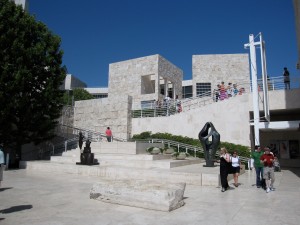
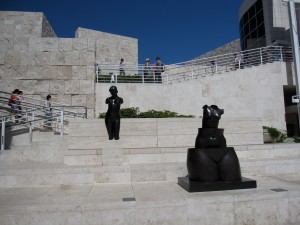
Did Richard Meier, the architect of the Getty Center in Los Angeles, explicitly intend to build a modern acropolis?

I’m almost sure that he did. This is the effect his superb architecture has. The museum’s contents–ie the art inside–is fine. But what makes the Getty Center a destination is that it is, well, what the acropolis of Athens would have been for Socrates: a space for civilized humanity. It has great Feng Shui.

Instead of sitting on a hill, the Getty Center, like the acropolis, seems to rise out of, or to be, the hilltop. It blends into its topography and simultaneously defines it. It signals itself to the people below as the obvious place to go up to. To the people already inside, it is a natural, light-filled place to dwell. It keeps you in, makes you reflective and social, encourages you to meander and talk.

It is simple and yet subtle, the equivalent of a Brancusi sculpture or of the kind of writing I like.

The easiest way to know that it is good architecture (= the way to know good writing) is that it does not make you tired. You can walk through the Louvre, for example, and feel all dutiful about being cultured, but within minutes you want to yawn, sit, sleep, escape, open a window. The Getty Center, and all good art in any medium, makes no such demand on you. It says “check your sense of duty at the door and come in: the culture will happen all by itself; you will feel refreshed after.”

Bookmark and Share

The manuscript is in a pouch to me

Things are about to get really interesting: My editor at Riverhead just emailed to say that he has finished putting his comments into my book manuscript and will send me (the old-fashioned way, this being the book industry) the pages next week.

That’s when I begin my favorite part of writing: the re-writing. Research, whether for The Economist or my book, can be a hard slog, and filled with anxiety. The first draft is then a way of cleansing the anxiety by letting it out and giving it shape. But beauty happens in the re-writing, as Khaled Hosseini (also with Riverhead) said so well.

I sent off the manuscript a few months ago, and have since (deliberately) not even looked at it. In my mind and memory, the text has settled. Parts have receded, parts have become amplified. When I look at it fresh next week, things will jump out that I was blind to in February.

When I talked to my editor a couple of weeks ago, he sounded very happy with the book. My agent is happy too. That’s a good reaction, if it is half of the reaction. The other half must be the assumption that it can be made even better. That’s what I’m going to do in the coming weeks.

Then, after I send it back to Riverhead again, we will find the best title, and the date of publication.

Bookmark and Share

The spoken and the written word

Socrates_teaching

So Socrates loved good conversations, which he called dialectic, and disdained bad conversations, which he called eristic, as I described in the previous post of this series on Socrates. But that actually opens up lots and lots of fascinating and difficult issues.

For instance: the relative value of the spoken and the written word.

Since I happen to write words for a living, I spend quite a bit of time pondering this, as you might imagine.

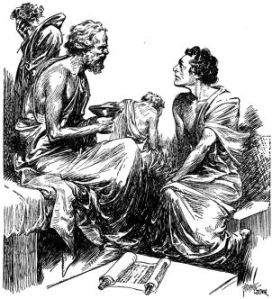
Socrates never wrote a single word. He did not believe in it. Why waste your time killing words (since to write them down was, to him, to kill them) when you could send them back and forth in intimate conversation such as the scene (with him on the left) above?

His student Plato was more schizophrenic on the point. He agreed with Socrates but also, obviously, felt that he should write things down to make them immortal, to reach more people, to make Socrates’ wisdom ‘scalable’ in our lingo. So he compromised, you see: He “wrote” by transcribing … conversations!

One generation on, and we get to Aristotle, who clearly did not agree at all, and wrote what we would consider genuine philosophical treatises. No qualms about the written word at all!

Why did Socrates disdain the written word?

He sort of tells us in one of his (ie, Plato’s) dialogues, the Phaedrus. He takes several shots:

  • He tells a legend from Egypt, in which a god gives a king the gift of writing as an aid to memory. The king, however, observes that writing things down is likely to be a remedy for reminding, at the expense of remembering, and thus will lead to less wisdom, not more.
  • He then compares writing to paintings, which “remain most solemnly silent” whenever you question them, and just say the same thing over and over, stupidly and dumbly. People wise and ignorant alike will look at them and understand and misunderstand them. And they (the words/pictures) cannot talk back, defend themselves, explain themselves.

So text has several problems, in Socrates’ opinion:

  1. It is not a conversation, not dialectic, because it cannot go back and forth and climb toward something higher, such as a truth.
  2. An author has no control over what idiots or assholes might read his text, whereas somebody in oral conversation does control with whom he speaks.
  3. Words outside of their original context (ie the intention of the person using them, and the way a listener might hear them) can mean anything, and thus nothing at all.

Ultimately, Socrates disdained writing for a subtler reason that unifies all these points: It’s just not what life is about!

Instead, life is about communing with others and discovering yourself and truths in conversation. Not about recording this or that, or propagating this or that. Socrates believed that you can’t find yourself when you write, only when you converse.

Where does that leave us writers?

In a tight spot, it would seem.

Then again, we have moved on 2,400 years, and few things are becoming clearer. Here is how I would converse with Socrates on the matter if he were to visit us today:

The need for conversation…

First, I would tell him that he is mostly right, even and especially for writers. Only a tiny part of “writing” consists of typing words–5%, if I had to guess. The other 95% consists of living, experiencing, interviewing, discussing, talking, reading what others have written, and so on. The ideas and stories that end up on pages don’t come out of nowhere. They still come out of conversations.

… but also for order

But writing, which should never replace conversation, has something to contribute: order. Real conversations–and Socrates’ own dialogue with Phaedrus is a great example–run all over the place, like foals on a meadow. That’s the fun. But it can also be frustrating when you want structure and discipline about one particular issue. Writing can simply be a way of forcing yourself to structure the thoughts that came up in conversations.

Why not written conversation?

This is one bit that Socrates overlooked. You can converse in written form.

Some of the greatest conversations in history have been exchanges of letters. Just think of Voltaire and Frederick the Great.

Today there is a fascinating technological twist. In 400 BCE, it was impossible to imagine ‘place-shifting’ (via tele-phony, far-hearing) or time-shifting conversations. But time-shifting is exactly what we do when we …. blog!. I write words, and those then turn into conversations in the comments below, or on other blogs that link to them. So the words are not dead at all. They can talk back. Writing can be conversation.

Indeed, by time-shifting the back-and-forth of a real conversation, the dialectic can become better. All of the people who talked to Socrates must have felt, a few hours later: “Doh! If only I had said…..” Well, now it’s possible to take a moment to think–without the distractions of, say, a famously ugly face such as Socrates’, or body odor, or wind, or sun–and then to come back with a clearer thought.

The inevitability of context

But Socrates was right on at least one point: The written word without context, as provided by conversation, is treacherous. Just take this notorious example, which we call the 2nd Amendment:

A well regulated Militia, being necessary to the security of a free State, the right of the people to keep and bear Arms, shall not be infringed.

Does that mean that a people has the right to keep an armed militia, or that every shmuck in the people individually has a right to bear everything from a pocket knife to nukes, whether there is a militia anywhere to be seen or not?

Socrates would find the author and … converse!

Bookmark and Share

A peek inside editing at The Economist

Pattabhi Jois

Pattabhi Jois

One ongoing thread on The Hannibal Blog concerns the art of writing per se, and thus automatically also the art of editing. In this post and perhaps a few more, I will give you an inside view of what the actual process of editing and re-writing can look like at The Economist.

To me, observing such changes to a narrative and to words, seeing the huge differences that can spring from the subtlest tweaks, is more riveting than the most suspenseful whodunnit. Those of you who like to write may feel the same way. But the rest of you, be forewarned: This post is long, and if you’re not totally sure you’re interested and would rather watch cat videos, you’re excused.

To business:

One of my pieces in the new issue of The Economist is an Obituary of Pattabhi Jois, a yoga guru. A few observations before we look at what actually happened to the “copy” (as journalists call text):

  1. For years, I practiced the style of yoga that Jois taught, and was immersed in the quasi-cultish subculture that is Ashtanga yoga. This is why his death meant something to me. At the same time, I knew that this put me in danger! The only thing more dangerous to a writer than not knowing what the heck he’s talking about is knowing too much and being too close to the topic.
  2. This was my first Obituary. I’ve written tons of other types of personality profiles, and love doing them (indeed my forthcoming book is essentially a story built upon character studies). But the Obituary page is the domain of Ann Wroe, one of our best writers and editors, and it is her job to preserve a style, tone, cadence on this page that is just so. It’s as though a chef were being invited into the intimate kitchen and home of a tight-knit family of foodies and told to cook “you know, something we will love.” Is it more important to cook your best dish, or to know the family?

What happened is that I sent one version, heard back from Ann with suggestions, and then sent a very different (!) second version. Ann then did something that is rare at The Economist (usually an editor will change only one or two words in my copy): She wove my two versions into a new third version. Something very interesting happened in that process:

Version 1 (my raw copy)

Pattabhi Jois, a yoga teacher, died on May 18, aged 93

YOGA has entered the mainstream of Western society, at least the urbane bits of it, and one sure sign is that its practitioners have splintered into separate and sometimes competitive tribes. In spas, resorts and studios from Byron Bay, Australia, to Big Sur, California, and wherever else one might also expect Priuses on the roads and organic kale on the tables, the question is less likely to be “Do you do yoga?” than simply “Ashtanga or Iyengar?”

If the answer is Ashtanga, that has everything to do with Pattabhi Jois. The word, meaning “eight limbs”, causes some confusion. Properly used, it describes the stages which all yogis need to traverse to reach enlightenment, only one of which, asana or “postures”, involves the physical stretches and balancing poses that Westerners associate with yoga. These days, however, Ashtanga means simply the style of postures taught by Pattabhi Jois.

For it was his luck, as a twelve-year-old Brahmin boy in the 1920s, to see those postures demonstrated most beautifully by Tirumalai Krishnamacharya, a charismatic yogi who performed them in a flowing series that was stunning in its grace, ease and power. Jois, able-bodied and strong, became Krishnamacharya’s student the very next day.

They called this vigorous style of yoga “vinyasa” because each movement was synchronised with one inhalation or exhalation. Each practice session began, usually at day break, with sun salutations toward the east until Jois was sweaty and hot. Then followed a never-changing sequence of standing postures to loosen up the joints.

Fully warmed up, Jois then began one of several series—progressively more challenging on each day of the week–of “seated” postures. In fact, there was precious little seating, for Jois strung each posture to the next by seeming to float, supported by his arms alone, into another sun salutation, then wafting effortlessly through his arms again and into the next posture. Each practice ended with backbends, shoulder and headstands, deep breathing in the Lotus position and meditative rest.

Jois soon went off to make a living by teaching this style of yoga to other Brahmins in relative obscurity. Meanwhile, Krishnamacharya had other students. One was B.K.S. Iyengar, Krishnamacharya’s brother-in-law.

Iyengar’s situation was the opposite of Jois’s, which may explain the intense and well-known, if rarely acknowledged, dislike between the two men. Whereas Jois was strong and vigorous, Iyengar was sickly and frail, recovering from malaria, tuberculosis and seemingly every other malady that India offered. Over time, Iyengar turned Krishnamacharya’s lessons into a very different style. His yoga was to be medicinal and bespoke for each student, depending on ability. Instead of sweaty acrobatics, the emphasis was on precise, almost mathematical, alignment.

Neither Jois nor Iyengar, however, was the first of Krishnamacharya’s students to become famous. That honour went to a Latvian woman who had the gall to burst into Krishnamacharya’s male, Indian, and Brahmin school, demanding to be taught. To his credit, Krishnamacharya did. By the late 1940s, this “First Lady of Yoga”, known as Indra Devi, had ecletic types from the Soviet Union to Hollywood breathing in the Lotus position.

By the 1960s and 70s, with summers of love and Eastern chic, the West was ready for the real deal: Brahmin men. Iyengar arguably got off to a head start, with the publication, in 1965, of “Light on Yoga”, often called the “bible of yoga”. Jois continued to teach his never-changing series of acrobatic postures until a few daring Westerners discovered him. One of them, David Williams, a hippie with a Carolinian drawl and spaghetti-like ligaments, brought Jois to California for a visit. His style and fame spread from there.

In time, the two branches, Iyengar and Ashtanga, became cult-like and easy to caricature. Iyengar studios drew the middle-aged women, who spent an eternity at the beginning of class simply spreading their toes properly while standing, then built complex poses with straps, blocks and chairs. Ashtangis were younger, more likely to have tattoos and rippling stomach and shoulder muscles. They began by chanting for “Guruji”, as they called Jois, then went into their hot sweaty routine, all doing the same exact sequences but at an individual pace.

The old teacher, Krishnamacharya, found plenty to frown about. He would live to the age of 100 in 1989, going ever deeper into the spiritual depths of yoga and now teaching his own son, T.K.V. Desikachar, a much gentler, more restorative style of yoga called “viniyoga”. He was not entirely happy with the cult-like aspects of the rival yoga camps in the West.

Jois, in particular, is said to have received a chilling sermon once when he met his teacher in later life. What had happened to the yogic principle of ahimsa, non-violence? In Jois’s yoga school in Mysore, it seemed, a good portion of the eager young things from the West were constantly limping around with injured knees or backs because they had received “adjustments” to yank them into Lotus or a backbend. And there were tales about the females receiving altogether different adjustments than the males.

Jois’s older students smiled at his foibles and were discreet about his contradictions. It was well known that Jois was estranged from his sons. One died young, the other emigrated to America and taught yoga, but kept his father’s movement at arm’s length for a long time; Jois’s grandson carries on the tradition instead. Most intriguingly, whereas Krishnamacharya, Iyengar and Desikachar all continued to practice what they taught, Pattabhi Jois long ago stopped doing his kind of yoga himself.

As you can see, the focus or “angle” I chose in this version was the amazing story of the heritage of yoga in the west, which goes back to one single teacher, Krishnamacharya, and has since branched out into different “tribes”. The unity of the origin and the rivalry and tension between Jois and Iyengar were what I thought might be most interesting.

As you can also see, I agonized over all those readers who were not already familiar with yoga. Hence what I would call an indirect opening, in which I was trying to give readers something familiar, before taking them into the arcane world of Brahmins to follow.

Ann wrote back and noted that the piece as it stood was “more about yoga than about Jois; as far as he’s concerned, it’s rather thin. The rivalry needs to be in the background, and J. in the foreground.”

I took this to heart, and completely turned the piece upside down. Preserving the length, I cut out almost everything about the lineage as such, and now went with a direct opening. Starting and ending with the man himself, with only a few side-trips along the way into yoga, would keep the focus squarely on Jois, as it should be. So I sent me second version:

Version 2 (my raw copy):

Pattabhi Jois, a yoga teacher, died on May 18, aged 93

A SMALL, smiling, potbellied Indian man in his undershirt and Calvin Klein shorts, Pattabhi Jois stood at the head of his yoga classes and counted, using Sanskrit numbers and broken English commands: “Ekam, inhale; dve, exhale; trini, inhale; catavari, exhale.” Before him, the lithe, mostly young and slim bodies stretched and balanced and swung through the air to the rhythm set by Jois, or “Guruji” as they affectionately called him. Their breathing was deliberate and audible, like Darth Vader’s; their perineal muscle flexed; their gaze fixed; their sweat dripping in rivulets.

This was just how Jois liked it. The ultra-athletic style of yoga he taught, known to his students as Ashtanga, was about generating intense internal heat to purify and cleanse the body. Jois disdained the fastidious and perfectionist alignment of postures that some of his rivals practiced in chilly yoga studios. To Jois, yoga was “99% practice and 1% theory,” as he liked to say with his squeaky and mischievous voice. Do the same sets of poses again and again, he believed, and the body will, over time, supply its own grace.

The yoga poses came in sets and sequences that never varied. They did not change when he taught his daughter’s son, whom he was grooming to carry on the tradition after losing one son to death and growing distant from another. Nor did they vary for new, pale and stiff arrivals from the West to Jois’s school in Mysore, India; nor for the Hollywood celebrities, from Madonna to Sting and Gwyneth Paltrow, who made the pilgrimage to catch Guruji on one of his world tours.

What changed was only how many of the six sequences—in theory, one for each day of the yoga week–the student was able and allowed to do. Each set had a theme. The first, with many forward bends, was cleansing and calming; the second, with lots of back bends, was very stimulating, and so on. Even the first series had its acrobatic moments, but the later ones began looking otherworldly in their contortions. It was said that only a handful of people in the world could do all six.

Jois first saw these yoga postures performed in one connected sequence in the 1920s, when he was twelve, as he was watching a demonstration by Tirumalai Krishnamacharya, a charismatic guru who would teach all the major yogis who later brought yoga to the West. Jois was electrified. He became Krishnamacharya’s student the very next day.

Jois was young, flexible and strong, and Krishnamcharya wanted to challenge him physically to keep him from getting bored. So they developed their style and called it “vinyasa” because each physical movement was synchronised with one inhalation or exhalation. Each practice session began, usually at day break, with sun salutations toward the east until Jois was sweaty and hot. Then followed that day’s sequence, and then shoulderstands, headstands, deep breathing in the Lotus position and meditative rest.

The word Ashtanga was not originally meant as a brand for this, or any, particular style. Meaning “eight limbs”, it came from Patanjali, the ancient sage of yoga, and described all the stages which yogis must traverse to reach enlightenment, only one of which, asana or “postures”, involves the stretches and balancing poses that Westerners associate with yoga. Krishnamacharya never in the hundred years that he lived lost sight of the other seven limbs, and was quite hoping that his students would not either.

As Jois went off to make a living by teaching what he had been taught—initially in obscurity, and only to other Brahmin men—Krishnamacharya had other students. One of these was B.K.S. Iyengar, his brother-in-law. Iyengar’s situation was the opposite of Jois’s, which may explain the intense and well-known, if rarely acknowledged, dislike between the two men. Whereas Jois was strong and vigorous, Iyengar was sickly and frail, recovering from malaria, tuberculosis and seemingly every other malady that India offered.

So Iyengar developed a very different style. His yoga was to be medicinal and bespoke for each student, depending on need. Instead of sweaty acrobatics, the emphasis was on precise, almost mathematical, alignment. From the 1960s onward, Jois’s and Iyengar’s styles would both spread forth and multiply in the West, but take the form of very different subcultures. A caricature of an Iyengar class might have middle-aged ladies spending an eternity studying how to spread their toes properly while standing, before building complex poses with straps, blocks and chairs. The “Ashtangis” might be younger and more likely to have OM tattoos and rippling shoulder muscles.

Jois and Iyengar also had opposite intellectual inclinations. Iyengar’s is a deep intellect. He is a prolific writer and his 1965 book “Light on Yoga” is sometimes called the “bible of yoga.” Jois, by contrast, only smirked when asked about the deeper reasons for his methods and quirks, looking bemused to some, evasive to others. Why, for instance, did he insist that one must enter the Lotus position right leg first? “Practice and all is coming,” Jois would say, leaving it at that.

Among his followers, Jois inspired a loyalty that became cult-like. Authentic “Mysore-style” Ashtanga classes in the West begin with Sanskrit chanting to a picture of Guruji. But some of his students have become estranged over the years and alive to ironies and contradictions.

What happened to the yogic principle of ahimsa, non-violence? A good portion of Jois’s students seemed constantly to be limping around with injured knees or backs because they had received “adjustments” yanking them into Lotus, the splits or a backbend. Or the yogic principle of brahmacharya, sexual continence? There were rather a lot of tales about the females receiving altogether different adjustments than the males. Most mysteriously, why had Jois himself, to all appearances, stopped decades ago to practice the yoga style that he was teaching?

As you can see, there is now much more about Jois, some direct speech, and still quite a bit about the contrast with Iyengar, because I thought that contrast brought out the character of Jois (who was not exactly an open book).

I personally much preferred this second version, including its opening, to my first and was quite confident that Ann would go with it.

Instead, she wove paragraphs from the two together, and put in smatterings of information that she had picked up on her own. Most interestingly, she opted for my original opening. And thus you have the piece as it is now published:

Version 3 (edited and published):

Pattabhi Jois, a yoga teacher, died on May 18th, aged 93

ONE sure sign that yoga has entered the mainstream of Western society, or at least the urbane bits of it, is that its practitioners have splintered into separate and sometimes competitive tribes. In spas, resorts and studios from Byron Bay, Australia to Big Sur, California, and wherever else one might expect Priuses on the roads and organic kale on the tables, the question is less likely to be “Do you do yoga?” than simply “Ashtanga or Iyengar?”

If the answer is Ashtanga, that has everything to do with Pattabhi Jois—“Guruji”, as his disciples called him. The word Ashtanga, “eight limbs”, originally meant the eight stages yogis must traverse to reach enlightenment, only one of which, asana or “postures”, is the sort of thing Westerners associate with yoga. But used in Mr Jois’s way, which is how most Westerners understand it now, Ashtanga meant stretching, balancing and swinging to the relentless rhythm set by a little, smiling, potbellied man in an undershirt and Calvin Klein shorts, crying “Ekam, inhale! dve, exhale! trini, inhale! catavari, exhale!”, until every member of the class was breathing like Darth Vader and running with rivers of sweat.

This was just how Mr Jois liked it. The intense internal heat generated by his sort of yoga was meant to purify and cleanse the body. For him, yoga was “99% practice and 1% theory”, as he liked to say in his squeaky, mischievous voice. Though he was the son of a Brahmin priest, and knew the teachings, anyone asking him for deeper philosophy would get a smirk in reply, or a scrap of his famously broken English. Why, for instance, did he insist that one must enter the Lotus position right leg first? “Practice and all is coming,” Mr Jois would say, and leave it at that.

He disdained the fastidious and perfectionist alignment of postures that some of his rivals practised in chilly yoga studios. He scorned Iyengar, the careful and medicinal branch of the art which, like his, arrived in the West in the 1960s, in which middle-aged ladies spent an eternity studying how to spread their toes properly while standing, before building complex poses with straps, blocks and chairs. His Ashtangis were younger and fitter, more likely to have Om tattoos and rippling shoulder muscles, and to start their exercises with a chant of “Guruji!” to a portrait of him pinned up on the wall.

His yoga poses came in sets and sequences that never varied. Do the same sets again and again, Mr Jois believed, and the body would, over time, supply its own grace. The poses did not change when he taught his daughter’s son, whom he was grooming to carry on the tradition after losing one son to death and growing distant from another. Nor did they vary for new, pale, stiff arrivals from the West at his school in Mysore, in India; nor for the Hollywood celebrities, from Madonna to Sting and Gwyneth Paltrow, who made the pilgrimage to catch Guruji on one of his world tours.

What changed was only how many of the six sequences—in theory, one for each day of the yoga week—the student was able and allowed to do. Each set had a theme, and they got harder and harder. The first, with many forward bends, was cleansing and calming; the second, with lots of back bends, was stimulating, and so on. The later ones were otherworldly in their contortions. It was said that only a handful of people could do all six.

Saluting the sun

Mr Jois first saw these yoga postures performed in one connected sequence in the 1920s, when he was 12. He was watching a demonstration by Tirumalai Krishnamacharya, a charismatic guru who would teach all the principal yogis who later brought yoga to the West. Electrified, he became Krishnamacharya’s student the next day. His teacher made him start at daybreak, with sun salutations towards the east until he was sweaty and hot. Then followed postures, shoulderstands, headstands, deep breathing in the Lotus position and meditative rest. Strong, flexible and easily bored, the boy had found a discipline that challenged him.

After running away from his village with two rupees in his pocket, Mr Jois eventually managed to study at Mysore and then began to pass on what he had learnt. At first he taught in obscurity, in one small room with a grubby carpet, and only other Brahmin men. But from the late 1960s onwards, as the perfume of joss sticks drifted over Western civilisation, yoga caught on there too. A hippie fan brought him to California for a visit in 1975, and his fame spread.

Among his followers, Mr Jois inspired a cultish devotion. But his students were not unaware of their teacher’s contradictions. What had happened, for example, to the yogic principle of ahimsa, non-violence? A good number of Mr Jois’s students seemed constantly to be limping around with injured knees or backs because they had received his “adjustments”, yanking them into Lotus, the splits or a backbend. And what about the yogic principle of brahmacharya, sexual continence? Women followers, it was said, received altogether different adjustments from the men. Most mysteriously, why had Mr Jois himself apparently stopped practising his sort of yoga decades ago? Was that another instance of the wisdom of the East?


Bookmark and Share

Patanjali’s Yoga Tweets

You know already that I consider Patanjali the greatest thinker ever, and that I have amused myself by pondering the resemblance between his medium, sutras, and the one you’re reading right now, blogging.

Now I come across this witty refinement of the idea. Patanjali, it turns out, was … a Tweeter!

I may yet have to eat my words about Twitter.

Bookmark and Share