Either odd to us or to them and we opt for them

As most of you know by now, I am an admirer of British irony and wit, the subtler instances of which I occasionally highlight or dissect, as here, here, and here. At its best, it is a matter of tone, not a matter of telling jokes. And it is best delivered casually.

Today happens to be our weekly deadline day at The Economist, and I am right now (thanks to the London time zone that I am forced to observe in California) finalizing my piece in the next issue with one of our editors, Ann Wroe, who happens to be one of my favorites (and who is a successful book author in her own right).

In the piece, I quoted an American think tank whose name starts (as they all seem to do) with “Center For The…”

Ann changed it to “Centre For The…”. I asked: Do we change words to British spelling even when they are names?

And she replied:

Yes, words are anglicised even within proper names; it either has to look odd to us or odd to them, and we opt for them.


Bookmark and Share

Observation, satire or snark?

Cintra Wilson

Cintra Wilson

Snooty, bitchy and arrogant? Or edgy, witty and incisive? In short, bad writing or good? That is the question.

That’s Cintra Wilson in the little mug shot above, and I would have absolutely no interest in, or knowledge of, her if she had not just re-inflamed some old kindling for all writers. Do not mistake this post as being about the content of the text I am about to refer to–I neither know nor care about fashion. In this post I care only about the issue of writer’s voice.

Background:

Cintra wrote a review in the New York Times of a J.C. Penney store that has opened in Manhattan. The review was, shall we say, scathing. Penney, she said, is a

dowdy Middle American entity

that, in essence, has no right to be on this island of skinny snobs. The clothing is full of polyester, the racks are full of sizes 10, 12 and 16, but not Cintra’s 2; and, perhaps most damningly, the store

has the most obese mannequins I have ever seen. They probably need special insulin-based epoxy injections just to make their limbs stay on.

Reaction:

Perhaps predictably, the country appears to have gone to war against Cintra. Bloggers are attacking her, for example herehere and here. Tenor: Cintra is an asshole; go shop at J.C. Penney just to spite her!

The New York Times, meanwhile, appears to have been receiving bags (gigabytes) of hate mail, decrying the newspaper’s

fat hatred, class bias and nasty humor.

The journalist, her editors, and the entire damn publication must be “smug”.

In response, Clark Hoyt, the Times‘ “public editor” or ombudsman (a bizarre and navel-gazing role, by the way) pens a characteristic mea culpa, oozing sudden humility on the newspaper’s behalf.

He does a great and succinct job of summarizing the eternal and underlying tension that is relevant for all writers when he asks:

What is the difference between edgy and objectionable? Or, as one reader … put it: How do writers “navigate the fine lines between observation, satire and snark.”

He even prompts the newspaper’s executive editor, Bill Keller, to say that

he wished it had not been published.

Wow. Cintra must be up there with Judith Miller and all those articles in the run-up to the Iraq War if she deserves editorial disavowal.

Cintra, meanwhile, has apologized on her blog and is back-peddling.

Exegesis:

So let’s contemplate Clark Hoyt’s question: How do we navigate that fine line?

Allow me to remind you that the publication that I happen to write for, The Economist, is accused of smugness on an hourly basis. And every time somebody calls us smug, somebody else is simultaneously calling us “refreshing” or “incisive” or something even more flattering.

Furthermore, I am right now trying to figure out just what my appropriate voice is in the book that I am writing.

So, just a few observations:

  1. Navigating that fine line is just one of the things that makes good writing so incredibly hard. Because yes, it really is hard, otherwise a lot more people would be doing it. So remember that, readers, when you write your angry (snarky!) hate mail to us journalists.
  2. Would you really–I mean really–prefer to shut up the Cintras out there, to sanitize them, to edit in the “on one hands” and “on the other hands”, to give 50% of the article to those who say that Iraq did have WMD and 50% to those who say it did not, because, you know, 50-50 is “balanced” and 10-90 might offend the heartland? You get my drift.
  3. Or would you prefer an authentic, damn-the-torpedoes, honest voice, one that tells it as its owner sees it and is prepared to explode with the torpedoes?
  4. Bill Keller: If you really do wish that Cintra’s piece had not been published, why did you not, as editor, nix it? Since you did not nix it, what the f*** are you doing now disavowing your writer?
  5. There is an easy way to address the reaction to pieces such as Cintra’s: Publish more pieces by other writers with an equally authentic but different voice. This would indeed be edifying for your readers. But do not dilute the copy that comes across your desk into the lukewarm bilge that would, at last, be the end of good writing.


Bookmark and Share

Writing better dialogue

Good at dialogue

Good between the lines

I don’t normally write dialogue in my day job at The Economist. Nor is dialogue a major part of my forthcoming book. But it is a small part of it, which is to say that I’ve inserted precisely one single dialogue between Hannibal and someone else that is not actually in the ancient sources (ie: Livy, Polybius, Cornelius Nepos, Appian, etc). This was necessary, as you guys will eventually see when I start blogging parts of the book.

The discovery that I made as a writer is that dialogue is

  1. very different from other prose, and
  2. difficult to do well, really well.

It should sound the way an actual conversation would sound, between real people, and between the specific people in their specific context in that particular dialogue. Not corny but meaningful, not overpolished but not sloppy.

In my first draft, the particular dialogue I am talking about was one of the weaker parts of the chapter it appears in. And that’s OK. I knew it at the time.

In this second draft that I am working on right now, I think I finally hit the sweet spot.

How? It helped that I practiced.

I wasn’t even aware that I was practicing when I wrote down–essentially transcribed–the conversation I had that night in a taxi cab when things went a bit wrong.

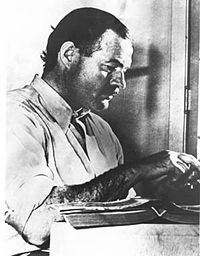
But then Cheri said in the comments that the dialogue reminded her of Hemingway’s A Clean Well-lighted Place. That was charitable of her, and it is not necessary to take her compliment too literally. But it did make me go and read that dialogue by Hemingway, and to my delight I think I understood what Cheri meant: There was a certain sparse, masculine, between-the-lines, staccato tone to the whole thing. It sounded the way a real dialogue between men sounds. Dialogues between women are very different.

And so I was able to transfer, not the content, but the tone of that dialogue into my second draft. It works. And so this is yet another way in which my dabbling in blogging has helped my craft as a writer.

Bookmark and Share

Great, if not greatest, thinker: Galileo

Galileo

Four hundred years ago exactly, Galileo Galilei pointed his telescope at the moon and began, with his wonderfully open mind, writing down what he saw. Other people had done this before him. So why include Galileo in my pantheon of the greatest thinkers ever?

Two reasons:

  1. He made us understand that our universe is much bigger than we could imagine.
  2. He, in his human and fallible way, stood up for truth against superstition, ignorance and fear, otherwise known as… but I get ahead of myself.

I) The universe is bigger than we can imagine

It’s one of those many cases in science, and in all thought (think: Socrates, Plato, Aristotle), when a great contribution came from several people building on the work of one another. This is wonderful. We place far too much emphasis on the solitary genius.

In Galileo’s case, he built on the prior work of, among others,

  1. Copernicus,
  2. Tycho Brahe, and
  3. Johannes Kepler,

in the process proving wrong the views of Aristotle and everybody else that the sun (and everything else) moved around the earth.

Copernicus

Copernicus

Copernicus was the first to realize that the earth in fact moved around the sun, which must count as one of the most revolutionary (pun intended) advances in our understanding of ourselves and our world. But Copernicus assumed (and why not?) that the orbit was a circle.

Tycho Brahe took things an important step further not so much by thinking as by measuring: the motion of Mars, in particular. He created data, in other words.

Kepler

Kepler

Kepler, who was Brahe’s assistant, then looked at those data and realized that our orbit, and those of the other planets, could not be circular but had to be elliptical. (A colleague of mine wrote a good and quick summary of all this.)

And Galileo? He filled in a lot of the blanks with his telescope.

  • He saw the moons of Jupiter, realizing that they were orbiting another body besides the earth and the sun, which was a shocker.
  • He saw that Venus was, like earth, orbiting the sun.
  • He saw that the sun was not a prefect orb.
  • He saw that the Milky Way contained uncountable stars just like our own sun.

For Homo Sapiens, who was still coming to terms with the fact that the earth was round, all this was almost too much to bear. Our universe was vastly, unimaginably, bigger than the Bible had told us. How would we react to that news?

II) Those who seek and are open to truth will have enemies

This brings us to the church, or shall we say “religion” generally. The church hated Galileo and everything he said and stood for. He questioned what they thought they “knew”, which unsettled them, scared them, threatened them. But they had power. With Nietzschean ressentiment, they attacked him.

You can make anybody recant, and Galileo did. Sort of. In any case, he was declared a heretic and sentenced to house arrest for his remaining life.

In one of my all-time favorite ironies, the Catholic Church, having condemned him, decided–359 years later, in 1992, two years before I sent my first email!–that Galileo was in fact right. How? A committee had discovered this. Good job, guys.

And so, Galileo is still with us, inspiring many. As he discovered that our universe was incomprehensibly big, we are discovering, as another colleague of mine, Geoff Carr, puts it, that

the object that people call the universe, vast though it is, may be just one of an indefinite number of similar structures … that inhabit what is referred to, for want of a better term, as the multiverse.

And as Galileo had to confront the the mobs of ignorance, fear and superstition, so do we today. Here, remind yourself with this casual comment by an Arizona state senator (!), Sylvia Allen, Republican, that the earth is 6,000 years old:

Oh, and what about Aristotle? He was the one proved wrong, you recall. That’s OK, as I have argued. You can be wrong sometimes and still be a great thinker, provided you were genuinely looking for the truth.

Bookmark and Share

Tracking The Economist’s success

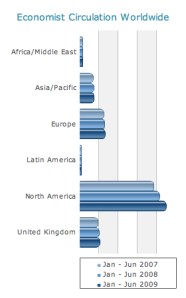
EconomistCirculationChartWe have a new, moderately interactive and even somewhat interesting “widget” on our website that gives all sorts of circulation data, by region, country and so forth.

It continues to amaze me, like everybody else, that we at The Economist keep growing when everybody else, with a few exceptions, is suffering.

The growth continues to come disproportionately from North America, as you can see on the left.

Worldwide, circulation has doubled in the past decade to about 1½ million a week now (which = about 3 million readers, since every copy tends to get “passed along”).

I joined a dozen years ago, so everything I write now reaches more than twice as many people as it did back then. I will continue to ponder this mystery, the sausage factory I work in, and the world around it. One day I will have an answer.

Bookmark and Share

American attitudes toward prisons

My policy, as most of you know by now, is not to link to my pieces in The Economist week after week, unless there is a special reason, because that would be, well, tedious and annoying.

So why link to my piece in the new issue on California’s prison overcrowding?

To make two separate and unrelated points:

1) the importance of length, once again.

It always amazes me, after all these years, how short most of our pieces in The Economist are. The pieces inside the regular “sections” are called “notes” in our nomenclature. Because we have fixed (paper-issue) layouts that determine article length, most notes are either 500, 600 or 700 words. For this note, I asked for 700 words, was told to make it 600, and the final piece ended up at 520.

That’s in effect a blog entry. Most people don’t realize how much harder it is to write a short article than a large article. The folks at the New Yorker can blather on and on (“On an overcast Monday afternoon, I strode across Fifth Avenue to interview John Smith, ….”). We have to get to the point. There should be some nuance, some color, and we should cover the main bases, but all in … 500 words!

It’s friggin’ difficult. Then the readers show up in the mostly infantile comments section below the articles, invariably accusing us of utter ignorance, if not downright malice, because they know (or imagine) one little detail that was not in the 500 words.

Beyond that, of course, the brevity often hurts me, the writer. Invariably, I do research for every piece until I am satisfied that I know the subject well enough. I could easily then fill a few thousand words. So much therefore gets left on the cutting floor.

Which brings me to my second reason for linking to this week’s piece…

2) The shame, the horror of America’s prisons and Americans’ attitudes toward them

Among the things I left on the cutting floor were some of the numbers that Barry Krisberg at the National Council on Crime and Delinquency bounced around with me (mostly 2005 numbers):

  • Most people know that America has the highest incarceration rate in the world, but did you know just how much higher? America locks up 732 people out of every 100,000. The G7 countries, which should be the appropriate comparison for America, lock up 96 people for 100,000. The country in the world that comes closest to America is Russia, yes Russia, where the number is 607.
  • Was there ever a country for which we have numbers that surpass America’s current incarceration rate? Yes, says Barry, and it was …. the Soviet Union during the years of Stalin’s Gulag!!!
  • America has about 5% of the world’s population but 23% of its prisoners.
  • America also has by far the highest ratio of prisoner to each kind of crime. What that tells you is that there is not more crime in America that would justify more imprisonment.

And on and on. In short, Americans love locking people up. They do not see any irony at all in claiming, often loudly when in the company of Europeans, to be “the freest country in the world” while robbing more individuals than any other country does of their freedom, their dignity, their rights. (This distorted understanding of freedom is what I have been exploring in my thread on America.)

I should add at this point that I have rehearsed the inevitable “debate” that usually ensues enough times that I can confidently predict every objection.

Allow me to give you a sample of the most typical “conservative” opinion on the matter. It is a reasoned, Republican-mainstream opinion taken from one of California’s conservative blogs.

In it, we discover the underlying assumptions that nowadays make America the exception among comparable countries:

The demand by federal judges to provide civilized health care to prisoners is

…forcing us to provide better medical care to prisoners than most law abiding citizens receive…

This is ironic because this particular argument tends to come from people who object to providing health care to those law-abiding citizens as well. And it is telling because its sets the tenor for all subsequent arguments, summarized neatly in this passage:

The only danger [prisoners] face is from each other, really bad people, that is people who have no respect for themselves, their neighbors, or for the rules, can be difficult to live with, without question, but that cannot be avoided.  Prison is for bad people, to keep bad people away from good people so that the bad people cant hurt the good ones.

And here you have it in a nutshell. The conservative and prevailing American attitude toward incarceration is based on:

  • vengeance in the Old-Testament style, not on rehabilitation, which is the assumption that prisoners must at some point be brought back into society. In effect, prisoners become outcasts, with no hope of atoning and changing and playing a productive role in society. Result: the world’s higest recidivism rate, 70% in California.
  • Refusal to see nuance: Nobody, and I mean nobody, is arguing that there are no bad people, no crazy people, no dangerous people that must genuinely be kept out of our neighborhoods. But what about the people who are in there for stealing socks, for smoking dope, for all the many misdemeanors that have increasingly been prosecuted as felonies to please the “tough-on-crime” electorate? There are many non-violent people who have simply made a mistake and end up brutalized in prison.
  • Meanness, lack of compassion. Nuff said.

The reality is that prisons contain:

  • bad people
  • average people who have done bad things but can and want to change their ways
  • and even some good people who have got caught up in a fundamentally unjust system

But in our overcrowded and barbarous prisons, they are all thrown together, so that good people become bad and bad people become worse, and society loses by turning away from justice and civility.

Back to the sample opinion. If you approach the entire topic from the point of view that those in the system are all bad, that they deserve to be brutalized and do not deserve protection in prison, then, and only then, can you conclude, as this commentator does, that

There is nothing wrong with our prisons.


Bookmark and Share

Socrates and the “town hall meetings”

Lest any of you think that I have abandoned my thread on Socrates, far from it!

Indeed, the reason that you haven’t heard much lately from me about the great and controversial and perplexing man is that I’ve decided to do a big piece on him in the Christmas issue of The Economist (large parts of which we actually produce in September).

So am I thinking about him? Every day, especially this week, as I cannot avoid, no matter how much I try, the news about these alleged “town hall meetings” on health care.

Town hall meetings?

Democracy?

America?

Oh, please. This is what the thread on Socrates has been about: Good versus bad conversation, debate that wants to find truth and climb higher versus debate that wants to win, to debase, to obscure.

PS: As I post this, I am downloading yet another lecture series by The Teaching Company on Plato, Aristotle and Socrates

Bookmark and Share

The leopard and the baby baboon

image

I have been puzzling over, and moved by, a scene from Eye of the Leopard, a film by Dereck and Beverly Joubert, a handsome couple (above) who are quite the up-and-coming wildlife-documentary makers.

It is the second clip in this video, called “Unlikely Surrogate”.

The “plot”, as provided by Mother Nature (and as narrated by Jeremy Irons):

A leopard hunts a baboon mother, kills her and begins to drag her up on tree for the feast. Suddenly, something wriggles, and it is the one-day old baboon baby that was clinging onto her mother and now falls out.

The leopard pauses. … It does not know how to react. It watches the baby for hours. Then it gently picks the little primate up with its fangs and carries it further up to the tree to safety from other predators. The leopard licks and comforts the baboon baby whose mother the cat has just killed. The baboon baby recognizes the kindness and snuggles into the leopard’s chin. They cuddle for hours together against the cold. Then the leopard moves back down to eat the baby’s mother.

You can study biology, Darwin, evolution. You can hypothesize why this trait is passed on and not that trait. You can throw around fancy terms, such as cross-species altruism. And just when you’re feeling reassuringly scientific, nature reminds you of her eternal, sublime, moving mystery.

Bookmark and Share

Let the post office atrophy (and change)

I’ve been meaning to offer an entirely unrelated aside regarding my mail box. Yours too, for that matter. I’d love it if the dang thing were gone, completely gone, retired into some landfill where the telex machines and vacuum-tube radios are rusting.

This will never actually happen, I realize, even though it now seems that the trend is in that direction. Which is to say: snail mail is obsolete. The volume of mail (chart, bottom right) started dropping before the recession, at about the time when most of us started having boadband internet. And I predict it will keep falling, just more slowly, when the recovery starts. Senators are contemplating cutting the loss-making Post Office’s service. I say: Make it once a week, then once a month.

I personally (as opposed to my wife and my kids!) get very close to zero mail. All our bills are electronic now, all my private and soulful communications are digital or in-person.

The only thing that comes into my mail box is:

  • junk mail, a genre in which America outdoes every other country that I am familiar with. Verdict: 👿
  • All the paper crap that America’s countless, overlapping and nasty bureaucracies churn out, such as jury-duty summons and IRS spam. Verdict: 👿
  • Tangible gifts by grandparents and fans to my son and daughter. Verdict: 😛 (But many of those things come by FedEx and UPS)
  • The occasional post card or letter from a friend who has still not sussed out that I’m OK, really OK, getting these things electronically. Verdict: 🙄

Snail mail gets soaked, lost and bent. I constantly carry important letters that were put into my mailbox in error to the neighbors. I rarely get any coming the other way: Does the carrier only make mistakes for others, or am I not getting something important? Either way, this would not happen with electronic communications.

Then let’s talk about our addresses as identifiers. How passé is that? People move (as I just have) and most of the stress in a complex country such as America is not hauling boxes but updating and untangling the dozens of databases of banks, DMVs, insurers and other authorities. Folks, this is not necessary. We use email addresses and passwords as identities online. That, and perhaps a new and improved (meaning safer) Social Security number, should be all the bureaucrats need from us.

Young people have already dropped their landline phones for mobile phones and skype, which are, well, mobile and personal. Landlines are silly. And so are mail boxes.

Rebuttal

As Solid Gold Creativity reminds us, (and thanks for pointing me to the chart), there is a certain sensual and sentimental value in the post. An old tradition, yet another of the many, is under threat.

I’m not against sensuality. Indeed, I love and need to touch some information in marked-up paper form. But that is not at risk! As I argued in the similar context of the “dying” newspapers, no old medium ever goes away when new media arrive. Instead, the old media change context.

When cars showed up, we did not kill horses. (Paul Saffo and I have had fun trying to verify our guess that there are more horses in America today than there were in 1850.) But we don’t take the horse to the Wal-Mart. We take the horse to the Polo Game or the ranch or the Lipizzaner stables. It’s a classy thing nowadays. The context is fun. That (ie the change from mundane uses to rewarding ones) is a positive change.

The same will happen to the post. We already have FedEx and UPS for things we care about. Well, the post office can start being as good as they are. Cut out the junk mail and perfunctory admin crap, and deliver–occasionally or at haste for a premium–only the good stuff. That would be progress.

Bookmark and Share

The joy of re-writing (with the right editor)

Photo 8

Here I am, leafing through the manuscript as I write the second draft.

Somewhat to my own surprise, I’ve discovered that there is something beautifully visceral about seeing the actual, manual ink comments of my editor on paper, as opposed to the “track-changes” mark-up in a computer file. You can see when he started to comment, then changed his mind and crossed it out; when he doodled or drew arrows and vectors as thought exercises to link ideas; when he pressed hard or light, and many other non-linear, sensual clues to how he was experiencing my manuscript.

For my part, I am having a blast.

Editors are hugely important for me as a writer, both in my day job at The Economist (even though this degree of editorial intervention was unique) and in my new role as author.

  • A bad editor either does not get it or thrusts himself into a text, in the process “de-sophisticating” it.
  • A good editor gets the author and his idea and wants to amplify it.

I have been very, very lucky: I have found a great editor. Not only does he get it, he has made comments that I myself had already thought, and thus was needing to hear. That may sound strange, but it happens a lot to writers: We get caught up in our own words, have a sense of what needs to be changed but feel obstructed until somebody gives us the liberating nudge.

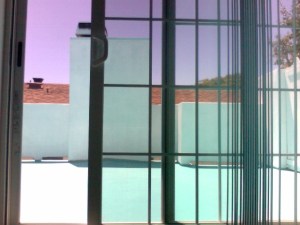
On an aside: It helps to be doing this in my new setting, after my recent move, while gazing at this scene below. It looks Greek but is Californian. Uncluttered. Nice blues.

Photo 7