Not seeing the obvious

Apparently, pre-schoolers and adults were asked whether this bus is traveling left or right.

Left … or right?

Most of the adults had no answer.

90% of the preschoolers had the correct answer (in the comments).

Strange that we lose the ability to see the obvious as we know more.

Bookmark and Share

Emphasis & beauty: More … or less?

Today, two questions for you to ponder:

  1. To emphasize something (an idea, a word, an image, a sensation, anything), should you add or remove?
  2. To make something more beautiful, do you need to add or remove?

So this is a post about adding and removing.

I come at this, naturally, from the perspective of a writer. And as you might remember from my post about “color in writing,” I like to use art as an analogy for writing. Of course, I could also use sound, or smell, or touch or taste — but that is harder to do on a blog. So let’s think about words as visual stimuli.

I. Zen writing or Thai writing

Look at those two temple scenes above (both from Wikipedia). I’ve been to both temples. Both are Buddhist. One is in Kyoto, Japan, the other in Chiang Mai, Thailand. Both cities are among the most beautiful I’ve ever seen.

All of that is beside the point. If you’re like me, you will immediately focus your glance on one object: the pile of sand (or was it pebbles?) in front of the Kyoto temple. You will then scan the Thai temple for something to focus on … and give up, returning to the pile of sand.

Which style, the Zen or the Thai, is better at emphasis?

The Zen, of course. And it does that by removing details, the better to show one stunning detail.

The Thai style, by contrast, is not interested in emphasis. It is interested in sensual barrage.

So, although both are nominally Buddhist, you realize that the two styles present two separate conceptions not only of aesthetics but also of religious experience. If you are like me:

  • the Zen experience leaves you serene,
  • the Thai experience leaves you stimulated.

(Incidentally, you will generally find the same contrast between Japanese and Thai food.)

Is one “better” than the other? That’s not a fair question. But life isn’t fair, so I will answer it. The Zen aesthetic is superior.

Now, let’s say you are a designer of temples (= writer). You better know at the outset which experience you’re trying to create. If you’re trying to make people serene, you better not incorporate any “advice” from the Thai guys; if you’re trying to stimulate, don’t listen to the Japanese.

Put differently: author, know thyself.

II. “Baroque” writing or “Baroque” writing

Let’s take another example. The caricature of Baroque and Rococo art is that they are overly ornate — Thai, rather than Zen, if you will.

This abbey in Ottobeuren, Bavaria, near where I grew up, is an example:

Do you see the wound of Jesus on the ceiling?

Didn’t think so.

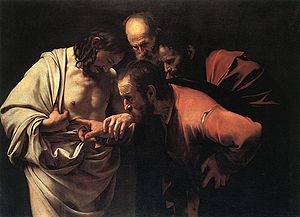
Now let’s try this famous painting by Caravaggio, also nominally “Baroque”:

Do you see the wound of Jesus? Of course you do. You see nothing else.

Which is “better”? Again, it is not a fair question, and let me answer it anyway. The Caravaggio is better. It is superb, in fact, one of the best paintings in art history. Ottobeuren is kitsch (which doesn’t prevent hordes of American tourists from visiting it).

But in the interests of fairness, I must qualify that the intent of the two artists was different:

  • The purpose of Ottobeuren is to overwhelm you when you come in.
  • Caravaggio’s purpose is to focus your attention on one action — with light, detail and gaze (ie, that of the disciples) all subservient to that purpose — so that you contemplate a story around that action.

What would Caravaggio have done if his patron had asked him to put, oh, a little angel or curlicue in the upper right hand corner, to “make better use of that space”? Caravaggio would have ignored him.

III. Microsoft or Apple

Let me sign off on this little meditation with the famous spoof of Microsoft “improving” Apple’s iPod packaging. As you watch and smirk, think of your Powerpoint presentation, your corporate memo, your essay, your book or whatever: Are you going to commit, with courage, to the point you want to make? Well, then cut the crap. Get Zen. Put the finger in it.


Bookmark and Share

The 4th (and final?) coming of Steve Jobs

As you regular readers of The Hannibal Blog know, I am fascinated by Steve Jobs. He is a main character in one chapter of my forthcoming book.

He is a man who is hard to like, impossible to hate and easy to admire. Complex, in a word.

And he is a man who has both lived and reflected on Kipling’s two impostors — ie, triumph and disaster. Oh, what ups and downs Jobs has known.

Now he has unveiled what may be the fourth device in his career (the first being the 1984 Mac, the second the iPod, and the third the iPhone) that fundamentally changes the way we live. It’s called the iPad.

This is not a review

Every tech and media blogger and journalist is right now weighing in on the iPad as a device, so I will not. We put it on the cover of The Economist this week, and my colleague Tom Standage adds context on his blog.

So let me just add some disparate and quirky observations.

1. Nobody imagines (and thus inspires) as Steve Jobs does

My Chinese mother-in-law, who only gave up dial-up internet when it ceased being offered as an option, wrote my wife the following email:

Subject: iPad

Is this the one I’ve been waiting for?

Now this is the Confucian equivalent of a gyrating pole dance. Steve Jobs has hereby cleared the highest hurdle in the excitement-generation industry.

How does he do this?

Jobs has always known how to imagine on our behalf. The truth is that people don’t know what they want (hence Henry Ford’s famous quip that if he had asked his customers what they wanted, they would have said ‘A faster horse’.) Jobs has the arrogance to understand that and to believe that he knows, and he tends to be right.

2. Nobody feints as Steve Jobs does

Two years ago, when Amazon brought out its Kindle eBook reader, Steve Jobs dropped all sorts of disparaging comments in such a way that he could be sure journalists would repeat the narrative on his behalf. For example, he said that

It doesn’t matter how good or bad the product is, the fact is that people don’t read anymore. Forty percent of the people in the U.S. read one book or less last year. The whole conception is flawed at the top because people don’t read anymore.

It was catchy because it rang true and caused many of us literati to hyperventilate about this dreadful trend (ie, people no longer reading).

But some of us guessed even then that Jobs in fact believed the exact opposite. And now we know. At the time he said it, he was 80% of the way into developing … his own eBook reader! For that’s what the iPad is, in part. It is Steve Jobs’ stab at reinventing buying and reading books as he once reinvented buying and listening to music.

Let us all pay extra attention to whatever he disparages next.

3. Even Steve Jobs feels his mortality

The man has been facing death for years now. He had pancreatic cancer. He had a liver transplant. He looks gaunt.

Could it be that this notorious perfectionist broke his own rules and accelerated the release of the iPad, launching it before it is really ready so that he could still be there for its birth, not only as father but also as midwife?

At the moment, the iPad is really a large iPod Touch — you can use only one app at a time, for example. Its trajectory, of course, points toward a time when it will indeed become a new “interface” for day-to-day computing. But I feel there is something half-baked about the release as it stands, by Jobs’ previous standards.

I also could not help but notice that Apple’s promotional video for the iPad does something uncharacteristic: It does not feature Steve Jobs, but instead highlights his lieutenants. They have, of course, been there all along, as ingredients of Apple’s secret sauce. But Jobs has never really displayed them, lest anybody might get the idea that he were grooming successors. The corporate message used to be that Jobs was Apple, and Jobs was forever.

Put differently, this may have been the beginning of a Good Bye. Viewed thus, it is especially moving.

Bookmark and Share

The unexpected page-turner: Virgil

Virgil

Of late, I’ve been worrying that I’m losing it. Specifically, my ability to concentrate and … to read. (To read, you must concentrate on what you’re reading.)

I read so much all day on screens large and small that I find myself struggling to read words on paper when they are bound into packets of a certain thickness, otherwise known as books. Perhaps that is why I struggle to appreciate tomes that others are still capable of savoring.

You will appreciate that this is an odd confession from an aspiring author. Soon, in my fantasies, I will persuade all of you to read my book, once it is published. If you’re still able, that is.

So I’ve been starting and dropping books. It’s so easy nowadays — one click on Amazon, a few seconds on the Kindle. But they can’t hold my attention anymore.

And then, I returned to an old book: Virgil’s Aeneid.

Perhaps Cheri reminded me to pick it up again when she did. Perhaps I was just looking for an excuse.

And oh, what a surprise. The pages turn themselves. The pace is fast but light, the action non-stop, the tension immediate, the storytelling riveting. My concentration is complete, my effort nil.

I am reading Robert Fitzgerald’s translation, which preserves the rhythm of Virgil’s Latin. I mentioned the other day how Virgil paid attention to his words, like “a she-bear licking his cubs.” Well, this is the result. Not a word is amiss or extraneous. The poem has speed.

Perhaps I need to get my head examined. Perhaps I am an anachronism, two millennia out of date. Or perhaps there is a reason why the Aeneid is a classic. It is so good. It made me remember how to read. If you’re like me, wondering whether “Google has made you dumb” (Nick Carr), pick up Virgil.

Bookmark and Share

Orpheus: First romantic hero

Today, a story about trust — the need for it, and the horrible consequences of losing it. The lesson comes wrapped in the myth of Orpheus.

So far in this evolving thread on heroes and heroism, I’ve looked at the brute archetype of a hero (Hercules), the more refined classical archetype (Theseus), and a more complex and ambiguous hero (Jason). They were all not only Greeks but also Argonauts — ie, they boarded the ship Argo to accompany Jason on his quest to get the Golden Fleece. The main purpose of that ship, besides conveying Jason on his quest, seems to have been precisely that: to establish who did and did not count as a hero.

Therefore it is clear that the Greeks considered Orpheus, also on board, a hero as well. And thereby the pattern of increasing complexity in the idea of heroism continues. Orpheus, I would say, was the first “romantic hero” in the history of storytelling.

Not strong but gifted

Who was Orpheus? A Wunderkind. He had the best singing voice in the world, the best musical ear, the most sublime talent for moving humans (and even animals and trees and rocks) with sound. He may have been the son of Apollo, the god of (among other things) music, and Apollo personally taught Orpheus to play the lyre. Whenever Orpheus filled the air with sound, nature relented and sighed and swooned.

That’s the first sign that he was a romantic hero — he was not known for his strength, as Hercules was, but for a talent.

Nonetheless, he was also brave, or at least bold. But his heroism had a different motivation. Orpheus did something heroic not because he could (Hercules) or because he had a public duty (Theseus) or because he wanted to reclaim a throne and power (Jason) but because he … loved.

He loved a woman named Eurydice and they married and lived in bliss. But one day (her wedding day, in some versions), Eurydice was walking through a meadow when a venomous snake bit her. She died and went to Hades, the underworld of shadows.

Orpheus was inconsolable. He decided that he could not live without Eurydice, so he set out to do something very bold: He went down to Hades, as a living human visiting the dead, to plead with Hades to give Eurydice back.

To get down there, he used his talent. When Cerberus, the huge three-headed dog who guarded the underworld, blocked his path, Orpheus sang so sweetly that Cerberus wagged his tail and let him pass. When Orpheus reached the dark and stinking river Styx, he sang again and Charon, the ferryman, was moved to bring him across.

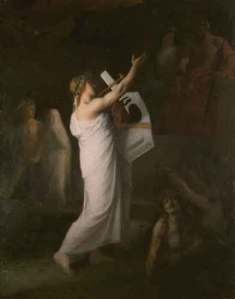
And so he arrived among the ghosts and shadows of the dead, keeping fear at bay by thinking only of his beloved. He appeared before King Hades and his queen, Persephone, and there sang and played his lyre more beautifully than he ever had before (pictured above).

Persephone in particular was moved that a man could love a woman so much, and Hades, also touched, relented. He would give Eurydice back to Orpheus — ie, make her alive again — on one condition.

The difficulty of trusting

That condition was simple: Eurydice would follow behind Orpheus up to the world of the living, but Orpheus was not to turn around to look at her.

So she was called and Orpheus began the long way upwards toward the surface of the earth. He could not hear footsteps behind him, but of course he knew that Eurydice was still a shadow and had no weight yet.

Orpheus kept climbing and looking forward with determination and focus. At last, he saw the first rays of light at the top.

But doubt seized him. What if Eurydice was no longer there? What if she had never been behind him to begin with?

Orpheus forgot himself and … turned.

And as he turned, he got one last glimpse of his beloved. Eurydice had indeed been behind him all this time, just as Hades had promised. But now, because Orpheus had turned, she dissolved back into the darkness. With a look of unbearable sadness in her eyes, she returned to Hades — this time forever.

So Orpheus returned to the world of the living alone. But who calls this living? He was a broken man. His songs and music were henceforth desperate and made animals and plants cry.

Eventually, a group of women (or nymphs or beasts) who could not bear it anymore tore him to pieces and threw his lyre and body parts into a river.

Nymphs (above) saw Orpheus’ head floating downstream, still singing its mournful song of love bereft and trust betrayed. Perhaps his shadow, when it arrived in Hades, found Eurydice’s at last.

Bookmark and Share

Video of the debate (California = failure)

And here, as promised, is the video of Tuesday’s debate. (If you’re new to The Hannibal Blog, I’m talking about this debate.) I kick things off, followed by Gray Davis, and it gets both humorous and intense rather quickly.

Your arm-chair analysis in the comments is encouraged. And don’t be polite. 😉


Bookmark and Share

We won: California IS the first failed state

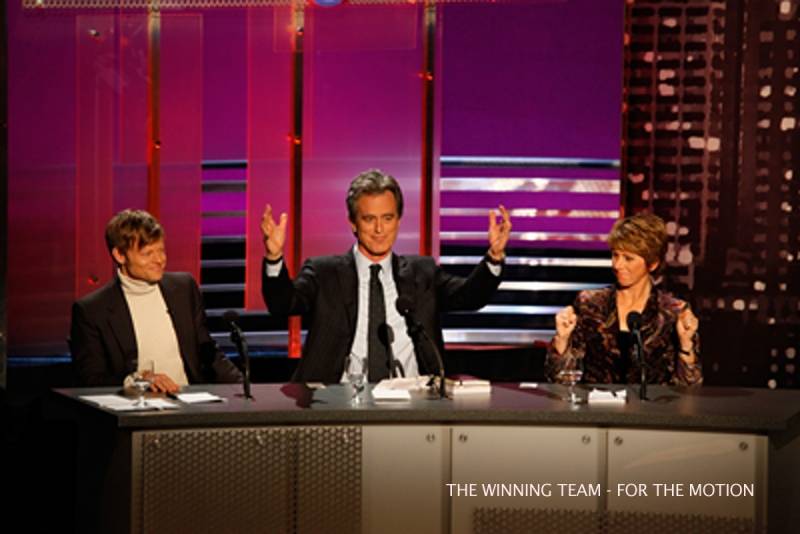
Here we are (I’m on the left, Bobby Shriver is in the middle, Sharon Waxman on the right), as the vote comes in, telling us that we “won” last night’s debate against Gray Davis, Lawrence O’Donnell and Van Jones.

The motion, as a reminder, was:

California is the first failed state

and we argued For.

We won because we moved more audience members in our favor.

Before the debate, 31% voted For the motion, 25% Against, and 44% were Undecided.

After the debate, 58% voted For, 37% Against, and only 5% were still Undecided.

I’ll be posting the full video here on Friday (Update: I have now posted the video), but just a few remarks.

First, it was great fun. As soon as the debate was over, we went to dinner together (“we’re living a Woody Allen movie,” somebody said as we descended into the quaint, subterranean New York restaurant) and had a great time. I talked for a long time to Gray Davis and his wife Sharon, and they were much more interested in discussing California (and that recall) than the debate proposition. I learned a lot.

Second, as you will have guessed already if you’re a regular reader of The Hannibal Blog, I was savoring the irony of the evening: I’ve been writing a lot about “good and bad conversations”, both here and in The Economist, and have argued that conversations in which one side tries to win are what Socrates considered “eristic” and thus “bad,” whereas conversations in which all participants are looking for the truth are “dialectic” and thus “good.”

Well, we were all trying to “win” last night, but now that it’s over it’s time to say that this was just a great, fun game. The real way to “win” was to edify and entertain the audience and ourselves, to spar and to learn, and we apparently did that. (If you were in the audience, feel free to agree or disagree below. ;))

So the goddess Eris was there, but she had her tongue in her cheek.

Second, and unrelated: What a difference a year makes! A bit over a year ago, I was telling you how I heroically resisted mile-high connectivity. Well, I’m posting this from the sky, in a Virgin America plane back home. And everybody around me is working on their laptops. We are all now Nomads, as I predicted. Don’t shrug because you’ve already done this, too. Don’t take it for granted yet. Join me, as Albert Einstein would, in wonderment.

I’ll have a thorough post-game analysis of the debate later this week.

Bookmark and Share

Jason and Medea: Noir hero & heroine

You may know it as the story of the Golden Fleece, or of the Argonauts, but it is really the story of Jason and Medea, arguably the most haunting couple of all time.

With that story (even though it appears to be as old as those of Hercules and Theseus), the Greeks, in my opinion, took a leap into complexity, subtlety and even modernity in their depictions of heroes and heroism.

In this thread on heroes so far, I called Hercules the brute and primal archetype of a hero and Theseus the more sophisticated classical archetype. And Jason? He would have to be the first “anti-hero” as you might find him in Film Noir.

Film Noir is that film genre in which a morally ambiguous and complex hero struggles against — and almost fails in — a corrupt world before he encounters a seductive and dangerous femme fatale who simultaneously challenges and saves him. (One convention in Film Noir is that the femme fatale wears a white or blue dress the first time you see her.)

As you read my (admittedly editorialized) re-telling of Jason and Medea’s story below, see if you recognize those noir-ish aspects, and reflect on some of the other issues that have come up in the comments to this thread so far, such as whether heroes have to be “good” or “altruistic” to be heroic.

I. The quest

As usual in the Greek myths (see Theseus), our hero is the son of a king. And as usual, there is some tension surrounding the throne. In this case, Jason’s evil uncle, Pelias, has usurped the throne from his brother and killed all of his nephews so that none can contest the throne in future. He is nervous because an oracle has warned him about a man with one sandal.

Jason is the only nephew who has survived. His mother has smuggled him into the wilderness, where the wise centaur Chiron educates him.

So we have a cast of archetypal characters: the evil oppressor, the young hero, and even the archetypal mentor, in the form of Chiron, who was also the tutor of Achilles and many other heroes.

Chiron and Achilles

Jason grows up to be a handsome young man. It is time for the young hero to set off on his quest, which is to reclaim his father’s throne. (Again, very similar to Hercules’ and Theseus’ quests.)

And we again meet the goddess Hera, whom we last saw when she tormented Hercules because she hated him so much. This time Hera hates Pelias, the evil uncle, and wants to help Jason. She tests him by appearing to him as an old woman, asking to be carried over a gushing stream. (An early appearance of chivalry as a heroic concept in history?) Jason carries her across, but loses one sandal in the river mud.

Jason arrives in Iolcus, the city where Pelias now reigns. Pelias sees that the stranger is wearing only one sandal and knows what’s up.

Pelias throws a banquet for Jason and — in one of these scenes that are so often implausible in the Greek myths — offers to give up his throne if Jason succeeds in stealing the famously valuable hide of a supernatural ram: the Golden Fleece.

Pelias considers the task impossible, and yet, we wonder why he does not simply kill Jason on the spot. In any case, Jason now knows what he must do.

II. The Argo

Jason is in Greece but the Golden Fleece is in barbarian Colchis (modern Georgia), on the other side of the Black Sea. So he must sail treacherous waters and needs an unusual boat. The Argo is built. The goddess Athena herself (in league with Hera, who wants to support this quest) donates for its prow a wooden plank that can foretell the future.

Jason now has to assemble a crew, and not only Hercules and Theseus but all the great Greek heroes become his shipmates. (If you’ve been reading my posts on Hercules and Theseus carefully, you might already have noticed that the implied chronology is impossible. But the Greeks were not worried about technicalities.) The point of this gathering, I believe, is to prove to us that Jason is indeed a hero — that he can assemble the other heroes, that he is their equal by association.

Off they sail, these Argonauts, and encounter the usual heroic adventures and dangers — rocks in the sea bashing passing ships to pieces, and so forth (compare Odysseus). I will skip over these, except for one subplot that may amuse those of you who share my opinion of Hercules.

Hercules is, of course, the strongest Argonaut — the best rower and all that. This means he cannot stay in this story because he would eclipse Jason and take over the whole plot. So we must get rid of him. How, in terms of storytelling, might we narrate him out?

Easy: Hera will drive him mad once again. Here is how: Along the way, the Argo pulls into port and Hercules’ lover (yes, indeed) Hylas goes to fetch water from a spring. Hera makes the nymphs in that spring seduce Hylas by drawing him down, never to be seen again (picture below). Hercules goes mad and runs around the forest smashing things and people (in other words, staying in character), and the Argo is forced — regrettably, you see — to depart without him.
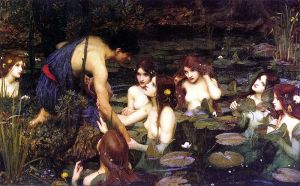
Hylas

III. Medea

So the Argo arrives in Colchis where Jason demands that its king, Aeetes, hand over the Golden Fleece. Aeetes would not dream of it, of course.

But Aeetes has a daughter named Medea. And just as Ariadne, King Minos’ daughter, fell in love with Theseus and helped him to achieve his quest, so Medea now falls in love with Jason (Hera asked Aphrodite to help). Madly in love. So in love that it will get creepy.

Aeetes, like Pelias, gives Jason a dare. He will hand over the fleece provided that Jason harness two fire-breathing bulls to plow a field.

The bulls would kill Jason (whom we may infer to be somewhat hapless and not altogether heroic sui generis). But Medea, who is a sorceress, mixes a salve for Jason (pictured at the very top) so that he becomes invulnerable.

Jason thus succeeds in harnessing the bulls and does plow the field. But when he begins sowing, it turns out that Aeetes has given him dragon teeth instead of seed. Out of each tooth a warrior sprouts, and this impromptu army is about to kill Jason. Again, Medea comes to his rescue, suggesting that he lob a rock at one of them. The newly-sprouted soldiers do not know who threw the rock, and fight and kill one another.

Jason has survived again, but Medea, who is now wholly on his side rather than on her father’s, finds out that Aeetes will renege on on his pledge and refuse to hand over the Fleece. So, at night, she leads Jason to the sacred grove where the fleece is nailed to a tree, guarded by a dragon. Again, it is Medea, not Jason, who overcomes the dragon — she bewitches it and puts it to sleep.

The two of them and the other Argonauts at once set sail and flee. Aeetes, when he wakes up, sets off in hot pursuit.

IV. The first transgression

If you ask me, the story only begins to get interesting from this point onward. For Medea, and later Jason, will now begin to make bad choices. They will transgress, take things too far, become corrupt.

Medea has taken her younger brother Absyrtus with her on the Argo. She now sees Aeetes’ fleet catching up. She has an idea. If she kills Absyrtus and throws him overboard, her father must stop to pick up the body, give his son a decent burial and mourn. She does exactly that. She murders her own brother so that she and her lover can escape.

This is too much, even for the gods and goddesses who were on Jason’s side. The gods send storms to punish the Argo. Athena’s speaking prow tells Jason that they must find the sorceress Circe to be purified of their sin (the same Circe whom Odysseus will later meet).

Circe, as it happens, is Medea’s aunt. She sacrifices to the gods so that Medea and Jason can be forgiven for their sin. Absolved, the Argonauts continue their journey (past the same Sirens and Scylla and Charybdis that Odysseus will have to pass).

V. The second transgression

They finally arrive at Iolcus, where King Pelias is already waiting with a plan to kill Jason. Again, Medea takes charge to save her lover.

She goes alone to Iolcus and claims that she is a witch who can make old people young again. King Pelias hears about this and asks her for a demonstration. Medea requests the oldest ram in the king’s herd, puts it into a caldron, mixes some herbs together and out comes a young lamb. The king is thrilled and wants the same treatment.

Medea tells him that only his own daughters can administer the rejuvenation. So the king’s daughters — Jason’s cousins — boil water in the caldron. Medea gives them herbs, but makes sure they have no magic power. The king enters the caldron, in which his own daughters unwittingly boil him to death.

Once again, this is simply too much. The gods and goddesses are outraged at the gratuitous cruelty of the murder. It would have been one thing for Jason to kill Pelias in open battle. But for Medea to make the king’s own daughters kill their father?!

The people of Iolcus do not want to be ruled by such a king and queen as Jason and Medea. The couple leave Iolcus and go to Corinth.

VI. The relationship turns sour

Medea murders her children

Perhaps because of Medea’s dark side, Jason has fallen out of love with her. And now he wants to marry a different woman, a Greek and the princess of Corinth, Glauce, so that he can become king of Corinth one day.

This is not unheard of — Theseus also dumped Ariadne after she helped him slay the Minotaur. Nor, however, is it heroic. Jason is fickle. He is alive only thanks to Medea, even if she has gone crazy. Our hero gets more complex, more recognizable, more human.

Medea now becomes the archetype for “hell hath no fury like a woman scorned.” She sends a beautiful gown to Glauce as a wedding present, but when Glauce puts it on she goes up in flames. Again, Medea has murdered an innocent.

But Medea is not yet done. She wants to punish Jason by erasing everything he loves. So she kills their two boys, her own children with Jason. In Euripides’ Medea, she rushes offstage with a knife and the children are heard emitting their final, terrifying scream.

Having become vengeance, Medea mounts a chariot and rides off into the clouds.

VII. Death of an anti-hero

And so Jason’s triumphs, above all his capture of the Golden Fleece, were impostors. He was led astray (the literal meaning of se-duced) by the wrong woman. Then he made things worse by breaking his vow to her, thus losing the respect of the gods and goddesses, even of Hera.

He grows old, lonely and bitter. His old ship, the Argo, is rotting on a beach in Corinth. Jason goes there to think about old times. One day, he falls asleep in its shade. The magic prow, put there by Athena, breaks off and kills Jason. So it goes.

Ready to debate California’ failure

So we now have the speaking order at next Tuesday’s Oxford-style debate in New York about the motion:

California is the first failed state.

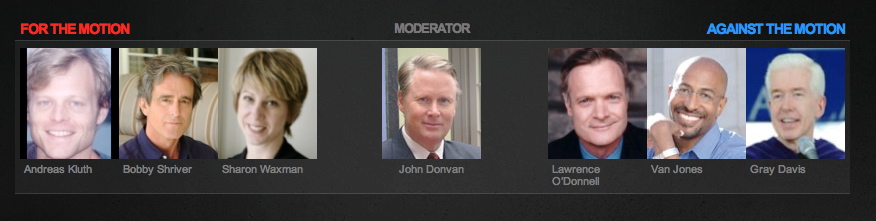
In the opening remarks, which are 7 minutes each, I go first, followed by former governor Gray Davis. The full line-up is as follows:

  1. FOR–Andreas Kluth
  2. AGAINST–Gray Davis
  3. FOR–Sharon Waxman
  4. AGAINST–Van Jones
  5. FOR–Bobby Shriver
  6. AGAINST–Lawrence O’Donnell

In the closing remarks (2 minutes each), the line-up is:

  1. AGAINST–Lawrence O’Donnell
  2. FOR–Andreas Kluth
  3. AGAINST–Van Jones
  4. FOR–Sharon Waxman
  5. AGAINST–Gray Davis
  6. FOR–Bobby Shriver

May the audience be edified.

Bookmark and Share

Manuscript, Round Three, with “lessons”

And it’s off. Last night I sent the third draft of my book manuscript to my editor at Riverhead.

I’m pleased.

In this draft, I addressed the two issues that my editor raised a month ago:

  1. I made the tone consistent throughout the whole book. Neither too formal nor too informal; sophisticated but simple; myth-like in the appropriate places, accessibly modern in the other parts; personal but intellectual.
  2. I clarified “lessons” without falling off the cliff of cliché.

Since my editor “bought” my book idea two years ago, we have been playing a little game.

He has been pushing me to be more explicit about the lessons about success and failure that arise from the biographical stories I tell.

I have been coy, feeling that “lessons” are always corny and banal, and that what I’m really doing is inviting readers to “meditate” along with me on timeless stories in which they recognize themselves.

Well, I think I have succeeded at merging those two instincts. Can’t wait to hear if my editor agrees. 😉

Bookmark and Share