Shaming distracted drivers: A blog we need

They could kill my children.

That’s what I think when I’m driving or walking alone and dodging the drivers around me. Yesterday a lady drove at medium speed through a Stop sign and right through the intersection where I was jogging — or rather, where I stopped jogging and jumped out of her way. She was looking only left (I was on her right, other cars straight ahead). And, of course, she was talking on her cell phone — the modern way, by holding the iPhone away from the ear in Speakerphone mode.

The thought that they could kill my children makes me mad, swinging mad, fighting mad. I am a “liberal” (meaning libertarian). But their freedom stops when my children’s security is threatened.

Matt Richtel

Matt Richtel at The New York Times (who, incidentally, took over my teaching spot at Berkeley’s Graduate School of Journalism when I left) has done a great public service by running a series of articles on the subject to raise awareness. I salute him. I want more of them. Give Matt an award.

But we also have to admit that it has not stopped. They are still texting and yapping about their important things (“like, ohmigawd, he was soooo creepy….”) while driving their killing machines past my children.

Dangerous misconceptions are spreading:

  • That “hands-free” (Bluetooth) technology makes any difference whatsoever (it does not)
  • That talking is OK, even if texting is not (it is not)
  • That others should not do it, even though I can control myself (I cannot.)

The reality is that merely talking on a phone in the car (“hands-free” or not) causes the same cognitive delay as drunk driving. Texting is several times worse.

A modest proposal

Eventually, they will pass laws, and those will be ineffective and late. (In the 70s, seat-belt laws were passed after spontaneous social change had already changed behavior. Politicians react to what voters believe already.)

So change must happen differently. How?

Through shame.

It’s a powerful emotion. We don’t like to be embarrassed, even in the face of complete strangers. They did studies (which I can’t find, so if you can, please share the link) that people wash their hands in a public toilet much more often when somebody else is there than when they are alone.

So, we must shame them. How?

I urge and plead with somebody who is reading this to start a blog devoted entirely to posting pictures and license plates of people yapping/texting while driving in flagrante.

Let them see themselves. Let them be googlable.

I promise my support.

Bookmark and Share

Bad writing in the mainstream press

[picapp align=”none” wrap=”false” link=”term=michael+kinsley&iid=1786394″ src=”1/e/8/a/Reporters_In_CIA_d2be.jpg?adImageId=8903306&imageId=1786394″ width=”234″ height=”309″ /]
Michael Kinsley, a witty and incisive journalist formerly of Crossfire and Slate, has an amusing critique in The Atlantic of the awful writing that dominates so much of America’s “mainstream media.” My only regret is that he was so gentle, by Kinsley standards.

I have long felt the same way, especially since I taught a course at Berkeley’s Graduate School of Journalism, where a lot of the students in my class were already “spoiled” by the same conventions that Kinsley here lampoons. And yet, I could not dissuade my students from using those conventions. So they produced over-long and corny writing that you might find, well, in the New York Times.

What are those conventions? First, says Kinsley, grandiose verbiage:

Once upon a time, this unnecessary stuff was considered an advance over dry news reporting: don’t just tell the story; tell the reader what it means. But providing “context,” as it was known, has become an invitation to hype. In this case, it’s the lowest form of hype—it’s horse-race hype—which actually diminishes a story rather than enhancing it.

Next, the convention of banal, pointless and stupid quotes from “experts”, which repetitively restate what the article’s author has already stated, and where identifying the speaker takes up more words than are in the (unnecessary) quote. Example:

“Now is the chance to fix our health care system and improve the lives of millions of Americans,” Representative Louise M. Slaughter, Democrat of New York and chairwoman of the Rules Committee, said as she opened the daylong proceedings. (Quote: 18 words; identification: 21 words.)

Why? Because in this American convention,

it’s not [the reporter’s] job to have a view. In fact, it’s her job to not have a view. Even though it’s her story and her judgment, she must find someone else—an expert or an observer—to repeat and endorse her conclusion. These quotes then magically turn an opinionated story into an objective one.

Compare this with our view on quotes at The Economist:

…all meaningless and trivial quotes should be excised … I cannot abide the constant oscillation between (a) serious reporting, and (b) meaningless quotes by non-entities. All I want is the story, clear and concise and preferably with a bit of style. As soon as I get to “Joe Bloggs, an accountant, says ‘these are big numbers’”, I turn over the page… In general, our rule with quotes should be that either the singer or the song should be interesting.

Back to Kinsley. The next stupid convention is the equivalent of what the software industry calls “legacy code”, meaning yet more verbiage

written to accommodate readers who have just emerged from a coma or a coal mine. Who needs to be told that reforming health care (three words) involves “a sweeping overhaul of the nation’s health care system” (nine words)? … Anybody who doesn’t know these things already is unlikely to care. (Is, in fact, unlikely to be reading the article.)

Next, what I (as opposed to Kinsley) call “fake color“, the obligatory “anecdotal lede”, whether it is germane and riveting or not. As Kinsley puts it, these are

those you’ll-never-guess-what-this-is-about, faux-mystery narrative leads about Martha Lewis, a 57-year-old retired nurse, who was sitting in her living room one day last month watching Oprah when the FedEx delivery man rang her doorbell with an innocent-looking envelope … and so on.

Kinsley’s conclusion: Cut out the crap. You might be better.

Bookmark and Share

“Density” he said, and died

David Halberstam

Strange how a voice can simultaneously inspire and haunt you.

As I go through the comments by my editor (at Riverhead, not The Economist) and write a new draft of my manuscript, I am constantly hearing the deep, deep voice of David Halberstam in my head, a voice, as our (The Economist’s) Obituary put it,

as sonorous as gravel shifting underground.

Halberstam was one of the great journalists of our time. He wrote for the New York Times, but perhaps is best known now for his books, above all The Best and the Brightest, about how a room full of smart people got us into a dumb war. His coverage of civil rights, but especially of the Vietnam War, influenced history.

I met Halberstam on April 21st, 2007. It was a Saturday night. Orville Schell, one of my mentors and the dean of Berkeley’s Graduate School of Journalism at the time (where he had invited me to teach), had brought Halberstam to talk to the school. Orville had also booked a table at Chez Panisse for a small group after the talk–he was looking for me in the room to bring me along but I was nowhere to be found (I don’t remember why not), which is one of my great regrets to this day.

Anyway, Halberstam was talking to us about writing and journalism that night. He had that habit that many journalists do, of answering questions with questions. We are inquirers more than opiners.

I was already thinking about writing a book, so naturally I was interested in how he paired journalism and book writing. I wanted to know about his research and writing process, about his approach.

You know your book is getting really good, you know you’re close to finished, Halberstam said at one point, when

you find yourself leaving good stuff on the cutting floor.

Doing so meant that you’ve been putting in so much research and detail and color and anecdote that the book wants to burst. He loved that quality of good writing, which he called

density

That is probably one reason why, all this week, I am hearing his voice say the word density every time I cut good stuff to make my manuscript, well, denser.

But the other reason is that this was Halberstam’s last Saturday night. The following Monday I got an email from Orville announcing that Halberstam, who had survived the jungles of war-torn Vietnam, had died in a car crash on a boring intersection in Silicon Valley, as he was being driven by one of the Journalism School’s students to an interview for the book he was then working on. Just like that.

Bookmark and Share

Pew and me, “imagining the internet”

The Pew Internet & American Life Project invited me to participate in the next iteration of their serial “expert” reports on the future evolution of the Internet.

The questions themselves were interesting and telling, and I thought I might share them with you and let you know how I answered. (I look forward to finding out what all the other participants said when “Future of the Internet” is published by Cambria Press.)

The questions were “tension pairs” of alternative scenarios around the following themes:

  • Human intelligence
  • Reading and writing skills
  • Social and human relationships
  • The Internet’s “end-to-end principle”
  • Desktop versus cloud computing
  • The next takeoff technologies

Human intelligence

Here is one tension pair (their words):

By 2020, people’s use of the internet has enhanced human intelligence; as people are allowed unprecedented access to more information, they become smarter and make better choices. Nicholas Carr was wrong: Google does not make us stupid.

Or:

By 2020, people’s use of the internet has not enhanced human intelligence and it could even be lowering the IQs of most people who use it a lot. Nicholas Carr was right: Google makes us stupid.

I chose alternative 1 and elaborated (my words):

What the internet (here subsumed tongue-in-cheek under “Google”) does is to support some parts of human intelligence, such as analysis, by replacing other parts, such as memory. Thus, people will be more intelligent about, say, the logistics of moving around a geography because “Google” will remember the facts and relationships of various locations on their behalf. People will be better able to compare the revolutions of 1848 and 1789 because “Google” will remind them of all the details as needed. This is the continuation ad infinitum of the process launched by abacuses and calculators: we have become more “stupid” by losing our arithmetic skills but more intelligent at evaluating numbers.

Reading skills

Here is another tension pair (their words):

By 2020, it will be clear that the internet has enhanced and improved reading, writing, and the rendering of knowledge.

Or:

By 2020, it will be clear that the internet has diminished and endangered reading, writing, and the intelligent rendering of knowledge.

Here, too, I chose alternative 2 but elaborated (my words):

We are currently transitioning from reading mainly on paper to reading mainly on screens. As we do so, most of us read more, in terms of quantity (word count), but also more promiscuously and in shorter intervals and with less dedication. As these habits take root, they corrupt our willingness to commit to long texts, as found in books or essays. We will be less patient and less able to concentrate on long-form texts. This will result in a resurgence of short-form texts and story-telling, in “Haiku-culture” replacing “book-culture”.

Friendship and intimacy

Here is another tension pair:

In 2020, when I look at the big picture and consider my personal friendships, marriage and other relationships, I see that the internet has mostly been a negative force on my social world. And this will only grow more true in the future.

Or:

In 2020, when I look at the big picture and consider my personal friendships, marriage and other relationships, I see that the internet has mostly been a positive force on my social world. And this will only grow more true in the future.

And again I chose alternative 2, but said:

The question presents a false dichotomy: Technology has no impact whatsoever in the long term on human relationships. What it does is to facilitate some aspects of it for a time (thoughts with letters, speech with telephony, updates with social networks, nearness-awareness with geo-location, etc) at the expense of outrunning the etiquette and courtesy protocols of the previous generation (disturbance during dinner time with telephony, privacy and discretion with social networks and geo-location, et cetera). Over time, etiquette catches up (or evolves), but efficiency advances elsewhere. But throughout, people remain responsible for their human connections–ie, the commitments in time and trust they make to others and their expectations of reciprocity.

Privacy and “sharing”

One more tension pair:

By 2020, members of Generation Y (today’s “digital natives”) will continue to be ambient broadcasters who disclose a great deal of personal information in order to stay connected and take advantage of social, economic, and political opportunities. Even as they mature, have families, and take on more significant responsibilities, their enthusiasm for widespread information sharing will carry forward.

Or:

By 2020, members of Generation Y (today’s “digital natives”) will have “grown out” of much of their use of social networks, multiplayer online games and other time-consuming, transparency-engendering online tools. As they age and find new interests and commitments, their enthusiasm for widespread information sharing will abate.

And again, I chose alternative 2 and elaborated:

The human maturation process does not change because of a new technology. Starting before we left the savannahs, the young members of Homo “Sapiens” have over-shared in order to make themselves socially interesting to the group and to potential mates, only to discover the enormous risks involved when shared information reaches malicious individuals or a group at large, at which point they have re-learned the discretion of their parents. Thus sharing on the internet will continue on its present trajectory: more will be shared by the young than the old, and as people mature they will share more banal and less intimate information.

The other topics didn’t interest me quite as much, although I gave my opinions. Regarding the question of “cloud computing” versus PC-based computing, I made my thinking quite clear when Apple’s support team gave me ample (in terms of time) opportunity to ponder it.

Can’t wait to hear what you guys think.

Bookmark and Share

“The best chapter in the book so far.”

So I’m moving along swimmingly and open Chapter 6 of my manuscript, where I find, above the title, this comment by my editor:

This is the best chapter in the book so far.

Fantastic! He loved the chapter! Everything is great, the book will be a success.

Wait. What was wrong with the previous five chapters? Why weren’t they the best chapters in the book so far?

My god, there is a flaw in the first five chapters. The book will be a failure.

Oh wait, one chapter has to be better than the others.

But which one?

And thus another author goes insane.

Bookmark and Share

Was Socrates an atheist?

Toward the end of my three-page article about “Socrates in America” in the Christmas issue of The Economist, there are these two lines:

Socrates almost certainly was an atheist. As was his wont, however, he cared more about debating, with a man named Euthrypho on the steps of the courthouse before his preliminary hearing, what piety even meant.

(This refers to one of the two charges against Socrates at his trial, which was disbelief in/disrespect for “the gods of the city.”)

By the placement of these lines, and by the word count I devoted to them (1% of the total words in the article), readers should be able to tell how interested I, as the writer, was in this particular point.

Ie, not very.

To quote I.F. Stone in The Trial of Socrates on the matter:

It was the political, not the philosophical or theological, views of Socrates which finally got him into trouble. The discussion of his religious views diverts attention from the real issues….

But I should have known better. After all, the word atheism appears!

It is a word that makes many people, but Americans in particular, go ballistic. Indeed, it is something of a Rorschach test: Mention it, and people immediately project their ideas, fears, and beliefs into the conversation. Whatever the conversation was about, it is now about something else.

Readers react

One of the online commenters, somebody named “RPB2”, tries to refute the possibility that Socrates was atheist by quoting him (presumably from English translations). Thus Socrates says in the Apology:

For I do believe that there are gods and in a far higher sense than any of my accusers believe in them. And to you and to God I commit my cause, to be determined by you as is best for you and me.

And in the Phaedo, he says:

In this present life I believe that we most nearly approach knowledge when we have the least possible bodily concerns and are not saturated with the bodily nature, but keep ourselves pure until the hour when God himself is pleased to release us.

In the Republic, he says:

[Society’s leaders] must be able to see the one in the many, to appreciate and realize the great truth of the unity of all virtues, have a genuine knowledge of God and the ways of God, and must not be content to rest on faith in traditions, but must really understand. Only in this way can they order all things for the benefit of all

From this RPB2 concludes:

You really have to work to find an atheist here; and thus, sadly, one can see that this article indicates that erudition often does not equate to understanding.

Another commenter, Michael  Bessette, offers RPB2 his support:

… Socrates repeatedly invokes not only gods, but “the god”, as in this famous passage from the Apology: “Athenians, I honor and love you, but I shall obey the god rather than you” (29d). Socrates further asserts that he has been specially chosen by “the god” to persuade the people of Athens of their ignorance (23b) and that abandoning this mission would mean also abandoning his god (30a)…

And a reader named Robert J. Farrell from Fort Mitchell, Kentucky, wrote in a letter:
… the most extraordinary statement in the piece is its labeling Socrates an atheist.  No one can read the accounts given by Xenophon or Plato without recognizing the philosopher’s piety.  His own pilgrimage to Delphi attests to this; and many, many statements exceptionlessly confirm it.  Indeed, he comes across as being very close to monotheism; for, as my tutor remarked years ago, whenever in the Memorabilia he is most earnestly referring to the divine , he speaks of “the god” (ho theos) rather than of “the gods” (hoi theoi).  To call Socrates an atheist for his coolness towards the conventional polytheism of the state is as misleading as it would be to so label Jesus because of his confrontation with the priesthood of the Temple…

Discussion

Let’s examine some of these points.

First, what does it prove if Socrates uses, in the writings of Plato or Xenophon, the word “gods”? Not a whole lot, I submit.

All sorts of atheists today scream Goddammit every time they hit the rush hour, and atheist starlets stammer Ohmigawd, ohmigawd when accepting their Oscars. We have to distinguish between a word as figure of speech, as familiar trope to facilitate communication, and as intended content.

What I find curious in the quotes above is the capitalization of the word God. It’s a loaded capital letter, to say the least. In fact, let’s use this occasion to parse some terms:

1) Monotheism:

Is it possible that Socrates believed that there was only one god? I believe we can rule this out. The Greeks did not have that concept. (Even the Jews, who invented it, were just developing at this time, in the century following the Babylonian captivity, as Robert Wright’s The Evolution of God explains quite well.)

2) Atheism:

Admittedly, the same is true for our modern concept of atheism–ie, the Greeks did not have that concept. If somebody was “godless”, that meant he had been abandoned by one god or goddess or another. It did not meant that he denied their existence.

3) Polytheism
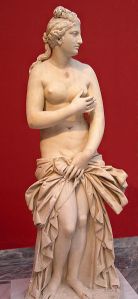
Aphrodite

Polytheism is how the Greeks (and most of the world at the time) understood divinity. Alas, this is a concept that has become quite alien to us (unless you happen to be, say, Hindu), so we are the ones struggling to understand it.

Polytheism was an infinitely stretchable and flexible spiritual instinct. A polytheist had mental room not just for many gods and goddesses but for new gods and for other people’s gods. Even the Greek pantheon included many gods and goddesses (Aphrodite, eg) “imported” from Mesopotamia and thereabouts, for instance.

4) Pantheism

So polytheists were also, by implication, pantheists. They had an expandable pantheon of gods, and divinity was to be found everywhere and in everything.

Zeus

Put differently, gods and goddesses were often personifications of things. Zeus/Jupiter/Thor/Baal of thunder, for example. Hermes of humble door-thresholds, among other things. Hestia of the hearth. Helios/Apollo of the sun. Kronos of time (→ Chrono-logy). And so on.

Names of things in effect became potential divinities. Sophia could be thought of as a goddess of wisdom, tyche (Roman fortuna) could not just mean luck but be the goddess of fortune, and so forth.

(In fact, I.F. Stone, believes that Socrates’ indictment for “impiety” referred specifically to two such personifications/divinities: The “gods of the city” of Athens may have been understood to be Peitho, a personification of “democracy” and thus a political concept, and Agora, which meant not only marketplace but also assembly, and thus dovetailed with Peitho.)

It was, in other words, a rich and metaphorical way of expressing ideas and telling stories. Eloquent people at the time were as unlikely to avoid using tropes of divinity as we are today to avoid metaphors.

“Science”

Having said all that, there was something interesting that happened in the Greek world at around this time, and we might think of it as the beginnings of “science”.

The Greeks traditionally relied on their religion (their “myths” to us) to explain the world. And they relied in particular on the corpus of stories in Homer and Hesiod.

Thus, if summer turned to winter (a perplexing process, if you think about it) it was because Persephone returned to her husband Hades, thus making her mother Demeter, the goddess of fertility and grain, so sad that she turned the earth barren for half a year. If somebody went into a rage and killed innocent people, it was because a jealous god or goddess possessed him temporarily (eg, Hera possessing Hercules). And so on.
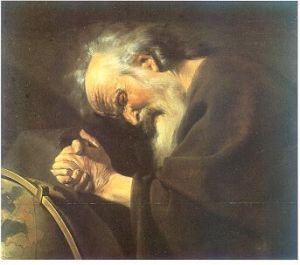
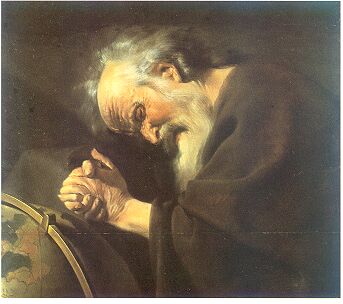
Heraclitus

But, starting about 200 years before Socrates’ trial, some (mainly Ionian) Greeks rejected these mythological explanations and tried to use direct observation of nature (physis in Greek, as in physics) and reason (logos) to explain the world.

These were the so-called “pre-Socratics”, such as Thales, Anaximander, Pythagoras and Heraclitus. They wanted to know what things were ultimately made of (fire, earth, water, etc) and how they changed. They wanted to understand the world better and differently.

So they ignored the gods. I don’t think they boycotted temples and sacrifices and other fun cultural activities, just as even Richard Dawkins today might sing along to Rudolph the Red-Nosed Reindeer. But the gods ceased, for them, to explain anything. In that sense, you might say, using a modern term, that they were atheists.

Pre-Socratic Socrates

Now let’s talk about Socrates. The first thing to know about him, as silly as it sounds, was that he spent the first half of his career as a pre-Socratic philosopher. (Obviously, “pre-Socratic” is a term we invented, not the Greeks). This is to say that he also tried to do “science”, to inquire into the nature and causes of the physical world and its phenomena.

Aristophanes

This is the Socrates, aged about 40, whom Aristophanes mocked in his comedy The Clouds. In that play, Socrates runs a “thinkery” where he examines how far flies jump and how they fart–presumably, with the Athenian audience, including Socrates, in stitches.

And Aristophanes has the Socrates in that thinkery argue that “Zeus does not exist.” “If no Zeus, then whence comes the rain?” he is asked by Strepsiades, a country bumpkin. Socrates offers another explanation for rain, and Strepsiades admits that he had always thought it was “Zeus pissing down upon earth through a sieve.” But at the end of the play, he burns down Socrates’ Thinkery, saying “strike, smite them, spare them not, for many reasons, But most because they have blasphemed the gods.”

Now, folks, this is humor. I get that. But there is more to it. Aristophanes was describing a new (proto-atheistic) worldview in a hilarious way. Socrates would, twenty-four years hence, at his own trial, say that this (ie, The Clouds) is where the charge of impiety originated.

The Socratic “turn”

At about the time of The Clouds Socrates had a wrenching midlife crisis. Apparently, he came to believe that he was not very good at being a philosopher–ie, he became frustrated by his inability to explain nature satisfactorily.

So he made his famous “turn”: away from questions about nature and toward the humanistic subjects of ethics, politics and meta-physics (literally: “beyond nature”). It is not much of an exaggeration to say that he invented all three as subjects.

Hades and Cerberus

But he brought with him his pre-Socratic proto-atheism, by which I mean his tendency to ignore myth and gods as explanations for anything.

For example, on his own deathbed he gives a moving (but confusing) speech about death and the immortality of the soul. As it happens, this should not have been necessary: Greek religion gave detailed information about what happened after death. You took a gold coin with you, went down to Hades, past Cerberus, the three-headed guard dog. Then you gave your coin to Charon, the boatman, who ferried you across the river Styx, where you would henceforth hang around as a shadow. Lots and lots of heros (Hercules, Odysseus….) had already been down there and come back to tell us about it.

But no, Socrates had none of that. No Thanatos, no Hades, no Charon. He used his reason alone. Again, I consider that proto-atheist.

Theism, Deism …

Did Socrates ever go one step further and deny spirituality or divinity? No. I doubt he was interested in that.

Did he really believe, as he claimed when addressing his jury, that his own personal daimonion (“little divine thing,” whence our daemon) talked to him to warn him of danger? Perhaps, perhaps not.

Did he consider himself a proto-atheist? Perhaps, perhaps not. The one time he could have spoken about the matter explicitly, during his trial, he reverted to form (ie, Socratic irony and dialectic) and maneuvered his accuser, Meletus, into defining atheism as both believing in unorthodox gods and no gods at all, which is impossible at the same time. He was a wise ass, in short.

So we do not know, and we will not know.

What we can agree on, I believe, is that Socrates was a highly unusual man with unusual opinions and extremely unorthodox views about everything, including religion. Whatever he believed, neither atheists nor theists today can claim his support to wage their ongoing battle.

In this respect, in fact, Socrates reminds me of another non-conformist I admire: Albert Einstein. Einstein also studied physis and inadvertantly ended up “beyond” it, in meta-physis. And Einstein also had notions about religion that still divide lesser minds today. Was he an atheist? A believer? Everybody wanted to know. So Einstein penned an answer, which concludes (page 387 in this biography):

The most beautiful emotion we can experience is the mysterious. It is the fundamental emotion that stands at the cradle of all true art and science. He to whom this emotion is a stranger, who can no longer wonder and stand rapt in awe, is as good as dead, a snuffed-out candle. To sense that behind anything that can be experienced there is something that our minds cannot grasp, whose beauty and sublimity reaches us only indirectly: this is religiousness. In this sense, and in this sense only, I am a devoutly religious man.

I believe Socrates might have said the same exact thing.

The Procrustean Bed, again

And so, I have spent as many words again on that one little sentence as I wrote in that entire article. Would I change the little sentence?

I’ve posted before about the Procrustean Bed that page layouts represent to writers: you must either stretch or, more often, amputate your text in order to fit the space an editor gives you. Socrates in America: Arguing about Death was not an article about religion. It was about how we talk to one another and the tension between individualism and democracy. Religion only came up en passant, and so I was forced to commit a journalist drive-by shooting.

When I said

Socrates almost certainly was an atheist

I had all this and more on my mind. Given another chance, I would say

Socrates may have been an atheist

or perhaps

Socrates’ views on religion were unorthodox to say the least.

And then I would have done just what I did: I would have moved on.

America, as observed through reader letters

After a few days during which my children had a monopsony on my attention, I am now browsing through the Reader Letters I got in response to my two articles in the Christmas Issue of The Economist. There were a lot!

I want to respond at length to some of the more thoughtful ones, because there is a theme. But in this post, I simply want to share with you a cavalier smirk at … the tone of those letters.

I’ve been getting and reading Reader Letters throughout the more than twelve years I’ve been writing for The Economist. Because I’ve changed beats and location, the demography of the writers has changed during that time. I used to get a lot of ‘Asian’ letters, for instance, then a lot of ‘techie-geekie’ letters, and now a lot of ‘American’ letters.

Speaking only of the latter category, I might generalize that 60% of my mail now serves only one purpose: to inform me that I am:

  • stupid,
  • malicious, and
  • ignorant.

Furthermore, that I (as well as The Economist generally, along with all ‘the media’) pursue an insidious ‘agenda’. That agenda is usually

  • pinko-Commie-gay-activist, although quite often it is
  • Fascist-rightist-capitalist.

Every now and then a letter writer manages to accuse me of both excesses simultaneously (on top of ignorance, see above, which is a constant).

For example, one New Yorker has taken the trouble this week to write separate letters in response to each of my articles (I have linked to those pieces elsewhere. They’re not the point here.)

In one letter he informs me that

… Minorities have more than enough protection. I have ben practicing law for 40 plus years and am amazed that a magazine of the Economist’s stature would allow the drivel contained in “The Tyranny of the Majority” to be spread on its pages. Is the Economist afraid to print a dissenting opinion from its gay activist orthodoxy?

In his other letter, he suggests that

The author of this Socratic exegesis should have his head examined. He does not define “values.” He is untruthful, ignorant. … The author of ARGUING TO DEATH, like the Economist itself, owes readers facts, not legal-sounding fabrications and unelucidated jibberish [sic] gussied up as “values.”

And thusly, a Happy New Year to all of you. More gibberish anon from your favorite ignoramus. Check in often in 2010 so you miss none of the drivel.

Bookmark and Share

Storytelling in leadership

An underlying assumption in my entire thread on storytelling, not to mention the book I’m writing, is that stories are the fundamental thought structures of the human mind.

Storytelling is inevitable, in other words. We do not make sense of the world except by telling stories about it.

So I was intrigued to see this piece in Foreign Policy by George Akerlof (left), an economist at Berkeley, and Robert Shiller (right) at Yale. (Thanks once again to Jag Bhalla for the link.)

The two argue that stories also influence the optimism and pessimism of, and toward, entire nations and economies.

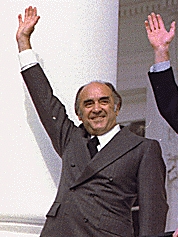
They give the fascinating example of José López Portillo (left), a Mexican president of the 70s and 80s, who presented his country, Mexico, in the context of an ancient story about the Aztec god Quetzalcóatl (also the title of a novel López Portillo had once written). The god was expected to reappear at a special time to make Mexico great again.

As it happened, this was during the oil shocks of the 70s and oil was being discovered in Mexico. Perhaps Quetzalcóatl’s time was now? It did not go unnoticed that the presidential jets were named Quetzalcóatl and Quetzalcóatl II. The country and foreign investors liked the story, and Mexico’s economy surged.

Until it stopped surging, of course. That’s when a different story took over.

The point, as Akerlof and Shiller put it, is this:

Great leaders are first and foremost creators of stories…

Indeed, the power of stories is such that

We might model the spread of a story in terms of an epidemic. Stories are like viruses. Their spread by word of mouth involves a sort of contagion.


Bookmark and Share

The classic hero story: Theseus

The story of Theseus and the Minotaur (above) is, in my opinion, the classical storyline, the archetypal Ur-Story. I much prefer it to the story of Hercules as I described it recently. It has:

  • unity
  • direction and momentum, propelling us forward
  • complexity, with characters male and female being fleshed out in a way that lets us empathize
  • relevance, collectively and individually, to our own life stories.

It is, in short, far superior to the myth of Hercules as a story.

Part I: Identity

As I interpret the story, it has distinct parts, which we see re-used, like Lego blocks, in our stories today. (If any of the parts remind you of stories, let us know in the comments.)

First, there is the boy who needs to find a) his identity and b) his calling.

Theseus grows up with his mother at the court of Troezen, where his maternal grandfather is king. But he does not know who his father is (ie, he does not yet know his identity).

This he discovers when he lifts a huge boulder and finds under it a sword. The sword was hidden there for him by his father, who is, as Theseus’ mother now reveals, the King of Athens, Aegeus (as in: Aegean Sea). In fact, there will always be some uncertainty about even that, since Theseus mother was visited by both Aegeus and the god Poseidon on the night of Theseus’ conception.

Theseus now sets out to find his father (= his identity, in my reading), which is of course a difficult path. A bit as Hercules had to complete his twelve labors, Theseus has to overcome and kill a series of villains who have been making the road to Athens unsafe. Thereby he delivers a public good. I won’t dwell on each adventure, except one: I’ve already told you about Procrustes, who either stretched or amputated his guests so that they fit into his special bed. Well, Theseus forces him into his own bed, with deadly effect.

Having prevailed (and thus established himself as a promising hero), Theseus arrives in Athens, where nobody yet knows who he is. Only Medea (who will also feature in another hero story, Jason’s), who is the king’s wife, intuits that he is Aegeus’ natural and rightful heir, and thus a threat to her own son. Using her feminine weaponry–guile–she persuades Aegeus that Theseus is dangerous and must be poisoned.

Aegeus reclines at a banquet to see the stranger drink the poisoned wine. But just then Theseus draws his sword, the same sword that Aegeus had hidden long ago for his heir to find, to cut a slab of meat. It is a recognition scene: Aegeus knocks away the poisoned cup and they re-unite. Medea, knowing her game is up, flees.

Part II: Quest

The stage is now set for Theseus, having found his identity, to go on a quest, on the one big task that will define him (in contrast to Hercules, who had twelve tasks but none that was definitive). It so happens that Athens is suffering. Every nine years, the Athenians, having lost a war with Crete, have to send seven maidens and seven boys to Crete as human sacrifice for a monster, half man and half bull, the Minotaur. The Minotaur lives in a labyrinth built be the greatest architect of Greece, Daedalus, and nobody who enters finds his way out again.

Theseus volunteers to be one of the seven youths on the next ship, heeding his “call to action” in the language of the mono-myth theory. The ship sets off with a black sail, and Theseus tells his father that, if he succeeds in slaying the monster and survives, he will return with a white sail.

And how different he is from Hercules even now, as he approaches his biggest task. Hercules occasionally had helpers in his labors, but they were mere stage props in the background. Theseus, on the other hand, is capable of love. He meets Ariadne, the daughter of King Minos of Crete, and they fall for each other.

Without this woman and her love, Theseus would fail. He is vulnerable. He needs an other, a woman, to complete him. And so Ariadne gives him her clew, telling Theseus to unravel its thread as he descends into the labyrinth in order to be able to follow it back out if he should survive his encounter with the Minotaur.

Theseus descends, finds the Minotaur and a ferocious fight ensues. This is his best moment (depicted above), his great act of heroism. He kills the Minotaur, follows Ariadne’s thread back out, and is ready to return home with the news that Athens has been liberated.

Part III: Return

But returns are never easy. Theseus elopes with Ariadne and they sail for Athens. But Theseus, now that the danger is past, falls out of love with her. She has done so much for him, and they have been so close. But now he abandons her on an island (where, in some versions, she will become the wife of Dionysus).

Did the Greeks think he was right to do so? Did they think he was bad? This is beside the point. Theseus, unlike Hercules, is complex. He is human. He gets confused, distracted, unsure.  We can see ourselves in him. He makes mistakes.

He makes a big one, in fact. He promised his father to set a white sail if he succeeded in slaying the Minotaur but evidently forgets and appears on the horizon before Athens with the black sail. Aegeus sees it, assumes that his son has failed and died, and throws himself off a cliff to his death.

But this tragedy marks another rite of passage. Theseus is the heir to the throne, so, having liberated Athens, he now becomes its king.

The story as model

At some later point, we’ll have to take stock of how Theseus (and all subsequent heroes in this thread on Heroes) fits into our debate about heroism. But for now, let’s just think of his story as such: as a story.

It’s all there. A search (for identity), a recognition and reunion (with Aegeus), evil (the Minotaur), a quest and a journey, love and dependency (Ariadne), a peak moment (the slaying), a return, betrayal, tragedy, destiny.

Are these not the parts out of which we build all our stories?

Bookmark and Share

WordPress: Plato’s Academy Today

Some of you may have noticed that my thread on Socrates was going strong all through the summer and then, seemingly, stopped. Something similar, you might have thought, occurred with my thread on America.

Well, no, the two threads did not stop. They went into overdrive, albeit in a different form. Indeed, they became a story–what we call a “Christmas Special”–in the new holiday issue of The Economist.

It is called “Socrates in America: Arguing to death“. Please think and smirk as you read it (which also, of course, goes for almost anything you read on The Hannibal Blog).

(A similar, though less pronounced, process led to my other piece in that issue, a sort of polemic against direct democracy. That idea occurred to me after amusing myself, here on The Hannibal Blog, in my thread on freedom, with posts such as this one on James Madison.)

Thank you!

But what am I saying! Nonsense. It was not I, amusing myself. It was we, amusing ourselves.

And that is the point of this post. It is, first, to say Thank You to you, who come here to comment, to teach me, challenge me, tease me.

Those of you who have been readers for a while will see yourselves in my story in The Economist. Cheri will recognize, in the ninth paragraph, the gem that she herself sent to me. Jag will spot, further down, his pun on the Greek word idiotes. Mr Crotchety, who offends the gods by not having his own blog, will see his own worldview–irreverent, humorous, incisive–throughout the piece, since he trained me well in it. Phillip S Phogg, with his deep erudition, subtly worn; Solid Gold Creativity, with her sensitivity and philosophy; Thomas StazykThecriticalline and the Village Gossip, with their almost poetic thought processes;  Peter G, with his outrageous wit; Steve Block with his precision mind; Douglas with his forging inquiry; …. the list goes on and on and on.

Those of you who come sporadically, such as Vincent and Kempton; those of you have come recently, such as Man of Roma, Susan and Dafna; those of you who disappear for a while and resurface months later; and the many, many more who don’t comment at all but just read: all of you have enriched this blog and my mind and my writing.

You are all now co-authors of stories in The Economist and of a book in the making.

Academy 2.0

Which leads me to another insight: Socrates was wrong about one thing, as he himself would gladly concede if he were given a WordPress account: the written word is not inimical to good conversation; text is not necessarily dumb and dead.

What we do here is dialectic, defined as good conversations. What we have here is the Academy that Socrates’ student Plato founded in Athens. Where they ambled in circles and joked and teased and inquired and contested and thought, we do the same thing here on our blogs, minus the ambling.

And there is something new and special about these conversations. I have debated in many settings–the famous “Monday morning meetings” at The Economist in 25 St. James’s Square, London, being a notable one.

When you practice dialectic in those settings, in the flesh, you are always aware who is speaking as well as what is being said. Often this adds an impurity into the mental flow. Are we paying more attention to somebody of higher status or rank, less to somebody who is new? Are we distracted by a twitch, a snort, a sniffle? A curve, accentuated by a fabric, reminiscent of a …

Here there is none of that. With one single exception, I have met none of you in person. (And is that not amazing?) Here, the only thing that matters is what, not who.

Put differently, here in this modern and more pure academy, we all feel safe:

  • safe to contradict ourselves,
  • safe to take intellectual risks,
  • safe to fail and advance,
  • safe from embarrassment.

We exist on our blogs, between which we skip and link and flit like thoughts across neurons, through our words and associations, our minds and thoughts alone.

Here, we are each equal with Socrates.

Bookmark and Share