My humor test in the lift

(This one may not work for you. But try to laugh with me anyway.)

Thirteen years ago, soon after I joined The Economist, I was riding down in the elevator (“lift”, according to our style guide) of our “Tower” at 25 St. James’s Street in London.

There were two or three of us. We were silent. Drab weather. Nothing to say.

Just before the door opened, one of the others turned toward me, with expressively furtive, even dirty or intimidating, body language. Was he about to flash open his trench coat? Confess to a crime? Attack me?

I have doubts about free trade,

he said, and ducked out into the drizzle and its pin-striped shadows.

Bookmark and Share

Editorial/logistical tour de force

Some of you may be wondering why I’ve been a bit slow to respond to your comments this week.

It’s because our United States editor from London is visiting me in California, and I’m taking him from one meeting to the next — all day long, three days in a row.

My mission on these occasional editorial visits is to orchestrate an exciting local experience, so that my editor and I get in front of the most interesting people from different walks of life and talk freely and spontaneously about what’s on their minds. Our interview partners include the high and mighty and the obscure but insightful.

I’ve done this for editors when I was stationed in Hong Kong, in Silicon Valley, and now in L.A. It’s exhausting (the scheduling and logistics mostly) but fun. I’ve already filled a notebook.

Starting tomorrow night, I’ll again be quicker to reply to you all.

Bookmark and Share

“I sense an obsession…”

So I’m haggling with an editor of mine about the word count of the two pieces I am writing for the next issue of The Economist. Writers always want more words; editors want fewer words (they’d rather run more articles).

In this case, I lobbied passionately for one of the ideas, leading the editor, who happens to be the same one I’ve previously highlighted for her British humor, to comment that

I sense an obsession, and feel it may be good to indulge it.

With that, she upped my word count by 20%.

This is another instance not only of charm and British humor but also of good editing. Even if you are a writer editing yourself, it is good advice:

Sense your obsession, then indulge it. It may be infectious.

Bookmark and Share

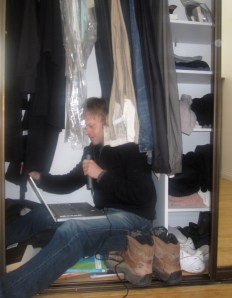
Your correspondent, in his closet

I climbed into our closet yesterday, with a laptop and a Flashmic. This was much less kinky than it might appear. In fact, I did so in the line of duty.

At The Economist, as at most other media organizations, we correspondents are being encouraged to produce occasional videos alongside our reporting pieces. So I did that this week: I wrote a piece about California’s “petition industry” for ballot initiatives, and produced an accompanying video.

Allow me to regale you with the rather comical process involved, and with some observations about technology.

First, I should point out that print journalism is as distant from video journalism as a Bach concerto from a a Salsa bar. You can excel at one and suck at the other. I stipulate that The Economist has been quite good at print for 167 years, but that we have not transferred that success to other media (for instance, when we tried to do television in the 1990s).

That said, multimedia seems to be the future, so it makes sense for us to buy a call option (ie, to risk a small amount for the potential of a big upside).

So a cameraman, Eric Salat, and I joined John Grubb, Tyler Vanderbilt and the team of Repair California as they collected signatures to put two measures on California’s ballot later this year. Eric then sent the footage back to London, where Marguerite Howell edited it. The first thing she did is to take me out. (You still see me briefly in a few frames.) That’s because, for the time being, we must stay on brand, you see. Meaning: anonymous. Apparently, you are allowed to hear my voice in the “voice-over”, as long as you don’t know my name.

Now, about that voice-over:

Marguerite wrote a “script” that would fit with the footage she selected. The first thing we had to do was to edit that script together. In the old days, we would have emailed a Word document back and forth. This time, I just clicked on “Open as a Google Doc” in my Gmail, then “shared” the doc with Marguerite.

This meant that we were now able to edit the script together — she in London, I in California — as though we were typing at the same computer. We weren’t even pressing “save” or “refresh” in the browser. Whatever change one of us made, the other saw in almost-real time.

“Please tell the others in London how easy life could be,” I begged Marguerite, aware that some of our colleagues are not yet ready to abandon their … typewriters.

Then it was time for me to read the script out loud. Skype is not good enough for this sort of thing, so I used the Flashmic, with Marguerite on speaker phone.

“You sound hollow, echo-ey,” she said. “Can you go somewhere with fewer bare surfaces?”

I took the laptop and mike and sat on our bed, amid the pillows and blankets. Still not good enough.

“There’s always the nuclear option,” said Marguerite. “Would you consider climbing into your closet?”

I did. Miraculously, that took care of the echo.

On cue, some of my wife’s items, stacked in a female way, descended on me from above — the sound effects of which Marguerite on speaker phone seemed to enjoy. It occurred to me that I was lucky my wife’s high heels were on the other side of the closet — I was in the hiking-boot section.

Once you actually voice-over, you have to keep fiddling with the script to fit the timing of the video footage, and I kept thinking how cool it was that I could simply look at my laptop screen, without even touching it, to see Marguerite in London change my words in the Google Doc.

I have been on American radio a few times, where producers always pester you to exaggerate and over-enunciate your syllables, CNN style, and to say words with shock and concern, especially when those words are banal. I’ve never mastered that tone. Now, however, to my pleasant surprise, Marguerite said: “Don’t worry about that. Just speak however you feel.” Great place, The Economist.

And so it was done.

Now, a few closing remarks:

1) Don’t despair (yet)

You will be tempted to point out all the obvious ways in which our website is bad at displaying multimedia content. For instance, I was not able to embed the video in this blog (even though there is a deceptive “embed” button?!). I was barely able to get the permalink — in fact, I’m not sure the link works even now. The print story does not obviously refer you to the video, nor the video to the story. Et cetera.

Rest assured, that those and other shortcomings are just as apparent to us as to you. And we are fixing them.

The problem, I am told, is our existing content-management system, which we are phasing out, with difficulty. The new system is called Drupal, and it rocks. Soon, very soon, the website will be great, in all the obvious ways.

2) Technology conclusions

Based on this little experience, I am able to endorse two technologies.

  1. Google Docs, and cloud computing in general.
  2. Closets.

Bookmark and Share

Was Socrates an atheist?

Toward the end of my three-page article about “Socrates in America” in the Christmas issue of The Economist, there are these two lines:

Socrates almost certainly was an atheist. As was his wont, however, he cared more about debating, with a man named Euthrypho on the steps of the courthouse before his preliminary hearing, what piety even meant.

(This refers to one of the two charges against Socrates at his trial, which was disbelief in/disrespect for “the gods of the city.”)

By the placement of these lines, and by the word count I devoted to them (1% of the total words in the article), readers should be able to tell how interested I, as the writer, was in this particular point.

Ie, not very.

To quote I.F. Stone in The Trial of Socrates on the matter:

It was the political, not the philosophical or theological, views of Socrates which finally got him into trouble. The discussion of his religious views diverts attention from the real issues….

But I should have known better. After all, the word atheism appears!

It is a word that makes many people, but Americans in particular, go ballistic. Indeed, it is something of a Rorschach test: Mention it, and people immediately project their ideas, fears, and beliefs into the conversation. Whatever the conversation was about, it is now about something else.

Readers react

One of the online commenters, somebody named “RPB2”, tries to refute the possibility that Socrates was atheist by quoting him (presumably from English translations). Thus Socrates says in the Apology:

For I do believe that there are gods and in a far higher sense than any of my accusers believe in them. And to you and to God I commit my cause, to be determined by you as is best for you and me.

And in the Phaedo, he says:

In this present life I believe that we most nearly approach knowledge when we have the least possible bodily concerns and are not saturated with the bodily nature, but keep ourselves pure until the hour when God himself is pleased to release us.

In the Republic, he says:

[Society’s leaders] must be able to see the one in the many, to appreciate and realize the great truth of the unity of all virtues, have a genuine knowledge of God and the ways of God, and must not be content to rest on faith in traditions, but must really understand. Only in this way can they order all things for the benefit of all

From this RPB2 concludes:

You really have to work to find an atheist here; and thus, sadly, one can see that this article indicates that erudition often does not equate to understanding.

Another commenter, Michael  Bessette, offers RPB2 his support:

… Socrates repeatedly invokes not only gods, but “the god”, as in this famous passage from the Apology: “Athenians, I honor and love you, but I shall obey the god rather than you” (29d). Socrates further asserts that he has been specially chosen by “the god” to persuade the people of Athens of their ignorance (23b) and that abandoning this mission would mean also abandoning his god (30a)…

And a reader named Robert J. Farrell from Fort Mitchell, Kentucky, wrote in a letter:
… the most extraordinary statement in the piece is its labeling Socrates an atheist.  No one can read the accounts given by Xenophon or Plato without recognizing the philosopher’s piety.  His own pilgrimage to Delphi attests to this; and many, many statements exceptionlessly confirm it.  Indeed, he comes across as being very close to monotheism; for, as my tutor remarked years ago, whenever in the Memorabilia he is most earnestly referring to the divine , he speaks of “the god” (ho theos) rather than of “the gods” (hoi theoi).  To call Socrates an atheist for his coolness towards the conventional polytheism of the state is as misleading as it would be to so label Jesus because of his confrontation with the priesthood of the Temple…

Discussion

Let’s examine some of these points.

First, what does it prove if Socrates uses, in the writings of Plato or Xenophon, the word “gods”? Not a whole lot, I submit.

All sorts of atheists today scream Goddammit every time they hit the rush hour, and atheist starlets stammer Ohmigawd, ohmigawd when accepting their Oscars. We have to distinguish between a word as figure of speech, as familiar trope to facilitate communication, and as intended content.

What I find curious in the quotes above is the capitalization of the word God. It’s a loaded capital letter, to say the least. In fact, let’s use this occasion to parse some terms:

1) Monotheism:

Is it possible that Socrates believed that there was only one god? I believe we can rule this out. The Greeks did not have that concept. (Even the Jews, who invented it, were just developing at this time, in the century following the Babylonian captivity, as Robert Wright’s The Evolution of God explains quite well.)

2) Atheism:

Admittedly, the same is true for our modern concept of atheism–ie, the Greeks did not have that concept. If somebody was “godless”, that meant he had been abandoned by one god or goddess or another. It did not meant that he denied their existence.

3) Polytheism
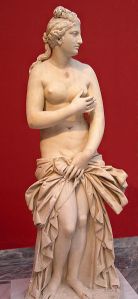
Aphrodite

Polytheism is how the Greeks (and most of the world at the time) understood divinity. Alas, this is a concept that has become quite alien to us (unless you happen to be, say, Hindu), so we are the ones struggling to understand it.

Polytheism was an infinitely stretchable and flexible spiritual instinct. A polytheist had mental room not just for many gods and goddesses but for new gods and for other people’s gods. Even the Greek pantheon included many gods and goddesses (Aphrodite, eg) “imported” from Mesopotamia and thereabouts, for instance.

4) Pantheism

So polytheists were also, by implication, pantheists. They had an expandable pantheon of gods, and divinity was to be found everywhere and in everything.

Zeus

Put differently, gods and goddesses were often personifications of things. Zeus/Jupiter/Thor/Baal of thunder, for example. Hermes of humble door-thresholds, among other things. Hestia of the hearth. Helios/Apollo of the sun. Kronos of time (→ Chrono-logy). And so on.

Names of things in effect became potential divinities. Sophia could be thought of as a goddess of wisdom, tyche (Roman fortuna) could not just mean luck but be the goddess of fortune, and so forth.

(In fact, I.F. Stone, believes that Socrates’ indictment for “impiety” referred specifically to two such personifications/divinities: The “gods of the city” of Athens may have been understood to be Peitho, a personification of “democracy” and thus a political concept, and Agora, which meant not only marketplace but also assembly, and thus dovetailed with Peitho.)

It was, in other words, a rich and metaphorical way of expressing ideas and telling stories. Eloquent people at the time were as unlikely to avoid using tropes of divinity as we are today to avoid metaphors.

“Science”

Having said all that, there was something interesting that happened in the Greek world at around this time, and we might think of it as the beginnings of “science”.

The Greeks traditionally relied on their religion (their “myths” to us) to explain the world. And they relied in particular on the corpus of stories in Homer and Hesiod.

Thus, if summer turned to winter (a perplexing process, if you think about it) it was because Persephone returned to her husband Hades, thus making her mother Demeter, the goddess of fertility and grain, so sad that she turned the earth barren for half a year. If somebody went into a rage and killed innocent people, it was because a jealous god or goddess possessed him temporarily (eg, Hera possessing Hercules). And so on.
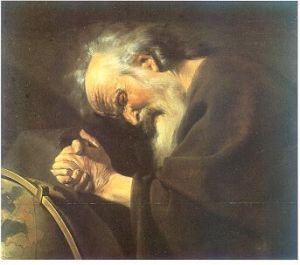
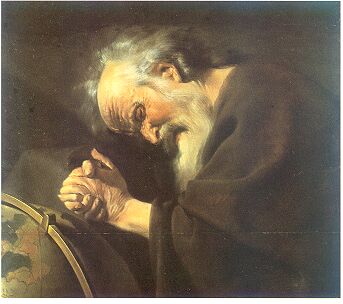
Heraclitus

But, starting about 200 years before Socrates’ trial, some (mainly Ionian) Greeks rejected these mythological explanations and tried to use direct observation of nature (physis in Greek, as in physics) and reason (logos) to explain the world.

These were the so-called “pre-Socratics”, such as Thales, Anaximander, Pythagoras and Heraclitus. They wanted to know what things were ultimately made of (fire, earth, water, etc) and how they changed. They wanted to understand the world better and differently.

So they ignored the gods. I don’t think they boycotted temples and sacrifices and other fun cultural activities, just as even Richard Dawkins today might sing along to Rudolph the Red-Nosed Reindeer. But the gods ceased, for them, to explain anything. In that sense, you might say, using a modern term, that they were atheists.

Pre-Socratic Socrates

Now let’s talk about Socrates. The first thing to know about him, as silly as it sounds, was that he spent the first half of his career as a pre-Socratic philosopher. (Obviously, “pre-Socratic” is a term we invented, not the Greeks). This is to say that he also tried to do “science”, to inquire into the nature and causes of the physical world and its phenomena.

Aristophanes

This is the Socrates, aged about 40, whom Aristophanes mocked in his comedy The Clouds. In that play, Socrates runs a “thinkery” where he examines how far flies jump and how they fart–presumably, with the Athenian audience, including Socrates, in stitches.

And Aristophanes has the Socrates in that thinkery argue that “Zeus does not exist.” “If no Zeus, then whence comes the rain?” he is asked by Strepsiades, a country bumpkin. Socrates offers another explanation for rain, and Strepsiades admits that he had always thought it was “Zeus pissing down upon earth through a sieve.” But at the end of the play, he burns down Socrates’ Thinkery, saying “strike, smite them, spare them not, for many reasons, But most because they have blasphemed the gods.”

Now, folks, this is humor. I get that. But there is more to it. Aristophanes was describing a new (proto-atheistic) worldview in a hilarious way. Socrates would, twenty-four years hence, at his own trial, say that this (ie, The Clouds) is where the charge of impiety originated.

The Socratic “turn”

At about the time of The Clouds Socrates had a wrenching midlife crisis. Apparently, he came to believe that he was not very good at being a philosopher–ie, he became frustrated by his inability to explain nature satisfactorily.

So he made his famous “turn”: away from questions about nature and toward the humanistic subjects of ethics, politics and meta-physics (literally: “beyond nature”). It is not much of an exaggeration to say that he invented all three as subjects.

Hades and Cerberus

But he brought with him his pre-Socratic proto-atheism, by which I mean his tendency to ignore myth and gods as explanations for anything.

For example, on his own deathbed he gives a moving (but confusing) speech about death and the immortality of the soul. As it happens, this should not have been necessary: Greek religion gave detailed information about what happened after death. You took a gold coin with you, went down to Hades, past Cerberus, the three-headed guard dog. Then you gave your coin to Charon, the boatman, who ferried you across the river Styx, where you would henceforth hang around as a shadow. Lots and lots of heros (Hercules, Odysseus….) had already been down there and come back to tell us about it.

But no, Socrates had none of that. No Thanatos, no Hades, no Charon. He used his reason alone. Again, I consider that proto-atheist.

Theism, Deism …

Did Socrates ever go one step further and deny spirituality or divinity? No. I doubt he was interested in that.

Did he really believe, as he claimed when addressing his jury, that his own personal daimonion (“little divine thing,” whence our daemon) talked to him to warn him of danger? Perhaps, perhaps not.

Did he consider himself a proto-atheist? Perhaps, perhaps not. The one time he could have spoken about the matter explicitly, during his trial, he reverted to form (ie, Socratic irony and dialectic) and maneuvered his accuser, Meletus, into defining atheism as both believing in unorthodox gods and no gods at all, which is impossible at the same time. He was a wise ass, in short.

So we do not know, and we will not know.

What we can agree on, I believe, is that Socrates was a highly unusual man with unusual opinions and extremely unorthodox views about everything, including religion. Whatever he believed, neither atheists nor theists today can claim his support to wage their ongoing battle.

In this respect, in fact, Socrates reminds me of another non-conformist I admire: Albert Einstein. Einstein also studied physis and inadvertantly ended up “beyond” it, in meta-physis. And Einstein also had notions about religion that still divide lesser minds today. Was he an atheist? A believer? Everybody wanted to know. So Einstein penned an answer, which concludes (page 387 in this biography):

The most beautiful emotion we can experience is the mysterious. It is the fundamental emotion that stands at the cradle of all true art and science. He to whom this emotion is a stranger, who can no longer wonder and stand rapt in awe, is as good as dead, a snuffed-out candle. To sense that behind anything that can be experienced there is something that our minds cannot grasp, whose beauty and sublimity reaches us only indirectly: this is religiousness. In this sense, and in this sense only, I am a devoutly religious man.

I believe Socrates might have said the same exact thing.

The Procrustean Bed, again

And so, I have spent as many words again on that one little sentence as I wrote in that entire article. Would I change the little sentence?

I’ve posted before about the Procrustean Bed that page layouts represent to writers: you must either stretch or, more often, amputate your text in order to fit the space an editor gives you. Socrates in America: Arguing about Death was not an article about religion. It was about how we talk to one another and the tension between individualism and democracy. Religion only came up en passant, and so I was forced to commit a journalist drive-by shooting.

When I said

Socrates almost certainly was an atheist

I had all this and more on my mind. Given another chance, I would say

Socrates may have been an atheist

or perhaps

Socrates’ views on religion were unorthodox to say the least.

And then I would have done just what I did: I would have moved on.

America, as observed through reader letters

After a few days during which my children had a monopsony on my attention, I am now browsing through the Reader Letters I got in response to my two articles in the Christmas Issue of The Economist. There were a lot!

I want to respond at length to some of the more thoughtful ones, because there is a theme. But in this post, I simply want to share with you a cavalier smirk at … the tone of those letters.

I’ve been getting and reading Reader Letters throughout the more than twelve years I’ve been writing for The Economist. Because I’ve changed beats and location, the demography of the writers has changed during that time. I used to get a lot of ‘Asian’ letters, for instance, then a lot of ‘techie-geekie’ letters, and now a lot of ‘American’ letters.

Speaking only of the latter category, I might generalize that 60% of my mail now serves only one purpose: to inform me that I am:

  • stupid,
  • malicious, and
  • ignorant.

Furthermore, that I (as well as The Economist generally, along with all ‘the media’) pursue an insidious ‘agenda’. That agenda is usually

  • pinko-Commie-gay-activist, although quite often it is
  • Fascist-rightist-capitalist.

Every now and then a letter writer manages to accuse me of both excesses simultaneously (on top of ignorance, see above, which is a constant).

For example, one New Yorker has taken the trouble this week to write separate letters in response to each of my articles (I have linked to those pieces elsewhere. They’re not the point here.)

In one letter he informs me that

… Minorities have more than enough protection. I have ben practicing law for 40 plus years and am amazed that a magazine of the Economist’s stature would allow the drivel contained in “The Tyranny of the Majority” to be spread on its pages. Is the Economist afraid to print a dissenting opinion from its gay activist orthodoxy?

In his other letter, he suggests that

The author of this Socratic exegesis should have his head examined. He does not define “values.” He is untruthful, ignorant. … The author of ARGUING TO DEATH, like the Economist itself, owes readers facts, not legal-sounding fabrications and unelucidated jibberish [sic] gussied up as “values.”

And thusly, a Happy New Year to all of you. More gibberish anon from your favorite ignoramus. Check in often in 2010 so you miss none of the drivel.

Bookmark and Share

WordPress: Plato’s Academy Today

Some of you may have noticed that my thread on Socrates was going strong all through the summer and then, seemingly, stopped. Something similar, you might have thought, occurred with my thread on America.

Well, no, the two threads did not stop. They went into overdrive, albeit in a different form. Indeed, they became a story–what we call a “Christmas Special”–in the new holiday issue of The Economist.

It is called “Socrates in America: Arguing to death“. Please think and smirk as you read it (which also, of course, goes for almost anything you read on The Hannibal Blog).

(A similar, though less pronounced, process led to my other piece in that issue, a sort of polemic against direct democracy. That idea occurred to me after amusing myself, here on The Hannibal Blog, in my thread on freedom, with posts such as this one on James Madison.)

Thank you!

But what am I saying! Nonsense. It was not I, amusing myself. It was we, amusing ourselves.

And that is the point of this post. It is, first, to say Thank You to you, who come here to comment, to teach me, challenge me, tease me.

Those of you who have been readers for a while will see yourselves in my story in The Economist. Cheri will recognize, in the ninth paragraph, the gem that she herself sent to me. Jag will spot, further down, his pun on the Greek word idiotes. Mr Crotchety, who offends the gods by not having his own blog, will see his own worldview–irreverent, humorous, incisive–throughout the piece, since he trained me well in it. Phillip S Phogg, with his deep erudition, subtly worn; Solid Gold Creativity, with her sensitivity and philosophy; Thomas StazykThecriticalline and the Village Gossip, with their almost poetic thought processes;  Peter G, with his outrageous wit; Steve Block with his precision mind; Douglas with his forging inquiry; …. the list goes on and on and on.

Those of you who come sporadically, such as Vincent and Kempton; those of you have come recently, such as Man of Roma, Susan and Dafna; those of you who disappear for a while and resurface months later; and the many, many more who don’t comment at all but just read: all of you have enriched this blog and my mind and my writing.

You are all now co-authors of stories in The Economist and of a book in the making.

Academy 2.0

Which leads me to another insight: Socrates was wrong about one thing, as he himself would gladly concede if he were given a WordPress account: the written word is not inimical to good conversation; text is not necessarily dumb and dead.
What we do here is dialectic, defined as good conversations. What we have here is the Academy that Socrates’ student Plato founded in Athens. Where they ambled in circles and joked and teased and inquired and contested and thought, we do the same thing here on our blogs, minus the ambling.

And there is something new and special about these conversations. I have debated in many settings–the famous “Monday morning meetings” at The Economist in 25 St. James’s Square, London, being a notable one.

When you practice dialectic in those settings, in the flesh, you are always aware who is speaking as well as what is being said. Often this adds an impurity into the mental flow. Are we paying more attention to somebody of higher status or rank, less to somebody who is new? Are we distracted by a twitch, a snort, a sniffle? A curve, accentuated by a fabric, reminiscent of a …

Here there is none of that. With one single exception, I have met none of you in person. (And is that not amazing?) Here, the only thing that matters is what, not who.

Put differently, here in this modern and more pure academy, we all feel safe:

  • safe to contradict ourselves,
  • safe to take intellectual risks,
  • safe to fail and advance,
  • safe from embarrassment.

We exist on our blogs, between which we skip and link and flit like thoughts across neurons, through our words and associations, our minds and thoughts alone.

Here, we are each equal with Socrates.

Bookmark and Share

Writing in a Procrustean bed

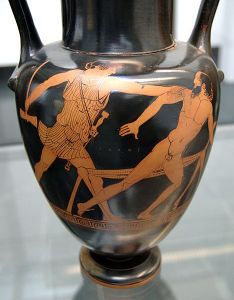
That stud on the vase is supposed to be Theseus, the Athenian hero who went on to slay the Minotaur, dealing with a ruffian named Procrustes.

Procrustes was famous for his bed. He invited passers-by to spend the night and to lie* in his bed. The bed was always too short or too long. So Procrustes “adjusted”, not the bed, but the guest as he was sleeping. He either stretched the guest (Procrustes = ‘the stretcher’) or cut off his legs.

Theseus eventually dealt with Procrustes by making him, Procrustes, fit his own bed. So there.

But from this myth we have the great term Procrustean bed. It applies whenever we force something into a size or a result (as with statistics) that is not natural and thus incorrect or inelegant.

I was thinking of the Procrustean bed once again while writing my piece for The Economist this week.

You recall my musings on the subject of a text’s optimal length, and how important it is neither to go under or over it. Well, in most print media, and certainly in The Economist, lengths are fixed in advance. What determines wordcount is the line count in the page layout of the print edition, which is done before the editor even has the “copy” (article) in question.

In my 12 years at The Economist I have, as you might expect, become very good at writing ‘to length’–ie, at delivering copy that fits exactly (thus evading any Procrustean tendencies by editors). Often I even enjoy the discipline of that constraint.

But it increasingly strikes me as bizarre, indeed unsustainable: We invariably cut good stuff out of articles, add unnecessary words to ‘turn lines’, or even entire paragraphs to fill a page when a chart shrinks. Sometimes this means sacrificing color and detail, or even logical connectors. Other times it means adding noise to signal.

And what happens next? People read the print edition, then pulp it. So much for the beautiful page layout.

But the same text survives forever online, where it faces no obvious layout constraints. Thus, all posterity reads a suboptimal text, stretched or amputated as Procrustes’ guests were.

The ancients (Homer, Virgil, etc) did not have this problem. They (or rather, their slaves) wrote on scrolls, which scroll as our web pages do, into infinity if necessary. Perhaps our evolving media habits will take us back to that future.

Bookmark and Share

“Sex” or “gender”?

I began the previous post with a parenthetical slur on Americans (of which I am half-one), propping myself up on two creaky stereotypes:

  1. that Americans can’t (really) speak English, and
  2. that political correctness is in part to blame.

Specifically, the issue was which of these two words was correct in the specific context:

  • Sex, or
  • Gender

Well, I thought I might regale you once again with the opinion of Johnny Grimond, our (The Economist‘s) doyen of usage and author of our official Style Guide, in which style quite often becomes a window into a very British, ironic and sophisticated worldview. Here is Johnny on the matter:

Gender is nowadays used in several ways. One is common in feminist writing, where the term has a technical meaning. “One is not born a woman, one becomes one,” argued Simone de Beauvoir: in other words, one chooses one’s gender. In such a context it would be absurd to use the word sex; the term must be gender. But, in using it thus, try to explain what you mean by it. Even feminists do not agree on a definition.

The primary use of gender, though, is in grammar, where it applies to words, not people. If someone is female, that is her sex, not her gender. (The gender of Mädchen, the German word for girl, is neuter, as is Weib, a wife or woman.) So do not use gender as a synonym for sex. Gender studies probably means feminism.

See also Political correctness

That said, I seem to remember reading somewhere–and I wish I knew where–that Sandra Day O’Connor started using gender instead of sex when she got to the Supreme Court, because she was worried that the word sex would conjure up all the wrong images in her (male) colleagues’ minds during deliberations.

Bookmark and Share

The Economist’s women and men

Down under in Melbourne, Solid Gold Creativity has embarked on an intriguing investigation into sex (or “gender”, as the Americans among you might prefer in this context) in journalism.

She found that only 27% of the articles in The Monthly, an Australian magazine, were written by women. Counting only “major” articles, defined as those longer than 3,000 words, 20% were written by women.

With a research assist from Phillip S Phogg, she then turned her attention to America, where she found that women wrote:

  • 27% of the articles in The Atlantic Monthly, and
  • 30% of the articles in the New Yorker.

(Both of those are five-issue averages.)

So, naturally, I offered to supply the relevant metrics for The Economist.

At first, I started counting the articles in our current issue by author’s sex. (You out there cannot know who the authors are, of course, because we don’t have bylines, but I have an internal list to aid me.) Then I realized that this doesn’t give a good picture, because we are too small. If one or two people are on holiday, that skews the numbers. Then a freelancer writes the odd piece; or somebody writes a big piece and a box to go with it; or several people collaborate on one story, and on and on.

So instead I counted the editorial staff, both total journalists (ie, correspondents + editors) and editors. (I defined as editors only colleagues who actually edit a section in the magazine or a part of the website, not those who have editor as part of their title on their business card.)

Here is what I found:

Of the 84 journalists (I tried to correct for those on sabbatical, those half-retired, and so forth) 19, or 23%, are women.

Perhaps more interesting: Of the 21 editors, 8 are women, or 38%.

In other words, those women who do work at The Economist have twice the chance to become an editor that men at The Economist have. Innaresting, ain’t it?

And if I had excluded the website from the numbers and counted only the magazine, the share of women would have gone up both among total journalists and editors.

That said, the percentages are still well below 50%.

Now, I quite like something that Solid Gold Creativity said in her comments:

… I’m not so interested in the “reasons” for this absence of female thinkers/writers. I can always think up a hundred reasons why something is one way or another. My interest is not “why”; my interest is what’s so…

In that spirit, let’s find out more…


Bookmark and Share