The World in 2010, our (ie, The Economist‘s) annual sister publication, is now out. This is a magazine in which we and our invited guests take shots at prognosticating the coming year.
My piece is this one on the Constitutional Convention that California is all but certain to call in 2010.
For you regular readers, this (ie, other constitutional conventions) is what I was researching in September when I eulogized James Madison.
On a more general note: Those of you who go to The Economist‘s website a lot might already have started noticing some changes. There will be more over the coming month or so. These changes have been long in the making and were partially cooked up at our powwow last year.
One great thing is that, even though much of the site will be behind a subscriber wall, all incoming links will in future take you directly to the article, whether or not you are a paying subscriber. This means I can keep sending you there. 😉
I have been pondering a recent comment by Phillipp S Phogg to the effect that, if I may amplify it, what I write on the Hannibal Blog is sometimes more fun than what I write in The Economist. Or, as he put it:
the very opposite of the blandness (and dare I say, triteness?) which permeates some (but not all, I hasten to add!!) of the Economist’s erudite and worthy pages.
Bland
Trite
Worthy
Ouch. No publication, writer or editor would want to be caught anywhere near those adjectives–especially the devastatingly faint-praising worthy.
Well, one of the minor purposes of this blog (besides the main one, which is to talk about my book once it comes out) is to let those of you who are fans/foes of The Economist speak truth to power in a safe setting.
Furthermore, this is the time for me to admit that I myself occasionally feel as Phillip Phogg does. And that frustrates and saddens me.
It also makes me think deeply about such evergreen writerly topics as style, voice, tone, and storytelling, because that’s what this seems to be about.
The Economist appears to succeed in part because it promises and delivers to its readers analysis that is:
disciplined, not florid;
terse but deep;
occasionally quirky but not self-indulgent.
Permit me to contrast that with, say, The New Yorker, which promises, and mostly delivers, storytelling that is
occasionally quirky and unapologetically self-indulgent.
What that means for me as a writer for The Economist is that I usually do the same research as writers for the New Yorker but then leave most, or even all, the “fun stuff” on the cutting floor to maintain the discipline of, say, a 600-word note.
This is frustrating. As a writer, I often know that I could spin a thrilling yarn out of my experiences during research but as a correspondent for The Economist I know that much of it is inadmissible. (There are exceptions, such a piece I have written about Socrates for our upcoming Christmas issue, which arose out of a thread here on the Hannibal Blog and is almost pure, unadulterated fun.)
One device that writers for the New Yorker (just to stay with that example) have but that we lack is the First Person, ie the “I”. I have said before that I consider the First Person “treacherous” for young writers because it subverts discipline. It is a good idea to learn to write without using “I” and “me”. That said, I have also discovered, on this blog and in my book manuscript, that the First Person makes certain things easier. One of those things is authenticity. Another is fun.
But it goes beyond the First Person and into storytelling. Occasionally, we do great storytelling in the pages of The Economist. But often we don’t, because that is not always the main objective.
But implicit in those elements is detail, also known as color. I have said before that color can be excessive and is best used sparingly, as in a good Rembrandt painting. But sparing does not mean monochrome.
Perhaps, when we fall short at The Economist it is because we overdo the sparing. Perhaps we should do more First Person narrating (which does not necessarily require us to give up our anonymity). Perhaps we should paint in more color.
In the next post, let me try to illustrate what I’ve been talking about in this post by looking at the back story behind one of my pieces in the current issue of The Economist.
Well, this week I woke up on Monday to get a message from our editor-in-chief that he would quite like a three-page (3,000-word) Briefing on California’s water wars, since the piece that was meant for that slot was not ready to run this week. Due to the inhumanely inconvenient times zone I am in (ie, California, when my bosses are in London), this meant I had to deliver the piece the following day (Tuesday) for London to be able to wake up to it on Wednesday and publish it on Thursday, ie today. This is the piece.
So I wrote the piece in quite a hurry and sent it. Then, on Wednesday, I worked with the fact-checker and map guy, Phil Kenny. He came up with a great map, the clearest depiction of California’s water infrastructure I have yet seen:
The editors are then supposed to send me the “subbed” (jargon for edited) “copy” (jargon for text) and, this being The Economist, forgot to do so. So I went to a yoga class. By the time I came back, it was late at night in London.
In our process, a correspondent sends his article to a section editor, who subs the piece and then sends it on to the editor-in-chief or a deputy, who then sends it through to a “night editor“.
I had heard that our night editor last night was Johnny Grimmond, the author of our style guide. Johnny guards our quaint British usage as Cerberus, the three-headed dog of the underworld, watches over Hades. You can call him, as you can call me, a pedant, and we would be proud of it.
I immediately knew that Johnny would pounce on one particular phrase of linguistic interest. The water legislation currently being negotiated in California contains a very important phrase that is also ugly and stupid in a characteristically American way. Which is to say that, in the same way that Americans gave the Anglophone world the word proactive (why not active?), the legislators in Sacramento now want to impose on the state’s environmentalists, farmers and urban water users
co-equal goals.
While doing my interviews for this story, I had kept a straight face every time the phrase came up, because I am keen not to appear, you know, loony or snippy. In my article I refrained from any overt pedantry. But I knew that Johnny, in the safety of his London office in the wee hours, would not. His cursor, I was sure, would find the pompous American redundancy faster than you can swat a greasy Hamburger with a cricket bat.
And so I asked a colleague with access to the system to send me the copy. My eyes skipped over the paragraphs until they alit on the one in question. I started grinning even before I read the new sentence:
The details of the legislation negotiated so far are complex, but its main feature is a phrase, “coequal goals”—though how coequal goals differ from equal ones is not clear.
Well, I’m off to another powwow of The Economist. This time it’s not a biggie, as last year’s was, but a little gathering of the US-based correspondents (politics+business+finance).
In case you’re wondering: that’s 17 of us, plus the US editor, plus the editor-in-chief. (I only say that because I have found that our readers tend to be surprised when hearing how few of us there are.) So 19 of us will decide the current direction, and thus future course, of America. That should take us only a short working day or so, so I hope to be back here blogging anon. 😉
More than three years ago–it seems like three decades–I wrote an eight-chapter Special Report in The Economist in which I tried to envision the future of the media. (It starts here, for those of you with a subscription.)
In it I argued that we (society) were in the midst of a transformation equal in significance to that started by Gutenberg’s printing press during the Renaissance. One media era was ending, another starting:
Old: Media companies produce content & captive, passive audience consumes it.
New: Everybody produces content and shares, consumes, remixes it.
Old: Media companies lecture the audience (one to many).
New: The audience has conversations among itself (many to many).
To show you how long three years can be, consider:
As part of my Special Report, I did our (The Economist‘s) very first podcasts–a word that many of the editors in London had not even heard yet. Today our podcasts are among the most popular on iTunes.
During my research for the Report, I heard the word “YouTube” for the first time (the company had just been founded). When I sent the Report to the editor, it contained one single reference to YouTube. Four (!) weeks later, when the Report was published, YouTube had already become the biggest story of that year (2006).
I had never heard of Facebook (not to mention Twitter). And so on.
How I use the media today
All of this sounds quaint today, so I thought I might share with you how my personal media habits have changed since my Report, and then answer some questions:
Does my 2006 thesis hold up?
Would I refine it today?
Is there a media “crisis”?
1) More efficiency in my work life
Back in 2006, I still subscribed to a lot of paper newspapers and magazines, as all journalists used to do, in order to “keep up” with the competition and to be informed. Those things piled up on my floor and made me feel guilty.
Today I have no paper subscription at all! I have precisely two electronic subscriptions on my Kindle, one newspaper (The New York Times) and one magazine (The Atlantic).
I use my Kindle in the morning over my latte to catch up with the global headlines, the mass market “news”. It is almost relaxing. It takes maybe 15 minutes. Later in the day, if I am driving, I will listen to NPR in the car. That represents my entire consumption of “mainstream” media through their traditional distribution channels. I do not own a TV set.
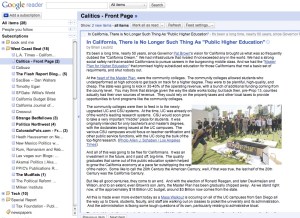
After I put down my Kindle, my work starts. This means that I open my own, personal “newspaper”, which is my RSS Reader. Here is what it looked like yesterday:
In my RSS reader I mix “feeds” from the “head” and the “long tail”, from the LA Times to small blogs on California politics and obscure research outfits such as the Public Policy Institute of California.
The important thing to note here is that I have
disassembled many disparate publications and information sources, including sources not traditionally considered “news”, and
reassembled them as only I can for my own productivity. I have thus replaced “editors” and will never, ever allow them back into this part of my life.
I probably spend an hour or so reading inside my RSS reader. This is not so relaxing. I consider it work. This is my deep dive into stuff I need to know to cover my beat (ie, the Western states). I don’t worry about printing or filing anything because I tag the items, knowing that I can search for them in future. (And yes, that means that my office is now paperless.) Sometimes I hit “share” and my editor can see what I’m reading.
Then I’m done for the day, and I move on a) to do research for my stories and b) to take occasional study breaks for fun with the other media….
2) My intellectual life: Social curation
In my “private” (ie, non-Economist) existence, I now essentially live the vision that I sketched in my Special Report. Which is to say that I am simultaneously the audience for other “amateur” producers of content and an amateur producer myself. This is simply a highfalutin way of saying:
I blog (right here) for motivations that are not remotely commercial, and
I read other blogs for intellectual stimulation, and
I occasionally post to my Facebook news feed, and
I glance into the Facebook updates of people I know.
Through the blog, Facebook and the old-fashioned medium of email, I now have a spontaneous and unplanned but remarkably efficient and bespoke system of social curation for my media content.
I can easily spend an hour or two a day just following the links that you guys, ie my blog readers, provide. Virtually all of you on this blog have never met me in person but you have a keen sense of my intellectual tastes by now, and you provide links that are, for the most part, stunningly relevant. Sometimes you bring to the surface specific research papers or articles in obscure journals that I would never have discovered in the previous media era.
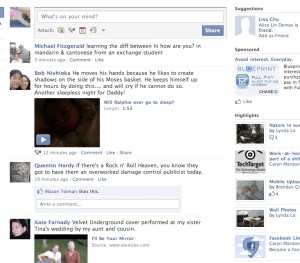
On Facebook, I find that the connections are of the opposite nature: Most of my “friends” I really do know in offline life, but many understand my intellectual tastes less than my blog readers. But my Facebook friends nonetheless are in my social circle, so their links tend also to be obscure, risqué, ironic, or moving–in short, more interesting and enjoyable than any content the media companies used to dish up for me in the previous era. Ten years ago, for instance, I would probably never have seen this stunning Ukrainian artist perform the Nazi invasion of Ukraine with sand:
The things to note here are:
My social curators also disassemble and reassemble the sources of content. They mix Jon Stewart clips (mainstream media, commercial) with homemade music ensembles (amateur, non-commercial) into one bespoke media flow.
My online and offline friends have thus become what media editors used to be, and they are far better at it than their media-conglomerate predecessors ever were. I will never allow the old editors back into my life.
It goes without saying that I “time-shift” and “place-shift”, which is just a highfalutin way of saying that I “consume” this content wherever and whenever (laptop + iPhone) I happen to be.
3) My intimate media
The final layer is what Paul Saffo in my Special Report called the “personal” media. These are media produced by family members and very intimate friends for defined and tiny audiences.
Example: baby pictures and clips on my private family web site. The site is protected and only grandparents and dear friends have access. The motivation is thus the opposite of the traditional media:
The audience is deliberately kept small (whereas media companies want large audiences)
The intent is to share and preserve personal memories.
Because the capture and sharing of such intimate media is so much easier than it ever was, I spend much, much more of my media time immersed in them. Where do I find this time? Easy. As Clay Shirky has been saying for years: We have a surplus of time, once we get rid of the crap in our lives.
Conclusion
So, to answer my three questions:
Does my 2006 thesis hold up? Yes, I believe it does. We all have the equivalent of many Gutenberg printing presses in our pockets and on our laps, and we use them to tell stories to one another as never before.
Would I refine it today? I would pay more attention to video and audio as opposed to text in the mix.
Is there a media “crisis”? No!
It is that last point that may come as a surprise. I am in an unusual position in that am both a professional and an amateur writer. So I must be aware that the news industry is dying, right?
I am indeed aware that it is shrinking. But is that a problem? There are indeed two crises:
A money and profits crisis for owners of media capital.
An employment crisis for journalists.
But those are two constituencies that the rest of society need not care about. For society as a whole, I believe there is no crisis, once we stop being hysterical and examine our media habits.
What I have discovered in my own personal media behavior is that I am today better informed than I have ever been before. But much of the information I consume no longer comes from journalists.
Instead, much, much more of it now comes from universities and think tanks in my RSS reader and iTunes University, from scientists and thinkers and other experts at conferences such as TED, and from you, who are a self-selected and thus qualified bunch of editors.
Speaking purely as a consumer of the media and a citizen, I believe that there is no media crisis–indeed, that we are entering a second Renaissance.
For my piece in the current issue of The Economist, I had the pleasure of talking to, among other people, the equivalent of Meryl Streep in the porn industry: Nina Hartley. She is 50 and says she loves sex more than ever, on camera or off. She has been at it (the camera part) since 1984.
A somewhat unfortunate part of my job, as I am increasingly discovering, is that the most interesting parts of my research and my conversations often fall well outside the realm of what can make it into my articles. Yes, of course, readers might care about how the porn industry is doing. But they’re human so they must also be curious about, well, sex. After all, it’s not everyday that you get to talk to somebody who does it for a living.
In my case, I was just a tad shy for the first few moments. It helped that I have never “consumed” Nina’s “content” so I had no visuals to distract me. Still: How would I talk to somebody who views having sex as I view writing?
It turned out that Nina was very easy and very interesting to talk to. The conversation ranged just as it would have ranged with anybody else. Our health care debate drives her “mad.” California can’t govern itself. That sort of thing.
Performing sex on camera, she said, is
a highly paid form of blue-collar work… sort of like farm labor.
Everybody is an independent contractor and there are no benefits. No benefits. It’s important in such a conversation not to reach for the double entendres.
About the porn industry, Nina was somewhat nostalgic and sentimental. In the 80s, when she started, it was apparently a glamorous sort of thing. The product was hard to get and had rarity value, the production took place in a subculture that considered itself revolutionary. There was a frisson, a pioneer spirit, a certain excitement.
Now it’s seedy, cheap, everywhere. She wouldn’t start again today if she were young now.
So why is she still in it?
In large part because she actually likes the sex, she told me. She thinks that women increase their sensitivity in middle age. At least that is happening to her.
My enjoyment of sex has increased, but for most [performers] it goes down, especially the men.
I asked her if she meant that doing it on camera makes people “numb.” Sometimes, she says. Many performers stop having sex in their private lives altogether. The men basically have to, since they couldn’t have private sex, then perform as well the next day on camera, and any hint of “having trouble” might kill their career. But they also genuinely lose interest.
Nina sees her role now as “mentor” as well as actress, so she counsels the young performers not to let that happen.
Frankly, it amazes me that it–burning out–hasn’t happened to her. She must be a modern Aphrodite.
As most of you know by now, I am an admirer of British irony and wit, the subtler instances of which I occasionally highlight or dissect, as here, here, and here. At its best, it is a matter of tone, not a matter of telling jokes. And it is best delivered casually.
Today happens to be our weekly deadline day at The Economist, and I am right now (thanks to the London time zone that I am forced to observe in California) finalizing my piece in the next issue with one of our editors, Ann Wroe, who happens to be one of my favorites (and who is a successful book author in her own right).
In the piece, I quoted an American think tank whose name starts (as they all seem to do) with “Center For The…”
Ann changed it to “Centre For The…”. I asked: Do we change words to British spelling even when they are names?
And she replied:
Yes, words are anglicised even within proper names; it either has to look odd to us or odd to them, and we opt for them.
Snooty, bitchy and arrogant? Or edgy, witty and incisive? In short, bad writing or good? That is the question.
That’s Cintra Wilson in the little mug shot above, and I would have absolutely no interest in, or knowledge of, her if she had not just re-inflamed some old kindling for all writers. Do not mistake this post as being about the content of the text I am about to refer to–I neither know nor care about fashion. In this post I care only about the issue of writer’s voice.
Background:
Cintra wrote a review in the New York Times of a J.C. Penney store that has opened in Manhattan. The review was, shall we say, scathing. Penney, she said, is a
dowdy Middle American entity
that, in essence, has no right to be on this island of skinny snobs. The clothing is full of polyester, the racks are full of sizes 10, 12 and 16, but not Cintra’s 2; and, perhaps most damningly, the store
has the most obese mannequins I have ever seen. They probably need special insulin-based epoxy injections just to make their limbs stay on.
Reaction:
Perhaps predictably, the country appears to have gone to war against Cintra. Bloggers are attacking her, for example here, here and here. Tenor: Cintra is an asshole; go shop at J.C. Penney just to spite her!
The New York Times, meanwhile, appears to have been receiving bags (gigabytes) of hate mail, decrying the newspaper’s
fat hatred, class bias and nasty humor.
The journalist, her editors, and the entire damn publication must be “smug”.
In response, Clark Hoyt, the Times‘ “public editor” or ombudsman (a bizarre and navel-gazing role, by the way) pens a characteristic mea culpa, oozing sudden humility on the newspaper’s behalf.
He does a great and succinct job of summarizing the eternal and underlying tension that is relevant for all writers when he asks:
What is the difference between edgy and objectionable? Or, as one reader … put it: How do writers “navigate the fine lines between observation, satire and snark.”
He even prompts the newspaper’s executive editor, Bill Keller, to say that
he wished it had not been published.
Wow. Cintra must be up there with Judith Miller and all those articles in the run-up to the Iraq War if she deserves editorial disavowal.
So let’s contemplate Clark Hoyt’s question: How do we navigate that fine line?
Allow me to remind you that the publication that I happen to write for, The Economist, is accused of smugness on an hourly basis. And every time somebody calls us smug, somebody else is simultaneously calling us “refreshing” or “incisive” or something even more flattering.
Furthermore, I am right now trying to figure out just what my appropriate voice is in the book that I am writing.
So, just a few observations:
Navigating that fine line is just one of the things that makes good writing so incredibly hard. Because yes, it really is hard, otherwise a lot more people would be doing it. So remember that, readers, when you write your angry (snarky!) hate mail to us journalists.
Would you really–I mean really–prefer to shut up the Cintras out there, to sanitize them, to edit in the “on one hands” and “on the other hands”, to give 50% of the article to those who say that Iraq did have WMD and 50% to those who say it did not, because, you know, 50-50 is “balanced” and 10-90 might offend the heartland? You get my drift.
Or would you prefer an authentic, damn-the-torpedoes, honest voice, one that tells it as its owner sees it and is prepared to explode with the torpedoes?
Bill Keller: If you really do wish that Cintra’s piece had not been published, why did you not, as editor, nix it? Since you did not nix it, what the f*** are you doing now disavowing your writer?
There is an easy way to address the reaction to pieces such as Cintra’s: Publish more pieces by other writers with an equally authentic but different voice. This would indeed be edifying for your readers. But do not dilute the copy that comes across your desk into the lukewarm bilge that would, at last, be the end of good writing.
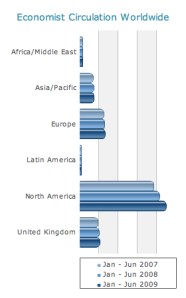
We have a new, moderately interactive and even somewhat interesting “widget” on our website that gives all sorts of circulation data, by region, country and so forth.
It continues to amaze me, like everybody else, that we at The Economist keep growing when everybody else, with a few exceptions, is suffering.
The growth continues to come disproportionately from North America, as you can see on the left.
Worldwide, circulation has doubled in the past decade to about 1½ million a week now (which = about 3 million readers, since every copy tends to get “passed along”).
I joined a dozen years ago, so everything I write now reaches more than twice as many people as it did back then. I will continue to ponder this mystery, the sausage factory I work in, and the world around it. One day I will have an answer.
My policy, as most of you know by now, is not to link to my pieces in The Economist week after week, unless there is a special reason, because that would be, well, tedious and annoying.
It always amazes me, after all these years, how short most of our pieces in The Economist are. The pieces inside the regular “sections” are called “notes” in our nomenclature. Because we have fixed (paper-issue) layouts that determine article length, most notes are either 500, 600 or 700 words. For this note, I asked for 700 words, was told to make it 600, and the final piece ended up at 520.
That’s in effect a blog entry. Most people don’t realize how much harder it is to write a short article than a large article. The folks at the New Yorker can blather on and on (“On an overcast Monday afternoon, I strode across Fifth Avenue to interview John Smith, ….”). We have to get to the point. There should be some nuance, some color, and we should cover the main bases, but all in … 500 words!
It’s friggin’ difficult. Then the readers show up in the mostly infantile comments section below the articles, invariably accusing us of utter ignorance, if not downright malice, because they know (or imagine) one little detail that was not in the 500 words.
Beyond that, of course, the brevity often hurts me, the writer. Invariably, I do research for every piece until I am satisfied that I know the subject well enough. I could easily then fill a few thousand words. So much therefore gets left on the cutting floor.
Which brings me to my second reason for linking to this week’s piece…
2) The shame, the horror of America’s prisons and Americans’ attitudes toward them
Among the things I left on the cutting floor were some of the numbers that Barry Krisberg at the National Council on Crime and Delinquency bounced around with me (mostly 2005 numbers):
Most people know that America has the highest incarceration rate in the world, but did you know just how much higher? America locks up 732 people out of every 100,000. The G7 countries, which should be the appropriate comparison for America, lock up 96 people for 100,000. The country in the world that comes closest to America is Russia, yes Russia, where the number is 607.
Was there ever a country for which we have numbers that surpass America’s current incarceration rate? Yes, says Barry, and it was …. the Soviet Union during the years of Stalin’s Gulag!!!
America has about 5% of the world’s population but 23% of its prisoners.
America also has by far the highest ratio of prisoner to each kind of crime. What that tells you is that there is not more crime in America that would justify more imprisonment.
And on and on. In short, Americans love locking people up. They do not see any irony at all in claiming, often loudly when in the company of Europeans, to be “the freest country in the world” while robbing more individuals than any other country does of their freedom, their dignity, their rights. (This distorted understanding of freedom is what I have been exploring in my thread on America.)
I should add at this point that I have rehearsed the inevitable “debate” that usually ensues enough times that I can confidently predict every objection.
In it, we discover the underlying assumptions that nowadays make America the exception among comparable countries:
The demand by federal judges to provide civilized health care to prisoners is
…forcing us to provide better medical care to prisoners than most law abiding citizens receive…
This is ironic because this particular argument tends to come from people who object to providing health care to those law-abiding citizens as well. And it is telling because its sets the tenor for all subsequent arguments, summarized neatly in this passage:
The only danger [prisoners] face is from each other, really bad people, that is people who have no respect for themselves, their neighbors, or for the rules, can be difficult to live with, without question, but that cannot be avoided. Prison is for bad people, to keep bad people away from good people so that the bad people cant hurt the good ones.
And here you have it in a nutshell. The conservative and prevailing American attitude toward incarceration is based on:
vengeance in the Old-Testament style, not on rehabilitation, which is the assumption that prisoners must at some point be brought back into society. In effect, prisoners become outcasts, with no hope of atoning and changing and playing a productive role in society. Result: the world’s higest recidivism rate, 70% in California.
Refusal to see nuance: Nobody, and I mean nobody, is arguing that there are no bad people, no crazy people, no dangerous people that must genuinely be kept out of our neighborhoods. But what about the people who are in there for stealing socks, for smoking dope, for all the many misdemeanors that have increasingly been prosecuted as felonies to please the “tough-on-crime” electorate? There are many non-violent people who have simply made a mistake and end up brutalized in prison.
Meanness, lack of compassion. Nuff said.
The reality is that prisons contain:
bad people
average people who have done bad things but can and want to change their ways
and even some good people who have got caught up in a fundamentally unjust system
But in our overcrowded and barbarous prisons, they are all thrown together, so that good people become bad and bad people become worse, and society loses by turning away from justice and civility.
Back to the sample opinion. If you approach the entire topic from the point of view that those in the system are all bad, that they deserve to be brutalized and do not deserve protection in prison, then, and only then, can you conclude, as this commentator does, that





 We have a new, moderately interactive and even somewhat interesting “
 Hannibal and Me: life lessons from history