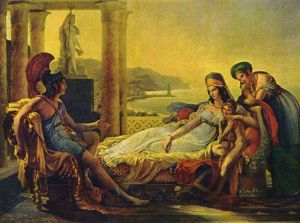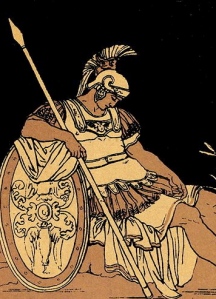
Alexander meets a yogi: Who’s the hero?

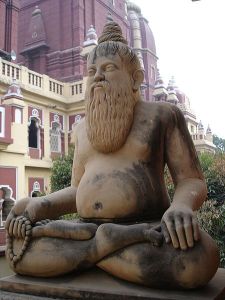
Alexander the Great was busy conquering the known world once, when he saw, on the banks of the Indus river in today’s Pakistan, a naked guy sitting in the Lotus position and contemplating the dirt.

“Gymnosophists” (gumnos = naked, sophistes = philosopher) the Greeks called these men. We would call them yogis — as in: Patanjali, say.

“What are you doing?”, asked Alexander.

“Experiencing nothingness,” answered the yogi. “What are you doing?”

“Conquering the world,” said Alexander.

Then both men laughed, each thinking that the other must be a fool.

“Why is he conquering the world?”, thought the yogi. “It’s pointless.”

“Why is he sitting around doing nothing?”, thought Alexander. “What a waste of a life.”

Devdutt Pattanaik

Thus Devdutt Pattanaik tells the story in the TED talk at the end of this post. (Thank you to Thomas for the link. Was it Thomas?)

Devdutt used to be successful and bored (the two can go together) in the pharma industry until he decided instead to make a living out of his passion, which is comparative mythology, by applying myths and storytelling to business. Wow. That’s exactly what The Hannibal Blog (at least in part) tries to do.

But let’s get back to this specific little anecdote (which echoes another such encounter Alexander was said to have had). It makes a perfect transition in my thread on heroes and heroism from the Greek and Roman heroes of antiquity to the Eastern heroes of antiquity.

As Devdutt says, Alexander grew up with the stories of Hercules, Theseus and Jason, which told him:

  • you live only once, so make it count, and
  • make it count by being spectacular!

The yogi grew up on up on different stories — the Mahabharata (which I love) and Ramayana and so forth. His heroes, such as Krishna and Rama, were not distinct individuals who lived once and made it count, but different lifetimes of the same hero.

The yogi’s stories told him that:

  • you get to live — nay, must live — infinite lives, until you get the point, so
  • stop wasting your time by conquering things that have been and will be conquered countless times, and try to see the point.

To approach this in a slightly different way:

In my last post on Aeneas, I argued that he was “the first western hero whose internal journey is as important as his external journey.” Well, I put the word western in there for a reason: Because I was already thinking of Arjuna, to whom I must turn in a separate post.

Now watch Devdutt:

Bookmark and Share

Finally: How most of us see TV news

Charlie Brooker

The Hannibal Blog thought that Michael Kinsley did a pretty good job critiquing bad writing in the news media. Now Charlie Brooker, a Guardian columnist and TV satirist, does an even better job critiquing television news.

It helps to be British, of course.

Watch:


Bookmark and Share

The first “almost modern” hero: Aeneas

Aeneas

It’s time to tie together three of my threads:

So what role did Aeneas play in the history of hero stories? What sort of hero was he?

A revolutionary one, it seems to me. He was a classical Homeric hero (literally mentioned in Homer’s Iliad) whom Virgil made into a recognizable modern hero, but with one interesting twist that still alienates him from us today.

I) The “weak” hero

In the Aeneid, we first meet Aeneas (and first meetings are important) in the middle of a storm that Juno has orchestrated in the hope of killing him and his Trojans. As the wind and waves tear his ships apart (sinking 7 of the 20),

Aeneas on the instant felt his knees go numb and slack, and stretched both hands to heaven, groaning out: ‘Triply lucky, all you men to whom death came before your fathers’ eyes below the wall at Troy! Bravest Danaan [ie, Greek], Diomedes, why could I not go down when you had wounded me, and lose my life on Ilium’s [Troy’s] battlefield? (I, 131-139)

This is an astonishing departure, a brave literary innovation, in ancient storytelling. We could not imagine, say, a Hercules or Theseus, or even a Jason, in despair — frightened to death in the sense of wishing to die.

Right from the start, therefore, we understand that Aeneas’ heroism will not consist only of strength — expressed as the overcoming of enemies or monsters — but, more importantly, of an inner struggle with himself.

So Aeneas is the first western hero whose internal journey is as important as his external journey. Virgil thus invites us, his readers, to empathize with Aeneas more than we would ever empathize with Hercules, Theseus or Jason.

II) The tender hero

Virgil also wants us to empathize in another way: Aeneas is the first hero (aside from Orpheus, arguably) who is presented to us as a whole man, a man who not only has a public duty but also private loyalties to:

  • father,
  • son,
  • wife,
  • and even lover.

Hercules, Theseus and Jason also had parents, wives and offspring, of course. But their stories never dwelt on these relationships.

Aeneas carries his father and son out of Troy

By contrast, Aeneas’ proto-Roman deference and respect for his father, Anchises, and his tender nurturing of his young boy, Ascanius, are deliberately touching. Here is Aeneas as Troy burns and its inhabitants are being slaughtered by the Greeks:

‘Then come, dear father. Arms around my neck: I’ll take you on my shoulders; no great weight. Whatever happens, both will face one danger, find one safety’…. Over my breadth of shoulder and bent neck, I spread out a lion skin for tawny cloak and stooped to take his weight. Then little Iulus [another name for Ascanius] put his hand in mine and came with shorter steps beside his father… (II, 921-924)

Aeneas loses his first wife, Creusa, in the genocide of Troy, but he makes clear how painful this is for him. Having rescued his father and son, he goes back into the burning city to look for her:

I filled the streets with calling; in my grief time after time I groaned and called Creusa, frantic, in endless quest from door to door. (II, 999-1000)

Aeneas also feels tenderness for his lover Dido, even after their “break-up” and her eternal hatred. We see this as Aeneas descends to Hades to seek advice from his dead father. In passing, he sees the shade of Dido (who has committed suicide, as Aeneas has guessed but does not know). Aeneas

wept and spoke tenderly to her: ‘Dido, so forlorn, the story then that came to me was true, that you were out of life, had met your end by your own hand. Was I, was I the cause? I swear by heaven’s stars, by the high gods, by any certainty below the earth, I left your land against my will … And I could not believe that I would hurt you so terribly by going… (VI, 611-625)

This is an unusual classical hero — a man who is aware of the ramifications his actions have on others, and man who has compassion.

III) The hero without free will

But there is also a clue to the aspect of Aeneas that alienates him from us today. “I left your land against my will,” he tells Dido’s shade. This is true. The gods ordered him to leave Dido, because they had sketched out a larger mission for him, which was to found the Roman nation.

This was his duty, and Aeneas is still, above all, pius Aeneas, as he himself says. (Dutiful is a better translation than pious here.)

In fact, as Susanna Braund points out in her fantastic (and free) Stanford lectures on the Aeneid, Aeneas uses a more telling phrase:

I sail for Italy not of my own free will. (IV, 499)

There you have it: no free will.

Braund thinks that this is the reason why the Aeneid has not yet been made into a Hollywood film, even though we’ve long had to suffer Brad-Pitt-Achilleses and their like.

It seems that we like heroes to be strong and weak, tough and tender, but that we need to believe that they are free. Subtle but interesting. To be continued.

Bookmark and Share

Success vs popularity: genius or slut?

James Patterson

Using the example of James Patterson, an apparently über-successful author of whom I had never heard, Mark Hurst recently made me think once again about my definition of success.

To paraphrase and amplify Mark’s point, would you rather …

  • create something truly yucky — something that you’re secretly ashamed of because you have good taste and know better — which nonetheless becomes a blockbuster?
  • or something that you are proud of, something you consider sublime, even if relatively few people agree or even notice?

As Mark says, this dilemma could appear in any walk of life:

You could be creating websites or software, or writing books, or designing products, or teaching classes, or producing events, or seeing patients. Whatever the case, what would you rather result from that experience: to be popular, or to create something that you yourself would be happy to receive?

If you answer “I’d like to do both” you’re cheating. The conundrum presents itself to all creative types sooner or later precisely because they must, at least sometimes, choose between the two options.

How to sell 14 million books

Which brings us to Patterson, who sold 14 million (!) books last year, as this profile claims. He published 9 books last year, and will publish 9 more this year. In fact, he is a book machine, an assembly line, a conveyor belt.

Literally: He uses “co-authors” to do the actual writing and “manages” the process rather as the boss of, well, an assembly line does.

Patterson is no boor. He himself reads both light and heavy fare, including Joyce. But when it comes to his own books he takes the approach of an advertising man. In fact, he start as an ad man, at J. Walter Thompson. He personally wrote and produced the TV ads for his early books.

He takes a marketing approach to everything from the story and characters to the jacket design, which tends to be

shiny, with big type and bold, colorful lettering — and titles drawn from nursery rhymes (“Kiss the Girls,” “Pop Goes the Weasel,” “The Big Bad Wolf”), with their foreboding sense of innocence interrupted. “Jim was sensitive to the fact that books carry a kind of elitist persona, and he wanted his books to be enticing to people who might not have done so well in school and were inclined to look at books as a headache …  He wanted his jackets to say, ‘Buy me, read me, have fun — this isn’t “Moby Dick.” ’ ”

Take that, Melville.

Patterson also does scientific market research:

Instead of simply going to the biggest book-buying markets, he focused his early tours and advertising efforts on cities where his books were selling best: like a politician aspiring to higher office, he was shoring up his base. From there, he began reaching out to a wider audience, often through unconventional means. When sales figures showed that he and John Grisham were running nearly neck and neck on the East Coast but that Grisham had a big lead out West, Patterson set his second thriller series, “The Women’s Murder Club,” about a group of women who solve murder mysteries, in San Francisco.

In other words, he does not conceive a story and wait for an audience; he finds an audience and tailors a story for it.

In this way, he practically took over Little, Brown, once a respected literary publishing house, where he now has a dedicated staff that answers only to him. A former boss of Little, Brown

says she was continually surprised by the success of Patterson’s books. To her, they lacked the nuance and originality of other blockbuster genre writers …

Then again, she is the former boss.

Patterson’s style, you ask? The profile describes it as

light on atmospherics and heavy on action, conveyed by simple, colloquial sentences. “I don’t believe in showing off,” Patterson says of his writing. “Showing off can get in the way of a good story.” Patterson’s chapters are very short, which creates a lot of half-blank pages; his books are, in a very literal sense, page-turners. He avoids description, back story and scene setting whenever possible, preferring to hurl readers into the action and establish his characters with a minimum of telegraphic details.

Does Patterson mind that he is not considered, you know, literary?

“Thousands of people don’t like what I do,” Patterson told me, shrugging off his detractors. “Fortunately, millions do.” For all of his commercial success, though, Patterson seemed bothered by the fact that he has not been given his due — that unlike King or even Grisham, who have managed to transcend their genres, he continues to be dismissed as an airport author or, worse, a marketing genius who has cynically maneuvered his way to best-sellerdom by writing remedial novels that pander to the public’s basest instincts. “Caricature assassination,” Patterson called it.

How, then does he, explain his success? He makes his books

accessible and engaging. “A brand is just a connection between something and a bunch of people,” Patterson told me. “Crest toothpaste: I always used it, it tastes O.K., so I don’t have any particular reason to switch. Here the connection is that James Patterson writes books that bubble along with heroes I can get interested in. That’s it.”

Now, as a bonus for those of you who are not only reading a blog but writing your own:

“I have a saying,” Patterson told me. “If you want to write for yourself, get a diary. If you want to write for a few friends, get a blog. But if you want to write for a lot of people, think about them a little bit. What do they like? What are their needs? A lot of people in this country go through their days numb. They need to be entertained. They need to feel something.”

And isn’t that interesting? I once wrote that the first rule of good writing is not to care about your readers, but that it needs to be tempered with the second rule of good writing, which is to have empathy.

Patterson, it might seem, proves instead that empathy is all.

Oh, wait. That gets back to the dilemma. Are we talking about good writing or popular writing, and do we care?

Bookmark and Share

Viewing Dido & Aeneas in 1992, in sawdust

While I’m at it in this mini-thread on the Aeneid, I might as well tip my hat to Henry Purcell and his Baroque-operatic interpretation of Dido’s death. But, more importantly, to Claus Guth.

Claus is a sort of de facto bigger cousin of mine. In 1992, I was spending the summer in Munich after college, where Claus was working on the equivalent of his Masters Thesis, or whatever they call it for opera directors. He had chosen to direct Purcell’s Dido and Aeneas.

Claus Guth

So I joined up as stage crew. I don’t recall contributing anything remotely useful, although I do recall being mightily impressed with the whole scene and with Claus, even if I did not yet appreciate Virgil’s underlying story as I do now. (I think that picture above is of Dido on that stage.)

And what a career that production launched! The next time I saw one of Claus’s opera’s, it was in Salzburg, where he was opening the Festival with Mozart’s Idomeneo. And it’s gone straight up from there.

Which proves, once again, how timeless good storytelling such as Virgil‘s is, and how crucial it is to find the right stage crew. 😉

Bookmark and Share

Dido conjures Hannibal: Avenge me!

Aeneas and Dido

What role did Carthage and Hannibal play in the history of Rome as Virgil saw it — ie, in the entire millennium between the Trojan War and Emperor Augustus?

Last time in this mini-thread on the Aeneid, I tried to sketch the big historical picture of that great poem, the overarching tale of how a band of Trojan survivors arrived in Italy and merged with the Latin race to found what would become, fifteen generations hence, the Roman nation.

But I promised in that post to pay a bit more attention to Hannibal and Carthage. For Aeneas the Trojan, the three Punic Wars between Rome and Carthage would not start for another thousand years. For Virgil and Augustus, the worst memories of those Punic Wars (ie, the years when Hannibal was in Italy) already lay two centuries in the past. Did Carthage need to be in this story at all?

And how.

It is clear that Virgil and the Romans in the time of Augustus still considered Hannibal their worst enemy ever, the man who brought them closest to extinction. And so Virgil almost stuctures the entire poem around Carthage, albeit in very subtle and psychologically surprising ways. Here goes:

Juno (Hera) again….

Hera, whom the Romans called Juno, has already come up repeatedly as an almost generic source of trouble in antiquity, as when she drove Hercules mad in her jealousy. Well, the Aeneid takes place just after the Trojan War, and Virgil has Juno still seething with rage at the indignity that caused that war, which was Paris’ choice of Aphrodite (Venus) over Hera as “the most beautiful.” Venus, of course, not only went on to fight for the Trojans but was also the mother of Aeneas.

So Juno would do everything she could to torment Aeneas:

… the origins of that anger, that suffering, still rankled: deep within her, hidden away, the judgment Paris gave, snubbing her loveliness; the race she hated… (I, 38-41)

And so Virgil starts his poem, on the very first page, with Juno and her new obsession, which is Carthage (“new city” in Punic), which was just then being built, at least in this mythical version:

Tyrian settlers in that ancient time held Carthage, on the far shore of the sea, set against Italy and Tiber’s mouth, a rich new town, warlike and trained for war. And Juno, we are told, cared more for Carthage than for any walled city of the earth… There her armor and chariot were kept, and, fate permitting, Carthage would be the ruler of the world. So she intended, and so nursed that power. But she had heard long since that generations born of Trojan blood would one day overthrow her Tyrian walls, and from that blood a race would come in time with ample kingdoms, arrogant in war, for Libya’s ruin… (I, 20-32)

There, in a nutshell, you already have it all: Juno would nurse Carthage to become the world power, and yet she already knew that destiny intended, after a bloody struggle, for Rome to “overthrow its walls” and be its “ruin.”

(Tyrian refers to Tyre, Carthage’s mother city in Phoenicia, today’s Lebanon. Libya at the time referred to the inhabitants of northern Africa.)

Carthage as eastern temptress

Aeneas and his Trojans, meanwhile, are at sea, trying to reach Italy. Juno tries to kill them, by persuading the god of winds to cause a storm. She almost succeeds. 13 of Aeneas ships sink, and only 7 remain. And where do they land?

At Carthage, as it is being built. Its ruler is the beautiful and good queen Dido. Dido is more than generous to these Trojan refugees. She even offers to share her kingdom:

Would you care to join us in this realm on equal terms? The city I build is yours; haul up your ships; Trojan and Tyrian will be all one to me. (I, 776-779.)

And then she beholds Aeneas, the Trojan leader, and falls for him,

for she who bore him [Venus] breathed upon him beauty of hair and bloom of youth and kindled brilliance in his eyes…. (I, 801-803)

From the start, there is a scintillating and even erotic chemistry between “Carthage” and “Rome”, these two opposites who are yet so attracted to each other.

So Dido asks to hear Aeneas tell of the sack of Troy, that Greek genocide about which all people in the Mediterranean had by then heard. Aeneas describes it, in Book II of the Aeneid, in harrowing detail (in the picture above, Dido is listening to him as Ascanius, Aeneas’ little boy, sits on her lap). Aeneas also tells of his wanderings, his “Odyssey”, that brought him from Troy to Carthage.

Did0 listens and is rapt:

The queen, for her part, all that evening ached with longing that her heart’s blood fed, a wound or inward fire eating her away. The manhood of the man, his pride of birth, came home to her time and again; his looks, his words remained with her to haunt her mind, and desire for him gave her no rest. (IV, 1-7)

They get together, in a wild cave on a wild night. It must have been great, for she wants more, infinitely more. In fact, she considers herself married.

Virgil’s Roman audience at this point pictures not only the temptresses that tried to seduce Odysseus but Cleopatra, another queen in northern Africa who had very recently led astray a great Roman (Mark Antony) with her wily and erotic eastern ways. This is titillating stuff to the Romans.

Indeed, Aeneas almost seems inclined to change his plans and stay with Dido. But this is not his duty, and he is “dutiful Aeneas”, pius Aeneas. Jupiter, via Mercury, reminds him unequivocally of his destiny: to go to Italy and sire the Roman race.

Aeneas understands and decides to be on his way. But he doesn’t know how to tell Dido. Indeed he fears her. So he orders the ships to prepare to sail away at night.

Dido finds out and goes into a rage, the mother of all meltdowns. As Cheri has said elsewhere, it is not a testosterone rage as Hercules might have it, defined as violent, intense and short. No, it is an “estrogen rage”: deep, lingering, even eternal and ultimately more destructive.

Thus Dido (Carthage) ceases being Aeneas’ (Rome’s) lover and becomes instead his enemy, indeed the enemy of his entire race:

Then, O my Tyrians, besiege with hate his progeny and all his race to come: Make this your offering to my dust. No love, no pact must be between our peoples; No, but rise up from my bones, avenging spirit! Harry with fire and sword … Coast with coast in conflict, I implore, and sea with sea, and arms with arms: may they contend in war, themselves and all the children of their children! (IV, 865-875)

Then she stabs herself with a sword and hurls herself on a funeral pyre.

Every Roman of Virgil’s day would have understood whom Dido was summoning as this “avenging spirit”: Hannibal.

Indeed, just in case anybody was still confused, Virgil later, in Book X, has Jupiter himself make it more explicit. At a council of the gods on Olympus, Jupiter says

the time for war will come — you need not press for it — that day when through the Alps laid open wide the savagery of Carthage blights the towns and towers of Rome. (X15-19)

You almost get the sense that the entire Aeneid was mere prologue … to this:

Bookmark and Share

How humans are (not) unique

Robert Sapolsky

Beat me, said the masochist.

No, said the sadist.

We, Homo sapiens sapiens, are the only species that can understand the humor (ie, the meaning) of this conversation. It involves advanced versions of simpler concepts such as Theory of Mind and tit-for-tat. But the simple versions of those and other concepts are not unique to humans. So the definition of human really rests on marginal complexity.

Take 37 minutes of your time to watch Robert Sapolsky, a brilliant and hilarious neuroscientist at Stanford, as he analyzes what makes humans “uniquiest”. It is a prime example of making science accessible through storytelling.

The short of it: Almost all of the things that we used to think made us humans unique in the wild kingdom can in fact be observed in other species. Such as:

  • Intra-species aggression (including genocide)
  • Theory of Mind
  • The Golden Rule
  • Empathy
  • Pleasure in anticipation & gratification-postponement
  • Culture

However, we humans exhibit these facilities with a twist — with an added layer of complexity.

(By the way, he refers to the same baboon study that I mentioned in this post, but could not locate. Does anybody have a lead?)


Bookmark and Share

Trojan/Roman Aeneas: the historical big picture

Aeneas

What was Virgil trying to accomplish in writing his Aeneid, perhaps the greatest poem in history?

That’s the question I want to try to answer in this post.

(Since the Aeneid merits several posts, I’ll get into what its hero, Aeneas, meant for the development of Western ideas about heroism in a subsequent post.)

I propose that to answer the question, we need to understand something about

  1. Virgil’s own time, and
  2. All of history (ie, ≈1,250 years between the Trojan War and Emperor Augustus), as viewed by Romans in Virgil’s time.

1) Virgil’s own time

Publius Vergilius Maro was born in 70 BCE in the northern part of what we now call Italy, which was then still considered part of Gaul. He probably became a Roman citizen only at the age of 21, when Julius Caesar extended civic rights to the region.

Virgil was thus born in the middle of the century-long Roman Revolution, a time when the old Republic disintegrated — first gradually, then suddenly — as strongmen seized power and fought one another, murdering and terrorizing much of the population in the process. Virgil lived through several rounds of civil war. He was a scholar and spent some of these years in the relative peace of Naples. But the constant and often arbitrary slaughter terrified everybody at the time, including him.
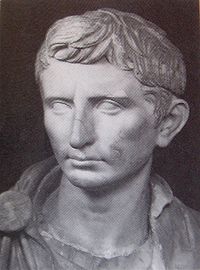
Octavian (Augustus)

Out of that chaos, like a Lotus flower out of pond muck, rose Octavian, later known as Emperor Augustus. Virgil was in Octavian’s social circle and began writing the Aeneid as Octavian consolidated his power, following his naval victory over Mark Antony and Cleopatra at Actium in 31 BCE.

Shrewd and subtle, Octavian was careful to avoid the mistakes of his great-uncle and adoptive father, Julius Caesar, who had begun to resemble a king — a dirty word to the Romans — and was murdered. So Octavian never called himself a king, but a princeps — “first head,” as in leading citizen (whence our word prince).

Over time, Octavian allowed the Senate and people of Rome — his genius manifested itself in this psychological coup — to bestow upon him ever greater powers and titles, increasingly mocking the non-use of the word king. In 27 BCE, the Senate began calling him Augustus, the august or blessed.

But to Virgil and most Romans of the time, all this was a huge improvement over the apparent alternative: more civil war. Augustus imposed peace, on Rome and on its empire. What we call the Pax Romana was really the Pax Augusta.

Augustus thus appeared to be the reluctant hero, the hero who wages war only to end war, who finally lets Rome reach its full, world-ruling and world-changing potential and mission. He seemed to be the end of Roman history, its telos.

What was needed was a story that would tell all of the past, starting before Rome even existed, as though everything inexorably led up to this man, this peace, by divine will.

And this is the answer to the question. Virgil wanted to write that story. We today might be tempted to call it propaganda, and it was. But it was sublime propaganda, in the most moving and intimate words, with allusions to all poems that preceded it. It was epic.

2) From Troy to Rome

There was, of course, an earlier epic poet to whom all of Mediterranean antiquity looked for explanation of the mysteries of life. That was Homer.
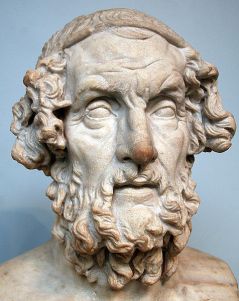
Homer

In about 750 BCE, Homer wrote the Iliad, about events in about 1,250 BCE just before the as yet un-named “Greeks” sacked Troy. And he wrote the Odyssey, one of the many nostos (“homecoming”) stories, in which the nominally victorious Greek heroes struggle and sometimes fail to re-enter society at home. (Whence our word nostalgia: nostos = return home; algos = pain.)

By Virgil’s time, the Romans had, of course, conquered the Greeks and in turn been culturally conquered by them. In fact, as Virgil has Aeneas’ father Anchises predict, in a vision just after the Trojan War for the not-yet-existing Rome:

Others [ie, the Greeks] will cast cast more tenderly in bronze their breathing figures, I can well believe, and bring more lifelike portraits out of marble; argue more eloquently, use the pointer to trace the paths of heaven accurately and accurately foretell the rising stars. Roman, remember by your strength to rule earth’s peoples — for your arts are to be these: to pacify, to impose the rule of law, to spare the conquered, battle down the proud. (VI, 1145-1154)

So this contrast, this proto-Ricardian division of labor, existed: Greek culture, Roman law. The Romans saw themselves as more trustworthy and purer than the Greeks, but simultaneously as the younger descendants of that older culture, a bit as Americans used to feel toward Brits.

So a creation myth had become fashionable in Rome that linked Rome to the same Homeric tradition and yet distinguished it from the Greeks.

This introduces a fascinating psychological symmetry and twist: The Romans had to have been there, to be fighting in the Trojan War, but not as Greeks. Ergo: They were the Trojans! As they had lost then, they prevailed now.

How? Homer himself had seeded the new storyline, in Book XX of the Iliad. Aeneas, a Trojan hero and the third cousin of Hector, Troy’s greatest warrior, fought the monstrous Greek killing machine Achilles and survived. Neptune (ie, Poseidon, to the Greeks) convinced the gods to take Aeneas out of danger, because

his fate is to escape to ensure that the great line … may not unseeded perish from the world…. Therefore Aeneas and his sons, and theirs, will be lords over Trojans born hereafter.
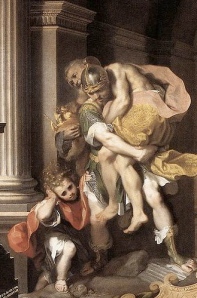
Aeneas rescuing his father and son

So there it is. Aeneas will survive the sack of Troy, a genocide he describes in the Aeneid in harrowing detail. With his father and his son and a band of other Trojan survivors, they will sail through the Mediterranean, trying to found a new Troy.

They try, and fail; again and again. One frustrating delay or disaster follows the next. As a result, Aeneas goes on his own “Odyssey”, criss-crossing the same ocean at the same time as Odysseus does. Virgil emphasizes this. Aeneas sails past Ithaca, Odyssues’ home, and meets one of Odysseus’ men who survived their encounter with the Cyclops. Aeneas’ itinerary, (click to enlarge), looks remarkably similar to Odysseus’:
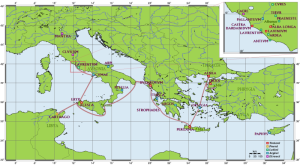
Aeneas knows all along that he has a duty to found a new city, but he only discovers the details along the way, as they are revealed to him.

This is crucial, because through these revelations we (ie, Virgil’s Roman audience) are foretold the destiny of Rome — Rome’s future in the story which is already Virgil’s past. Indeed, Aeneas and his band of Trojans gradually become Romans — Virgil has them staging games and rituals that the Romans recognized as their own.

When Aeneas descends to the underworld to talk to his dead father, he, Anchises, spells out the next thousand years. He gives Aeneas glimpses of the Gallic wars and Pompey and Caesar and Augustus.

When Vulcan (Hephaestus, to the Greeks) forges him special armor, the shield depicts all of Roman history on its front — including, of course, Octavian’s victory at Actium. Message: This is what Aeneas is fighting to make come about!

The most traumatic part of the next thousand years of Roman history (ie, the millenium between Aeneas and Octavian) occurred during the third century BCE, when Rome fought Carthage and Hannibal came close to exterminating the race of Aeneas. How Virgil deals with that is fascinating. This being The Hannibal Blog, I’ll have more to say about it, as you might imagine. But I will do that in a separate post.

So this is the context of the first six books of the Aeneid: an “Odyssey” from burning Troy to “Hesperia”, the land of the West (ie, Italy).

The context of the remaining six books is a war that must be fought once Aeneas arrives in Italy, at the mouth of the Tiber: another “Iliad”, but this time a war for the founding of a city rather than the destruction of one.

Yes, it is his destiny to found a new Troy on this land, a new race that will rule the world. But the land is already taken. Aeneas and his Trojans will have to make alliances and to defeat the Latins. As Achilles once overpowered Aeneas’ cousin Hector, Aeneas now must become a Trojan Achilles to overpower the Latin hero Turnus.
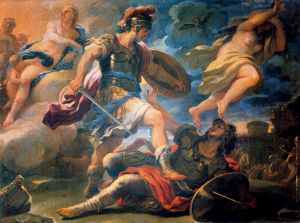
Aeneas, killing Turnus

The Aeneid ends abruptly as Aeneas finishes the job, after a grueling battle. The last lines are these:

He sank his blade in fury in Turnus’ chest. Then all the body slackened in death’s chill, and with a groan for that indignity his spirit fled into the gloom below.

But through the revelations up to that point, and of course through the history that the Roman audience knew, it was clear that Aeneas is now done with killing. The time for generating has begun. Aeneas marries the Latin princess Lavinia, and Trojans and Latins merge to become a new race, the future Romans.

The city of Rome itself, mind you, will not be founded for another few centuries, when Romulus kills his brother Remus, both suckled as babies by the she-wolf, and starts building the city he names after himself.
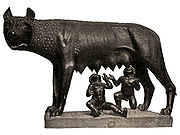
But the Romans bridged those centuries in their story with genealogy. Romulus and Remus were the offspring of Aeneas and Lavinia fifteen generations downstream. If you define a generation as 25 years, this places Romulus and Remus 375 years after Aeneas. If you assume that Aeneas arrived in Italy between 1,200 and 1,100 BCE, then this fits Romulus’ customary founding date of 753 BCE.

Name is destiny

Ever wonder why the Iliad is not called the Troiad? Well, there’s a little story there that brings us full circle in this post. (This is a bonus round for geeks.)

Remember what my premise for this post is: The Aeneid was a genius work of propaganda for Octavian.

Well, Octavian was adopted by Gaius Julius Caesar, and in Roman law the son takes the name and lineage of his new father. So Octavian’s name was also Gaius Julius Caesar. We call them the first of “the Caesars” (whence the words Kaiser, Tsar, Shah, etc). But they were from the clan of the Julii.

Now, Troy and the Trojans were a city and people with many names (ditto the Greeks), depending on which ancestor you wanted to emphasize.

There was a Dardanus, so the Trojans in the Aeneid are sometimes the Dardans or Dardanians. In fact, we still call the former Hellespont, the straits that separate Europe from Asia, the Dardanelles. Troy was a few miles inland.

There was a Teucer, who married Dardanus’ daughter, so the Trojans are also sometimes called Teucrians. And Teucer had a grandson named Tros, whence Troy.

Tros had three sons: Assaracus, Ilus and Ganymede.

Ilus gave the city one of its names, Ilium. Hence the Iliad. (Ilus was also the grandfather of Priam and great-grandfather of Hector.)

Assaracus, meanwhile, was the grandfather of Anchises, who had the enormous luck to sleep with the goddess Venus (Aphrodite) and sire Aeneas. Aeneas then married Hector’s sister (his own third cousin) Creusa, and they had a son, Ascanius, also named Iulus, a form of Ilus.

Ilus, Iulus, Julius: They are all variations of the same family name. The Julii claimed direct descent from Aeneas and Venus.

Julius Caesar Augustus, you see, was Iulus, was Aeneas, was the reluctant warrior peacemaker, and Rome was the new Ilium, the new Troy.

Bookmark and Share

The “story” of Iceland and Greenland

Once upon a time, war broke out among Norwegian Vikings. One band launched the boats and fled. They discovered a green island and settled. Afraid that their enemies might pursue them, they sent word back to Norway that their island was actually an ice-land, but that another island — more distant, larger and indeed covered by ice — was inhabitable green-land. And so the green island became Iceland, and the icy island became Greenland.

This story is fiction, which is to say false.

The true (non-fiction) story of Iceland’s founding is more complicated and had something to do with Ingolfur Arnason (above), a Norse chieftain who founded Reykjavik in 874.

Greenland, meanwhile, was not “discovered” (by Norsemen, that is) until a century or so later, when a Norwegian who was sailing to Iceland was blown off course. It was later named “green land” by Erik the Red, another Norwegian, who really was fleeing from Norway and first went to Iceland before settling in Greenland. He wanted to bring more settlers and was obviously good at branding and marketing — “green jobs” for his “green economy”, if you will.

Fiction trumps non-fiction

I heard the first version — ie, the fictional account — at some point when I was young and I never forgot it. Even when I learned that the real history was different, I could never quite keep its details together in my memory and returned in my mind to the fictional account. To me, that’s how it happened. And that is odd.

Melanie Green

I was reminded of this when I read about the research of Melanie Green (perhaps the “green” did it). She is a social psychologist at the University of North Carolina at Chapel Hill, and another of the researchers in the Scientific American article I discussed in the previous post.

She found that when information is presented as “fact” or non-fiction, people switch on their critical-analysis brain, whereas when information is presented as fiction, they switch on their story brains. And story brains are much more receptive and open than analytical brains, as mine was when I first heard the story about Iceland and Greenland. (In fact, I tried to “prime” your story brain, too, by opening with Once upon a time).

But once we accept a fictional story, it is in us and affects the “real” world. The article gives the example of the 2005 film Sideways, in which a cranky but lovable wine snob refuses to stoop to Merlot. Well, Merlot sales plummeted after the film, because people (like me) had accepted the story. We all started drinking Pinot Noir. I’m slightly embarrassed by it, in fact.

Lesson (for all areas of life): Never underestimate the power of narrative.

Other tidbits

A few other points of interest or research areas mentioned in the article:

Theory of Mind

Our human brains appear to be wired for stories. The key is our human Theory of Mind, our ability to attribute awareness and intent to other creatures and even objects (which most other animals seem not to have).

Children develop Theory of Mind around age four or five. Which perhaps explains why picture books for two-year-olds are not yet stories but pictures of objects without much connection. Once the kids have Theory of Mind, however, everything becomes a story, whether it involves trains (Thomas!) or worms or blocks.

Empathy and immersion

The best stories captivate us so much that psychologists speak of “narrative transport.” That’s what we authors all hope to achieve, in part by empathizing with our audience, as I have written previously. But it’s actually the audience who must empathize, and

the more empathetic a person, the more easily he or she slips into narrative transport.

Social cohesion

I’ve mentioned Robin Dunbar before, when I talked about Facebook and human group size. Well, Dunbar also has a lot to say about storytelling, it turns out. As our ancestors evolved to live in groups, apparently, they kept track of — and reinforced — their complex social relationships through … storytelling.

Maslow’s hierarchy of needs

I’ve written before about Abe Maslow and his hierarchy of needs, and have even compared that hierarchy to the chakras in Yoga. Well, I should have extended the idea to storytelling.

Patrick Colm Hogan, a professor of comparative literature at the University of Connecticut, has found three narrative prototypes in almost all human stories:

  1. Romantic scenarios, (= the trials and travails of love)
  2. Heroic scenarios (= power struggles).
  3. “Sacrificial” scenarios (= agrarian plenty or famine)

These correspond neatly to the lower three chakras (survival, sex, power), or the bottom of Maslow’s pyramid of needs. No surprise there, I suppose.

Heroines and “literary Darwinism”


Helen and Paris


Ask people to name a woman in the Iliad, the story of the Trojan War, and they will name Helen, the cause of that war, who was known for her beauty.

Ask people to name a man, and they will not name Paris, also known for his beauty but otherwise considered a pansy even though Helen eloped with him. Instead, they will name Achilles (or Hector, Odysseus etc), who were heroes.

So: beauty for women; strength for men (see Hercules). Right?

I began contemplating this when Solid Gold commented under a recent post in my thread on heroes and heroism that

the real question is whether a woman can be a hero.

I think that question deserves books. But I thought I’d share a tidbit from an article about storytelling (another big thread on The Hannibal Blog) that attempts an answer. (Thanks to Jag Bhalla for the link.)

It cites research by a professor of English at Washington & Jefferson College named Jonathan Gottschall, who is apparently one of the scholars known informally as “literary Darwinists.” (The ideas of that great thinker seem to be infinitely extensible.)


Gottschall


As far as I can tell, these literary Darwinists have corroborated the thesis of Carl Jung and Joseph Campbell that all humans in all cultures and ages tend to re-tell fundamentally the same archetypal stories. But whereas Jung and Campbell used psychological logic, the literary Darwinists are using the (Darwinian) logic of relative reproductive success.

And so Gottschall analyzed “90 folktale collections, each consisting of 50 to 100 stories,” ranging from industrial nations to hunter-gatherer tribes, and found overwhelmingly similar gender depictions:

  • strong male protagonists (aka “heroes”) and
  • beautiful female protagonists.

We couldn’t even find one culture that had more emphasis on male beauty,

Gottschall is quoted.

In all, the stories had had three times more male than female main characters and six times more references to female beauty than to male beauty.

Why?

That difference in gender stereotypes, [Gottschall] suggests, may reflect the classic Darwinian emphasis on reproductive health in women, signified by youth and beauty, and on the desirable male ability to provide for a family, signaled by physical power and success.

Let me try to make this Darwinian logic more explicit:

  1. Let’s say you have two hypothetical tribes, each reflecting its values through the stories it tells.
  2. Tribe A values male beauty and female strength whereas Tribe B values male strength and female beauty.
  3. We might assume that, over time, Tribe B not only reproduces more than Tribe A, but even that it does so at the expense of Tribe A (resources, conflict, etc).
  4. Ergo, we, who are by necessity descendants of Tribe B, live to retell its stories, the B stories.

Discuss.

Bookmark and Share