Why I am shrinking this blog

I told you in the previous post that, for the first time, I deleted a post (it no longer matters what the post was about) because I came to the conclusion that it was badly written by my standards.

Upon further reflection, that made me realize that I have to “shrink” this blog. Now I’ll explain what I meant by that. (And yes, I savor the irony that I will talking about a “shrinking” a blog in a 2,000-word blog post.)

I) What I consider “badly written”

I write so much that the mechanics — syntax, grammar, flow — are rarely bad anymore. But that’s not what writing is about.

Ultimately, words deserve to be spoken or written only if they communicate what the speaker or writer wants to communicate. And that very much includes not only the substance denoted but also the tone, voice and other bundles of connotation.

We all know that perfect control over the meaning(s) of words, especially written ones, is impossible. That is why Socrates refused ever to write, and always only spoke. Just think of our ongoing debate about the words (and punctuation) in a phrase written 219 years ago:

A well regulated Militia, being necessary to the security of a free State, the right of the people to keep and bear Arms, shall not be infringed.

Did the writer intend that only “a Militia”, and “a well regulated” one at that, was to have the right to bear arms? Or that “the people”, collectively and individually, should have that right, although it might also be, you know, nice if a Militia were around? Who knows?

This conundrum — that writers lose control over their words as soon as they make contact with any audience — led people like Jacques Derrida to suggest that we stop even pretending that we can control meaning: Words mean whatever anybody wants them to mean, so get over it.

I don’t subscribe to that. A good writer should have some control over his words, the way a good rider should be able to rein in his horse. Naturally, horses sometimes go berserk, as do words. But that’s when it’s time to kill a blog post.

That the now-deleted post had to be dispatched became clear not when it led to vigorous debate (as many posts here on The Hannibal Blog do), but when the comments looked to me, the writer, as utter non-sequiturs. I looked at some of them and could only say: “Huh?” How did the commenter read this meaning into this post?

This is when I remembered my Second Secret to Good Writing, which is empathy. Don’t blame your audience. Re-examine your words.

My words had not just evoked an unintended response, but in a few individual cases the opposite of the response intended. That should not happen to a good writer.

And so I decided that the words had to die.

II) Why might this have happened?

1) The issue of quantity

Less than a month ago, I wondered whether there was “a Laffer Curve” of writing — in other words, a point beyond which increasing quantity (of words written) decreases quality.

I was pondering that question because, over the past couple of years, the number of words I produce, and am expected to produce, has inexorably been increasing.

When I started at The Economist in 1997, we were expected to write articles for the weekly (print) issue. And that was it. (Quite enough, I thought.)

I first recall internal discussions about “blogs” in 2006. I might have had something to do with that, because I wrote a Special Report in 2006 about “the new media.” In it, I said that all the new media (including blogs) would collectively transform society, which they clearly have done. But I never said that individual news organizations had to add blogs.

But blogs we began having, even at The Economist. For a while we didn’t really take them seriously. But now we do. And we have more and more of them. And we are expected to “feed” them. So, in addition to the articles we write, we write blog posts.

We also do podcasts, and those often take a surprisingly long time (the logistics, not the actual talk time). And we do video pieces. Those take even more time to set up.

To take this week as an example, I produced two articles, two blog posts and one podcast … in four days (because on Friday I allegedly started a holiday.)

Our heritage, our “print DNA”, means that we will always put the utmost effort into the print-issue articles. So that’s still where the research, fact-checking, deliberation, travel, background reading, interviewing goes. (And real-life logistics have an annoying habit of not aligning perfectly with The Economist’s Greenwich-mean-time deadlines.)

But that doesn’t actually leave all that much time to produce all that other stuff.

Then add a personal blog in support of a forthcoming book, such as The Hannibal Blog.

Yup, now this amounts to a lot of words. Some of those words will not be redacted, honed, polished, and stress-tested as much as they should be. This must mean, from time to time, that some words are less than optimal.

Conclusion: Don’t produce more, perhaps less.

2) The issue of audience expectations

I recall an internal discussion once where the theory was put forth that the web audience is sophisticated. In other words, readers of blogs (whether on The Economist’s web site or WordPress) know that the medium is more intimate, conversational, relaxed, aphoristic and subjective. Blogs are essentially personal diaries, except public and social.

Readers, goes the theory, do not expect a blog post to be balanced, polished and fact-checked. They can discriminate between a blog post and an article.

Not only that, but they like to have that less formal window into the writer’s soul, they like hearing about what happened to him on the way to this-or-that, what he was thinking when so-and-so said something-or-other. It’s like knowing somebody by email and then seeing a handwritten note from him: the handwriting, with its imperfections, says something. Or like meeting a public figure and getting a peek behind the scenes.

Well, that’s the theory. The reality is that audiences get confused. Many readers/listeners/viewers merely see the brand, and do not discriminate among media. The brand could be The Economist or, at micro scale, The Hannibal Blog. But what if the human beings behind the brands straddle their boundaries? When is the writer allowed to speak personally, and when is he expected to be a journalist upholding a 160-year-old brand?

This is not a new issue. Correspondents of The Economist have always gone to dinner parties (OK, rarely) and often moderate panels at conferences, for example. When we’re chatting with our table neighbor, are we allowed to kid around and speak our minds? How about when we’re on a podium?

Blogging (and all its descendants, such as tweeting) is a genie that is out of the bottle and won’t go back in. I’m simply flagging a new tension. And a new need to make explicit to audiences what they should expect in which context.

Here on The Hannibal Blog, by the way, you get me, just me, my quirky, personal musings, which represent nothing else.

Conclusion: Don’t assume that readers let you speak “off-the-record”, be circumspect. If in doubt, say less.

3) The issue of scope

You may have heard people described as coconuts or oranges. Coconuts mix everything together inside, oranges come in neat sections.

Well, most people are coconuts, especially at The Economist. We have many interests, strange hobbies, and what’s interesting is what you get when you mix it all up. One of my favorite colleagues is simultaneously a connoisseur in the subjects of sailing tall boats, all matters Mongolian, Tango and bird watching, and that is only the beginning of a long list.

Should he stick to his beat in writing articles? Should he have a blog for each interest? On The Economist’s web site or on his own? Is it alright if he mixes it all together, the way it is mixed in his own soul?

In my case, for example, I started this blog about two years ago, intending to make it purely about the book I was writing. This was naive. I soon realized that the process of publishing a book takes a lot longer than the writing of it (and I now expect the book to be out next year). So what do you do in the mean time?

I was advised not to publish excerpts, because that would give the book away. So I began blogging about other stuff. All those other interests. Pretty soon, that included the whole dang coconut, even The Economist.

And again, it’s possible that some of you got confused.

I now face the interesting development that The Economist is constantly, almost every week, making available to me new “coconut straws”. Just one example: This summer we started yet another blog, called Johnson. It is about Language. I have not contributed to it yet, but it so happens that Language is one the big threads on The Hannibal Blog. Obviously, I have to rethink that. My future language posts should probably go to Johnson, not The Hannibal Blog.

Conclusion: Reduce this blog’s scope; become an orange; write about fewer and better defined topics. No politics.

4) The issue of fear

When you write you make yourself vulnerable. When you write on a personal blog you are even more vulnerable. Who knows what weirdos show up alongside the intended audience? Who knows who does what with your words?

That can lead to fear, and fear leads to the worst writing. And bad writing, for a writer, equals failure.

The most important prerequisite for being a good writer is therefore an ability to overcome fear and find courage. You must say something interesting, which invariably means that somebody somewhere could take offense (even when the topic might at first blush seem innocuous — no topic stays innocuous if it gets a large enough audience.) And you must say it clearly, which is to say simply and thus strongly.

This gets into one of the big topics in my book, the tension between tactics and strategy. Writing well (ie, with courage and risk) about many topics is like a country fighting a war on many fronts. You will eventually lose. Writing more timidly or carefully about all these topics is like fighting less fiercely on all those fronts. You will — again — eventually lose. So you must choose your topics (your fronts) strategically.

Conclusion: Again, write about fewer topics in each medium, such as this blog.

III) Postscript

I want to end by giving a little shout-out to two bloggers who, in their very different ways, have explicitly or implicitly addressed some of the issues above.

1) “Phil”

First, there is “Phil”. I don’t know what his real name is and I don’t need to know. He has several blogs, indeed he seems to keep switching blogs and starting new ones, to my ongoing confusion. His current “main” blog seems to be here.

Phil once observed, either in a comment here or in a post on his own blog, a phenomenon: Time and again, Phil finds an interesting new blogger, a strong and idiosyncratic voice, and follows that voice. After a while, that blog becomes popular. And then, as its audience grows, the blog becomes … bad.

(Phil, if you can provide the URL to your observation, I would like to link to it.)

So I speculate: Perhaps Phil, by starting new blogs all the time, is conflicted as we all are about gaining an audience. An audience gathers, and he runs away to start a new one. Because he understands, as we all do, that audiences are a threat as a well as a blessing.

2) “Man of Roma”

The other blogger who deserves a shout-out here is Man of Roma. He is a bon vivant and connoisseur of classical wisdom. And this summer he did something very civilized: He simply left (his blog, that is) and enjoyed himself, knowing that the audience that matters, which includes me, will be there whenever he returns.

Bookmark and Share

This blog must be shrunk

I just did something for the first and, probably, last time: I deleted a post on The Hannibal Blog.

Why?

I’d like to make the answer general, not specific to the post in question. The post was badly written, and that tells me that I must shrink this blog — not in size but in scope.

I will explain in the next post.

Bookmark and Share

Done but still untitled

By the way, it turns out that the fourth draft of my manuscript, which I sent off to my editor at Riverhead in May, was indeed the last and final draft.

In other words, the manuscript (ie, book) is officially finished. It is written. Done.

I chatted with my editor the other day, and he loved it. Thinks it’s a winner. All that.

In particular, you may recall that the only major and noteworthy change in the final draft was a new final chapter. A chapter of “lessons”. My editor likes that chapter exactly as is, without any iteration.

So we now have an interesting timeline:

  • I got my book deal with Riverhead in December 2007, a bit over 2½ years ago.
  • About one year later, I delivered the first draft. So that was 1½ years ago.
  • Just over 2 years after the deal, I sent my final draft.

So I guess it took two years to write the book. But for much of the time between drafts, I was really just waiting for my editor to get back to me. So it actually only took about 1½ years of work. And always part time, (after the kids went to bed, on weekends etc.). No big deal. Consider that, if you’re thinking about writing a book.

That said…

The surprise, therefore, is not how long it took me (not long) or how hard it was (not hard) but how incredibly, mind-numbingly slow the publishing industry is.

The next step, I have been told, is now for the publishers of Riverhead (ie, the boss) to set a publication date. You might think, as I once thought, that they simply start printing and there we are. Oh no. Various mysterious processes now begin, and they take half a year or so.

Furthermore, the scheduling of a book release is apparently both science and art, so tactics come into it. You may not want to release in the fall, when celebrity authors come out; you may want to release just after Christmas when reviewers and connoisseurs apparently look for new talent; and so forth.

So now I am, as I have been, waiting. Just waiting.

Oh, and we haven’t chosen a title yet. They think it’s incredibly important, but are in no hurry. You’ll be the first to know.

Bookmark and Share

The Laffer curve of writing quality

You’ve probably heard of the Laffer Curve. Economist Arthur Laffer allegedly sketched it on a napkin during a 1974 meeting in Washington that included Dick Cheney and Donald Rumsfeld.

It is a thought experiment intended to show that if you raise the tax rate beyond a certain point you actually end up collecting less tax revenue. (At a tax rate of 100%, for instance, nobody would bother earning income at all anymore.)

Well, the curve just popped into my head as I was contemplating something completely different: The quality of my writing — or of anybody’s writing.

Look at Laffer’s curve above and replace Government Revenue on the Y axis with Writing Quality, and Tax Rate on the X axis with Words Written.

Up to the peak

In general, I have noticed that my writing in the past always improved when I wrote more.

So, at The Economist for example, I noticed ‘being on a roll’ every time I finished a Special Report (those 12,000-word inserts). Then, when I wrote my book in my spare time, I again noticed that all my writing seemed to improve. When I added this blog, my writing seemed to get better again. And so forth.

Why might this be the case?

Perhaps because when you write too little (which applies to most people), you are too timid with your words, too diffident that you actually have something to say. As you write, you discover that you do have something to say, and the words come more easily and fluidly.

Or perhaps you feel less less uptight about your words as you write more of them, and you become looser as a result. Who knows?

So far, the advice for most writers and bloggers would therefore seem to be:

Write more.

Down from the peak

But of late, I’ve also been wondering whether one can write too much.

At The Economist, for example, we’ve been adding all these blogs, not to mention the “multimedia” content. So now we’re expected to “feed” those as well.

Internally, we’ve resolved that readers come to blogs with different expectations of polishedness (as opposed to quality, which should stay high). It’s OK to shoot from the hip.

Still, I wonder about the Laffer Curve. When do I start writing so much and so often that my writing gets worse?

Writing = Vita interrupta

That’s my silly word play on Coitus Interruptus. What I’m trying to say that writing is always and necessarily the second step in a process.

The first step must be:

  • thinking,
  • reporting,
  • experiencing
  • living

Then you interrupt that first step and write about it. But if you write too much, you cannibalize the thinking, reporting, experiencing and living, do you not?

Perhaps then it’s time to

write less.

Bookmark and Share

Olivia on ideas and writing

Olivia Judson

Olivia Judson, a science writer and New York Times blogger, used to be a colleague of mine at The Economist in London when I started there in the late 1990s. She then left and went on to do lots of very interesting things. This always thrilled me vicariously because it offered proof that there is indeed life after and outside of The Economist.

So I enjoyed reading her final blog post, in which she muses about her writing process as she leaves to take a book sabbatical. It’s a good read for any writer, whether the subject is science or not.

(Thanks to Dan Braganca over at the Renaissance Roundtable for the heads-up.)

About her job, Olivia feels rather as I feel about mine:

It’s like owning a pet dragon: I feel lucky to have it, but it needs to be fed high-quality meat at regular intervals . . . and if something goes wrong, there’s a substantial risk of being blasted by fire.

Which is in part why she’s decided to take some time off:

to ensure a supply of good meat in the future [by] reading, reflecting, and replenishing my stash of ideas.

Ahhh. Replenishment. I have my moments of yearning for that, too.

She also talks about how she gets and nurses ideas and writes. And again, I might have used the exact same words for myself:

For me, ideas are capricious. They appear at unpredictable (and sometimes inconvenient) moments — when I’m in the bath, falling asleep, jumping rope, talking to friends. They are also like buses — it’s never clear when the next one will come, or how many will arrive at once. So it’s important to catch them when they do appear: to that end, I have a list. It’s not well-organized — my desk is littered with scraps of paper and post-it notes, covered in scrawls like:….

The only difference for me is that I recently disciplined myself to move my list from scraps of paper to a Google Doc, which I share with my editor and colleagues so that they can see, whenever they please, what my list looks like at a given moment. (However, they never remember actually to look, so perhaps I’ll end up back on paper.)

She also touches on some of the things that I like to talk about here on The Hannibal Blog, such as the issues of length in writing and the risks of investigating and developing story ideas without knowing whether they will work:

having an idea is one thing; developing it is another. Some ideas look great from the bathtub, but turn out to be as flimsy as soap bubbles — they pop when you touch them. Others are so huge they can’t easily be treated in 1,500 words or less, or would take two or three months to prepare. Still others — luckily — are just right. But I don’t usually find out which is which until I begin to investigate them.

Best of luck, Olivia.

Bookmark and Share

Perhaps not one for The Economist

Credit: CLUI.org

The Center for Land Use Interpretation (CLUI) is a fascinating and provocative outfit and has so much to say — albeit in an oblique way — about America, as I said in the previous post.

Who else would study, with the same quasi-scientific rigor and implicit irony, the following?

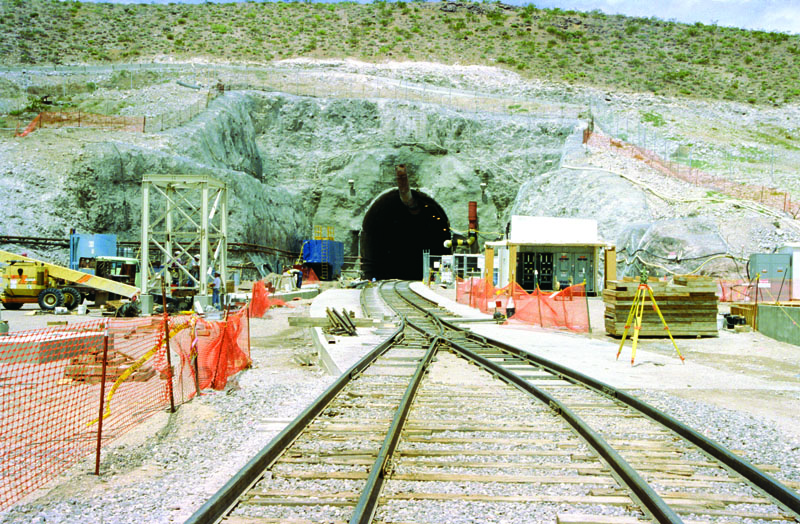
  • Yucca Mountain (above), America’s preferred dumping ground for nuclear waste,
  • Cathedral Canyon (below), a random crack in the desert turned into religious shrine,
  • Emergency training centers such as Del Valle, California (all the way at the bottom), and
  • the thousands and thousands of other non-obvious but telling places in America

And yet, we decided not to run a piece on it in The Economist. At least for the time being.

Why?

Credit: CLUI.org

I decided to let you peak into the process because I think it might give you a useful glimpse into

  1. writing, and
  2. The Economist

Specifically, the issue involved all of the writerly themes that you guys and I have been writing about:

Here is what happened

After my visit to the CLUI, I did indeed write a draft, at about 700 words, for our US Section. And I sent it off.

I had an unsure feeling. I felt that I had not done justice to the CLUI or the places I had chosen as examples.

1) Length

Our pieces in The Economist are short, and they are best when they compress complexity into a dense and yet simple and forceful narrative. The CLUI, however, seemed to need the opposite: not to be compressed but to be expanded and developed. It seemed to need length.

2) Momentum

Worse, I had not spotted an underlying narrative in the CLUI (or the Museum of Jurassic Technology, for that matter) at all. This, in fact, is my criticism of the CLUI: They are so meticulous about their neutrality that they forget to do storytelling.

In fact, the Center’s name is a misnomer. It is not the Center for Land Use Interpretation but the Center for Land Use Observation. The interpretation is what is missing.

3) Voice

So I felt that to do this justice, I would have had to make it a humorous-but-profound story about a search for something elusive.

When you’re searching in vain, the story is about doubt, uncertainty, futility. Not things that The Economist is naturally good at, even though I excel at them personally. 😉

4) The First  Person

To be really fun, moreover, a search narrative would have to be about me, the searcher. Me looking for answers and getting confused. Me on a CLUI bus in the desert with other searchers…

The First Person: Definitely not something that The Economist is naturally good at. 😉 😉

(Since we have no bylines, we also have no First Person. It is banned. The most you might see is “As your correspondent took his seat…”. Yuck.)

Conclusion: This really wanted to be a New Yorker piece.

A few weeks later, I got an email from my editor. He essentially said the same thing:

The problem with the piece as it stands is that it poses a lot of questions, but does not answer them. I appreciate that that is part of the philosophy the point of the CLUI, but it doesn’t really satisfy as a US section article. It reads too much to me like a long list of interesting and not-so-interesting places…

What is it, in fact, that we learn about American culture from the landscape, other than its uses are many and various? That America (like every other country) cherishes, abuses and neglects its physical space? …

I think this piece could benefit from being longer… Such a longer and more narrative piece would not, I think, work in the US section.

In a way, this was reassuring: My editor and I had come to exactly the same conclusion independently.

There was another upshot: Another editor had read it and expressed interest in a longer and more narrative version for our Christmas Issue, the one occasion every year when we really let our writerly hair down.

Did I want to expand the piece for the Christmas issue?

Opting for easy

This is when experience kicked in (13 years at The Economist now).

My experience told me that it was time to move on.

I did a risk-benefit analysis. I could sink a lot more time and effort into this story in the hope that a forceful narrative might emerge out of it. Or I could write the many easy and obvious stories that were offering themselves to me like streetwalkers.

In case you’re wondering, there is pressure on us to perform. We’re supposed to write something in every issue, on average. In fact, the last sentence in that same email from my editor was:

PS: that said, I am therefore in the market for a piece from you next week! Can you call me on the mob once you’re up and about?

And so I moved back into streetwalker alley, where it has been easy pickings and obvious stories since.

How judge ye?

Credit: CLUI.org

Bookmark and Share

The importance of the first reader

Eliza Hamilton

Every writer has, or ought to have, a more or less special first reader. For me it is my wife.

My wife is the first person to see every article I write for The Economist and every draft of my book manuscript. (I don’t show her my blog posts or emails, obviously, which may explain why those are so much worse.)

This is a very important and intimate relationship. The first reader is, in effect, the first editor, and also the sanity test, the acoustics check, the aesthetic focus group and the umpire of taste.

The first reader must be so confident of the underlying relationship as to be above flattery and fear of (lasting) repercussions.

Both writer and first reader must protect their credibility. My wife is probably most impressed with me when she gives a brutal but vague critique of something I have written … and I come back to her shortly after, having done even more brutal violence to my own words. This is known as “crucifying your darlings,” and it is what gives me credibility.

So it is fun to learn how the great writers of the past viewed that relationship.

Molière apparently tested his writings on his nurse to get her reaction. And Alexander Hamilton, my favorite Founding Father as well as by far the most prolific writer among them, had his wife, Eliza Hamilton. (Get ready for a new thread on Hamilton soon!)

On page 508 of this fantastic biography of Hamilton (recommended by Thomas Stazyk), Eliza recollects, 40 years after the fact, how her husband wrote George Washington’s famous farewell address. (Yes, most of “Washington’s” writings are in fact Hamilton’s.)

He was in the habit of calling me to sit with him that he might read to me as he wrote, in order, as he said, to discover how it sounded upon the ear and making the remark, “My dear Eliza, you must be to me what Moliere’s old nurse was to him.” The whole or nearly all the “Address” was read to me by him as he wrote it and a greater part, if not all, was written by him in my presence.

I probably appreciate more than most people how important Eliza Hamilton therefore was for American and world history.

Bookmark and Share

Draft IV of the manuscript is off…

I seem, magically, to be keeping the same exact rhythm, turning over each new draft of my manuscript in one month.

My publisher, Riverhead, sent me the last round of comments one month ago, and I just now emailed the new draft.

The actual re-write this time took me only a few days.

And the main objective was accomplished, I think: To come up, in the last chapter, with “lessons” from the lives in the book that are catchy, not at all corny and actually meaningful.

We’ll see what my editor says.

Bookmark and Share

Ready for Round IV of the manuscript

Arriving back home from a reporting trip, I was delighted to find a FedEx package from Riverhead with my manuscript in it.

To extrapolate from the previous three drafts: I seem to turn around a new draft in one month, then to wait for three months to receive it back from my editor with comments.

This time, both processes might go faster: There are far fewer comments in the margins than in previous rounds.

But there will be one change:

I will finally bow to the pressure of the market (letting no side, neither the artistic nor the commercial, “win”, as Ed Catmull might say). I will drop my resistance and add a concluding chapter with …. lessons.

Bookmark and Share

A change to save my neck

From time to time, some of you contact me to find out more about an eccentricity of mine that involves sitting on the floor (ie, on a tatami mat that amounts to my “office”), usually with intention of adopting the same habit.

I first explained why I started doing that in the Yoga Journal seven years ago, and then showed you two (of the many possible) poses in which I sit — ie, Lotus and Virasana.

The original reason I started sitting on the floor was to make and then keep my hip and knee joints supple, and to have better posture.

But I have been noticing an unpleasant side effect: Even as I was keeping my hips open, I was ruining my neck and shoulder muscles.

I should have thought of that: While we did evolve to sit on the ground, not on chairs, we did not evolve to sit on the ground in front of … laptops!

Fortunately, Matthew Gertner has come to my aid, and now deserves a big Thank You. Matthew is one of the many among you whom I only “know” through the blog (ie, we have never met offline). But he has also been trying to get himself down onto the floor (are you down now?).

Matthew advised me to save my neck by investing in three new things (whereas I usually try to avoid accumulating clutter):

  • a laptop stand, to raise my screen to just below eye level,
  • a Bluetooth mouse, and
  • a Bluetooth keyboard.

This week, I followed Matthew’s advice, and already my neck feels a lot better. Once again, Thank You, Matthew, and here is another close-up of what it looks like:


Bookmark and Share