Recommended reading on Jung and archetypes

Thanks to Christopher for pointing me to The Third Eve, a blog by a Jungian psychologist about all things Jungian.

As you may have noticed, The Hannibal Blog has a thread on Carl Jung which overlaps with my thread on storytelling in general and will eventually (ie, closer to the launch of my forthcoming book) help you to understand the story of Hannibal and Scipio, which is the story of you and me, of disaster and triumph not being what they seem. The idea is that Hannibal and Scipio were real-life, flesh-and-blood emodiments of archetypes.

So visit The Third Eve for primers on Jung’s model of the psyche and his ideas about archetypes. Then compare that with the influence that the so-called monomyth theory has had on me.

Then read The Third Eve on the orphan archetype and tales of leave-taking and compare that with, say, my post on Heidi.

Incidentally, because there have been a lot of newcomers to The Hannibal Blog lately: All this is deep background for my coming book, but the book itself is an easy read, a text that–I hope–reveals the universality across people’s lives through the stories themselves. It is not a text book. You do not need to have even heard of Carl Jung!

Bookmark and Share

The monomyth inside Heidi

422px-heidi_titel

Quite a while ago in my ongoing thread on storytelling, I told you about a fascinating theory that all stories (or at least all good and lasting stories) are really at some deep level the same story, because that is how we humans seem to be wired. This meta-story is the so-called monomyth. The idea goes back to Carl Jung’s ideas about archetypes but was made popular by Joseph Campbell.

Well, I was just reading Heidi to my daughter, in the original (Swiss) German. Don’t think that you can ever get too old for good children’s stories. We both had moist eyes at the end, but mine were moister.

What struck me is that Johanna Spyri’s great and simple and timeless tale is really, you guessed it, another version of the monomyth. So indulge me, please, as I “translate” the plot and characters of Heidi into the nomenclature of the monomyth. (Archetypes are in italics.) Here goes:

  • Heidi is, obviously, the hero–ie, heroine. She is a different hero than, say, Achilles or Odysseus, of course. She is an orphan, and thus the archetype of the vulnerable part in each of us. Her less-than-warm aunt wants to get rid of her and drags her up an Alp to the hut where Heidi’s cranky grandfather, or Öhi, lives.
  • We stay with our hero just long enough to become part of the scene and characters so that we never want Heidi (or ourselves) to have to leave. Heidi befriends Peter and they have fun herding the goats. Heidi thaws Öhi’s heart and he falls in love with her. Heidi brightens the darkness of a blind woman nearby whom she calls grandmother. Even the goats are besotted. Oh please, we readers want to scream, let nothing ever change!
  • But the monomyth kicks in: There is a call to adventure, which Heidi, like many heroes, tries to refuse. But go she must. A rich family in Frankfurt has a sweet daughter in a wheelchair who needs a companion. Heidi’s nasty aunt, smelling money, has already sealed the deal.
  • As our hearts break along with everybody’s else’s (even the little orphan goat’s), Heidi sets off and crosses several thresholds. These are physical, such as the descent from her Alp, the arrival in Frankfurt and the crossing of her new home’s threshold. Thresholds are reminders of liminality. We are on edge.
  • Heidi has now, willy nilly, accepted her call to adventure. She meets other archetypes. There is Fräulein Rottenmeier, the annoying (and annoyed) spinster who looks after Heidi’s charge, and who seems to be the anima, ie the dangerous woman who must be overcome. Heidi meets her new friend Clara, her ally. She meets Clara’s father, the understanding, powerful and sympathetic Wise Old Man.
  • Heidi overcomes adversity and trials. To everybody’s surprise, she learns to read, thus obtaining a boon to society (in addition to the boon of her presence). She is lonely and so homesick that she sleepwalks at night.
  • With the help of the Wise Old Man (Clara’s father, once he understands that Heidi sleepwalks out of sadness), Heidi returns from her quest. She passes the thresholds (and her liminal state) again, in the other direction.
  • She arrives home, and brings the boon of her quest back, thus completing the monomythical definition of a hero. She makes life worth living again for Öhi, for grandmother (to whom is now able to read books aloud!), for Peter and the goats. Oh, and for us.

Simple, universal, powerful: great story-telling!

Bookmark and Share

Newspapers and the “unthinkable”

Required reading for all who care about newspapers, journalism and the current revolution (for that is what it is.) By Clay Shirky, whom you have met here before.

Bookmark and Share

Storytelling and the credit crisis

And another brief detour to The Hannibal Blog‘s older but ongoing thread on the art of story-telling.

I’ve already featured stories high and low, old and new, conventional and zany, but one insight emerging recently (when I highlighted the storytelling inside an ad), was that stories are ubiquitous and inescapable. It is how we humans make sense of stuff.

So look at this explanation, which is really a sort of story, of the credit crisis:

This is the product of Jonathan Jarvis, who did this as part of his graduate thesis at the Art Center College of Design in Pasadena, California. As Jonathan says,

The goal of giving form to a complex situation like the credit crisis is to quickly supply the essence of the situation to those unfamiliar and uninitiated.

So for him the story-telling principle of simplicity reigns supreme, although, as you can see, he also made sure to depict (subtly, cheekily and cartoonishly) character and scene and plot. As Ira Glass might say, right from the start, the viewer senses that

something is about to occurr, …. [that things are] heading in a direction …. raising and answering questions … [and that we] can’t get out.

Well done, Jonathan.

Bookmark and Share

Another book based on Kipling’s If

By now you all realize that the idea for my entire (forthcoming) book came out of two powerful lines in a powerful poem, If, by Rudyard Kipling. “My” lines are

… If you can meet with Triumph and Disaster
And treat those two impostors just the same…

Well, it turns out that I’m not the only one getting book ideas from lines in that moving poem. Craig Mullaney, a pretty impressive young man, is just out with The Unforgiving Minute. (He’s with Penguin Press, the corporate sister of my publisher, Riverhead.) Here he is on the Daily Show, talking to Jon Stewart.

“His” lines from the poem, which made it into the title, are the final four:

If you can fill the unforgiving minute
With sixty seconds’ worth of distance run,
Yours is the Earth and everything that’s in it,
And-which is more-you’ll be a Man, my son!

As Mullaney says, it’s a book

about growing up to be a man; starts at West Point when I was seventeen, ends when I sent my brother off to war.

I have not read it yet, so I can’t review it. (I’m swamped with books at the moment for a particular reason, which I’ll tell you about in the coming week or so.) But could we just, you know, have a moment for Kipling? He fell pretty far out of fashion in the past century. And yet: a sudden outbreak of young authors feeling so touched by his words that they conceive entire books. Not bad, Rudyard, not bad. Dare I say that whatever slump your reputation suffered in the previous century, it is fast turning out to have been an … impostor?

Bookmark and Share

Fear and the English Language

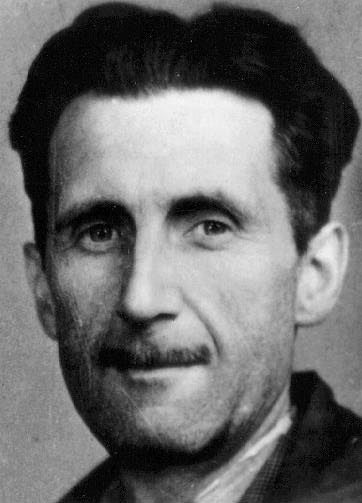
georgeorwell

Fear and the English Language is my attempt at a meaningful pun on George Orwell’s Politics and the English Language, one of the most important essays ever written.

You may remember that our own Style Guide at The Economist begins with Orwell’s six cardinal rules of good writing, taken from this essay. And now a reader of The Hannibal Blog has written, and shared with me, a very thoughtful Socratic dialogue based on this same essay (Orwell is Socrates in this dialogue, speaking to a student.) So I decided to re-read Orwell’s essay, which is always a good idea.

What is Orwell’s bigger point? Let me try to put it this way:

Thought + Intention → Words and Words → Thought + Intention

That’s why words are so important. They reflect thoughts and intentions. If your thoughts are jumbled, vague or absent, the words will come out badly, even if the intention is good. If your intention is insincere, the words will come out badly, even if you have a good thought. It also works in the other direction: If you get in the habit of using insincere or evasive words or talking nonsense, you will probably start thinking that way.

And so we can state, as confidently as Orwell did 63 years ago, that most of the words we read and hear by politicians, businesspeople, PR people, academics and celebrities are bad, embarrassingly bad.

Here are the two qualities common to this sort of language, according to Orwell:

The first is staleness of imagery; the other is lack of precision. The writer either has a meaning and cannot express it, or he inadvertently says something else, or he is almost indifferent as to whether his words mean anything or not.

Orwell makes fun of the sort of monstrosity that this led to in his day by “translating” a famous verse from Ecclesiastes,

I returned and saw under the sun, that the race is not to the swift, nor the battle to the strong, neither yet bread to the wise, nor yet riches to men of understanding, nor yet favour to men of skill; but time and chance happeneth to them all.

into “modern” English:

Objective considerations of contemporary phenomena compel the conclusion that success or failure in competitive activities exhibits no tendency to be commensurate with innate capacity, but that a considerable element of the unpredictable must invariably be taken into account.

What might that be today? Oh, pick your category. (You can come up with your own best worst phrase in the comments.) Let’s take the businessmen or PR people that I regularly deal with. They might turn Ecclesiastes into:

Whilst it is important to proactively leverage one’s core competencies, market conditions and timing largely determine what becomes a game-changer and what not.

Again, Orwell’s point is that

The whole tendency of modern prose is away from concreteness.

But why?

1) Laziness, often.

Speaking or writing clearly takes enormous effort because you first have to think, clarify and simplify. On the other hand, speaking or typing words, especially in hackneyed phrases you’ve heard others use thousands of times, takes vastly less effort and fills the time. Yesterday I was interviewing one of the people running in next year’s Californian gubernatorial race: what a torrent of words, in response to every question, and how little I had in my notebook at the end!

2) Fear or cowardice, more often.

This is the real answer, I believe. If you speak or write clearly you end up producing incredibly strong words. If they are noteworthy at all, they are sure to offend somebody. Are you up for that? Most writers are not, which is why they reserve their most honest writing for the grave, as Twain quipped. Usually, people want to speak or write without bearing any consequences. So, as Orwell says, you let your words fall upon the world

like soft snow, blurring the outline and covering up all the details.

This amounts to insincerity. You are really using words to hide. Typically, this is when the mixed metaphors and clichés come out. (By the way, I am not endorsing that American genre–you know who–of writers who see offending people as their niche. You can’t just be offensive, you still need a genuine thought.)

So: good writing, good language, good style comes down to, yes, having something to say and saying it as simply as you can, but above all to the great courage that this takes. That’s why good writing is so rare.

Bookmark and Share

In praise of wonderment

Amazing, isn't it?

Amazing, isn't it?

Cheri’s comment about my use of the word wonderment made me … wonder. And so, a brief paean.

Einstein (on page 387 of this biography), once said:

The most beautiful emotion we can experience is the mysterious. He to whom this emotion is a stranger, who can no longer wonder and stand rapt in awe, is as good as dead, a snuffed-out candle.

I’ve talked before about Einstein’s love of simplicity and his non-conformity as keys to his astonishing creativity. But I should have started with his famously child-like ability to wonder.

Wonderment is the origin of every creative act. The natural flow of Hmms leads to questions and inquiries that are usually never quite answered but become signposts on a great journey, a great story.

People sometimes ask journalists how we get our ideas for stories and I’ve never had a good answer. There is no shortcut, no ten-steps process, no secret vault. Instead, it always starts with simple–and yes, child-like–curiosity and wonderment.

An ability to wonder is of course also what the reader/listener/viewer of a story needs. If you don’t find your own life and its ups and downs somewhat mysterious, you probably won’t enjoy my book when it comes out.

So here’s to wonderment, and its official inclusion in our thread on story-telling. Every good story begins and ends with it.

Bookmark and Share

Traveling again, but thinking of Hannibal ….

And I’m on the road again. But I’ll try to keep posting. In particular, I’m trying to think of ways to get back on message, the main “message” being the book that I’ve just delivered to my editor at Riverhead.

You recall that my dilemma is the following: I’m not ready yet to start giving away parts of the book as such. (I don’t have a publication date yet and want to start doing that closer to the time.) But I love the story and topic so much that I started an entire blog with the intention of discussing it, not just ahead of but forever after the book launch.

So maybe I’ll start by setting the scene, in a more cerebral and less narrative way, for the main plot and the main characters. The main plot, you recall, takes place during the Second Punic War between Carthage and Rome, and the main characters are Hannibal and Scipio. (For some of the more modern characters that appear inside the individual chapters, browse my tags.)

Since the Punic Wars are not exactly common knowledge nowadays (I was born in the wrong generation, by the way), I might start by setting those in context on The Hannibal Blog. What were they? Why were they? How are they still visible all around us today?

Would that be fun?

PS: One of you has let me know via email that he is working on a graphic book about Hannibal. How cool is that? Whenever you’re ready (I don’t “out” people who contact me via email), please share the excitement here on The Hannibal Blog. I’d be honored and want to be the first to link to you…
Bookmark and Share

A paperless German anthropologist named Andreas Kluth

Claude la Badarian

Claude la Badarian

On the even lighter side (and still off message, but not much longer): one of you has made me aware of an author named William Monahan, who wrote this sentence in the final installment of his serial story Dining Late with Claude La Badarian (reviewed here):

I was able to convince the police, after a few minutes difficulty on the landing (I was coming back from the shower, inconvenienced by precarious towel, soap-on-a-rope in the form of Sneezy the Dwarf), that I was not “Claude Le Bandarian,” blackmailer, but a paperless German anthropologist named Andreas Kluth.

I would be flattered, but No, as far as I know, I cannot have inspired this reference. (Paperless? I try. German? Largely, but that’s between us. Anthropology? More as object than subject. Andreas Kluth? Unequivocally.)

I admit that my name is not exactly household. But you do notice that I couldn’t get the .com or .net domains. I’m aware of a municipal politician somewhere in Germany who has my name. He must be the anthropologist. 😉

Bookmark and Share

Obama and I; Obama and me; Obama and … myself?

800px-barack_and_michelle_

Psst, are they cheering you and me or you and I?

So-and-so “graciously invited Michelle and I,” he says. “The main disagreement with John and I,” he begins. Obama, Obama. You and I need to have a word. (But which one?)

All of you know by now that I’m a lover of, yes, Obama, but also of language, words and style. On the spectrum between grammar fundamentalists and libertines, I am closer to the fundamentalists (in this and only this in life!).

So I side with Naomi Baron, a linguist whom I quoted in this story in The Economist decrying the “linguistic whateverism” that is taking over (American) culture. It would make snobs out of people who care about the difference between who’s and whose, it’s and its, I and me, like and as, and so forth.

And so we come to Obama. First–still speaking about grammar–he is of course vastly preferable to the alternative. (Check out these speech diagrams comparing Obama and Palin.) And even though he entered his presidency with a grammatical stumble, that was John Roberts’ fault, not his. (Steven Pinker called it “blowback” for Roberts’ fundamentalism, since the chief justice apparently could not bring himself to “split the verb” and thus mangled the oath of office.)

But Obama is no grammar saint either. Bloggers have been pointing it out, and now Patricia O’Conner and Stewart Kellerman, the authors of a forthcoming book about language, are opining about it in the New York Times.

One issue is subjects and objects; another is pomposity and naturalness. In turn:

I object

Nobody could possibly invite “Michelle and he” but quite a lot of people would love to invite “Michelle and him“. That is because the inviter is the subject and first couple are the objects (direct, in this case).

Nor could anybody give a fistbump to “Michelle and he”, although I would personally love to give one to “Michelle and him”. In this case the object is indirect (the fistbump being the direct object), but English doesn’t distinguish.

Oh puhleeze

Americans increasingly don’t see it that way, of course. To them you say the word me (him, her, them) whenever you’re being informal and the word I (he, she, they) whenever you’re being formal. Now that is pompous. It’s like eating a hamburger with fork and knife. It’s overcompensating, because a toff is watching.

Saying myself is not the answer, by the way. I cannot invite “Michelle and himself”, only “Michelle and him.” But, he could invite himself, although he is unlikely to be so presumptuous.

But it’s me

That brings us to the old chestnut: Which is correct: It’s me or It’s I?

The problem here is that the is is not an action verb but a linking verb.It is being linked to me or I, but neither it nor I are obviously the subject or object. So let’s see how other languages deal with the problem:

C’est moi. OK, the French think it should be it’s me.

Es bin ich. Oops, the Germans think it should be it am I.

Damn foreigners. They’re Old Europe anyway.

So the answer is that it doesn’t matter. And since there is the puhleeze factor to consider, I lobby for it’s me.

Now, I did say that is is not an action verb. There is of course one exception to that rule:


Bookmark and Share