The Parthian Shot

Parting Parthian

Parting Parthian

You’ve heard people talk about a “parting shot”, when, for example, somebody makes a miffed exit and on the way out emits a toxic word or two. Well, that’s wrong. It’s not a “parting” shot. It’s a Parthian shot. Who were the Parthians that we name a shot after them?

I bring this up because I’m still reading about Cleopatra as research for my book. And I’m now approaching the bit where Mark Antony, her second lover (after Julius Caesar, the first), is preparing to head east to conquer those Parthians, even as Cleopatra was four or five months pregnant with their third child.

Those are the same Parthians that had succeeded the mighty Persian empire, and who had only a generation before slaughtered an entire Roman army under Crassus, after presenting him his son’s head on a stake. They were utterly not to be messed with. Indeed, Mark Antony, too, would turn back in disaster, with two-fifths of his army killed. The Parthians would remain invincible for another century and a half.

Now to the point: Their most insidious and effective tactic was the retreat, real or feigned. The mounted Parthian archers would suddenly gallop away, drawing the enemy army after them in hot pursuit. But the archers, in full gallop (no reins or stirrups needed), would turn and shoot back, arrow after arrow.

In short, a great party trick, to this day.


Kipling’s If

Rudyard Kipling’s If:

If you can keep your head when all about you
Are losing theirs and blaming it on you,
If you can trust yourself when all men doubt you
But make allowance for their doubting too,
If you can wait and not be tired by waiting,
Or being lied about, don’t deal in lies,
Or being hated, don’t give way to hating,
And yet don’t look too good, nor talk too wise:

If you can dream–and not make dreams your master,
If you can think–and not make thoughts your aim;
If you can meet with Triumph and Disaster
And treat those two impostors just the same;

If you can bear to hear the truth you’ve spoken
Twisted by knaves to make a trap for fools,
Or watch the things you gave your life to, broken,
And stoop and build ’em up with worn-out tools:

If you can make one heap of all your winnings
And risk it all on one turn of pitch-and-toss,
And lose, and start again at your beginnings
And never breath a word about your loss;
If you can force your heart and nerve and sinew
To serve your turn long after they are gone,
And so hold on when there is nothing in you
Except the Will which says to them: “Hold on!”

If you can talk with crowds and keep your virtue,
Or walk with kings–nor lose the common touch,
If neither foes nor loving friends can hurt you;
If all men count with you, but none too much,
If you can fill the unforgiving minute
With sixty seconds’ worth of distance run,
Yours is the Earth and everything that’s in it,
And–which is more–you’ll be a Man, my son!


Bookmark and Share

Postscript on McCain

Read David Grann in The New Yorker on what I consider an epic, a Greek, a heart-rending tragedy: the transformation, under pressure, of a great man, John McCain.

This is a man who was once “more at peace when he was losing” and who, above all, was afraid only of one thing: losing his honor.

Thinking in terms of the underlying idea for my book, I can’t help but wonder whether his (unexpected) “triumph” in the primaries was in fact the great “impostor” of his life, leading to an all-encompassing “disaster.”

(To those of you who are new to this blog, those words are from a Kipling poem that inspired my entire book.)


Bookmark and Share

Uncle Lulu

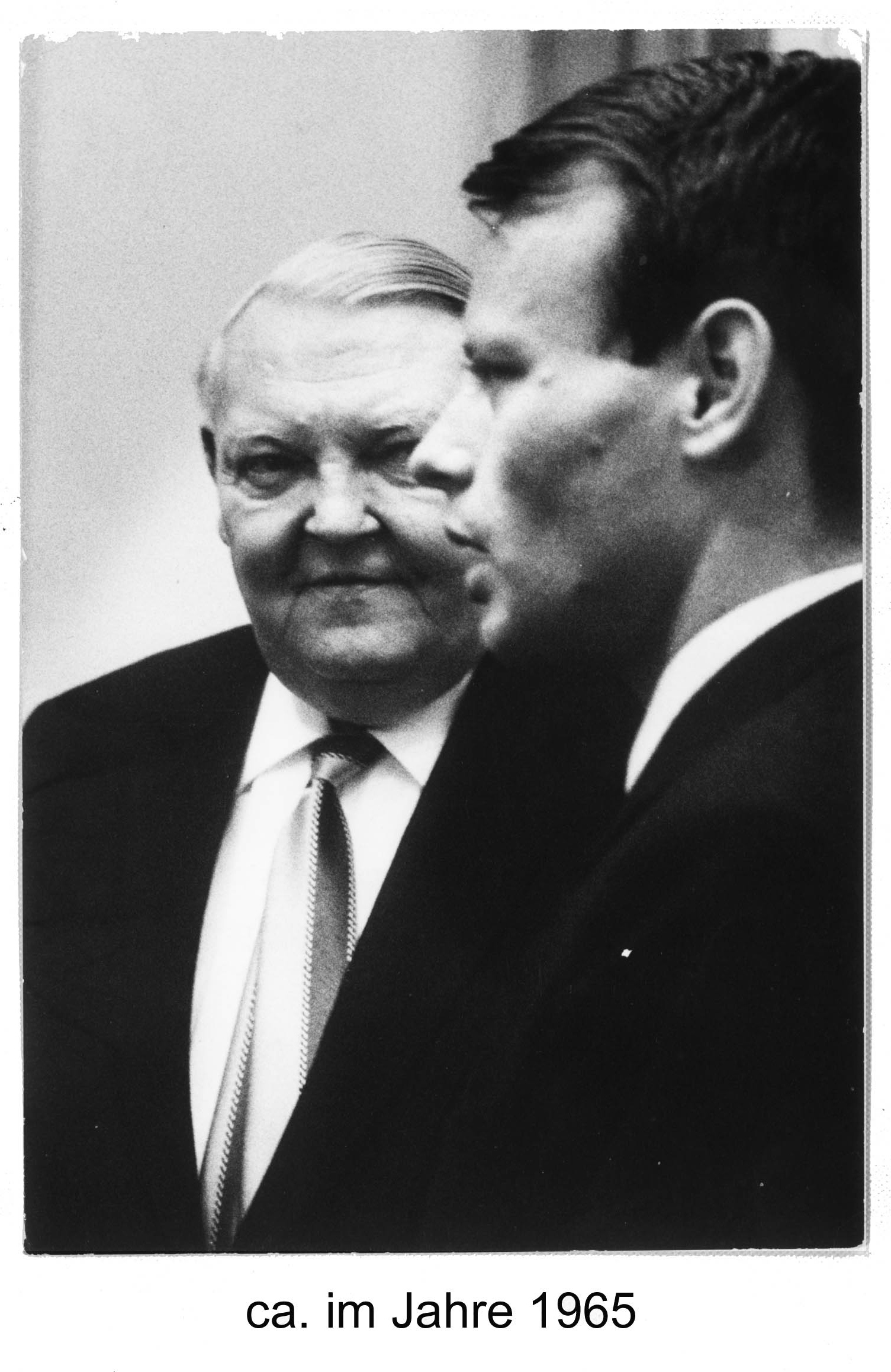
That guy with the cigar on this West German stamp from 1987 is my great-uncle, Ludwig Erhard, or “Onkel Lulu” in our family.

Why is he on this blog?

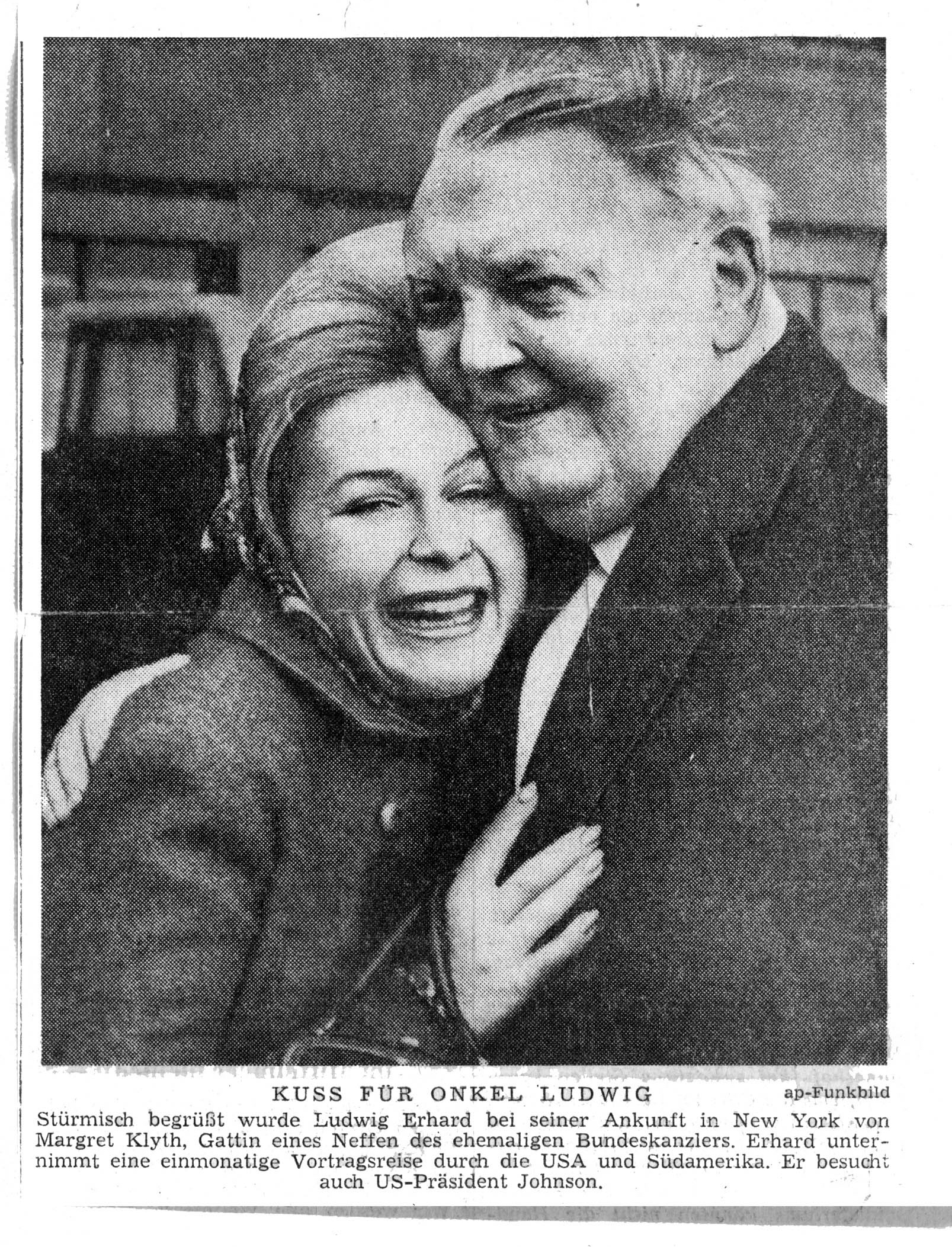
Newspaper cutting of my dad and his uncle

Newspaper cutting of my dad and his uncle

Because is life is one of those I trace in my book, to show that that what happened to Hannibal and Scipio happens to all of us, one way or another.

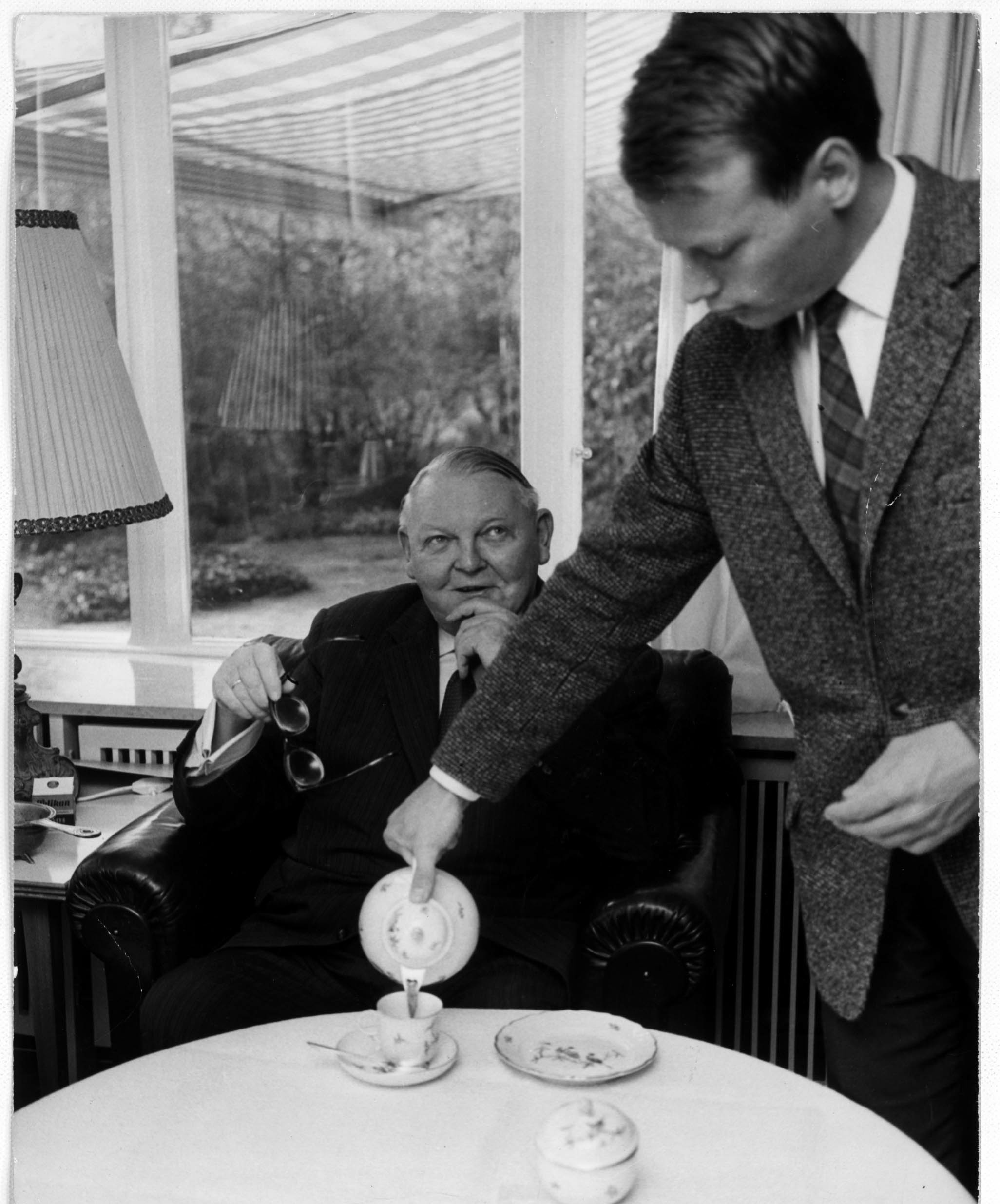
My dad pouring tea for his uncle, the chancellor, in the 60s

My dad pouring tea for his uncle, the chancellor, in the 60s

In Germany and continental Europe, Ludwig Erhard is a household name. In America, he is not, but should be. He is famous for being a founding father of post-war (West) Germany, its first economics minister, the father of its currency (the Deutsche Mark), and then its second chancellor (ie, prime minister). He is credited with causing the stunning economic growth of the 1950s, sometimes called (but not by him) an “economic miracle”. And he is probably the most steadfast proponent of freedom, tolerance and open and fair markets in German history.

Dad and Lulu again

As my father’s uncle and godfather, he practically raised my father after my grandfather died. I only met Lulu when I was very small (he died in 1977). He liked to hide Easter eggs for me in his steep hillside garden by the Tegernsee, an Alpine lake south of Munich. His influence lives on, in Germany, in our family, and now in my book.

My mom with Lulu in New York, where I was born

My mom with Lulu in New York, where I was born

Our election, Napoleon, and that map again

Remember that famous and superb map of the impostor success that I wrote about the other day? Well, it depicted Napoleon’s invasion of Russia, and how it went from triumph to disaster, which is one of the twin themes I explore in my book. There is a famous picture of Napoleon’s retreat. And now The New Yorker has updated it just in time for the remaining presidential debates:

The New Yorker

The New Yorker


Bookmark and Share

A map of the impostor Success

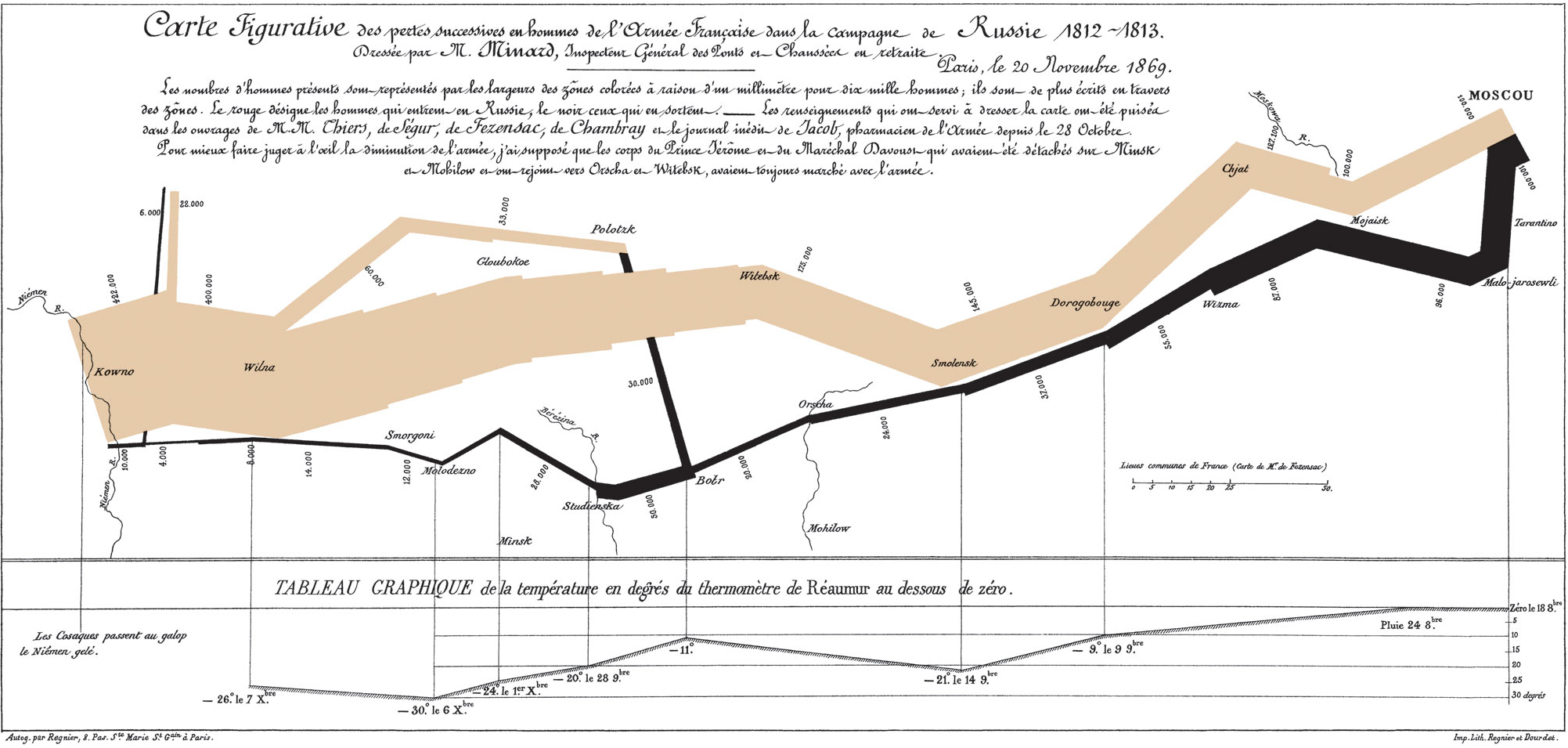
Above is perhaps the most famous map and chart of all time (via the Wikimedia Commons). It is too small in my post, so please click through to the image. Its French caption begins:

Figurative Map of the successive losses in men of the French Army in the Russian campaign 1812-1813. Drawn up by M. Minard, Inspector General of Bridges and Roads in retirement. Paris, November 20, 1869.

The numbers of men present are represented by the widths of the colored zones at a rate of one millimeter for every ten-thousand men; they are further written across the zones. The red [now brown] designates the men who enter into Russia, the black those who leave it. …

What’s the big deal? 1) It is perhaps the first time in history that somebody thought about visualizing data. 2) Just look at the scale of this Impostor and Disaster!

You see the thick trunk of Napoleon’s Grande Armée as it invades Russia in 1812. Next you see Napoleon sweeping through Russia in apparent victory. His army is decreasing (the brown line is getting thinner), in part to casualties and in part because he has to leave troops behind to guard supply lines. But he is winning. And thus he takes Moscow.

Now the impostor drops his veil! Russia does not surrender. Napoleon does not win the war. Instead, he has to retreat. In the Russian winter. While the Cossacks attack. As Russian peasants pull away French stragglers and spear them with their pitchforks. The French starve, freeze and bleed to death. The black line shrinks.

And then, perhaps the most chilling pixels (you have to click through to see it well): As the French cross the freezing river Berezina, they discover that hell has indeed frozen over. You see a thick-ish black line on the eastern bank, a thin trickle on the western bank. The river became a mass grave. That’s why the French still today have a phrase to describe disaster: C’est la Berezina!

And if you’re new to this blog and wondering why I keep mentioning the word Impostor, here is why.
Bookmark and Share

The suffering of Frida Kahlo

Frida Kahlo and Diego Rivera. Photograph by Carl Van Vechten at Wikimedia Commons

Kahlo and Rivera. Photo by Carl Van Vechten, via Wikimedia Commons

I popped into the Frida Kahlo exhibition currently at the San Francisco MOMA. Mainly, to see her piercing paintings–and boy, do they pierce–but also, at least in part, as research for my book.

A friend of ours, Erika Lessey Chen, had suggested Kahlo to me a year ago as a possible life-story to look into. I had told Erika that I’m interested in people whose success (triumph) somehow turned into failure (disaster), or whose failure somehow turned into success, à la Kipling’s impostors.

Does Kahlo fit my story-line? Mostly, I’m looking at characters such as Hannibal’s enemy and nemesis Scipio to illustrate how disaster at the right moment in a life can liberate a person–set free his or her imagination and creativity, and thus initiate a much bigger triumph in the future. People such as J.K. Rowling and Steve Jobs.

But disaster can have other effects, of course. There is the strength that comes from overcoming it. I’ve mentioned Joe Biden and Demosthenes in that context. Among the main characters in my book, the person who would personify that is Fabius, the old Roman senator who was the only one not to despair after Hannibal’s crushing victories.

And Kahlo? As I walked through the exhibition and looked at her absolutely harrowing self-portraits, I realized that she had done something else again with her own disasters: She had made the disasters themselves the success.

Here she was on a hospital bed in Detroit, her body writhing and bleeding, with a uterus and a fetus torn out of her. She painted it after yet another miscarriage. The people in the exhibition became very quiet in front of that one.

There she was bound in a steel corset with a broken spinal column, her entire body pierced with nails. In this painting, she is all pain and frustrated sexual desire.

Over there she is sitting in a double-self-portrait, after her marriage to Diego Rivera had failed. She is holding hands with herself, and simultaneously tries and fails to stop the bleeding of her heart. (All these paintings seem to be copyrighted, so I don’t want to show them here.)

What were her disasters? The first was polio, which she caught at age six, and which left her right leg atrophied. The second was a bus accident when she was eighteen. She broke her spine, her pelvis, and lots of other bones, and an iron handrail pierced her uterus, leaving her infertile. The third, arguably, was falling in love with Diego Rivera, whom she adored but who was never faithful to her.

In short: pain, infertility, loneliness. And to deal with it, she painted. And the painting made her into the most “successful” Mexican artist ever.


Bookmark and Share

Which Bhagavad Gita?

“With no desire for success, no anxiety about failure, indifferent to results, he burns up his actions in the fire of wisdom. Surrendering all thoughts of outcome, unperturbed, self-reliant, he does nothing at all, even when fully engaged in actions.

There is nothing that he expects, nothing that he fears. Serene, free from possessions, untainted, acting with the body alone, content with whatever happens, unattached to pleasure or pain, success or failure, he acts and is never bound by his action.” (BG, 4.19-26)

Boom. Could anybody say it better? Who do you think did say it? Rudyard Kipling, whose two impostors are the seed of my entire book?

Actually, it was Krishna, in conversation with Arjuna, on the eve of an 18-day battle that would kill about four million (!) and which only eleven men would survive. Here are Arjuna and Krishna, his charioteer, in between the opposing armies just before the battle, as Krishna reveals to Arjuna the two crucial secrets to our lives: how to know and do your duty, and how to live.

I’m talking, of course, about one of the greatest poems (books, texts) ever written, the Bhagavad Gita, or “song of God”. It is a relatively short song inserted into a huge (!) epic story, the Mahabharata, which is several times the length of the Bible, or of the Iliad and Odyssey combined.

I’ve been re-reading the Gita in several translations while researching one chapter in my book. Why? Because Hannibal faced the same dilemma that Arjuna faced, when he broke down sobbing before the great battle, a battle that he suddenly did not want to fight at all, but which, as Krishna made him realize, he could not not fight. So Arjuna faced the same conundrum that Hannibal and Scipio faced: how to get into the right frame of mind to live life.

Oh, wait a minute. Did I say that Hannibal was in the same situation as Arjuna? I meant, that we all are in the same situation as both Arjuna and Hannibal. That is the point of the Gita, and also (more humbly) of my book.

Now, for those of you who love the Gita, I thought I’d do a quick review of the three translations and commentaries I’ve recently re-read. That way, maybe, I can help you choose the one that’s right for you.

The Gita is a poem in the original Sanskrit, and the translation that best preserves the beautiful, easy, fluid feel of a poem is the Bhagavad Gita by Stephen Mitchell (Three Rivers Press). The opening quote above comes from his translation.

A slightly less beautiful but perhaps more helpful and accessible translation is The Bhagavad Gita: A Walkthrough for Westerners by Jack Hawley (New World Library). The title sounds as if it were a sort of “For Dummies” version, but it’s not. It’s intelligent, and editorializes a bit whenever the words in the poem mean something very different from the same words in our ordinary language.

Then, of course, there is the intimidating two-volume brick God Talks with Arjuna: The Bhagavad Gita by Paramahansa Yogananda (Self-Realization Fellowship). That is the kosher version among yogis, because it’s academically and intellectually thorough. I’ve tried several times to get through it and failed. If it’s beauty, ease and enjoyment you’re looking for, don’t pick this one. But….

do pick this one if you have even the slightest interest in a deeper understanding of the Gita. For example, the thing to get about the poem is that there are two battles going on: the external one involving four million warriors and elephants and chariots; and the internal one that we all wage every day. Paramahansa Yogananda is great at the genealogy of all the people in the war, so that you realize, for example, that Arjuna and his four brothers are the intelligent and higher parts of our mind, who are fighting 100 cousins, who are the powerful but lower parts of our mind, such as anger, desire, greed, and so forth.

Enjoy.


Bookmark and Share

Two great Russians

Aleksandr Solzhenitsyn has died, and his happens to be one of the lives I’ve been researching for one chapter of my book. (Lots of reversals between disaster and triumph, obviously, including some non-obvious and subtle ones.)

This won’t make sense out of context, but I’m pairing him not only with Hannibal but also with another great Russian, Mikhail Gorbachev, although I’m just starting my research about him.

Can anybody recommend any great biographies of Gorbachev, especially ones that include his years since power–ie, his time in relative obscurity?

In the comments or by email, please. (The form underneath this page sends me an email.)


Bookmark and Share

Impostor Failure, Part II: J.K. Rowling

In my post on Steve Jobs, I suggested that his biggest failure in life turned out–certainly in his own opinion–to be a liberating event that made possible his subsequent success. In other words, his failure was an impostor, just as Rudyard Kipling would say. In this post, I want to suggest the exact same thing, with a different example: one that is female, creative, vulnerable, touching. The example of J.K. Rowling.

Rowling is one of the most successful book authors of all time, and the most successful by far of those alive today. Who knows? Her Harry Potter books may yet become classics that endure down the ages. Rowling herself would be thrilled, because she loves classics and studied them, to the distress of her poor (literally) parents, who wanted her to study something “useful”. As a classics fiend myself (in a world of blank stares whenever anything Greek or Roman comes up), I love her just for that.

But let’s get to her “failure”. Her commencement address at Harvard this year was, in its entirety, a paean to failure–its ability to help a young person navigate life and to liberate her imagination. For the first nine minutes, she reminds her audience of (mostly) successful Harvard graduates and parents of her own family’s crushing poverty when she went to university, but says that “What I feared most for myself at your age was not poverty, but failure.” Then failure came:

… by any conventional measure, a mere seven years after my graduation day, I had failed on an epic scale. An exceptionally short-lived marriage had imploded, and I was jobless, a lone parent, and as poor as it is possible to be in modern Britain, without being homeless. The fears my parents had had for me, and that I had had for myself, had both come to pass, and by every usual standard, I was the biggest failure I knew.

She did not see it at the time, but this turned out to be a liberating event, rather as Steve Jobs’ career disaster at the age of thirty had been for him:

Here are the key passages:

So why do I talk about the benefits of failure? Simply because failure meant a stripping away of the inessential. I stopped pretending to myself that I was anything other than what I was, and began to direct all my energy into finishing the only work that mattered to me. Had I really succeeded at anything else, I might never have found the determination to succeed in the one arena I believed I truly belonged. I was set free, because my greatest fear had already been realised, and I was still alive, and I still had a daughter whom I adored, and I had an old typewriter and a big idea. And so rock bottom became the solid foundation on which I rebuilt my life.

More disasters followed. She lost her mother, she thought of killing herself, she was depressed. But she kept writing–in cafés, whenever her baby daughter fell asleep–and letting her imagination range freely as it now, after failure, could. The irony would soon be complete: several publishers turned down her Harry Potter story! Even her book, in other words, began as a failure. Then, one publisher took it. And the rest, as they say, is history.


Bookmark and Share