Searching for heroines (II): Psyche

Psyche

In the previous post, I gave you one model of how heroines might be similar to, but also different from, heroes. Here is another model for the archetypes of femininity and heroism. It is the story of Psyche.

Right away, the heroine’s very name might get our attention. Psyche is of course what we call mind or (as in the Greek meaning) soul. Clearly, the story of Psyche promises to be about more than intrigue, sex, love, fear and overcoming (although it certainly has all those in plenty). There is something universal and large hiding in the story. Your task is to find it.

Before I tell the story in brief and analyze it, here is the context for newcomers to this blog: This post is part of a series exploring heroes and heroism. The premise is the monomyth theory, according to which all of humanity shares certain archetypes of storytelling that appear again and again in every culture and age. After I featured several male heroes, the question arose: What is female heroism?

This post, like the previous one, is based on a lecture course by Grant Voth, who in turn borrows from research by Meredith Powers and others.

To make the heroic pattern more explicit, I’ll break the story into “chapters” with “titles” taken from some of the archetypes as Joseph Campbell described them. (Here is the list.)

The call to adventure

Psyche is the youngest of three daughters of a king, and the most beautiful woman of her time, so beautiful that she rivals even the goddess Aphrodite.

Aphrodite naturally becomes jealous and wants to punish Psyche. So she tells her son, Eros (known to the Romans as either Cupid, desire, or Amor, love), to shoot one of his little arrows into Psyche so that she might, perversely, fall in love with the nastiest and ugliest creature alive.

When Psyche’s father, the king, asks the Oracle of Apollo about Psyche’s future, he receives a dreadful reply (which I took from here):

On some high crag, O king, set forth the maid,

In all the pomp of funeral robes arrayed.

Hope for no bridegroom born of mortal seed,

But fierce and wild and of the dragon breed.

He swoops all-conquering, born on airy wing,

With fire and sword he makes his harvesting;

Trembles before him Jove, whom the gods do dread,

And quakes the darksome river of the dead.

Psyche’s marriage, in other words, is to be a funeral; love is to be death; and the groom makes even hell tremble!

The threshold

Psyche and her parents submit to the oracle’s command in sorrow, and Psyche is brought in a funeral procession to the mountain top. But instead of plunging to her death, she is wafted by gentle winds to a valley where she falls asleep.

When she wakes up, she finds herself in a beautiful palace, where voices invite her to dine and bathe. This looks more like paradise than hell.

At night, in total darkness, her groom comes to Psyche’s bed to consummate the marriage. Psyche cannot see him and he leaves before dawn.

This happens night after night. Psyche quite enjoys the love-making, but she has no idea with whom she is making love.

After a while, her two sisters come looking for her. Psyche’s husband, whoever he is, does not want Psyche to see them. When he finally relents, he makes Psyche promise never to let her sisters talk her into trying to find out who he is.

The sisters (also archetypes: picture the step sisters in Cindarella, for instance) arrive and are impressed by the splendor of Psyche’s palace. They themselves are in bad marriages with husbands who are much older and no fun. They envy Psyche.

Psyche makes up a story that her husband is away all day hunting.

The sisters leave. The next time they visit — Psyche is pregnant by now — they try harder to find out who Psyche’s husband might be. Psyche, who has forgotten her previous story, tells them that he is a rich merchant, away on business.

The sisters realize that Psyche is lying. Still envious, they want to spoil her fun. They remind her of the oracle and tell of alleged rumors that her husband is really a terrible serpent who will eat both Psyche and whatever child creature she will bear.

They persuade Psyche, who is suddenly full of doubt and fear, to bring a knife to bed for self-protection and also an oil lamp so that, when her husband falls asleep after love-making, she might shine a light on him and see who he is.

Entering the “belly of the whale” (ie, the danger zone)

The next night, after Psyche and her husband make love and he falls asleep, Psyche lights the oil lamp. This is the first heroic moment: It is an act of choosing knowledge and self-awareness, a daring shedding of light into the dark places of the unconscious, whether the heroine is ready or not.

To Psyche’s great surprise, she beholds not a monster but the most handsome man she can imagine, the god Eros. She immediately falls in love. Wanting to make her love eternal, she deliberately pricks herself on one of his arrows.

But as she does so, a drop of oil falls from her lamp and wakes Eros. Eros must now tell his story.

He tells Psyche how his mother, Aphrodite, issued her cruel order, how he came to execute the command, and how he, upon seeing her, fell in love with Psyche, deciding to take her as his own wife.

But he thereby subverted his mother’s wishes, which is very, very dangerous. And now the truth is known. Devastated, Eros abandons Psyche.

Eros returns to his mother and confesses all to her. (Archetypes are a Jungian thing, but the Freudians among you might have fun analyzing the relationship between Eros and Aphrodite.)

Aphrodite is livid. She wants revenge. She wants to punish “that whore”, Psyche.

Initiation and trials

Psyche at first tries to kill herself, then decides, like the hero(ine) she is now becoming, to rise to the challenge and seek out her enemy, Aphrodite, in order either to placate her or to die in the attempt.

What Psyche wants, of course, is her husband. (As the soul forever wants to be reunited with love?) Psyche is thus on a love quest.

Aphrodite, however, wants to humiliate Psyche, to make her fail by giving her seemingly impossible tasks. (These seem to be very close analogs to the labors of Hercules, so if there ever was any doubt, we are definitely in a hero story.)

Psyche must, for instance:

  • sort a pile of mixed seeds (= the Augean stables? Certainly reminds me of Cindarella again!), which she does with the help of ants;
  • fetch wool from a lethal sheep (Hercules’ Nemean lion?), which she does with the help of a reed growing by the river;
  • fill a vial of water from a spring that is guarded by dragons and runs into Styx (Hercules’ Hydra?), which she does with the help of Zeus’ eagle; and
  • go to the underworld, Hades, to bring back in a box a bit of Persephone’s immortal beauty, which she does with the help of a tower that tells her how to get to Hades and back.
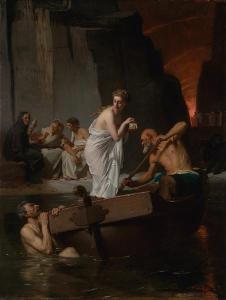
She is now in exalted company indeed. Hercules, Theseus, Odysseus, Aeneas, Orpheus — only the greatest heroes get to go to Hades and back, to die and be reborn in a more aware state, to cross the ultimate boundary in both directions.

She’s been warned not to open Persephone’s box. But (compare Orpheus) curiosity overcomes her, and she does open it. She falls into a deep coma and seems dead (≈Sleeping Beauty?).

Her lover and husband, Eros, finds her and pricks her with an arrow. This wakes Psyche. Eros now pleads with Zeus to let them be reunited.

Zeus sympathizes. He gives Psyche ambrosia, thus making her immortal (as he also made Hercules immortal).

The return and the boon

Psyche has now become one of the family, as it were. She has been accepted. Aphrodite, too, must embrace her as part of the family. And thus, there is finally the proper wedding and a feast.

Psyche soon gives birth. The baby is Voluptas, either joy or pleasure.

The harmony of the new, or newly reunited, family and the gift of joy and pleasure is Psyche’s boon, her gift to mankind. She has thus completed her heroic quest, quite as a male hero might have done.

The feminine twist

But we might observe two subtle differences between Psyche’s apotheosis and those of the male heroes we have been comparing her to:

1) Psyche has not killed anybody! It was not expected of her, not a prerequisite of her heroism.

The only two people in the story who die are her sisters (and they kill themselves, after coming to the mountain top again, greedy to revisit their sister’s palace, then plunging down, only to discover that this time no gentle wind wants to catch them).

2) The goal of Psyche’s quest was not individual triumph but family reunion and group harmony.

Postscript

A Freudian might see this entire tale as a “family romance”, as the story of a young woman coming of age and overcoming her repression about sex and intimacy until her mate is no longer bestial and loathsome but lovable and desirable.

But the monomyth theory, which dates back to Jung and regards archetypes as “collective dreams”, sees in Psyche’s story universals:

  • the human journey toward self-awareness,
  • our yearning to unify sex and love, body and soul, individual and family,
  • our striving for harmony.

Viewed this way, Psyche plays the same heroic role that Arjuna plays in the Bhagavad Gita (recall that Arjuna really stands for the noble part of our own soul, in battle with our sordid instincts).

Finally, Psyche is clearly a very powerful archetype. Variants of her seem to appear in countless stories through the ages. I leave you with the familiar image of just one: Beauty and the Beast.

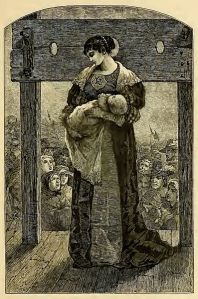
Searching for heroines (I): Hester Prynne

What exactly is a female hero — ie, a heroine? In this post and the next, I’ll put forward two possible models.

Today: The model of Hester Prynne (above, with her baby Pearl) and Demeter (below).

Even though one is a character in 19th-century American fiction and the other a Greek goddess, you may, by the end of this post, agree that they tap into the same archetype of female heroism.

Recap

So far in this series exploring heroism, we breezed through all sorts of mythical and timeless heroes, both Western (Greek) and Eastern (Indian). The presumption has been that they are all different and yet all the same, because they tap into archetypes of human storytelling (this is called the Monomyth theory).

But along the way we repeatedly slammed into the “problem” of women. Is there a female version of heroism?

(We’re not, by the way, just talking about an individual being brave, or admirable, or good. You can be all of those things and yet not be a hero.)

I engaged the topic with an opening salvo on Joan of Arc, but the prodigious debate that ensued in the comments taught me, and I think all of us, that we were in an intellectual cul-de-sac. We need an entirely different way of approaching the topic of feminine heroism. We cannot just graft male archetypes onto female protagonists to declare them heroines.

Female as opposed to male heroism

Implicitly, the monomyth relies on male archetypes of heroism:

  1. A young man proves himself to be unusual in some way, usually by passing a test by, or for, or against, his father. (For example, Theseus moves the boulder to find the sword left there by his father, King Aegeus.)
  2. The lad then receives a call to adventure, and follows it.
  3. He leaves society in an act of autonomy and individualism, crossing thresholds (for Theseus, the dangers along the road to Athens) to emphasize this separation.
  4. He meets women along the way, but they are probably temptresses, femme fatales or helpmates (Ariadne, for Theseus).
  5. He finally succeeds in his quest (in Theseus’ case, killing the Minotaur, liberating Athens), and
  6. returns to society, bringing it a boon (Athenian democracy).

(Now you might be able to see why I looked into the story of Joan of Arc, even though she was a historical rather than mythical character: her journey hewed closely to these male archetypes.)

A female version would look quite different. Meredith Powers apparently explored this in her book, The Heroine in Western Literature. I haven’t read it, but I listened to some lectures on mythology by Grant Voth, which he bases on Powers’ book.

Here, according to Powers and Voth, are the differences:

  1. Instead of some tense situation between father and son which marks the son as hero, it is now the deep connection between mother and child, and probably mother and daughter, which marks the mother, not the daughter, as the heroine.
  2. The ‘call to adventure‘ takes a totally different form than for men. It is probably some oppressive inflexibility in patriarchal society that threatens the mother/daughter dyad.
  3. In answering the call, the heroine does not leave society in an act of (male) individualism, but stays within it. As Powers puts it: “alone, apart, she accepts herself as a living critic” of her society.
  4. The heroine then form new bonds of solidarity with other women and
  5. also gives a boon to society in the process, a civilizing gift of a communitarian nature that is good for the group.

Example 1: Demeter and Persephone

Demeter was not, of course, a heroine but a goddess, but for Powers she establishes the archetype. Demeter (the Romans called her Ceres, whence our word cereal), was the goddess of grain and agriculture. She was the sister of Zeus, Hades and Poseidon, and the mother of Persephone.

Demeter

The love between mother and daughter is our archetypal starting point. So what is the call to adventure?

It comes in the form of a deal between her brothers, Hades and Zeus, whereby Hades is allowed to abduct Persephone and take her as his wife in the underworld. This is classic patriarchy: Zeus is the mightiest of the gods as well as Persephone’s father; Hades is Persephone’s uncle.

Demeter is beside herself with maternal grief and for one year becomes barren — meaning that the crops fail. Her brother Zeus realizes that he has destabilized Olympian society and tries to placate her.

But Demeter does not accept the abduction. Nor, however, does she confront or attack Zeus or Hades in a test of power. Nor does she exile herself from the Olympian family. She stays within it.

As she does so, she wins the solidarity of other women, including her (and Zeus’ and Hades’) grandmother, Gaia, and mother, Rhea. Together they sway the men to soften their stance.

Finally, they reach a compromise. Persephone is to spend half of each year with her mother and half with her husband. The first half becomes spring and summer, the second becomes autumn and winter.

Thus Demeter gives her boon to the world: It is called agriculture, and introduces the rhythms of fertility, where every death (Persephone’s departure) leads to a rebirth. Everybody is better off.

Example 2: Hester Prynne

Those of you who are American and have read Nathaniel Hawthorne’s classic The Scarlet Letter, probably already see how its heroine (for that is what she is!), Hester Prynne, is really a Puritan Demeter.

Hester bears a child, named Pearl, out of wedlock in 17th-century Boston. This makes her an adulteress, so she must wear a prominent and scarlet letter A to bear the public shame.

Here, too, the archetypal love between mother and daughter is our starting point. And again, the call to adventure arrives from an inflexibility of patriarchal society: the community demands to know who Pearl’s father is. Hester goes to prison, then stands for hours on a scaffold in Boston. But she accepts the call to adventure: she does not divulge the father.

Again, Hester is, in Powers’s phrase, “alone, apart, a living critic of society.” She embroiders the Scarlet A as though to emphasize it. She does not leave Bostonian society (although she will later go to Europe before coming back). Nor does she attack it.

Instead, she reaffirms the act that created her daughter and the relationships around it.

And she changes society in the process. Years later, she returns to Boston with her boon. She does charitable work. Society now respects and admires her. Everybody is better off.

More British humor from The Economist

From time to time, I try to give you glimpses into the most distinctive aspect of our corporate culture at The Economist, which is, of course, humor.

So yesterday I received an email. A colleague had sent it to “All Editorial”, requesting some help with what appears to be a story idea he or she is developing. Here it is:

Dear all,

I’ve noticed a tendency for companies to expect/demand that their employees enjoy their jobs, and give visible signs of so doing–being happy, wacky, fun and funny…

Has anybody else come across examples of this depressing and obnoxious trend? I’d love to hear from you if you have….

Steinbeck, grapes, wrath, success, writing

I) Grapes

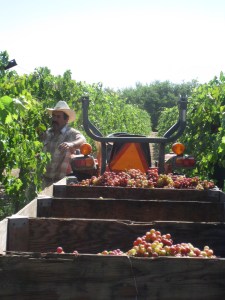
Here I was the other day in California’s San Joaquin Valley, with a crop buddy, after a day of picking grapes. It was 105 Fahrenheit (40 Celsius). I was drenched in toxic pesticides, which I was unable to avoid while picking.

What on earth was I doing there?

Well, it’s part of a little literary project, something longer-term. Can’t say much more yet.

We happened to be standing a few hundred yards away from the location of a Depression-era government camp for migrant farm workers which became the basis of John Steinbeck’s fictional Weedpatch Camp in his unforgettable novel The Grapes of Wrath. This was the camp that took in the Joad family and gave them brief respite from their harsh existence.

Was my location a coincidence? Not entirely. Nor was it entirely planned. (Sometimes, “accidents” help in the creative process.)

In any event, I took the occasion to re-read The Grapes of Wrath and also to read a bit about Steinbeck’s writing of it.

II) Writing

In 1963 Steinbeck said:

I wrote The Grapes of Wrath in one hundred days, but many years of preparation preceded it. I take a hell of a long time to get started. The actual writing is the last process.

This fits my own experience: The actual writing (sadly) is almost an afterthought, the easiest and most pleasant and shortest part of conception.

(But Steinbeck wrote longhand, of course. His 200,000-word manuscript took up 165 handwritten pages of a lined ledger book.)

Steinbeck apparently wrote fast, paying little or no attention to spelling, punctuation, or paragraphing. All that was cleaned up later. That, too, fits my experience.

III) Anger

In a 1952 radio interview, Steinbeck also said something else:

When I wrote The Grapes of Wrath, I was filled . . . with certain angers . . . at people who were doing injustices to other people.

And six years later, he told a British interviewer:

Anger is a symbol of thought and evaluation and reaction: without it what have we got? . . . I think anger is the healthiest thing in the world.

I had to think about that for a minute. But then this also fit my experience as a writer. Anger is a great motivational spur. It focuses the mind and leads to energetic storytelling. And isn’t writing a wonderful channel for anger to be released? Way better than any alternative, methinks.

IV) Success

Also of obvious interest to me (given that I’m writing a book about success and failure being impostors) was what the mind-boggling success of The Grapes of Wrath did to Steinbeck.

Critics, agents, publishers — the whole world naturally wanted him, as one said,

to write The Grapes of Wrath over and over again.

(That reactive and retroactive instinct in publishing also strikes me as familiar.)

But Steinbeck refused, saying that

The process of writing a book is the process of outgrowing it… Disciplinary criticism comes too late. You aren’t going to write that one again anyway. When you start another—the horizons have receded and you are just as cold and frightened as you were with the first one.

In another interview, he said that

I have always wondered why no author has survived a best-seller. Now I know. The publicity and fan-fare are just as bad as they would be for a boxer. One gets self-conscious and that’s the end of one’s writing.

Here, of course, I have nothing to add (not having scored a best-selling success yet). But it does rhyme beautifully with what Amy Tan said on the same subject.

Below, by the way, you see my perspective as I was picking grapes: I was crouching below the vines, because the best bunches grow in the middle and underneath. (“Low-hanging” fruit are not necessarily “easily picked’ fruit, I discovered.) And that tractor constantly moves alongside you. Several times I almost had my feet run over, and it banged into my shins so often that I could barely walk at night.

The vapors of Delphi

Pythia (oracle of Apollo)

When the ancient Greeks and Romans had a question of great import, they traveled to the navel (omphalos) of the world, which they believed to be at Delphi, on the steep slopes of Mount Parnassus in Greece (see map below).

They climbed up the Sacred Way, past about 3,000 statues and various temples and shrines, until they reached the Temple of Apollo. (This post is apropos of our discussion about Apollo the other day.)

Mount Parnassus was Apollo’s mountain — the mountain of wisdom and music, the place where Apollo had given Orpheus his lyre and taught him to play it, a place that other artistic places (such as Montparnasse in Paris) still try to evoke today.

Click for credits

Because Apollo could see the future, he would have the answer to any question, here at his temple.

And he gave his answer through a woman, the Pythia (pictured above). She would sit above a chasm in the rock through which the god sent vapors (pneuma) that put the woman in a trance. Thus possessed, the Pythia would babble, and priests were at hand to transcribe her words into beautiful hexameter which they gave to the individual who had asked a question.

The answer was coherent syntactically but not necessarily substantively. You recall that both King Croesus and Socrates, for example, had received answers from the Pythia that were ambiguous at best (disastrously so, in Croesus’ case).

But nobody could dispute the power of the god, or rather of his vapors.

And that remains true even today. The vapors are real, it turns out. Mount Parnassus sits atop several very active faults. The earth below constantly rubs and often quakes, grinding the rock until it emits … vapors.

Which vapors? Methane and ethane, apparently. Even the spring water at the site contains ethylene.

In short, even the scientists who go there today, if they hang out there long enough, if they inhale and ingest, may enter the trance of the Pythia and receive the ambiguous wisdom of Apollo.

And so mythos and logos meet; and ‘Socrates’, Dionysus and Apollo become one.

Godin: Sayonara, publishers

Seth Godin, a bestselling author and marketing guru, has apparently forsaken books.

Not the writing of them, mind you. Rather, the publishing of them — at least through the old-fashioned channels, meaning publishing houses (such as Portfolio in his case or Riverhead in mine).

In this interview, Godin says:

I’ve decided not to publish any more books in the traditional way. 12 for 12 and I’m done. I like the people, but I can’t abide the long wait, the filters, the big push at launch, the nudging to get people to go to a store they don’t usually visit to buy something they don’t usually buy, to get them to pay for an idea in a form that’s hard to spread … I really don’t think the process is worth the effort that it now takes to make it work. I can reach 10 or 50 times as many people electronically. No, it’s not ‘better’, but it’s different. So while I’m not sure what format my writing will take, I’m not planning on it being the 1907 version of hardcover publishing any longer.

On his own blog, he elaborates, somewhat more diplomatically.

I finally figured out that my customer wasn’t the reader or the book buyer, it was the publisher… Traditional book publishers use techniques perfected a hundred years ago to help authors reach unknown readers, using a stable technology (books) and an antique and expensive distribution system.

Those of you who’ve been following my own progress in (first) writing a book and (now) waiting for Riverhead to publish it will understand why Seth struck a chord with me.

“I can’t abide the long wait,” he says. I would say the same, except I have no choice, because I’m waiting for my first book to be published, whereas Seth is thinking of his 13th.

So I wait, and wait, and wait…

What mysterious processes are unfolding that require me to wait? As I’ve said before, I’ve never had a satisfactory explanation from anybody in the formal ‘book industry’.

In the analytical part of my mind, I know that Seth is right. Book publishers as we know them will die, will become extinct.

Books per se will never disappear, because, as Seth himself once told me for an article in The Economist, certain books (very few, actually) will always be around as “souvenirs for the way we felt” at the time of reading.

But book publishers as they exist today are very near their expiry date. My children will read about them as they read about the history of dodos or the telegraph.

At this point, I just hope the industry dies after its printing presses squeeze out a whole lot of copies of the book I have written.

Bookmark and Share

Somewhere between Apollo & Dionysus

Apollo

Friedrich Nietzsche not only loved Greek art and culture per se but he was also, as we discussed the other day, always searching for timeless lessons from the Greeks to help us understand modernity and ourselves.

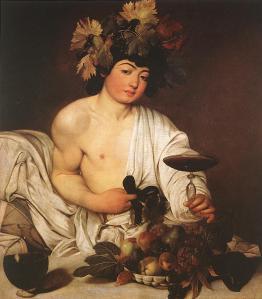
He found one such lesson in an apparent duality that ran through all of Greek art: the tension between two gods who were also two archetypes and half-brothers: Apollo and Dionysus.

Think of them as a Greek Yin and Yang.

Apollo, the god of the sun and wisdom, as well as poetry and music, would be the equivalent of the Chinese yang (ie, the bright, masculine sun).

Dionysus, the god of wine, intoxication, ecstasy, passion and instinct, would be the equivalent of the Chinese yin (ie, the dark, feminine moon).

Obviously, I am stretching that analogy, so don’t get too wound up about it. If you prefer, you can think of them in our contemporary pop-psychology terms of left brain (Apollo) and right brain (Dionysus).

Dionysus

So why should this duality be so interesting, for the Greeks or for us?

From Homer to John Wayne: The Apollonian

Nietzsche saw in these two archetypes two approaches to art, and indeed life.

Homer, for example, followed his Apollonian instinct in writing the Iliad and Odyssey in the 8th century BCE. How so? Because he glorified the war against Troy and the subsequent nostos (homecoming) of Odysseus. He made these stories beautiful, as Apollo was. He gave the Greeks and us role models.

He made the Greeks proud to be Greeks, proud to descend from whichever hero in the long catalogue of ships they traced their lineage to. He made them aware of their individuality, of the structures of society, of its fundamental order to which, after intervening episodes of wrath (see: Achilles), everything must return.

Julian Young in his biography of Nietzsche compares this to, for example, our Westerns (the ones with John Wayne more than those with Clint Eastwood). There, too, you see people dying, but they die in a stylized, Homeric way: The bullet hits and they tumble from their horses, looking good as they do so. They are our heroes, beyond the sordidness of reality.

Young gives another modern example: women’s magazines. Those are full of celebrities (our goddesses?) with their tales of disease, divorce, death and drugs. The subtext is ugly, and yet it is presented to us as glamour.

Nietzsche calls this being “superficial out of profundity.” Apollonian art does not censor facts (such as death) but perspectives. It involves a certain amount of self-deception, but it is uplifting. It deifies everything human, whether good or bad. And so it is, yes, religion.

From Sophocles to the rock concert: The Dionysian

By contrast, Aeschylus and Sophocles (but not Euripides, see below) followed their Dionysian instincts in the tragedies they created the fifth century BCE. This might have been expected: Those tragedies were, after all, performed once a year at the festival of Dionysus.

Dionysian art is about the abandonment of order, or ecstasy (ex-stasis = standing out of everyday consciousness). It transcends words or concepts. This is why it tends to involve visuals and music.

Music was in fact an important part of Sophocles’ and Aeschylus’ tragedies (we just don’t know how it sounded, what a pity!). Apparently, the audience sang along with the chorus and became one with it.

The individuals there would have become hypnotized by the sound (rather as yogis feel a certain ‘vibe’ when chanting Om with others). In fact, they would have, as one says, lost themselves in the crowd. They would have stopped feeling separate and individual, Athenian or Greek. They would have had (Freud’s) oceanic feeling.

Credit: Nambassa Trust and Peter Terry

Young compares this to our rock concerts or raves, to our football and soccer stadiums. Dionysian art is a trance and a trip, usually good, sometimes bad.

It is, in contrast to some Apollonian art, apolitical and devoid of any message. The Athenians participating in Sophocles’ tragedies stopped caring about worldly affairs. They became almost apathetic.

This was the only way they could bear to see their heroes — those same Apollonian heroes — torn down and devastated, knowing that they themselves might meet the same fate, understanding that reality was sordid, that it was primal and dark, and that it demanded to be accepted in that way. And they found a beauty in that feeling, too. So it, too, was a form of religion.

From Socrates to Princess Diana: What Nietzsche decried

Nietzsche loved both the Apollonian and the Dionysian, understanding that, like yin and yang, neither can ever be denied.

What he did not like, however, might surprise you: Socrates.

Why? Because Socrates represented, to Nietzsche, the religion of reason — not Apollonian wisdom but cold, methodical logic. In that sense, Nietzsche believed that Socrates “killed” Attic tragedy and Homeric poetry, and the playwright who represented that trend (to Nietzsche) was Euripides, the youngest of the three great tragedians.

Our own age, Nietzsche might say, is “Socratic” in the sense of scientific and myth-less, neither Apollonian nor Dionysian. Because we can’t act out these two instincts, we instead cobble together what Young calls “myth fragments”. We don’t release urges, as the Greeks did, but instead look for thrills, for sex and drugs and trips. We sky- and scuba-dive, we get a new app.

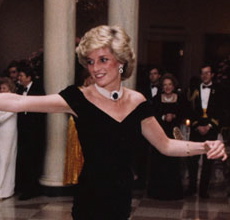
We worship neither Dionysus or Apollo but idols like Princess Diana. How appropriate, since Diana was the Roman Artemis, sister of Apollo.

Bookmark and Share

The American joy deficit

The Americans,” he wrote (and it is your job to guess who he is),

strive for gold; and their breathless haste … is already spreading to the old Europe… Already one is ashamed of keeping still; long reflection almost gives people a bad conscience. One thinks with a watch in hand, as one eats lunch with an eye on the financial pages … the desire for joy already calls itself ‘the need to recuperate’ … ‘one owes it to one’s health’ — that is what one says when caught on an excursion in the countryside. Soon we may well reach the point where one cannot give in to the desire for a vita contemplativa [contemplative life] (that is, taking a walk with ideas and friends) …

Bookmark and Share

Deliberate ambiguity in writing

Strategically ambiguous

One of my points in the previous post was that a good writer should have

control over his words, the way a good rider should be able to rein in his horse,

so that the words evoke the intended response only.

This led Jim M. to an insightful addendum:

So much has been written about how ambiguity distorts communication, it is easy to miss how ambiguity aids communication…. [M]anaging ambiguity is not merely a matter of its reduction, but its proper exploitation.

This is a great point, and in fact completes (rather than refutes) my thesis on writerly control over words.

To make the distinction clearer: The goal of writing is always to evoke a particular response. But:

  • sometimes this means making the words so precise as to leave no room for ambiguity. (The Second Amendment in the U.S. Constitution fails to do this, which is why I cited it in the previous post as an example of “bad writing”);
  • other times it means making the words intentionally ambiguous to leave the reader in a vacuum of meaning precisely circumscribed by the writer. The writer thus has the reader not at a point but in a space, because that is the intention.

The best example that I could think of off the top of my head comes from International Relations. The so-called Taiwan Relations Act, signed by Jimmy Carter in 1979 (but really the result of deliberate policy since Nixon’s visit to China), has been a diplomatic success precisely because it includes a deliberate ambiguity.

It is found in various passages but most notably in Section 3301(b). There it is written that “the policy of the United States” is

to consider any effort to determine the future of Taiwan by other than peaceful means, including by boycotts or embargoes, a threat to the peace and security of the Western Pacific area and of grave concern to the United States…

Of great concern. Genius! Does that mean that if China were to attack Taiwan,

  1. America would defend Taiwan? Or that
  2. America would be “concerned” without defending Taiwan?

The point, of course, is that the writer had two audiences in mind: The mainland Chinese and the Chinese on Taiwan.

  • The mainland Chinese had to be able to interpret the phrase to mean that America would probably defend Taiwan, thus concluding that attacking the islands would be a really bad idea.

  • The Chinese on Taiwan had to be able to interpret the phrase to mean that American might not defend Taiwan, thus concluding that declaring formal independence (and thus provoking an attack) would be a really bad idea.

This deliberate ambiguity is one reason (I’m not saying it’s the only reason) why China’s cross-straits conflict has been one of the stablest hotspots in the world. Wouldst that all conflicts were like it.

To expand this concept of deliberate ambiguity to the other arts: The best analogy I can think of

  • in painting and sculpture is the so-called “negative space”, and
  • in music the pause.

So ambiguity definitely plays a role in good writing and art — as long as it produces the response the writer intended.

Bookmark and Share

Why I am shrinking this blog

I told you in the previous post that, for the first time, I deleted a post (it no longer matters what the post was about) because I came to the conclusion that it was badly written by my standards.

Upon further reflection, that made me realize that I have to “shrink” this blog. Now I’ll explain what I meant by that. (And yes, I savor the irony that I will talking about a “shrinking” a blog in a 2,000-word blog post.)

I) What I consider “badly written”

I write so much that the mechanics — syntax, grammar, flow — are rarely bad anymore. But that’s not what writing is about.

Ultimately, words deserve to be spoken or written only if they communicate what the speaker or writer wants to communicate. And that very much includes not only the substance denoted but also the tone, voice and other bundles of connotation.

We all know that perfect control over the meaning(s) of words, especially written ones, is impossible. That is why Socrates refused ever to write, and always only spoke. Just think of our ongoing debate about the words (and punctuation) in a phrase written 219 years ago:

A well regulated Militia, being necessary to the security of a free State, the right of the people to keep and bear Arms, shall not be infringed.

Did the writer intend that only “a Militia”, and “a well regulated” one at that, was to have the right to bear arms? Or that “the people”, collectively and individually, should have that right, although it might also be, you know, nice if a Militia were around? Who knows?

This conundrum — that writers lose control over their words as soon as they make contact with any audience — led people like Jacques Derrida to suggest that we stop even pretending that we can control meaning: Words mean whatever anybody wants them to mean, so get over it.

I don’t subscribe to that. A good writer should have some control over his words, the way a good rider should be able to rein in his horse. Naturally, horses sometimes go berserk, as do words. But that’s when it’s time to kill a blog post.

That the now-deleted post had to be dispatched became clear not when it led to vigorous debate (as many posts here on The Hannibal Blog do), but when the comments looked to me, the writer, as utter non-sequiturs. I looked at some of them and could only say: “Huh?” How did the commenter read this meaning into this post?

This is when I remembered my Second Secret to Good Writing, which is empathy. Don’t blame your audience. Re-examine your words.

My words had not just evoked an unintended response, but in a few individual cases the opposite of the response intended. That should not happen to a good writer.

And so I decided that the words had to die.

II) Why might this have happened?

1) The issue of quantity

Less than a month ago, I wondered whether there was “a Laffer Curve” of writing — in other words, a point beyond which increasing quantity (of words written) decreases quality.

I was pondering that question because, over the past couple of years, the number of words I produce, and am expected to produce, has inexorably been increasing.

When I started at The Economist in 1997, we were expected to write articles for the weekly (print) issue. And that was it. (Quite enough, I thought.)

I first recall internal discussions about “blogs” in 2006. I might have had something to do with that, because I wrote a Special Report in 2006 about “the new media.” In it, I said that all the new media (including blogs) would collectively transform society, which they clearly have done. But I never said that individual news organizations had to add blogs.

But blogs we began having, even at The Economist. For a while we didn’t really take them seriously. But now we do. And we have more and more of them. And we are expected to “feed” them. So, in addition to the articles we write, we write blog posts.

We also do podcasts, and those often take a surprisingly long time (the logistics, not the actual talk time). And we do video pieces. Those take even more time to set up.

To take this week as an example, I produced two articles, two blog posts and one podcast … in four days (because on Friday I allegedly started a holiday.)

Our heritage, our “print DNA”, means that we will always put the utmost effort into the print-issue articles. So that’s still where the research, fact-checking, deliberation, travel, background reading, interviewing goes. (And real-life logistics have an annoying habit of not aligning perfectly with The Economist’s Greenwich-mean-time deadlines.)

But that doesn’t actually leave all that much time to produce all that other stuff.

Then add a personal blog in support of a forthcoming book, such as The Hannibal Blog.

Yup, now this amounts to a lot of words. Some of those words will not be redacted, honed, polished, and stress-tested as much as they should be. This must mean, from time to time, that some words are less than optimal.

Conclusion: Don’t produce more, perhaps less.

2) The issue of audience expectations

I recall an internal discussion once where the theory was put forth that the web audience is sophisticated. In other words, readers of blogs (whether on The Economist’s web site or WordPress) know that the medium is more intimate, conversational, relaxed, aphoristic and subjective. Blogs are essentially personal diaries, except public and social.

Readers, goes the theory, do not expect a blog post to be balanced, polished and fact-checked. They can discriminate between a blog post and an article.

Not only that, but they like to have that less formal window into the writer’s soul, they like hearing about what happened to him on the way to this-or-that, what he was thinking when so-and-so said something-or-other. It’s like knowing somebody by email and then seeing a handwritten note from him: the handwriting, with its imperfections, says something. Or like meeting a public figure and getting a peek behind the scenes.

Well, that’s the theory. The reality is that audiences get confused. Many readers/listeners/viewers merely see the brand, and do not discriminate among media. The brand could be The Economist or, at micro scale, The Hannibal Blog. But what if the human beings behind the brands straddle their boundaries? When is the writer allowed to speak personally, and when is he expected to be a journalist upholding a 160-year-old brand?

This is not a new issue. Correspondents of The Economist have always gone to dinner parties (OK, rarely) and often moderate panels at conferences, for example. When we’re chatting with our table neighbor, are we allowed to kid around and speak our minds? How about when we’re on a podium?

Blogging (and all its descendants, such as tweeting) is a genie that is out of the bottle and won’t go back in. I’m simply flagging a new tension. And a new need to make explicit to audiences what they should expect in which context.

Here on The Hannibal Blog, by the way, you get me, just me, my quirky, personal musings, which represent nothing else.

Conclusion: Don’t assume that readers let you speak “off-the-record”, be circumspect. If in doubt, say less.

3) The issue of scope

You may have heard people described as coconuts or oranges. Coconuts mix everything together inside, oranges come in neat sections.

Well, most people are coconuts, especially at The Economist. We have many interests, strange hobbies, and what’s interesting is what you get when you mix it all up. One of my favorite colleagues is simultaneously a connoisseur in the subjects of sailing tall boats, all matters Mongolian, Tango and bird watching, and that is only the beginning of a long list.

Should he stick to his beat in writing articles? Should he have a blog for each interest? On The Economist’s web site or on his own? Is it alright if he mixes it all together, the way it is mixed in his own soul?

In my case, for example, I started this blog about two years ago, intending to make it purely about the book I was writing. This was naive. I soon realized that the process of publishing a book takes a lot longer than the writing of it (and I now expect the book to be out next year). So what do you do in the mean time?

I was advised not to publish excerpts, because that would give the book away. So I began blogging about other stuff. All those other interests. Pretty soon, that included the whole dang coconut, even The Economist.

And again, it’s possible that some of you got confused.

I now face the interesting development that The Economist is constantly, almost every week, making available to me new “coconut straws”. Just one example: This summer we started yet another blog, called Johnson. It is about Language. I have not contributed to it yet, but it so happens that Language is one the big threads on The Hannibal Blog. Obviously, I have to rethink that. My future language posts should probably go to Johnson, not The Hannibal Blog.

Conclusion: Reduce this blog’s scope; become an orange; write about fewer and better defined topics. No politics.

4) The issue of fear

When you write you make yourself vulnerable. When you write on a personal blog you are even more vulnerable. Who knows what weirdos show up alongside the intended audience? Who knows who does what with your words?

That can lead to fear, and fear leads to the worst writing. And bad writing, for a writer, equals failure.

The most important prerequisite for being a good writer is therefore an ability to overcome fear and find courage. You must say something interesting, which invariably means that somebody somewhere could take offense (even when the topic might at first blush seem innocuous — no topic stays innocuous if it gets a large enough audience.) And you must say it clearly, which is to say simply and thus strongly.

This gets into one of the big topics in my book, the tension between tactics and strategy. Writing well (ie, with courage and risk) about many topics is like a country fighting a war on many fronts. You will eventually lose. Writing more timidly or carefully about all these topics is like fighting less fiercely on all those fronts. You will — again — eventually lose. So you must choose your topics (your fronts) strategically.

Conclusion: Again, write about fewer topics in each medium, such as this blog.

III) Postscript

I want to end by giving a little shout-out to two bloggers who, in their very different ways, have explicitly or implicitly addressed some of the issues above.

1) “Phil”

First, there is “Phil”. I don’t know what his real name is and I don’t need to know. He has several blogs, indeed he seems to keep switching blogs and starting new ones, to my ongoing confusion. His current “main” blog seems to be here.

Phil once observed, either in a comment here or in a post on his own blog, a phenomenon: Time and again, Phil finds an interesting new blogger, a strong and idiosyncratic voice, and follows that voice. After a while, that blog becomes popular. And then, as its audience grows, the blog becomes … bad.

(Phil, if you can provide the URL to your observation, I would like to link to it.)

So I speculate: Perhaps Phil, by starting new blogs all the time, is conflicted as we all are about gaining an audience. An audience gathers, and he runs away to start a new one. Because he understands, as we all do, that audiences are a threat as a well as a blessing.

2) “Man of Roma”

The other blogger who deserves a shout-out here is Man of Roma. He is a bon vivant and connoisseur of classical wisdom. And this summer he did something very civilized: He simply left (his blog, that is) and enjoyed himself, knowing that the audience that matters, which includes me, will be there whenever he returns.

Bookmark and Share