Tiger Woods and the two impostors

Tiger, Tiger, Tiger. You’re making me … re-write my manuscript.

My book, as a reminder, is about success and failure and how the two can be, as Kipling put it so poetically, impostors. The main character is Hannibal, and his story introduces the various themes that come up in the course of a life, each of which is then illuminated with other lives, ancient or modern.

Here is how I went about it:

  • Mainly I chose relatively obscure people for my characters studies, which is to say people who are interesting or known for a good reason but not ‘famous’.
  • When I did include somebody conventionally famous (and there had to be a good reason!) I focused on an obscure or non-obvious aspect of that person’s life.

Well, Tiger falls into that latter category. I examined one aspect (I won’t say which) that he shared with Hannibal, and one that he didn’t, both of which made him unbelievably successful.

And now… the babes. So many of them. They’ve started keeping a cheat sheet to keep track of them. Plus: Wives swinging golf clubs after mid-night car crashes; cable-TV know-it-alls pontificating about morality; coy mea culpas and a career inter- and perhaps dis-rupted.

What can I say? I notice that everybody suddenly has a strong opinion about this young and immature genius. Tragic hero? Victim of hubris? Pervert?

Somebody from Pakistan informs us that it is entirely normal to have lots of women if you can. Somebody else explains why black women are not mad at Tiger. And so on.

My own default position in these matters is to be cavalier. But Tiger’s self-immolation now looks to be epic in scale. And tragic if the flames sear his children.

Among athletes, Diego Maradona comes to mind–the best in his sport, only to waste it all in decadence. Among politicians (well, where do you start?), perhaps Eliot Spitzer.

Yes, they were successful. Yes, their success was an impostor, by goading them, psychologically, into self-destruction. Is it simply the old Greek theme of hubris? Was it a character flaw? More subtle?

One thing is clear: I have to adjust my manuscript.

And one other thing should not be forgotten: Kipling said triumph and disaster are impostors. Tiger is young, as is his wife (not to mention their kids). As a great advertisement featuring Tiger (before his fall) once put it:

It’s what you do next that counts.

Bookmark and Share

Facebook flashes your trench coat open

Mark Zuckerberg

Facebook just “updated” its privacy settings, and I almost did not notice. That’s because I’m (Facebook founder) Mark Zuckerberg’s nightmare: I don’t “share” anything on Facebook to begin with, so my Facebook profile contains little to be private about.

But some of those who do share things on Facebook “came close to killing [their] account this week”, as Danny Sullivan did, when they paid attention to the details of the change.

A year ago I predicted in our (The Economist‘s) sister publication, The World in 2009, that this brave new culture of “sharing” would cause discontent. Maybe that point is now nigh. For me personally, it arrived long ago.

Because I used to cover the internet in my previous beat at The Economist, I had to be one of the first to try new things like Facebook, and I usually was. But from the start I made a pact with myself:

  • No pictures of, or (indexable, Googlable) information about, my loved ones.
  • No names, birthdays, diaper photos etc.
  • No drive-by shootings (photo, video, status update) of third parties

In particular, my wife and children should, in effect, not be on the internet at all unless they themselves later choose to put themselves there. You may have noticed that their names do not appear on The Hannibal Blog, even though I share my ideas here quite liberally. Yes, you may know me very intimately by now in an intellectual way–as I feel I know some of you quite intimately through your comments even though I only see your pseudonym and avatar. But you do not know me biographically beyond what I choose to divulge. I practice Platonic sharing.

So why am I Mark’s nightmare? Because getting people to share all that other sort of stuff–the biographical and, in particular, the intimate bits–is his mission, his strategy, his imperative, as he himself already told me two and a half years ago, before he was famous.

(Ironically, that was one of the hardest interviews I ever conducted, because Mark, well, would not share anything. In conversation, I mean. He gives short, linear, monosyllabic answers. Getting him to open up offline is like getting blood out of a stone.)

To make people feel secure enough to share more, Facebook subsequently introduced increasingly complex (“granular” was Mark’s word) privacy settings. By fiddling around with dials and such, you could determine how public/private your photos, updates, contact info etc were.

I never bothered, because I hate fiddling and, well, I had made that pact, so I didn’t care. There was nothing to keep private.

But I watched, with curiosity verging on shock, what information I began to see, in my peripheral Facebook vision, about my Facebook contacts. If I may generalize: The men shared thoughts and opinions, intended to be public, and the women shared baby photos and such that used to be considered intimate. (The differences between men and women on Facebook go a lot further.) I occasionally felt like a voyeur, and became bashful. Surely I was not meant to see all of this? Or perhaps I was? Perhaps I just belong to a different era, such as Hannibal’s.

But, based on my conversation with Mark all those (internet) eons ago, I always knew that Facebook was a pair of scissors that would sooner or later cut. The two blades are these:

  • For Facebook to stay interesting to its users, Mark needs people to share ever more of this stuff.
  • For Facebook to stay interesting to Mark and his investors, he needs to start doing things with that information, things that go beyond just showing the information to your friends.

A lot of people will be cut by the “transition tool” that Facebook is now providing as part of its privacy changes. Danny in his post went through it, so read his analysis there. Just one hint: Online, everything is about the “default” option, because that is the one most people will use. You notice that the default setting in the “tool” for who may see most kinds of information is ….

Everyone


Bookmark and Share

Brute and primal hero: Hercules

Heracles, or more commonly Hercules (the Roman version), is the quintessential and archetypal hero, the one the Greeks considered their greatest and, more importantly, the one my four-year-old daughter names when I ask her who her favorite hero is.

So Hercules must, of necessity, open this thread on heroes and any investigation of heroism.

Which is interesting because I put it to you that the myth of Hercules is one of the worst stories of antiquity when you consider the storytelling per se. We today would consider Hercules a brute, a meathead, a boor. He is one-dimensional as opposed to complex. His story is in essence a repetitive list of triumphs that leaves no room for suspense, surprise or sympathy. (I meant empathy, really, but why not alliterate?).

And yet, Hercules is the one my daughter picks. So there must be something primal there. And that’s what this post wants to establish.

The man and his dilemma

Hera (Juno)

Hercules was, like many other Greco-Roman heroes, half god, half human. His father was Zeus, which meant that Hera, Zeus’s sister and wife, was jealous and would forever hate Hercules (some say that she is the Hera in Hera-cles) and make his life difficult. If there is tension in the story at all, it is this fight among the gods (some goddesses, such as Athena, helped Hercules) and between a goddess and a mortal. We’ll encounter this theme all throughout ancient mythology (Hera also fought against Aeneas, for instance).

Hera is thus how the Greeks, in this story, personified adversity and even what we would call our dark side. If things go wrong, even if Hercules himself does wrong, we will blame Hera. She is the Ur-bitch, you might say.

Just so this is clear, the story starts when Hera sends two venomous snakes into the crib of baby Hercules to kill him off. Poor snakes. Baby Hercules strangles them, one in each cute fist.

And thus you have the only other piece of information you need about Hercules, the thing that he is known for, the only thing we can really say about him: He is …. strong.

Strength is probably the first trait of a hero, as Jens has already pointed out. But strength against or for what?

Combine the malign influence of Hera and this awe-inspiring strength and you get a combustible cocktail.

Indeed, we need an explosion to get started: Hera causes Hercules to go temporarily mad. He rages with blood lust, destroying and killing not just anybody but … his own children! (Ask yourself: Could Hercules be a modern hero? Do heroes have to be “good”?)

This sets up a rather complicated and unconvincing double rationale for what must come next–ie, the ostensible “story”. Hercules has sinned and must atone, by doing certain labors of penance.

But penance did not work for the Greeks as a story line, so there is another, simpler layer: a good old power struggle. Hercules was supposed to have been a prince, but Hera (who else?) had played with Zeus’ mind and given the throne to Hercules’ cousin Eurystheus, a caricature of mediocrity. The deal is that Hercules can get his throne back if he completes the tasks that Eurystheus gives him. (Ask yourself how plausible that is. Why wouldn’t Hercules just bash his cousin’s head in?)

I’ve been dwelling on all this only to show you what a “bad” story this is. It should be entirely clear by now that the ancients were not the least bit interested in the why of Hercules’ labors, and arguably only modestly interested in the how. They were interested in the that. Namely, Hercules accomplished twelve amazing feats because … he could.

The labors

I won’t, as it were, belabor the labors, even though they are the myth, because you know them and, frankly, I consider them rather predictable and thus dull. (Compare any one of them to the fiendish complexity and uncertainty of, say, Jason having to get that fleece.) To jog your memory, here is the list:

  1. Hercules kills a monstrous lion and henceforth wears its skull and fur as hat and cape, which is how we picture him.
  2. He kills the Hydra, a monster with many heads. Every time he cuts off a head, two more grow in its place. (Compare this with the monster that Siegfried confronts in Norse myth).
  3. He captures a golden-horned deer that is the favorite of the goddess Artemis. (I think this task was included to show that Hercules also had Fingerspitzengefühl, finesse. He could not kill the doe, lest he piss off yet another goddess, so he aimed an arrow so carefully that it immobilized the doe without killing her. But ask yourself: Why did he have to use an arrow at all?)
  4. Next: a boar. Hercules runs it down in the snow, where the boar can’t run fast.
  5. He cleans the famous Augean stables. The cattle of King Augeas had been pooping uninterrupted for eternity and the entire Peloponnesus was reeking. Instead of shoveling shit, Hercules diverts two rivers to flush out the mess. (An import from the river cultures in Mesopotamia and Egypt? Meant to show that Hercules could not be humiliated?)
  6. Next, Hercules kills some terrifying birds who shot brass feathers into people.
  7. Next, Hercules carries the Cretan bull to the mainland. (This is the bull that would father, with King Minos’ wife, the Minotaur that Theseus will later deal with, which theoretically locates Hercules in time as slightly older than Theseus. Probably included to establish a link between the two heroes, the greatest, respectively, of the Peloponnesians and the Athenians. Updated and corrected thanks to Bill Frank.)
  8. Next, Hercules deals with the mares of Diomedes, horses that tear apart and devour any guest of their king. Hercules somehow turns the tables and feeds Diomedes himself to his mares, and they lose their appetite.
  9. Next, the belt of Hippolyte, queen of the Amazons. We need some sex in the story and this is it. Hippolyte falls in love with Hercules and wants to give him her belt, but Hera interferes again, making the other Amazons think that Hercules is about to kill their queen, and causing a battle in which Hercules and his men kill the Amazons. (Every time he kills children or women, you see, it’s really Hera’s fault.)
  10. Next, Hercules has to steal some cattle from a three-headed monster named Geryon. What’s interesting here is the location: Geryon is in Spain, and Hercules travels back to Greece via Italy (thus allowing the Romans to link him with their locales). Also, he has to cross the Alps along the way, and this was, in the Roman mind, not done again “at scale” until … Hannibal did it. I digress.
  11. Next, Hercules has to get the apples of the Hesperides, in today’s Morocco. He persuades Atlas, a Titan who is holding up the sky on his shoulders, to fetch the Apples for him, holding the sky (strength!) while Atlas obliges. When Atlas returns, he doesn’t want to take the burden of the sky back. Hercules says “Fine, I’ll keep carrying it, just take it for one second so that I can put a pillow on my shoulders.” As Atlas helps him out, Hercules makes off with the apples. (I think this is included to show that Hercules also had wit, besides strength. But that qualifies?)
  12. Last, Hercules must fetch Cerberus, the three-headed dog who guards the underworld of the dead. This is de rigueur for heroes: Odysseus and Aeneas will also visit Hades and return. I think it is meant to symbolize a brush with death, a transcendence of mortality.

Death and meaning

And that’s it, a smooth ride from one triumph to the next. If there is a twist, it is only in Hercules’ death.

Hercules and his wife crossed a river once and Hercules let a centaur, half man and half horse, carry his wife across (why did Hercules himself not carry her?). The centaur tried to elope with her, so Hercules shot him. As the centaur lay dying, the beast whispered to Hercules’ wife that she should keep his blood and soak Hercules’ clothes in it, which would prevent him from straying with other women. She did as told, but the blood was really venom. And thus she inadvertently killed her husband.

And yet, Hercules, alone among heroes, did not totally die. Zeus, his father, made him immortal and brought him to Mount Olymp. Another indication that Hercules was special.

So what is Hercules to us?

He represents the idea, once universal and now arguably fading, that heroes are somehow beyond morality and the law, beyond ordinary standards, “beyond good and evil”. That happens to be the title of a book  by Nietzsche, and I think Hercules might have fit Nietzsche’s idea of an Übermensch. It is what Dostoyevsky examined in Crime and Punishment: Can the hero be beyond morality? The ancients believed Yes. We have opted for No. Today, we would lock Hercules up or, if he happened to be president, appoint a special prosecutor.

But back to the point: Hercules may have got rid of some nuisances for his fellow men–a boar here, a monster there–but that was not why he did his labors.

Hercules was simply a strong man at a time when nature was ever-threatening and as arbitrary as a jealous woman (Hera), when our frightened ancestors yearned for one among them, whatever else his flaws, to stand by at the gate with a bludgeon and brawn.

Bookmark and Share

The manuscript: Round III

And the manuscript is back again. Five months after I received his comments on my first draft, and three months after I sent him my second draft, my editor at Riverhead has now sent me his comments for the third (and perhaps final?) draft.

They’re very good comments, once again. We’re now trying to figure out two things:

  1. How to make the tone consistent throughout the entire 100,000-word story. Right now, as my editor puts it, the book reads “overly serious in some passages, too informal in others.”
  2. How explicit to make the “moral” of each chapter. Not enough, and you sacrifice oomph and clarity. Too much, and you dumb down the story or make it corny and banal.

Both are points that all writers struggle with, I stipulate.

Number 1, in particular, is interesting: In my day job at The Economist, I write short articles in a single day at a time, and always in the same tone and voice. But my book was written over many, many days, and I felt different on each one (and was using my personal voice). Some days, I had my tongue in my cheek; others, I was doing deep thinking.

You see that on this blog, of course. Its tone has changed a lot over the 17 months or so that I’ve been writing it, and each post has its own mood. On a blog, that’s allowed, and even fun.

My book, however, should not be like that. It should have variety, but one steady and reassuring voice. As it turns out, that’s surprisingly hard to achieve.

Bookmark and Share

Hannibal in the Alps–today!

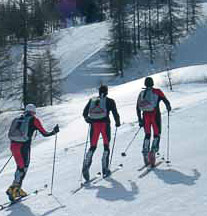
When seven young ski climbers from Germany, Austria, Italy, Spain and France decide to cross the Alps in only three days, using only their touring skis to climb up and down 13,500 vertical meters for 210 kilometers, what do they call their trip?

But it’s obvious:

Hannibal

(Thanks to Mr Crotchety, a fellow ski enthusiast, for the link.)

It hardly matters that this team, representing Dynafit (a ski maker), made the crossing in the eastern (Austrian) Alps, right around the mountains and valleys where I spent my youth. Hannibal made his crossing, with elephants but without Dynafit skis, in the western (French) Alps, near their highest point. Here is the map of his trip and life (as well as in the masthead above).

We’re not sure exactly where he crossed, so teams from Stanford and other universities are trying to follow in his footsteps to find them (ie, the steps).

But it hardly matters. Daring crossings of the Alps, eastern or western, still evoke, and forever will, the most daring crossing of them all.

Bookmark and Share

On English (and other dialects of Sanskrit)

I mentioned en passant in the previous post that the Sanskrit word vira, hero, is related to the Latin vir, man, and thus to our virtue and virility. And, of course, to the Modern Hindi vir, brave. (Thank you, Susan.)

Well, that sort of thing brings out the language geek in me, and I can’t help myself. There is something beautifully mysterious in this common Indo-European heritage (pictured above just after the fall of the Western Roman Empire) of our Western languages and this Eastern Ur-language, Sanskrit. It is like visiting very distant relatives and suddenly seeing a nose, a toe, a tilt of the head or an allergic sneeze that is exactly like your own and makes you imagine the stories of the past that unite you.

So indulge me in some word play.

The easiest way to compare languages is by counting to ten in them. Look how incredibly similar most of these word roots have stayed across millenia and continents:

Sanskrit
Latin French German English

ekam
unus un eins one

dve
duo deux zwei two

trini
tres trois drei three

catvari
quattuor quatre vier four

panca
quinque cinq fünf five

sat
sex six sechs six

sapta
septem sept sieben seven

astau
octo huit acht eight

nava
novem neuf neun nine
dasa decem dix zehn ten

But the real magic starts when you compare more meaningful words, because then you see not only their etymology but the genealogy of concepts and meanings (this used to be a hot field, called philology, and is how Nietzsche arrived at his philosophy about the evolution of morals).

Maya

Since I used the word magic, let’s start there. It “comes from” the Sanskrit word maya, whence the Latin magicus, French magique, German Magie.

Of all these, the Sanskrit word is by far the most interesting and nuanced and deep. It points to a philosophical and religious concept. Maya means magic in the sense of cosmic illusion, the metaphysical head-fake that our senses play on us. We think we exist in our mortal bodies in this changing world, but if we pierce the magic (maya) by making our minds completely still, we realize that there is only pure energy (Brahman) and our soul (Atman) merges into this void.

Bonus: Compare that last word, Atman (soul) with the German atmen (breathe).

Yoga

Yoga not only means, but is the root of, union. But it gets more interesting. Yoga is also related to the Latin junctio, French joindre, English join.

Its Germanic descendants resemble it even more closely: German Joch, English yoke. (English, as is its wont, gets the root twice, once via Saxon and once via Norman French.)

A yoke at first does not seem very yogic. But if you think about it, that’s a matter of technological connotation. We yoke an ox to a cart, thereby imprisoning him. But in yoga, you yoke (connect, join, unite) your breath to your mind, thence to your soul (Atman), and thence to one-ness or union (Brahman), thereby liberating yourself.

Maharaja

Maharaja means great king in Sanskrit. So it has two words: maha (great) and raja (king). Now recognize:

  • maha → Latin magnus (great), French majeur, German macht (might), English might & major
  • raja → Latin rex/regina (king/queen), French roi, German Reich/reich/reichen (empire/rich/reach), English rich, reach, regal, royal

And so it goes on and on and on…

Bookmark and Share

New thread: Heroes and heroism

Hercules

I’m announcing a new “thread” on The Hannibal Blog: Heroes.

I’ve already written lots about heroes, of course:

And I’ve discussed how the hero or heroine is an archetype at the heart of almost any story, and thus crucial to storytelling. (This is why the new thread will overlap a lot with that on storytelling.)

Why a new thread on heroes?

Because I think there is a lot to say about them. As always with my threads, I have no idea where we will end up, but I’m quite curious to find out. I have a vague sense that I will discover quite a bit, from you more than from myself, as we get deeper into the thread.

A very tentative outline of future posts in this thread might run as follows:

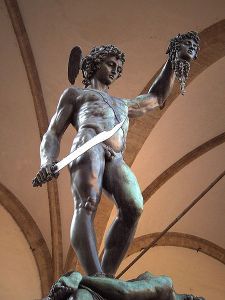
Perseus

First, the classical heroes of antiquity:

  • Hercules
  • Theseus
  • Perseus
  • Jason
  • Achilles
  • Odysseus
  • Aeneas

Then, some non-Western heroes, including my favorite:

  • Arjuna

(For the yogis among you, did you know that the Sanskrit word for hero is vira, as in the yoga poses virasana and virabhadrasana? It is related to Latin vir, man, and thus virile, virtue…)

Then some fictional heroes and heroines from our folk-tales, our movies, modern literature. Then some real-life heroes. And eventually, some anti-heroes, who are really modern heroes. (Albert Camus’ Meursault in The Stranger jumps to mind.)

Feel free to nominate heroes in the comments that you’d like to have discussed.

I’m interested in what makes these various heroes and heroines heroic, what makes them timeless. Why did some heroes enter our collective unconscious, and others not?

About threads

For those of you who are new to The Hannibal Blog, a thread is simply a mini-series of blog posts, not necessarily sequential or coherent, united by a common tag or category on the right. By clicking on the tag of a thread you get a list of all the posts in it, in reverse order.

And threads never really end. So all the previous threads–such as those on the great thinkers, storytelling, Socrates, Hellenism, Carthage, stuff, America, freedom, et cetera–will go on.

Bookmark and Share

Me against Gray Davis

Well, this should be fun.

An amicable, edifying and ultimately futile debate (the sort The Hannibal Blog loves) in January, between, on one side:

  • Kevin Starr, the preeminent historian of California (and a preferred source of mine), and (see Update below).
  • Sharon Waxman, distinguished journalist and author,
  • Bobby Shriver, Renaissance man and Kennedy/Schwarzenegger clan member, and
  • me

and, on the other side,

  • Gray Davis, the former governor of California, and
  • Van Jones, Obama’s former “green czar”, and
  • Lawrence O’Donnell, cable-TV analyst and, more importantly, father of The West Wing, the most intelligent TV series ever.

My team will argue that, yes,

California is the first failed state.

The other guys will argue the opposite.

Then the audience will annoint the winners.

Feel free to suggest debate strategies/arguments (for either side!) in the comments.

Bookmark and Share

Writing in a Procrustean bed

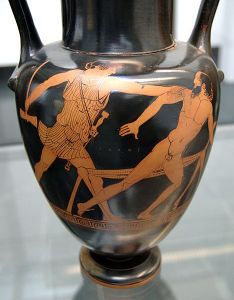
That stud on the vase is supposed to be Theseus, the Athenian hero who went on to slay the Minotaur, dealing with a ruffian named Procrustes.

Procrustes was famous for his bed. He invited passers-by to spend the night and to lie* in his bed. The bed was always too short or too long. So Procrustes “adjusted”, not the bed, but the guest as he was sleeping. He either stretched the guest (Procrustes = ‘the stretcher’) or cut off his legs.

Theseus eventually dealt with Procrustes by making him, Procrustes, fit his own bed. So there.

But from this myth we have the great term Procrustean bed. It applies whenever we force something into a size or a result (as with statistics) that is not natural and thus incorrect or inelegant.

I was thinking of the Procrustean bed once again while writing my piece for The Economist this week.

You recall my musings on the subject of a text’s optimal length, and how important it is neither to go under or over it. Well, in most print media, and certainly in The Economist, lengths are fixed in advance. What determines wordcount is the line count in the page layout of the print edition, which is done before the editor even has the “copy” (article) in question.

In my 12 years at The Economist I have, as you might expect, become very good at writing ‘to length’–ie, at delivering copy that fits exactly (thus evading any Procrustean tendencies by editors). Often I even enjoy the discipline of that constraint.

But it increasingly strikes me as bizarre, indeed unsustainable: We invariably cut good stuff out of articles, add unnecessary words to ‘turn lines’, or even entire paragraphs to fill a page when a chart shrinks. Sometimes this means sacrificing color and detail, or even logical connectors. Other times it means adding noise to signal.

And what happens next? People read the print edition, then pulp it. So much for the beautiful page layout.

But the same text survives forever online, where it faces no obvious layout constraints. Thus, all posterity reads a suboptimal text, stretched or amputated as Procrustes’ guests were.

The ancients (Homer, Virgil, etc) did not have this problem. They (or rather, their slaves) wrote on scrolls, which scroll as our web pages do, into infinity if necessary. Perhaps our evolving media habits will take us back to that future.

Bookmark and Share

Tudor sex and beheadings made complicated

Henry VIII

I’m reading Wolf Hall by Hilary Mantel right now. It’s a historical novel about the efforts by Henry VIII of England and Anne Boleyn to annul Henry’s marriage to Catherine of Aragon, his first wife, so that he and Anne could marry instead and–so it was hoped–produce male heirs.

The rest, you might say, is history. What stood in Henry and Anne’s way was the Catholic Church, ie the pope, so Henry had to “fire” the church and start a new one, the Church of England, whence sprang Anglicanism and its offshoot, Episcopalianism.

The new marriage, however, was not, ahem, ideal and Henry went on to have a few more wives, while Anne, and an awful lot of other people, lost their heads.

In short, it is a fantastic topic, a fantastic story! The sort I love, because it is simultaneously:

  1. grand and important, and
  2. riveting and engrossing.

    If it were entertaining but trivial, I probably would not bother, because life is short and I want to spend it on important things. If it were important but boring, I also might not bother, because, well, life is short and I want to minimize my pain.

    Anne Boleyn

    So by being important and riveting, Mantel’s topic is exactly like the events that I chose as the main storyline in my own forthcoming book, ie the Punic Wars that led to the rise of Rome and the fall of Carthage. And this is one reason why I chose to read Wolf Hall. I wanted to see Mantel’s storytelling.

    The other reason is that the book won the Man Booker Prize, one of the most prestigious awards in the English-speaking world. I distrust prizes, but at the same time they do promise to make our lives easier by pre-winnowing some of the wheat from the chaff. Others have taken their cue from the prize and are heaping more praise. So I started reading.

    What a disappointment

    I’m half-way through the book now, at page 200-and-something, and boy, is it hard work.

    I read, I get confused, I go a few pages back to see if I missed something, discover that I did not, struggle on, get tired, fall asleep, try again the next day.

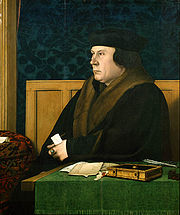
    Thomas Cromwell

    Here are the problems, as I see them:

    1. Who the heck is speaking? Dialogue is difficult to write and separates great writers from mediocre ones. Mantel tells the story through the eyes of Thomas Cromwell, an influential lawyer and wheeler-dealer behind the scenes. She therefore makes him a default he in the story. The problem is that there are lots of other hes (ie, men), and when several men are talking, we don’t know which he is thinking, talking, doing whatever he is doing. This sounds banal, but it is annoying. It does not help that everybody is named Thomas (that’s not Mantel’s fault, of course).
    2. Who are all the people and why should I care? Mantel assumes that I already know all the characters, the chief ones being Cardinal Thomas Wolsey, Thomas More, Thomas Cranmer, Jane Seymour, the Dukes of Norfolk and Suffolk and so forth. As it happens, I love history and have indeed heard of most of them before, but my knowledge of this era has got rusty. I wanted it to be Mantel’s job to re-introduce me to these people so that I don’t have to make an effort.
    3. What is the historical context, ie the import? Mantel assumes that we already know the interrelationships and geopolitical constellations between the Holy Roman Empire; the papacy; the French, Spanish and English kingdoms; and so forth. As it happens I do, sort of, know about these matters–at least more so than Mantel can expect from most readers–and it still does not suffice.

    Thomas Wolsey

    So I took time out and resorted to … Wikipedia. Yes, I did. I spent a good hour last night reading all the main characters’ entries, as well as brushing up on why, say, the Archbishop of York had less power than the Archbishop of Canterbury or who the heck a “Lord Chancellor” was again, and other matters that Mantel does not deign to make clear.

    Hilary: Is that what you want your readers to do–go to… Wikipedia????

    As it happens, it worked and Wikipedia did give me the context I need. But what an indictment of Mantel’s storytelling technique. The whole premise of books like this is that you get the history and the humanity, the importance and the drama, at the same time.

    Hilary, you seem to be too busy being ‘literary’–with complex points of view, revisionist interpretations and what not–to hold me by the hand. You were supposed to make it easy for me. You did not.

    Bookmark and Share