Podcast about my book

Abhishek and I are talking for half an hour in this podcast about my book. The Indicast, if you don’t know it, is an up-and-coming podcast show in India.

We’re really having fun and getting side-tracked a bit, so it’s not until 16 minutes in that I actually summarize the book’s plot. The sound quality is a bit grainy, because I’m talking from California, and Abhishek from Mumbai.

Click play:


Bookmark and Share

Hannibal’s brother and … Mayonnaise!

Every now and then I convince myself that that I know quite a bit about ancient history, and then I stumble across something not just new but whiplashingly new. Did you know that the word mayonnaise is named after Hannibal’s youngest brother?

According to Livius, it came about as follows: Hannibal’s brother was named Mago (a common Carthaginian/Punic name), and he

… lives on in a most surprising way. On Menorca, he had founded the city that is still called Port Mahon. The typical local egg sauce that has conquered the world is known as mayonnaise.

And while we’re on the subject of Hannibal’s brothers:

Hasdrubal Barca's head, before the Romans got it

Hasdrubal's head (before Roman cosmetic intervention)

Hasdrubal, who was younger than Hannibal but older than Mago, died valiantly in battle against the Romans as he tried to bring a second invasion army to Italy to support Hannibal.

The Romans cut off his head. Then they marched it to the other end of Italy and catapulted it into Hannibal’s camp. Hannibal, who still did not even know that Hasdrubal had arrived in Italy, last saw his brother’s face …. as it rolled toward him.

So it goes, as Vonnegut would say. But those Romans sure had a way of doing things.


Bookmark and Share

Zidane rode for Hannibal

Well, this is really cool. I learned something that has long puzzled me, and I did it through blogging.

You recall that I recommended a blog post by Mathilda, in which she explains the ethnic categories of “Africans” in antiquity. (In a nutshell: “Libyan” = white; “Ethiopian” = black). All of which fascinates me because I want to form the most accurate picture possible of what Hannibal, a Carthaginian, and his Numidian and Iberian allies may have looked like.

And now somebody named Ureus left this comment (thank you, Ureus!) in which he/she explains that:

I am also a descendant of the Numidians, but nowadays we are called Kabyle Berbers.
Contrary to the Afrocentrist view; we are a white Mediterranean race. For the Afro-centrists out there: even the word Africa is of Berber origin; it comes from the word Ifriqiya, which designated the tribal territory of the Berber tribes of Northern Tunisia.

Fine, so how should we picture these Numidians, who were the fiercest horsemen of antiquity (they rode without stirrups or saddles and wrought havoc on the Romans in Hannibal’s battles)? Well, here is one Kabyle Berber you may have seen before:

Zidane, a Kabyle Berber

Zidane, a Kabyle Berber

The Beeb (BBC, for the Americans) has a Q&A on Berbers here.

Now, if somebody could please help me with the “Iberians”, please?
Bookmark and Share

Pyrrhic victories

Heard about my victory?

Heard about my victory?

You’ve heard of Pyrrhic Victories, which are defeats disguised as triumphs–in other words, Kipling-esque impostors of the sort that I will be describing in my book. But do you know why they are called that?

It’s thanks to Pyrrhus, who is well worth five minutes of your time.

Pyrrhus was the ancient world’s equivalent of a dumb jock whom all the girls loved, who bashed the equivalent of Budweiser cans on his forehead and beat up the enemy football team but never quite figured it all out.

Put differently, he was the King of Epirus in northern Greece, and wanted to be like Alexander the Great, who died a couple of generations before him. (Pyrrhus in turn died a generation before Hannibal was born.) He wanted to be a hero and to conquer. Basically, that’s all there was to it. And he was great at it–brave, courageous, strong. Plutarch says that once, when he was thought dead on the battlefield, he just got up and cleft an enemy soldier in two pieces with one blow of his sword.

One day, an opportunity came up: Tarentum, a Greek city in southern Italy that was fighting the Romans, invited Pyrrhus to come over and fight Rome on their behalf. Pyrrhus was thrilled. As he was preparing to leave for Italy with his army and his war elephants (sounds a lot like Hannibal, doesn’t it?), he had a conversation with the wise Cineas. This is one of my favorite exchanges in antiquity. Here is Plutarch’s version:

Cineas: If we beat the Romans, what should we do next?

Pyrrhus: Why, then we’ll be masters of all Italy.

Cineas: “And having subdued Italy, what shall we do next?”

Pyrrhus: “Sicily.”

Cineas: “But will the possession of Sicily put an end to the war?”

Pyrrhus: “We will use that as the forerunners of greater things” such as Libya and Carthage. Would anybody resist us after that?

Cineas: “None,” for then we can take Macedon and even all of Greece. “And when all these are in our power what shall we do then?”

Pyrrhus: “We will live at our ease, my dear friend, and drink all day, and divert ourselves with pleasant conversation.”

Cineas: “And what hinders us now, sir,” from doing exactly that?

At this Pyrrhus was nonplussed. But left for Italy anyway!

Next, he had his Pyrrhic victories. He beat the Romans, but each time he lost so many men and gained so little that once, when congratulated on yet another victory, he sighed: “Another such victory over the Romans and we are undone.”

Eventually, as he was wont, he got distracted. There was another opportunity for glory in Sicily, so he sailed around a bit there and bashed a few heads. You can see on that map what that trip (dare I say his life?) looked like.

Courtesy PIOM, via Wikimedia Commons

Courtesy PIOM, via Wikimedia Commons

In any event, Sicily also failed to make him happy, so eventually he made his way back to Greece.

Once home, he kept fighting wars here and there. I mean, it’s a hard habit to kick! His end came as it had to come (irony alert): He was in the middle of some vicious street fighting in a Greek city, when an old woman on a rooftop dropped a tile, which landed on his heroic pate and knocked him dead. So it goes, as Vonnegut would say.

Have you ever been a Pyrrhus in your life? Do you know any Pyrrhuses?
Bookmark and Share

When success ends in suicide

Thanks to Stephanie for suggesting that I look into David Foster Wallace, a literary wunderkind who just hanged himself.

There might be the obvious angle of a very successful person … killing himself.

Then there is the genre of suicide in general–Hannibal poisoned himself, besides lots and lots of other interesting people.

Stephanie, were you thinking of a specific angle that might fit my book that I haven’t noticed yet? I will look into his life story a bit more….

Bookmark and Share

A lot about fathers

So I’m staring at the two books that have just dropped from the pile (a tall one) onto the floor, and they are titled: Faith of My Fathers (left) and Dreams from My Father (right).

“This boy is really doing his civic homework during an important election,” you may be saying. Actually, no. I’m doing research for (no surprises) my book.

You see, these two–Obama and McCain–made me think of my main characters, Hannibal and Scipio. No, it’s not because Obama is half African (I’ve explained here why I don’t think that Hannibal was “African” in that sense). No, it’s not because McCain has “something Roman about him”, as a friend of mine said, referring to McCain’s martial honor code. And it’s only a little bit because both pairs were formidable rivals and opponents.

It’s because Hannibal and Scipio, if they had written books, might well have given them the exact same titles.

Hannibal lived his life as he did, one could argue, because he inherited a “dream from his father,” Hamilcar. Hamilcar had fought the Romans in the First Punic War, and felt humiliated when Rome won, and wanted revenge. He even made Hannibal, when the boy was nine, swear an oath to keep the “faith of his father”. (100falcons has a nice write-up of it here.)

Scipio could have said the same. He had the same name as his father, Publius Cornelius Scipio, and fought in his father’s army against Hannibal, when Hannibal seemed invincible. His father and uncle later died in battle against Hannibal’s brothers, Hasdrubal and Mago. Scipio, too, was keeping the “faith of his fathers” when he rose at a precocious age to become Rome’s leader and last hope.

So, fathers clearly matter. Or perhaps only for sons? For Amy Tan, it seems to have been her mother who was the important early influencer.

Lots to ponder. Lots to ponder. The role of background in life choices, goal-setting, Success, failure….


Bookmark and Share

The trouble with titles, continued

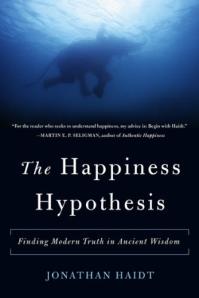
I’m just finishing Jonathan Haidt’s The Happiness Hypothesis, which Baltimore Bookworm already does a great job of summarizing.

Naturally, I’m especially interested in what Haidt has to say, for instance, about the uses of adversity in life (he gives an entire chapter to it), since that fits one of the impostors in my book.

But, since I can’t help but think about book titles these days, which you may have noticed here and here, I found myself lamenting the title that Haidt’s publishers forced on him. The book is not just about happiness, and hypothesis, no doubt meant to sound mysterious, is too academic to hit me in the gut. Instead, it occurred to me, there is a much more obvious title that Haidt’s publisher, Basic Books, could have chosen.

Haidt gives us, above all, a great extended metaphor for our psyche as consisting of a huge elephant  and a little rider on top. Hence the cover image you see here. The elephant is that part of our brain/mind that we’re hardly aware of but that is actually in charge most of the time. The little rider is our intellectual brain/mind, which evolved much later and which does its best to drive the elephant but most often just ends up having to go where the beast goes. In all those cases, the rider’s main skill is to confabulate (Haidt’s word) a story to explain to himself why he, the rider, really wanted to go where the elephant went. You see, he couldn’t possibly admit to himself that he, as mahout, is not in control. In other words, we are great at fooling ourselves. We do things for reasons we barely understand, and then retroactively concoct a logic that makes the action sound plausible, to ourselves and society.

So, if the metaphor was good enough for the cover image, why not for the title? In my opinion, the book should have been called:

The elephant and his rider: What really drives you, and why you lie to yourself about it.

(And, because this is the Hannibal Blog, one more reason why I like the cover image: This is how you must imagine Hannibal’s mahouts riding their elephants across the mighty Rhone river, while under attack from Gauls on the far side. Most of the mahouts drowned. But the elephants, natural  snorkelers that they are, made it across. Having crossed the stream thus, Hannibal was able to take them onwards to the Alps, and then…. well, you know. More about his elephants here.)
Bookmark and Share

Hannibal’s life in eight minutes

Well-made YouTube video (meaning: hewing closely to Polybius and Livy) about Hannibal’s life, by Wolfshead:

Interesting moment of interpretation: why Hannibal, in this version, chose not to take Rome itself, which was the single biggest decision of his life. “We are not animals,” he says here.

(Also: did I detect stirrups on the cavalry? Maybe not. There weren’t any in those days.)


Bookmark and Share

Carthaginians and “Libyans”

Great research by Mathilda about ancient Libyans here. In a nutshell, the ancients apparently considered “whites” living in Africa to be “Libyans”, in contrast to “black” Africans, who were called “Ethiopians.”

This fits my previous description of Hannibal and the Carthaginians, according to which Denzel would not be the most historically correct choice of actor.

Hannibal’s mercenary army, incidentally, contained lots of “Libyans”, alongside lots of “Numidians”, who were the most feared horsemen of their day, and “Iberians”, “Celto-Iberians” and Gauls. Then there were assorted other types, such as the renowned slingers from the Balearic islands (Mallorca, Menorca and Ibiza), who apparently trained by shooting birds out of the sky with their slingshots. I’m trying to find out more about all these ancient tribal and ethnic categories. More to come.


Bookmark and Share

Which Bhagavad Gita?

“With no desire for success, no anxiety about failure, indifferent to results, he burns up his actions in the fire of wisdom. Surrendering all thoughts of outcome, unperturbed, self-reliant, he does nothing at all, even when fully engaged in actions.

There is nothing that he expects, nothing that he fears. Serene, free from possessions, untainted, acting with the body alone, content with whatever happens, unattached to pleasure or pain, success or failure, he acts and is never bound by his action.” (BG, 4.19-26)

Boom. Could anybody say it better? Who do you think did say it? Rudyard Kipling, whose two impostors are the seed of my entire book?

Actually, it was Krishna, in conversation with Arjuna, on the eve of an 18-day battle that would kill about four million (!) and which only eleven men would survive. Here are Arjuna and Krishna, his charioteer, in between the opposing armies just before the battle, as Krishna reveals to Arjuna the two crucial secrets to our lives: how to know and do your duty, and how to live.

I’m talking, of course, about one of the greatest poems (books, texts) ever written, the Bhagavad Gita, or “song of God”. It is a relatively short song inserted into a huge (!) epic story, the Mahabharata, which is several times the length of the Bible, or of the Iliad and Odyssey combined.

I’ve been re-reading the Gita in several translations while researching one chapter in my book. Why? Because Hannibal faced the same dilemma that Arjuna faced, when he broke down sobbing before the great battle, a battle that he suddenly did not want to fight at all, but which, as Krishna made him realize, he could not not fight. So Arjuna faced the same conundrum that Hannibal and Scipio faced: how to get into the right frame of mind to live life.

Oh, wait a minute. Did I say that Hannibal was in the same situation as Arjuna? I meant, that we all are in the same situation as both Arjuna and Hannibal. That is the point of the Gita, and also (more humbly) of my book.

Now, for those of you who love the Gita, I thought I’d do a quick review of the three translations and commentaries I’ve recently re-read. That way, maybe, I can help you choose the one that’s right for you.

The Gita is a poem in the original Sanskrit, and the translation that best preserves the beautiful, easy, fluid feel of a poem is the Bhagavad Gita by Stephen Mitchell (Three Rivers Press). The opening quote above comes from his translation.

A slightly less beautiful but perhaps more helpful and accessible translation is The Bhagavad Gita: A Walkthrough for Westerners by Jack Hawley (New World Library). The title sounds as if it were a sort of “For Dummies” version, but it’s not. It’s intelligent, and editorializes a bit whenever the words in the poem mean something very different from the same words in our ordinary language.

Then, of course, there is the intimidating two-volume brick God Talks with Arjuna: The Bhagavad Gita by Paramahansa Yogananda (Self-Realization Fellowship). That is the kosher version among yogis, because it’s academically and intellectually thorough. I’ve tried several times to get through it and failed. If it’s beauty, ease and enjoyment you’re looking for, don’t pick this one. But….

do pick this one if you have even the slightest interest in a deeper understanding of the Gita. For example, the thing to get about the poem is that there are two battles going on: the external one involving four million warriors and elephants and chariots; and the internal one that we all wage every day. Paramahansa Yogananda is great at the genealogy of all the people in the war, so that you realize, for example, that Arjuna and his four brothers are the intelligent and higher parts of our mind, who are fighting 100 cousins, who are the powerful but lower parts of our mind, such as anger, desire, greed, and so forth.

Enjoy.


Bookmark and Share