What Mendel tells us about thinking

Find quietude. Observe whatever is around you. If it seems banal, discover it to be fascinating and mysterious. Ignore distractions, otherwise known as ‘everybody else’. Ask simple questions that puzzle you. Be patient in pondering them.

That is how I imagine Gregor Mendel might answer us today if we asked him: How  — I mean how! — did you achieve your stunning intellectual breakthroughs, on which we today base our understanding of biology?

Put differently: Let’s pretend that Gregor Mendel were alive today instead of in the 19th century, and that he were not an Augustinian monk in the former Austrian Empire but a wired and connected, über-productive modern man with an iPhone, a Twitter account, cable television, a job with bosses who email him on the weekend, etc etc.

Would this modern Mendel be able to achieve his own breakthrough in those circumstances?

So far in my rather long-running thread about the greatest thinkers in history, I’ve featured mostly philosophers and historians, with the odd scientist and even one yogi. But it occurred to me that Mendel belongs into that pantheon — not only for his thought but also for his thinking. I think he offers us a timely life-style lesson, an insight that fits the Zeitgeist of our hectic age.

So: First, a brief recap of his breakthrough. Then my interpretation how his life style and thought process made that breakthrough possible (and why ours might make such breakthroughs harder).

1) Mendelian genetics

Mendel was an Augustinian monk in what used to the Austrian Empire (and what is now the Czech Republic). He had an open and inquisitive mind and, as a monk, wasn’t all that busy, so he had plenty of spare time. He liked to breed bees. Then he began breeding peas. That’s right. Peas.

Peas intrigued him. (Would they intrigue you? What else does not intrigue you?) He found peas interesting because they had flowers that were either white or purple and never anything else. (Would you find that interesting?)

Mendel contemplated what peas could therefore teach him about how parents pass on traits to their offspring, ie what we would call genetics.

At the time, conventional wisdom held that the traits of parents are somehow mixed in their children. If parents were paint buckets, say, then a yellow dad and a blue mom would make a green baby bucket, and so on. (It’s interesting that nobody spotted how implausible this was: After several generations every bucket, ie every living thing, would have to end up mud-brown. Every creature would look the same. Instead, nature is constantly getting more colorfol, more diverse, with more and stranger new species.)

So Mendel, in the late 1850s and early 1860s, started playing with his peas. Pea plants fertilize themselves, so Mendel cut off the stamens of some so that they could no longer do that. Then he used a little brush and fertilized the castrated pea plant with pollen from some other pea plant. He thereby had total control over who was dad and who was mom.

He was now able to cross-breed the peas with purple flowers and the peas with white flowers. So he did. Then he waited.

Surprise #1:

Already in the next generation, Mendel could rule out the prevailing “paint-bucket-mixing” theory. No baby pea plants had lighter purple (or striped or dotted) flowers. Instead they all had purple flowers.

So he took those new purple-flowered pea plants and cross-bred them again. And again, he waited.

Surprise #2:

In the next generation, most pea plants again had purple flowers. But some now had white flowers. Wow! How did that happen?

Moreover, the ratio in this generation between purple and white flowers was exactly 3:1. Hmm.

Mendel kept doing these experiments, and kept thinking, and then inferred the simple but shocking conclusion:

  1. Each parent had to be contributing its version of a given trait (white vs purple, say) to the offspring.
  2. Each baby thus had to have both versions of every trait, but showed in its own appearance only one version, which had to be dominant.
  3. The other (“recessive“) version, however, did not go away, and when these pea plants had sex again, they shuffled the two versions and randomly passed one on to their offspring (with the other coming from the other parent), so that their baby again had two versions.

This looks as follows:

In the second generation, every pea plant has a purple (red, in this picture) and a white version, one from each parent, but since the purple is dominant, every flower looks purple.

In the next generation,

  • one fourth will have a purple from dad and a purple from mom (and look purple),
  • one fourth will have a purple from dad and a white from mom (and still look purple),
  • one fourth will have a white from dad and a purple from mom (and still look purple), and
  • one fourth will have a white from dad and a white from mom (and look white).

The rest, you might say, is history. With all our amazing breakthroughs in biology in the 20th century, we merely elaborated on his insights, in the process explaining the mechanism of evolution (Darwin, coming up with that idea at the same exact time, had no knowledge of Mendel’s breakthrough.)

In today’s language, Mendel

  • showed the difference between genotype and phenotype. (Your genotype might be white/purple, for example, but your phenotype would be purple.)
  • understood the basic idea of meiosis (the division of a cell into two haploid gametes — a sperm cell or egg with half of the mother cell’s chromosomes, randomly chosen),
  • described how two gametes then merge sexually to form a diploid zygote (ie, a cell with all chromosome paired up again, one member of each pair coming from each parent),
  • explained how some versions of the gene pairs, called alleles (such as purple or white), are expressed and some not, even as those not expressed can re-emerge in the phenotype in the next generation.

DNA, RNA, ribosomes and all that were merely detail.

2) How was it possible?

Let’s make ourselves aware, first, of what it must have been like for Mendel during these years (this is purely conjecture):

  • He got up.
  • He prayed.
  • Had breakfast.
  • Went into the garden.
  • Looked at the pea flowers for a long time.
  • Watered them.
  • Took a break.
  • Watched the peas some more.
  • Thought about them.
  • Dozed off for a nap.
  • Woke up and had an idea, still inchoate in his mind.
  • Went to bed.
  • Thought about it some more….

You get the idea. Not exactly stressful. Few interruptions. Lots of waiting (how long is one generation of peas anyway?).

He was, we would say, switched off. He was not multi-tasking, he did not have adrenaline coursing through his veins as he answered a text message while watching a video stream while writing a Powerpoint …

Compare his time with his pea plants to Einstein‘s time at the Bern patent office, where he was utterly underemployed and could easily have been bored, but instead did thought experiments and had his “miracle year”.

Or compare it to Isaac Newton‘s time after had to leave the action of Cambridge (because plague broke out) and returned to the isolation of his family farm with nothing to do except watch apples drop from trees….

Or compare it to the time when Gautama Siddhartha (aka the Buddha) withdrew from all action and sat, just sat, under a tree, with the birds pooping on his head until there was a pile of guano on his hair, with his flesh melting from his bones because he was too deep in concentration to eat…..

Lesson #1:

Good stuff can happen during downtime (even if you didn’t volunteer for it).

Corollary: Can good stuff happen during uptime? You may have to take time out to be creative.

Lesson #2:

Be amazed.

Corollary: Don’t assume the things and people in your daily life are boring.

Lesson #3:

Turn the devices off.

Corollary: Distraction not only kills people, it also kills thought.

Lesson #4:

Be patient.

Corollary: You can’t breed peas in internet time. Nor novels, scripts, songs, paintings…

Lesson #5:

Look for the simple.

Corollary: The more bewildering the complexity observed, the simpler the solution.

(See also: Gordian knot.)

Lesson #6:

It doesn’t have to be complete to be original.

Corollary: It took us a century to explain the process Mendel grasped; an idea is good even if it “merely” starts something.

(See also: Incompleteness theorem. Mr Crotchety’s favorite — need I say more?)

Lesson #7:

Don’t expect the world to get it right away.

Corollary: If it took us a century to understand Mendel’s breakthrough, we might take a while even for yours. 😉

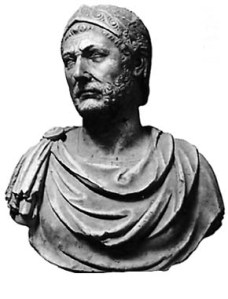
John and Hannibal, respective favorites

There on the left you see John. He baptized people.

And on the right you see Hannibal. He vanquished Romans.

John is not in my book, whereas Hannibal is its main character, but that’s neither here nor there.

I just figured out a rather exciting linguistic connection between their names. (“Exciting”, that is, if you’re a language geek.)

Background:

John comes, via Indo-European Greek and Latin, from either the (Semitic) Hebrew Yochanan or the (equally Semitic) Aramaic Youhanna. That origin is clearer in some other European languages, such as German Johann/Johannes.

And Hannibal is our transliteration of HNB’L, a Punic word. Punic was a Roman mispronunciation of Phoenician. It was the language of Carthage and of Phoenicia, and thus also Semitic.

I’ve already posted about the close family connections between Punic, Hebrew, Arabic, Aramaic and other Semitic languages, by using Hannibal’s family name, Barca, as the example. The relationship is as close as that between, say, Dutch, German and Danish, or between Spanish, Italian and Rumanian.

Favor and the gods

Now to the meaning of the two names:

According to Luke 1, 13, the angel Gabriel visited Zechariah and told him that his old and infertile wife would bear him a son and that “you shall name him John” (ie, Youhanna).

The footnote in my bible says:

The name means “Yahweh has shown favor,” an indication of John’s role in salvation history.

So:

Ba'al

YOU ≡ Yahweh

and

HANNA ≡ Favor

As in: Yahweh’s favor.

In Hannibal’s case,

HANN(I) ≡ Favor

and

BAL ≡ Baal

That’s Baal (or Ba’al) as in the god that Yahweh is so jealous of in the Old Testament, because he’s one of those Semitic deities so popular in Canaan, where both Phoenicians and Jews lived.

So John was favored by one, Hannibal by the other. Name is destiny. 😉

Gabrielle Giffords, American Gracchus

Gaius Gracchus

The Roman republic was 375 years old — more than 1½ times as old as the American republic is today — when, in 133 BCE, something unprecedented and indeed hitherto unimaginable occurred: domestic political violence.

A populist politician had got himself elected tribune by the citizens of Rome, in exactly the sort of democratic process that Rome was proud of. His name was Tiberius Gracchus, and he was ambitious, idealistic and perhaps somewhat naive. (He was also the grandson of my hero, Scipio Africanus, the nemesis of Hannibal.) This elder Gracchus — he had a younger brother named Gaius — then proposed reforms to improve the lot of the people. Many patricians in the Roman Senate did not like that.

It had never, up to this point, mattered that Senators and Tribunes, plebeians and patricians, Optimates and Populares (those were the names of Rome’s political factions) disagreed on matters of policy.

Of course they disagreed! Peaceful disagreement, in which the more persuasive arguments prevailed over time, was what the Roman republic was about. It was the reason Romans loved Rome.

Rome had withstood existential threats — a sack by the Gauls, near-extinction by Hannibal — without ever sacrificing its founding ideals: inside the city walls, there was no place for violence in politics.

But on that day in 133 BCE, a group of senators and their supporters made their way toward a popular assembly in progress. They beat Tiberius Gracchus and his supporters to death.

Yes, Rome was shocked. Of course it was. This incident had to be an outlier. The exception that proved the rule.

But it seems that a taboo had been broken, a precedent set. Something unthinkable had become thinkable: Political violence.

A decade after Tiberius’s murder, Gaius Gracchus (pictured above) followed in his brother’s footsteps. He, too, got himself elected tribune. He, too, intended to launch reforms.

And again, a mob of senators and their supporters came for him. Gaius fled to a grove and killed himself, as the attackers murdered his supporters.

Another outlier, they told themselves. An exception. Never to be repeated.

And yet, it was repeated. Over the next century the Romans — a people always well-armed, often for the right reasons — began flashing blades to intimidate other Romans in any disagreement. The tone of debate changed. The incidents of political violence became more frequent, and worse.

A taboo once toppled is difficult to re-erect.

Marius, Sulla, Pompey, the Caesars….

Violence, or the threat of it, now prevailed in Rome.

Rome would remain a superpower for much longer. But no longer a republic. Not the Rome that the likes of Scipio Africanus had ever fought for. Not the Rome they considered worth preserving and defending.

Freedom to, freedom from

Pericles' Funeral Oration

Two years ago, near the beginning of my amateurish exploration of the concept of freedom here on The Hannibal Blog, I dabbled a bit in the nuance between

  • negative and
  • positive

liberty.

As it happens, there is a much, much better treatment of that distinction in this lecture by Hunter Rawlings, a classicist at Cornell (as well as that university’s former president).

We today subscribe largely to the negative concept of freedom. We want to be free from things (intrusion, government, …)

Most of the ancients — such as Pericles, the Athenian statesman who probably summed up classical democracy best in his famous Funeral Oration, pictured above — took nearly the opposite point of view. They wanted to be free to do things (speak in the assembly, sit on juries, fight in the army, co-determine the fate of their polis…)

(One exception in antiquity might be Diogenes, which is perhaps what makes him so interesting to us, or at least to me.)

As Rawlings puts it, neither society, Greek or American, would regard the other as “free”.

The Greco-Romans had a communitarian (and largely tribal) definition of freedom and were concerned about virtue (but hardly at all about property).

Enlightenment thinkers, starting with John Locke, defined freedom in much more individualistic terms and were more concerned about property than virtue.

The mixture of the two strands was at first (in the minds of geniuses such as Madison or Hamilton) tonic. But something has arguably gone wrong in the centuries since then, leading us gradually to stunningly childish and unsophisticated notions about freedom today.

A short excerpt of the lecture is below, but I hope you take time for the full hour, because it is fascinating and touches on all the topics dear to The Hannibal Blog: Greece and Rome, the Founding Fathers, democracy, et cetera.

Incidentally, I discovered the speech through this Greek blog post, which discusses some of my own posts and which Google has only translated for me very imperfectly. Thank you very much!

I’ll leave you with one snippet from Rawlings’ lecture, which is that the ancient Greeks, being so busy with their freedom to participate in the public business, had … no word for boredom! 🙂

Now the excerpt:

The case for Alexander Hamilton (II)

Alexander Hamilton came from a different background than the other Founding Fathers, one that gave him a different worldview and philosophy of governance and freedom.

It is a philosophy that was bitterly contested at the time — and still is today, especially in this “Tea-Party” year. But overall, Hamilton’s vision is the one that prevailed. We today are, to a surprising extent, living in Hamilton’s America. So what was that vision?

  1. In the previous post, I looked at Hamilton as a man, at his character, life and background.
  2. In this post, I try to describe the ideas that such a character, life and background produced, and their timeless (but, as you’ll see, tragic) legacy.

Balance in government

Recall from the previous post that Hamilton, illegitimate and foreign-born, felt like an outsider in America, felt vulnerable as result, and had reason to be pessimistic about human nature, for he had seen, in the West Indies and in revolutionary America, atrocious human acts.

In particular, he had seen how dangerous mobs could be.

Recall also that he was a superb intellect, deeply versed in the classics.

It was therefore natural that he should appreciate an ancient concept, dating all the way back to Polybius and Aristotle: that balance is necessary to preserve liberty.

The government that best reflects human nature, in this view, blends the elements of

  • monarchy,
  • aristocracy (which literally means rule of the best) and
  • democracy.

But they have to stay in balance, because an excess or corruption of any one of these elements will destroy liberty, by becoming, respectively,

  • tyranny,
  • oligarchy or
  • mob rule.

Thus, for example, Aristotle and Polybius considered Carthage and Rome balanced, but Athens during the time of Socrates to be too democratic to be stable. In Hamilton’s own day, the French Revolution might illustrate the point even better: tyranny and oligarchy (the ancien régime) gave way to mob rule (the guillotine), which gave way to another tyranny (Napoleon), without any intervening liberty in more than motto.

In particular, Hamilton and several other important Founding Fathers, especially James Madison, shared with the classical philosophers an admiration of Rome. When they wrote public treatises, such as The Federalist Papers (discussed below), they adopted Roman pen names. Hamilton, for instance, was Publius (after Publius Valerius, the first consul of Republican Rome).

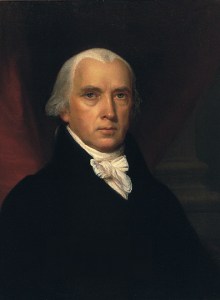
Madison

Early in their careers, Hamilton and Madison were intellectual allies in this respect. They wanted a republic, not a democracy. They feared tyrannical minorities and majorities equally. Thus they became the most important individuals in the creation and passing of America’s Constitution.

Madison had more intellectual input into the actual document, and was the note-taker during the Constitutional Convention. But Hamilton and Madison then collaborated in campaigning for that Constitution to be ratified by the states. (The document, much as we esteem it today, was very controversial and ratification was a close call.)

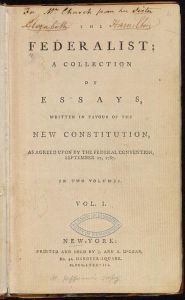
The Federalist Papers

This meant above all explaining and interpreting the proposed Constitution, which Hamilton and Madison, along with John Jay, later the first Chief Justice, did with one of the most impressive literary achievements in history: The Federalist Papers.

The Federalist Papers are a collection of 85 essays, of which 51 are attributed to Hamilton, 29 to Madison and 5 to Jay (so Hamilton was clearly the main author). The essays amount to about 175,000 words. And they wrote them in the space of only seven months, in their spare time (!), for they were still pursuing their main vocations during office hours — Hamilton as a lawyer.

Here is a measure of how important The Federalist Papers continue to be: By the year 2000, they had been quoted 291 times in Supreme Court opinions, with the frequency of citations rising with the years. (p. 261 in Ron Chernow’s biography of Hamilton)

And in these Federalist Papers, we see Hamiltonian values — meaning the ancient values of balance — on display. Hamilton envisioned:

  • a strong executive, (≈ monarchy)
  • a strong legislature (≈ democracy), and
  • an independent judiciary that could and should, if necessary, overrule the “popular will” if it destroyed liberty. (≈ aristocracy)

Judicial Review (and Prop 8 )

That this last bit is the “aristocratic element” might take a bit of explaining. To be sure, it is not the only aristocratic element in America’s overall structure. The electoral college originally had actual powers to select the president. Members of the upper chamber of the legislature — called the Senate, in direct allusion to Rome — were elected by state legislatures rather than the voters (an idea that many in the Tea Party want to bring back). And so on.

But the judiciary seems to me to be the most important aristocratic check on both potential tyranny and mob rule. In Federalist Nr 78, Hamilton wrote that

no legislative act … contrary to the constitution can be valid.

This sounds simple and obvious now, but it is not actually in the Constitution. In effect, Hamilton said that the Supreme Court (ie, a meritocratic elite) must be able to overturn legislation (ie, the popular will). Hamilton thus prepared the way for a later Supreme Court decision (Marbury v Madison, 1803) that established the concept of judicial review.

And that, of course, is what we have today. If you want to see the inherent and eternal tension that Hamilton foresaw, look, for instance, to the controversy about California’s “Prop 8“:

  • it is a ballot measure (ie, an expression of the popular will),
  • in which a majority voted to restrict a right (marriage) of a minority (gays and lesbians),
  • before a federal court overturned that vote.

Each side in the Prop 8 debate is screaming “tyranny” at the other, but Hamilton’s notion of balance will prevail. Hamilton, in the 18th century, would certainly have been surprised by the context (gay marriage) but not by the principle involved.

Center and periphery: “enumerated” and “implied” powers

That example of Prop 8, in which a federal judge has overturned a state ballot measure, also shows another aspect of Hamilton’s vision: there also had to be a balance between the core and the periphery, between central government and state government.

Recall the previous post again: Hamilton was actively fighting — as George Washington’s chief of staff, mostly — in the Revolutionary War, whereas some of the other Founding Fathers, and specifically Hamilton’s future enemies (I will get to them in a minute), remained in the comfort of their plantations or with the Continental Congress in Philadelphia, with its bustling dinner-party circuit.

What vantage point did that give Hamilton on the fledgling nation?

He saw that the nation was not viable as such. If the United States then has an equivalent today, it would be the United Nations.

America was fighting a professional army and navy (the Brits) with a ragtag force of militiamen who had no uniforms, and often no shoes and weapons. These Americans enlisted for a year at a time, which meant that Washington feared that his entire fighting force might literally disintegrate and vanish at the end of each enlistment period.

The nation, such as it was, had no powers of taxation. At all. So it had no money to pay its soldiers. And it could not issue debt. It relied on the individual states both for money and for soldiers. On occasion, the American troops mutinied, once even marching on Philadelphia and sending Congress to flee from its own soldiers.

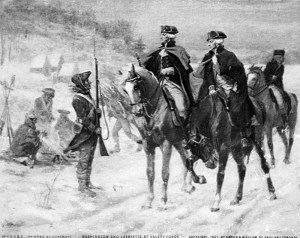
This was not an abstract matter for Hamilton or Washington: They were starving and freezing with their soldiers at, for instance, Valley Forge, a miserable plateau in Pennsylvania where the Americans wintered in 1778-9.

The painting above (of Washington and Lafayette on horseback, with perhaps Hamilton as the rider behind them?) does not really do the misery justice. According to Chernow’s new biography of Washington, the Americans (unlike the soldier in the picture) had no shoes, no coats, sometimes no shirts, and were dying of cold, disease and starvation.

So Hamilton and Washington formed a vision of a strong center, one that could feed and clothe its soldiers and hold the states together. For the center to be strong, it would have to have a professional army, and powers of taxation and borrowing (“Aha,” say the Tea Partiers of 2010…).

When opponents later charged that the Constitution did not explicitly mention the things necessary to build such a strong central government (for example a Central Bank), Hamilton replied that

it is not denied that there are implied as well as express powers.

And thus Hamilton, almost en passant, submitted another evergreen argument into American politics, which you hear debated this year by Tea Partiers parsing “enumerated” and “implied” powers.

But Hamilton was not for a Leviathan (I believe he would be shocked by the bloat of our federal government today). He definitely envisioned the central government, though strong, as sitting atop states that remained otherwise sovereign in their daily affairs. Hence the “federalist” nature of the new country, and the name Hamiltonians called themselves: Federalists.

The federal balance that Hamilton conceived was so stable that Switzerland, in 1848, imported it wholesale and Germany, a century later, in large part.

The first American Capitalist

Alexander Hamilton was the only Founding Father who grasped not just one but both revolutions occurring in his time:

  1. the political revolution in governance and
  2. the industrial revolution.

For background: America was an agrarian society. The colonies were dependent on Britain for manufactures. There were no companies as such (both the legal form and the accounting systems did not exist in any form recognizable to us). Banks as such did not exist. Stock exchanges did not exist.

Hamilton’s enemies, primarily Thomas Jefferson, wanted to keep it that way. To Jefferson, an agrarian America was more “pure” than an industrial America. Here, arguably, likes the origin of America’s schizophrenia regarding “Main Street” versus “Wall Street”. But let’s remember (recall once again the previous post) that the agrarian “purity” of which Jefferson talked was based on slave plantations such as his own in Virginia. It was pre-capitalist, yes, but in a feudal, illiberal, dehumanizing way.

Hamilton, on the other hand, wanted to abolish slavery and looked ahead to a capitalist era. He read Adam Smith’s (then new) Wealth of Nations. He grasped modern concepts of finance. He wanted America to manufacture things, and to finance this new economy with banks and securities.

So he entered the most fruitful period of his career, as the first Treasury Secretary. Washington was president, and the only two other members of the cabinet were Thomas Jefferson as Secretary of State and Henry Knox as Secretary of War. But neither Jefferson nor Knox had much to do, whereas Hamilton became a de facto prime minister to Washington in putting the new country together. Within a few years, Knox had a dozen civilian employees in War, Jefferson had six at State, and Hamilton had … more than 500 at the Treasury. Knox was a jovial nature and didn’t care. But Jefferson was seething.

Hamilton was too busy to care. Within a few years, he created:

  • a central bank,
  • a monetary policy and paper currency to go with it,
  • a stock exchange,
  • a coast guard and customs service to collect the tariffs that were to finance the government (there was no income tax).

In short, he seeded the modern American economy.

The tragic lesson: American inversion of reality

You may agree by now that Hamilton was a genius and that, yes, his vision, more than any other Founding Father’s, created the nation we know. But I personally have learned more from the tragic aspect of his career.

The tragedy has to do with the political inversion of reality that was threatening to undo Hamilton’s career when he died so prematurely in his duel.

And that, too, may be the Founding Fathers’ legacy to us.

What am I talking about?

Opposition to Hamilton and his ideas started early. Some compatriots always found something sinister in his charm and success and genius, in his foreign origins and cosmopolitan attitudes, and in specific opinions such as Hamilton’s abolitionism.

For example, during the struggle in the states to ratify the Constitution, the anti-federalists began posing as populists, even though the most prominent of them were rich slave owners. Patrick Henry of Virginia — the very same Henry who famously said “Give me Liberty or give me Death!” — argued against the Constitution by telling delegates that

They’ll free your niggers.

Others, less blunt than Henry, wrapped their scorn in the emerging meme of the day, which painted Hamilton as a closet monarchist or aristocrat, whereas the (slave-owning) agrarians were the true democrats.

George Washington, who usually kept a dignified distance from the political swamp but reliably sided with Hamilton, wryly observed the irony:

It is a little strange that the men of large property in the South should be more afraid that the Constitution will produce an aristocracy or a monarchy than the genuine, democratical people of the East.

By the “people of the East” he meant the mostly northern farmers, merchants and industrialists in Hamilton’s circles.

Hamilton himself also deployed his irony. In a newspaper piece in 1791, referring to Madison and Jefferson, he wrote (Chernow, p. 307):

As to the negroes, you must be tender upon the subject … Who talk most about liberty and equality …? Is it not those who hold the bill of rights in one hand and a whip for affrighted slaves in the other?

But irony rarely wins in America. Then as now, the most effective political strategy in American politics is relentlessly repetitive attack until reality becomes what the attacker wants it to be. Jefferson was the worst offender, but Madison, Hamilton’s erstwhile soulmate, was just as bad after he split from Hamilton and went over to the “Republican” side.

And let’s reflect on that label the Jeffersonians chose, for a moment. Why call yourself “Republican” if not to imply that your opponents are un-republican? Everything you’ve read in this post so far tells you that Hamilton was a true republican, and yet Jefferson and his cronies now campaigned to make people think the opposite.

And cronies they had plenty. (Both sides did, to be fair). The Fox News of the day was the National Gazette, first published in 1791, a newspaper that served as the mouthpiece for Jeffersonian attacks branding Hamilton as a monarchist, tyrant and what not.

And thus it was that

  • the future presidents Jefferson and Madison, the patrician owners of slaves and plantations, became known and remembered for generations as the folksy democrats who were close to the land and people, whereas
  • Hamilton, the illegitimate quasi-orphan from the Caribbean who had worked his way to success with sheer talent and grit and who wanted to free the slaves, became the elitist aristocrat.

I have, in the paragraphs above, suggested several modern analogs to the issues raised in this post. But I will leave you to ponder this last subject on your own. And I will end, very much as Hamilton might, on that note of pessimism.


The case for Alexander Hamilton (I)

Alexander Hamilton is “my favorite” Founding Father, as I’ve hinted several times before. But I’ve never actually explained what I meant by that.

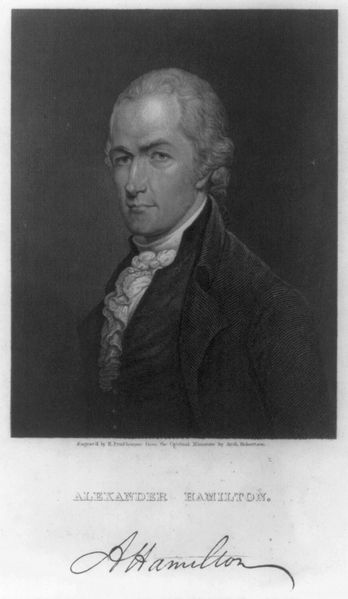
In this and the next post, I will try to unravel which aspects of this complex, visionary and soulful man (just look at that portrait above!) so resonate with me.

  • In this first post, I’ll sketch the man, his temperament, his journey and philosophy about people and life.
  • In the next post, I’ll describe his intellectual contribution to American governance and political philosophy.

You’ll see after the second post that the man can’t be separated from his ideas, nor the ideas from the man. And you’ll see (I hope) how timeless — meaning: relevant today — Hamilton is.

I will give you my interpretation, but my main source is Ron Chernow’s excellent biography of Hamilton. (I am now reading Chernow’s new biography of George Washington as well.)

Now, to Hamilton, the man:

1) He was an outsider who ended up on the inside

Hamilton was the only Founding Father born outside of what became the United States. He was born in a Caribbean hellhole (called Nevis, in the West Indies) that seemed to specialize in tropical diseases, random violence and the slave trade.

And he was born as an ‘outsider’ in another way: he was illegitimate. His mother was not married to his ostensible father, James Hamilton, and even James Hamilton was probably not his biological father (instead, that seems to have been a gentleman by the name of Thomas Stevens).

His childhood was rough. When Hamilton was a teenager, in the space of a few years,

  • his mother died,
  • his father vanished,
  • his aunt and uncle and grandmother also died,
  • his cousin committed suicide, and
  • Alexander and his brother were disinherited and left penniless orphans.

As Chernow puts it:

that this fatherless adolescent could have ended up a founding father of a country he had not yet even seen seems little short of miraculous.

2) He had an open mind

This experience might mark him as, yes, an American archetype: The Immigrant Who Reinvents Himself.

Reinvent himself he certainly would — several times throughout his short life, and in a unique, and uniquely compelling, way.

He began by getting himself to America. Through savvy, wit, charm, chutzpah, and luck, Hamilton found himself on a trading ship to New York, with an allowance from an older mentor and a job that gave him a bottom-up view of international commerce, shipping and smuggling. (Much later, this expertise would serve him well, when he founded the US customs service and Coast Guard.)

Already his mind was expansive, open to new worlds, both of experiences and ideas. Coming from the Caribbean, he was bilingual in English and French (although, unlike Franklin, Jefferson and Adams, he would never set foot in that superpower of the day).

He was, in a word, cosmopolitan. And this would, yet again, mark him as an outsider in America. For America has always had, and continues to have, an ambivalent — nay, schizophrenic — relationship with cosmopolitan types. Yes, Americans sometimes admire and appreciate them and their perspective. But they also distrust cosmopolitans and are ready to exclude them at a whim — by calling them elitist, for example, or insinuating that they are not real Americans.

Hamilton was also unapologetically erudite, immersing himself into the classics, and in particular in Plutarch, one of my favorites. Among the Founding Fathers he was in good company in this respect, for they all valued intellect and learning. But in America at large this erudition would — yet again — make him potentially suspect, for America has always had, and continues to have, the same ambivalence toward intellectuals that it has toward cosmopolitans.

3) He had a romantic sense of honor

His illegitimate and Caribbean background, and his cosmopolitan style, made him vulnerable to attacks on his reputation. Understandably enough, Hamilton was therefore unusually touchy about his good name, and fiercely keen about defending it. He was an Enlightenment man who believe in reason and law, but he simultaneously retained an older, classical, romantic, even Homeric sense of honor.

His thirst to earn and defend his honor — and specifically his American and patriotic honor — made him demand to be in battle, in the line of actual fire. So he fought with extra valor in the war and came to the attention of George Washington. Hamilton was 22 and Washington 43 when the general made the young man his protégé and chief of staff, giving Hamilton not only a perfect view into American history as it unfolded but a role in shaping it.

Washington was tall, imposing, dignified, laconic and kept his emotions bottled up. Hamilton was five foot seven, slim and athletic, elegant, gave his emotions free reign and was so articulate that he talked himself into trouble as much as out of it. The two men, so different and yet like father and son, would form one of the most important relationships in history.

Hamilton yearned to be more than chief of staff. He wanted to become a war hero, by commanding troops and risking his life. At Yorktown, Washington gave him that command and Hamilton became that hero, after fighting as though driven by a death wish.

In this respect, Hamilton was certainly very different than those Founding Fathers who would become his enemies — above all Jefferson, who somehow always found himself where there was no physical danger, and in one case (when he was governor of Virginia) actually fled on horseback from fighting, for which he was accused of dereliction of duty.

(Remember this when we get to the next post, and the hyper-partisan fight between Jeffersonians and Hamiltonians.)

4) He was ethical but all-too-human

The biggest ethical issue of the day was, of course, slavery. And how did Hamilton regard this institution?

As despicable and evil. He was unambiguous and clear about it. He was the first and staunchest abolitionist among the Founding Fathers.

To us this is a no-brainer, but to Americans at the time it was not. Washington, Jefferson, Madison and all the Southern Founding Fathers owned, bought and sold slaves. They may have had qualms, but never enough to free their slaves or to push for abolition (Washington was the only one of them to emancipate his slaves after his death). This, of course, is the founding irony at the heart of the American idea: Thomas Jefferson owned human beings at the very instant in which he wrote the words “… life, liberty and the pursuit of happiness.”

So Hamilton was unusual in that he was ethically on the right side of this issue. Which would make it all the more ironic — in that inevitable American way — that his political enemies, including some of the aforementioned slave owners, would later try to paint him as immoral.

How? The way one does this in America: with a sex scandal. Hamilton, stupidly and unnecessarily, allowed himself to be seduced. It was America’s first public and politicized bimbo eruption, a sort of proto-Lewinsky affair. It is of no interest or consequence to us, but it was in its day.

Hamilton was certainly a charmer and flirt. That episode aside, however, Hamilton was also a devoted husband and father, perhaps because he had never had a father. He and his wife had an intimate bond. And his eight children meant everything to him. When his oldest son, handsome and also sensitive about his honor, died in a duel, Hamilton went to pieces in grief.

5) He had a nuanced grasp of human nature

From his reading of history and the classics, and his own upbringing in the West Indies, Hamilton developed a sophisticated worldview that was somewhat pessimistic about human nature, at least in comparison to the — then as now — reflexive and simplistic optimism that usually wins arguments in America.

Thus he saw the potential evil of tyranny — which, of course, he was actively fighting with Washington in the war against the British crown — but he also saw the potential evil of mobs, of anarchy. There was a lot of violence in those days, much of it directed at Tories or loyalists, who might easily end up tarred-and-feathered or even lynched. But Hamilton, even though he fought for the republic, always remained humane towards individuals on the other side — and wary of mobs on any side.

Our countrymen have all the folly of the ass and all the passiveness of the sheep in their compositions,

he once said. And that would lead him to say things such as this:

We should blend the advantages of a monarchy and of a republic in a happy and beneficial union.

But that will be the segue to the next post.

6) He died as he lived, but too young

But before I hand over to that next post, just one final anecdote that gives a glimpse into his character. Because he guarded his reputation and honor so jealously, he had, on occasion, to duel. He certainly saw the folly of dueling as he got older. He must even have hated it after he lost his beloved son in a duel.

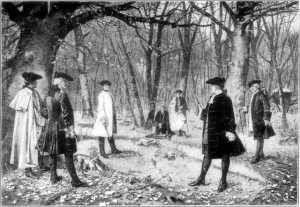
But when, in the ordinary course of bitter partisan politics, certain things were said between him and a vulgar mediocrity named Aaron Burr, Hamilton picked up the very pistols his son had used, rowed across the Hudson to New Jersey (duelling was illegal in New York), and met his challenger in a clearing by the river.

It appears that Hamilton shot first, but “threw his shot away”, in the parlance. In other words, he deliberately missed by firing into air, thus signaling that both parties had satisfied the requirements of honor and could end this business without shedding blood.

Then it was Burr’s turn. But Burr had a different sense of chivalry. He aimed at Hamilton and found his target.

Hamilton, in convulsions, was rowed back to New York, where he died many agonizing hours later, as his family and city grieved over the loss of a great man, who, aged about 47, had already changed the world in ways that would only fully become clear generations later.

The vapors of Delphi

Pythia (oracle of Apollo)

When the ancient Greeks and Romans had a question of great import, they traveled to the navel (omphalos) of the world, which they believed to be at Delphi, on the steep slopes of Mount Parnassus in Greece (see map below).

They climbed up the Sacred Way, past about 3,000 statues and various temples and shrines, until they reached the Temple of Apollo. (This post is apropos of our discussion about Apollo the other day.)

Mount Parnassus was Apollo’s mountain — the mountain of wisdom and music, the place where Apollo had given Orpheus his lyre and taught him to play it, a place that other artistic places (such as Montparnasse in Paris) still try to evoke today.

Click for credits

Because Apollo could see the future, he would have the answer to any question, here at his temple.

And he gave his answer through a woman, the Pythia (pictured above). She would sit above a chasm in the rock through which the god sent vapors (pneuma) that put the woman in a trance. Thus possessed, the Pythia would babble, and priests were at hand to transcribe her words into beautiful hexameter which they gave to the individual who had asked a question.

The answer was coherent syntactically but not necessarily substantively. You recall that both King Croesus and Socrates, for example, had received answers from the Pythia that were ambiguous at best (disastrously so, in Croesus’ case).

But nobody could dispute the power of the god, or rather of his vapors.

And that remains true even today. The vapors are real, it turns out. Mount Parnassus sits atop several very active faults. The earth below constantly rubs and often quakes, grinding the rock until it emits … vapors.

Which vapors? Methane and ethane, apparently. Even the spring water at the site contains ethylene.

In short, even the scientists who go there today, if they hang out there long enough, if they inhale and ingest, may enter the trance of the Pythia and receive the ambiguous wisdom of Apollo.

And so mythos and logos meet; and ‘Socrates’, Dionysus and Apollo become one.

Somewhere between Apollo & Dionysus

Apollo

Friedrich Nietzsche not only loved Greek art and culture per se but he was also, as we discussed the other day, always searching for timeless lessons from the Greeks to help us understand modernity and ourselves.

He found one such lesson in an apparent duality that ran through all of Greek art: the tension between two gods who were also two archetypes and half-brothers: Apollo and Dionysus.

Think of them as a Greek Yin and Yang.

Apollo, the god of the sun and wisdom, as well as poetry and music, would be the equivalent of the Chinese yang (ie, the bright, masculine sun).

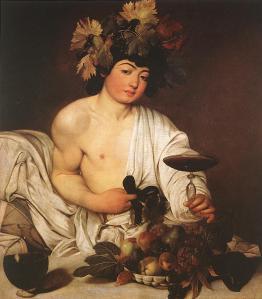
Dionysus, the god of wine, intoxication, ecstasy, passion and instinct, would be the equivalent of the Chinese yin (ie, the dark, feminine moon).

Obviously, I am stretching that analogy, so don’t get too wound up about it. If you prefer, you can think of them in our contemporary pop-psychology terms of left brain (Apollo) and right brain (Dionysus).

Dionysus

So why should this duality be so interesting, for the Greeks or for us?

From Homer to John Wayne: The Apollonian

Nietzsche saw in these two archetypes two approaches to art, and indeed life.

Homer, for example, followed his Apollonian instinct in writing the Iliad and Odyssey in the 8th century BCE. How so? Because he glorified the war against Troy and the subsequent nostos (homecoming) of Odysseus. He made these stories beautiful, as Apollo was. He gave the Greeks and us role models.

He made the Greeks proud to be Greeks, proud to descend from whichever hero in the long catalogue of ships they traced their lineage to. He made them aware of their individuality, of the structures of society, of its fundamental order to which, after intervening episodes of wrath (see: Achilles), everything must return.

Julian Young in his biography of Nietzsche compares this to, for example, our Westerns (the ones with John Wayne more than those with Clint Eastwood). There, too, you see people dying, but they die in a stylized, Homeric way: The bullet hits and they tumble from their horses, looking good as they do so. They are our heroes, beyond the sordidness of reality.

Young gives another modern example: women’s magazines. Those are full of celebrities (our goddesses?) with their tales of disease, divorce, death and drugs. The subtext is ugly, and yet it is presented to us as glamour.

Nietzsche calls this being “superficial out of profundity.” Apollonian art does not censor facts (such as death) but perspectives. It involves a certain amount of self-deception, but it is uplifting. It deifies everything human, whether good or bad. And so it is, yes, religion.

From Sophocles to the rock concert: The Dionysian

By contrast, Aeschylus and Sophocles (but not Euripides, see below) followed their Dionysian instincts in the tragedies they created the fifth century BCE. This might have been expected: Those tragedies were, after all, performed once a year at the festival of Dionysus.

Dionysian art is about the abandonment of order, or ecstasy (ex-stasis = standing out of everyday consciousness). It transcends words or concepts. This is why it tends to involve visuals and music.

Music was in fact an important part of Sophocles’ and Aeschylus’ tragedies (we just don’t know how it sounded, what a pity!). Apparently, the audience sang along with the chorus and became one with it.

The individuals there would have become hypnotized by the sound (rather as yogis feel a certain ‘vibe’ when chanting Om with others). In fact, they would have, as one says, lost themselves in the crowd. They would have stopped feeling separate and individual, Athenian or Greek. They would have had (Freud’s) oceanic feeling.

Credit: Nambassa Trust and Peter Terry

Young compares this to our rock concerts or raves, to our football and soccer stadiums. Dionysian art is a trance and a trip, usually good, sometimes bad.

It is, in contrast to some Apollonian art, apolitical and devoid of any message. The Athenians participating in Sophocles’ tragedies stopped caring about worldly affairs. They became almost apathetic.

This was the only way they could bear to see their heroes — those same Apollonian heroes — torn down and devastated, knowing that they themselves might meet the same fate, understanding that reality was sordid, that it was primal and dark, and that it demanded to be accepted in that way. And they found a beauty in that feeling, too. So it, too, was a form of religion.

From Socrates to Princess Diana: What Nietzsche decried

Nietzsche loved both the Apollonian and the Dionysian, understanding that, like yin and yang, neither can ever be denied.

What he did not like, however, might surprise you: Socrates.

Why? Because Socrates represented, to Nietzsche, the religion of reason — not Apollonian wisdom but cold, methodical logic. In that sense, Nietzsche believed that Socrates “killed” Attic tragedy and Homeric poetry, and the playwright who represented that trend (to Nietzsche) was Euripides, the youngest of the three great tragedians.

Our own age, Nietzsche might say, is “Socratic” in the sense of scientific and myth-less, neither Apollonian nor Dionysian. Because we can’t act out these two instincts, we instead cobble together what Young calls “myth fragments”. We don’t release urges, as the Greeks did, but instead look for thrills, for sex and drugs and trips. We sky- and scuba-dive, we get a new app.

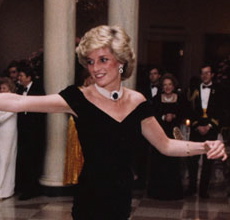
We worship neither Dionysus or Apollo but idols like Princess Diana. How appropriate, since Diana was the Roman Artemis, sister of Apollo.

Bookmark and Share

Competitive Christians on poles

Constantine

The Roman emperor Constantine (above) caused a counterintuitive problem for early Christians.

By converting to Christianity and making it the official religion of the Roman Empire in about 313 AD, Constantine made it impossible for early Christians to be either confessors or martyrs.

  1. To be a confessor meant to acknowledge openly to the Roman bureaucracy that you were a Christian. This carried the risk of martyrdom.
  2. To be a martyr then meant actually going through with the process and dying for your faith.

Why was this a problem?

Because these were the two main ways in which early Christians competed for religious kudos — and those Christians were (are?) a competitive bunch. Both confessing and martyrdom constituted a sort of second baptism and suggested spiritual excellence.

Being martyred, in particular, was surprisingly difficult, since the Romans (with rare exceptions, as under Diocletian) did not actually want to kill anybody because of religion. Historians have recovered trial transcripts that show how eager the Roman administrators were to accommodate Christians. The administrator might ask the confessor whether he might, please, consider a small sacrifice — not to any pagan gods but merely to the Emperor. No? OK, how about a pinch of incense just to acknowledge the Emperor? No? OK, how about….

But when the Roman Empire officially became Christian, this form of Christian achievement came to a complete and screeching halt.

Christians had to find some other way to excel….

(What follows is based on Lecture 5 of Philip Daileader’s excellent course on the Early Middle Ages.)

The first monk

In perhaps the strangest psychological twist in human history, the most competitive Christians in the fourth and fifth centuries AD responded by, in effect, martyring themselves (ie, attacking their own bodies).

Perhaps the most famous to do so was Anthony, who lived in Egypt. Early in his career, when it was still possible, he tried and failed to get himself martyred in Alexandria. When that didn’t work, he went far into the desert to live as a hermit.

He was, in Greek, a Monakhos, a lonely one (as in mono, one; and of course monk).

He ate nothing, slept little, did everything to punish the human senses. (No sex ever, it goes without saying.) When that made him delirious, he imagined that demons and Satan himself attacked him, but he despatched them heroically. Here is Michelangelo’s depiction of that cheerful anecdote:

Word of Anthony’s self-torture got out, and other Christians traveled to the desert to see him. Anthony, of course, wanted to be a Monakhos, so he moved further into the desert to lose his groupies. Eventually, he gave up and accepted that his followers were going to live together in the desert near him, in a sort of … monastery (not that lonely anymore, obviously).

Anthony’s fame soon spread west and throughout the Roman Empire. The reason was that a man named Athanasius, Bishop of Alexandria and a publisher with a sense of Zeitgeist, wrote a book called Life of Saint Anthony, describing what Anthony got up to in the desert.

From the book’s title, you notice that Anthony is now a “saint”. And thus a new genre is born: the hagiography. (Greek hagio = saint, as in Hagia Sophia; graphe = writing.)

To put this in contemporary perspective, Life of Saint Anthony was the Eat, Pray, Love of the late Roman Empire. Everybody suddenly wanted to try it out…

Grazers, fools and stylites

The result was a competitive free-for-all, as Christians tried to one-up each other in search of spiritual kudos.

  • The Grazers, for example, ate only grass and shoots and chained themselves up as barnyard animals.
  • The Holy Fools behaved as though they were insane, or tried to be insane. The most famous of them once paraded into the women’s bathhouse and disrobed, at which point the women, suspecting that he might be less foolish than he pretended, beat and ejected him.
  • The Stylites lived on top of pillars (Greek stylos) or poles.

The most famous Stylite, named Simeon (above) and also sainted before long, lived on top of his pole for some 40 years. (He reminds me of some tree sitters in Berkeley that I wrote about in The Economist once.) People sent food up to him via ladders and pulleys and presumably received and disposed of Simeon’s detritus by the same method.

Simeon became a tourist spectacle. Crowds watched from below as he performed painful exercises. He once touched his feet with his head 1,244 times in succession.

Exegesis

Let’s sit back for a moment, perhaps with a glass of sensual Cabernet Sauvignon and a cavalier mindset, and reflect.

Regular readers of The Hannibal Blog already know that I have a recurring Diogenes fantasy. Diogenes was the guy in classical Greece who lived in a barrel like a dog (the first “cynic”).

But Diogenes did that to be free, not to compete with other barrel-dwellers. He was an eccentric.

You may also recall that I admire Patanjali and his contemporary, the Buddha. Many yogis and Buddhists also (then as now) practice asceticism.

But, like Diogenes, they also do so in search of freedom. (The Sanskrit word for this kind of freedom is moksha, which is achieved at the highest stage of yoga, which is called kaivalya or detachment.)

For them, asceticism is a way to reclaim our peace of mind from the oppressive push and pull of our desires (appetite, lust, jealousy, et cetera). It is a path toward clarity, serenity and humility.

Somehow, this kind of freedom seems not to have factored as a motivation for the pole-sitting Christians.

A seconds difference:

Christianity soon turned lifelong asceticism and total chastity into a virtue.

By contrast, asceticism in antiquity and in Eastern philosophy was a temporary effort, practiced at a certain stage of life.

Vestal Virgin

The Vestal Virgins in ancient Rome, for example, were expected to remain chaste while serving the goddess of the hearth (Roman Vesta or Greek Hestia). But only until they were 30! Then they were expected to do the natural and healthy thing, which was to get married and start a family.

Hindus and yogis first make a living, marry and have sex, start a family, and then, at the end of life, withdraw into asceticism to contemplate the absurdity of it all. (This is called sannyasa, and it is the last of the life stages, or asrama.)

So, asceticism has a place in many spiritual traditions.

But what were these early Christians up to? Were their stunts not huge ego trips?

Worse, did they not begin what Nietzsche would later consider the ultimate perversion of nature — by slandering every one of nature’s instincts to be evil? Were they not fundamentally … sick?

Bookmark and Share

In praise of sublime Greek violence

Nietzsche turned 26 as the Franco-Prussian war was raging (above). He saw this bloodshed as a failure of culture. So he started thinking more deeply about culture and its most fundamental mandate: dealing with human violence. And he arrived at some very interesting insights.

He did this by weaving together two strands of his thinking:

  1. the nature of violence in humans, and
  2. the nature of ancient Greek civilization

This is a great example of the benefits of cross-fertilization between areas of expertise. That’s because Nietzsche was not yet what we would call a philosopher. Instead he was, by training and profession, a philologist, which at that time in Europe basically meant a classicist — somebody who studies antiquity, which in turn mainly meant studying the Greeks.

Nietzsche absolutely adored the Greeks of the classical era (as we do here on The Hannibal Blog). He believed that they were the first to elevate humanity by transcending violence. Here is how.

(This is based on pages 139-141 of Julian Young’s excellent philosophical biography of Nietzsche, which I am currently reading.)

I) Violence

First, according to Nietzsche, the Greeks were honest about the human instinct to violence, and that’s a great start.

The Greeks knew that they were just as capable of violence as the barbarians. (Just read Homer’s account of Achilles’ wrath, or Thucydides’s account of the rape of Melos.) So they accepted that violence was simply part of human nature. The question was what to do about that knowledge.

Pause here for a moment:

a) 19th-century context

In Nietzsche’s own time, this was already a radical interpretation. First, European academe (of which he was part) basically viewed the Greeks as serene and enlightened über-thinkers, as beyond violence. And second, European society (of which he was also part, at least at the outset) had adopted a Christian morality (which Nietzsche would later in his life set out to debunk) that considered violence sinful and tried to eliminate or even deny it. So Nietzsche was already being politically incorrect.

b) Our contemporary context

While no longer politically incorrect, this view is still controversial today.  Which is to say that we are still arguing about whether we are at heart peaceful, like our cousins the bonobos, or violent, like our other cousins the chimps. (Video via Dan.)

In any case, the Greeks recognized the chimps in us humans, but then went a crucial step further.

II) Agon

That step was to redirect and sublimate whatever violent energy there is in humans.

Rather than denying or suppressing human aggression (what Nietzsche would later call the “will to power”), the Greeks purified it through the filter of culture.

The result was agon — strife or, better, competition. That’s agon as in agonize, agony, protagonist and antagonist, et cetera.

Classical Greece was perhaps the most agonistic — meaning competitive — civilization in world history, surpassing even modern America. Everything was a competition:

  • poets such as Homer and Hesiod competed with words,
  • playwrights such as Aeschylus, Sophocles and Euripides competed with their tragedies — literally for an award given out during the Dionysian festivals at which their plays were performed,
  • Socrates and Plato competed with the Sophists, and the Sophists with one another,
  • orators like Demosthenes and Aeschines competed with their rhetoric, and
  • athletes competed at the Olympic Games.

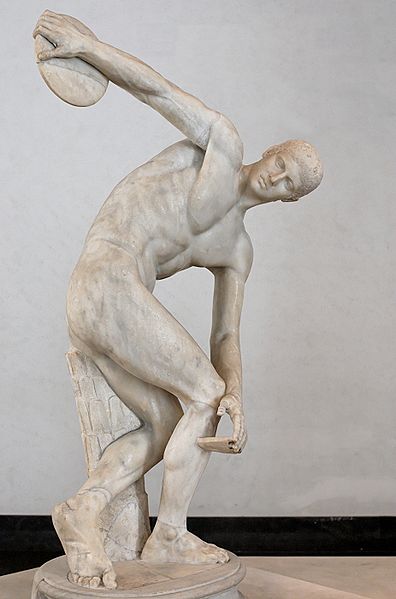
The result was beauty such as this discus thrower, sculpted by a competitive artist of a competitive athlete:

Agon pervaded every single aspect of Greek culture. It was the nasty goddess of strife, Eris, reincarnated as “good Eris”. Bad Eris had started the Trojan War. But Good Eris, according to Hesiod,

drives even the unskilled man to work: and if someone who lacks property sees someone else who is rich, he likewise hurries off to sow and plant… Even potters harbor grudges against potters, carpenters against carpenters, beggars envy beggars and minstrels envy minstrels.

You can choose to see infinite parallels in our own time and lives. For example, culture succeeds when Good Eris enters a courtroom in an adversarial justice system such as America’s. Culture fails when Bad Eris takes her place.

In the name of peace, may humanity study the Greeks and learn to ‘agonize.’

Bookmark and Share