Perhaps not one for The Economist

Credit: CLUI.org

The Center for Land Use Interpretation (CLUI) is a fascinating and provocative outfit and has so much to say — albeit in an oblique way — about America, as I said in the previous post.

Who else would study, with the same quasi-scientific rigor and implicit irony, the following?

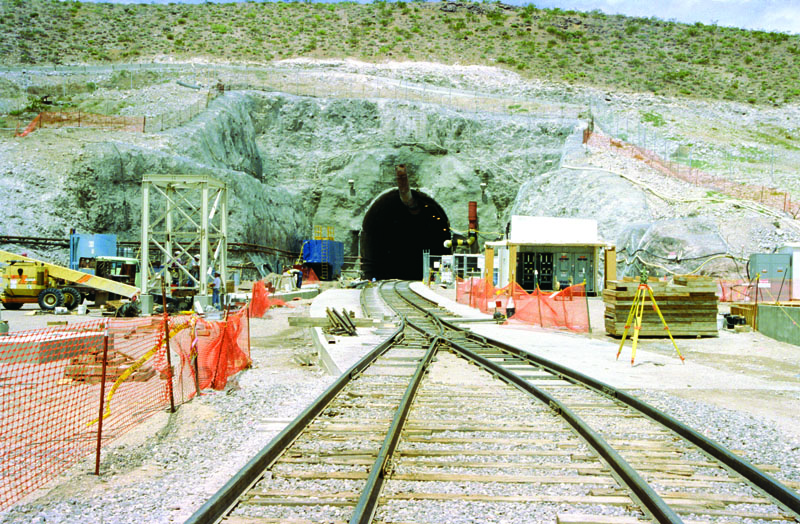
  • Yucca Mountain (above), America’s preferred dumping ground for nuclear waste,
  • Cathedral Canyon (below), a random crack in the desert turned into religious shrine,
  • Emergency training centers such as Del Valle, California (all the way at the bottom), and
  • the thousands and thousands of other non-obvious but telling places in America

And yet, we decided not to run a piece on it in The Economist. At least for the time being.

Why?

Credit: CLUI.org

I decided to let you peak into the process because I think it might give you a useful glimpse into

  1. writing, and
  2. The Economist

Specifically, the issue involved all of the writerly themes that you guys and I have been writing about:

Here is what happened

After my visit to the CLUI, I did indeed write a draft, at about 700 words, for our US Section. And I sent it off.

I had an unsure feeling. I felt that I had not done justice to the CLUI or the places I had chosen as examples.

1) Length

Our pieces in The Economist are short, and they are best when they compress complexity into a dense and yet simple and forceful narrative. The CLUI, however, seemed to need the opposite: not to be compressed but to be expanded and developed. It seemed to need length.

2) Momentum

Worse, I had not spotted an underlying narrative in the CLUI (or the Museum of Jurassic Technology, for that matter) at all. This, in fact, is my criticism of the CLUI: They are so meticulous about their neutrality that they forget to do storytelling.

In fact, the Center’s name is a misnomer. It is not the Center for Land Use Interpretation but the Center for Land Use Observation. The interpretation is what is missing.

3) Voice

So I felt that to do this justice, I would have had to make it a humorous-but-profound story about a search for something elusive.

When you’re searching in vain, the story is about doubt, uncertainty, futility. Not things that The Economist is naturally good at, even though I excel at them personally. 😉

4) The First  Person

To be really fun, moreover, a search narrative would have to be about me, the searcher. Me looking for answers and getting confused. Me on a CLUI bus in the desert with other searchers…

The First Person: Definitely not something that The Economist is naturally good at. 😉 😉

(Since we have no bylines, we also have no First Person. It is banned. The most you might see is “As your correspondent took his seat…”. Yuck.)

Conclusion: This really wanted to be a New Yorker piece.

A few weeks later, I got an email from my editor. He essentially said the same thing:

The problem with the piece as it stands is that it poses a lot of questions, but does not answer them. I appreciate that that is part of the philosophy the point of the CLUI, but it doesn’t really satisfy as a US section article. It reads too much to me like a long list of interesting and not-so-interesting places…

What is it, in fact, that we learn about American culture from the landscape, other than its uses are many and various? That America (like every other country) cherishes, abuses and neglects its physical space? …

I think this piece could benefit from being longer… Such a longer and more narrative piece would not, I think, work in the US section.

In a way, this was reassuring: My editor and I had come to exactly the same conclusion independently.

There was another upshot: Another editor had read it and expressed interest in a longer and more narrative version for our Christmas Issue, the one occasion every year when we really let our writerly hair down.

Did I want to expand the piece for the Christmas issue?

Opting for easy

This is when experience kicked in (13 years at The Economist now).

My experience told me that it was time to move on.

I did a risk-benefit analysis. I could sink a lot more time and effort into this story in the hope that a forceful narrative might emerge out of it. Or I could write the many easy and obvious stories that were offering themselves to me like streetwalkers.

In case you’re wondering, there is pressure on us to perform. We’re supposed to write something in every issue, on average. In fact, the last sentence in that same email from my editor was:

PS: that said, I am therefore in the market for a piece from you next week! Can you call me on the mob once you’re up and about?

And so I moved back into streetwalker alley, where it has been easy pickings and obvious stories since.

How judge ye?

Credit: CLUI.org

Bookmark and Share

Hair in politics

Credit: Bloomberg

Here is a little relief on the light side, reblogged from my post on The Economist’s Democracy in America:

NO SOONER had Carly Fiorina won the Republican nomination to challenge Democrat Barbara Boxer for her Senate seat than the race became hair-raising. Probably unaware that a microphone was on, Ms Fiorina relayed “what everyone says” about Ms Boxer, which is, of course: “God, what is that hair. So yesterday.”

Hair has factored in politics at least since the Roman Republic. The enemies in the Senate of an up-and-coming young general, Publius Cornelius Scipio, tried to derail his rise by implying that he grew his hair un-Romanly long, in the Greek style that seemed soft and suspicious; Scipio went on to defeat Hannibal anyway and, balding, became Rome’s saviour. Julius Caesar was famously touchy about his receding hairline. And Julian the Apostate, Rome’s last pagan emperor, grew a shaggy beard to make an anti-Christian statement which became so controversial that Julian wrote a satire called Misopogon, “The Beard Hater”, in his own defence.

Hair remained political for the Holy Roman Emperors, from Charles the Bald to Frederick I Barbarossa (“red beard”). In the modern era, Kaiser Wilhelm II twirled his mustache just so. China’s top Communists have always amazed with hair that is ink-black at any age. Ronald Reagan’s was impressive, though he is now arguably outdone by Mitt Romney, who during the 2008 campaign warned fellow Republican Mike Huckabee “Don’t touch the hair.”

Women have it harder. Their hair, above all Hillary Clinton’s, is more analysed and yet they are not supposed to bring it up, lest they seem petty or catty. This was the charge against Ms Fiorina last week. Please. “My hair’s been talked about by a million people,” responded Ms Fiorina defiantly. Of late, that’s because she lost all of it while fighting and beating breast cancer. Her hair is now growing back. It is a short, strong statement.

Bookmark and Share

The Economist’s new home page

I’ve mentioned here and there how The Economist has been — really, really, honestly, totally, prove me wrong! — entering the internet era. 😉

Well, you should finally start to see some changes.

Our new home page will go live at the beginning of July. You can see a mock-up here, and you can take tell the web designers what you think about it here.

Bookmark and Share

Individuals, tribes & classes

How do genuine liberals (as correctly defined) view the world? As a collection of individuals.

How do conservatives view it? As a collection (clash?) of cultural communities.

Socialists? Economic communities (or blocks).

Communists? Classes.

Fascists? Tribes, nations or races.

People have drawn many diagrams to depict the political spectrum. But they don’t make sense to me. So I drew my own (in the new Google Draw. Try it.) Here it is:

This way of looking at the spectrum might help you to explain “left” and “right” to a child, should you ever need to. (More about the historical and arbitrary origins of “left” and “right” in a subsequent post.)

If you view the spectrum not as a matrix or a line but as a loop or circle, things become clearer. Liberalism then reveals itself to be not the “place in the middle,” the “split-the-difference” no-man’s-land of compromise and moderation, but the extreme and radical opposite of collectivism, which includes everything from Nazism to Communism.

Yes, Liberals care most about freedom, whereas collectivists tend to care more about “equality” (insofar as it pertains to the group of interest to the respective collectivist — ie, the class or the tribe.)

But the debate is not merely about the desired outcomes — freedom vs equality — of policy. It goes deeper. It is a debate about the unit of analysis. What — or rather whom — do we care about? What matters?

As a liberal, I instinctively choose individuals. People matter.

Now, it’s easy to lampoon this instinct. The caricature usually involves a quote from Margaret Thatcher, when she allegedly said:

There is no such thing as society. There are only individuals.

Here is what she actually said. As you can tell, it doesn’t come close to Ayn Rand in shrillness.

Individuals do form families and other groups, and liberals do care about those. But those are groups that individuals volunteer to form. (By contrast, I never volunteered to be American, German or middle class. Most of the time, I’m not even sure what those group memberships are supposed to mean.)

Let’s talk about Arizona

Enough prologue. Let’s talk about the new Arizona law against illegal immigration.

In my article in the new issue of The Economist, I try to analyze how the law and the backlash against it might affect American politics. My editor wrote a “leader” (ie, opinion editorial) to go along with it. And both of those pieces follow a short piece I whipped up the other day, when the law was first signed.

Now, it may not surprise you to learn that, in addition to the hundreds of, shall we say, passionate comments on our website, I have also been getting reader letters.

I have already regaled you with you my cavalier amusement at the tone of the American reader letters I get. But I must say, the mail bag of late has taken another turn for the worse. I leave it to your imagination.

So let’s step back and try to understand why I, and The Economist, would instinctively be

  • for more open borders,
  • for more liberal migration laws,
  • for freer movement of people.

Is it because I love Latinos, as some of my reader letters suggest (albeit in a different vocabulary)?

Well, yes it is. I do love them. Though no more so than I love Eskimos, Wasps and Tibetans. I love them all, but only as individuals.

There was a time, not all that long ago, when only diplomats carried passports. Other people moved freely where they wanted to go. Just read Casanova’s memoirs. 😉

This sounds like an ideal world: Free individuals and families moving wherever they want to go, with a minimum of hassle (besides the natural stress of moving).

I admit that this was before some countries had welfare states which might attract poor migrants and thus be overwhelmed. This issue — whose taxes pay for whose benefits in a given land — must be addressed.

And I also admit that this was before terrorists (who already existed) had access to weapons of mass destruction. So this issue — how do we keep murderous migrants out — also must be addressed.

On the other hand, I do not admit that immigrants in general, whether legal or illegal, are more likely than natives to commit crimes, because research proves this not to be true.

Garden of Earthly Delights

So what would a liberal Utopia look like?

All individuals anywhere would be free to move to and live where they please, within basic and minimal parameters to address the two issues above.

Americans, for example, would be allowed to go to Latin America or Europe to pursue careers, loves and dreams. Latin Americans and Europeans would be just as free to come to America to do the same.

This would apply to the “high-skilled” migrants, such as Indian graduates from the Indian Institutes of Technology (IIT), probably the best university system in the entire world today. And it would apply equally to “low-skilled” migrants, because they, too, have contributions to make and dreams to pursue.

Is this realistic? Probably not.

But is it desirable?

That depends whether you view the world largely as tribes, classes or, as I do, individuals.

Bookmark and Share

Brilliant and me

Larry Brilliant

You remember me mentioning the chat I had with Larry Brilliant, the man who helped to eradicate smallpox, at our (The Economist‘s) recent “innovation summit” in Berkeley?

The video of it is now on our site.

It’s about 14 minutes, and after a brief warm-up we talk about how to think about the worst threats facing the world.

As usual, there were some snafus: I had recorded an “intro” and “outro”, but we lost the recordings, so the voice you hear at the beginning and end is not mine. But then it’s me talking to Larry.

Larry is a bit of a Renaissance Man — interested in many things, like The Hannibal Blog — so it took us a bit to focus the conversation. Regrettably, some of the most interesting parts of our chat occurred after we turned off the camera. It turns out that Larry, like me, is fascinated by the Bhagavad Gita and Arjuna, so we discussed that for a long time.

Anyway, if you have 14 minutes and want to be scared, check it out.

Bookmark and Share

My 12-minute “book teaser”

If you’re taking a 12-minute cappuccino break, watch me give this “teaser” about my book at our (The Economist‘s) recent innovation conference in Berkeley.

(You’ll also find most of the other sessions on video now, including those with Arianna Huffington, Jared Diamond, Matt Mullenweg, et cetera.)

I’m not good at “teasers” or “elevator pitches”, especially since I tried to tell a story in my book that would keep you reading for 100,000 words. But I’m constantly being told that I now have to practice condensing that story into two seconds for some occasions (cocktail parties, elevators), two minutes for other occasions, 10 minutes for yet others, and so on.

So, er, I’m practicing. (Even while determined not to give too much away yet.)

Your feedback would be welcome. Do I snare your interest or do you say ‘so what’? Are there howling non sequiturs, or does it make sense? And so forth.

Bookmark and Share

PR people and internet etiquette

In September 2007, I received — as part of that never-ending, never-even-ebbing stream of emails from public-relations people that all journalists used to get — a message from one of the better known PR women in the San Francisco Bay Area.

At the time, I tried to reply to all emails for the simple reason that I was raised to be polite. If somebody sends you a message, it behooves you to answer.

That day’s email chain put an end to that gentilesse. I will reproduce it below, with all the names XXX-ed out to protect the individual.

It started on September 11, 2007. This PR woman emailed me (Subject: “Quick Q”) to ask whether I covered a certain industry segment in which she had a client she was hoping to introduce me to.

On September 12 at 10:58 PDT I replied:

Sure. But I’m not planning an article right this second

At 11:02 PDT — in other words, four minutes later — her reply showed up in my inbox, except that it was addressed to her client. She must have accidentally hit Reply instead of Forward.

In any case, I now saw my email (the one she thought she was forwarding), which she had edited:

[Client’s first name],

With your permission, I am going to set up a lunch with you and Andreas – in early October.

XXX

From: Andreas Kluth [mailto:andreaskluth @ economist.com]

Sent: Wednesday, September 12, 2007 10:58 AM

To: XXX

Subject: Re: Quick Q

Sure. But I’m not planning an article right this second. Let’s plan a lunch in October?

AK

This was strange, and I thought it appropriate to point it out. So I sent one more email to her:

Er, XXX, there is something highly bizarre going on. Today I replied to your email with the first and second sentence in the email trail that allegedly comes from me below. I did not write the third sentence and i don’t sign with AK.

I don’t recall asking for a lunch in October

A

And, not entirely to my surprise, I never got another peep from this lady (who had been firing off emails at a rapid clip).

***

What was I to make of this?

On one hand, I like to consider myself, whenever possible, a Cavalier, not a Roundhead. Basically, that means smirking at life, not frowning.

On the other hand, I was somewhat puzzled and miffed.

If the exchange had not been so utterly trivial and boring, one might have called this fraud. But it was simply too petty. Did this woman really think that her client would be impressed if he saw an email from me to her with (as opposed to without) my initials? Did she really think that she could somehow insinuate me into a lunch in October that I had never suggested?

***

So I took a look at my inbox as it was at that time. In 2007, I received more than 500 emails a day — 90% from PR people — on a weekday. This robbed me of a lot of time and thus made me less productive. PR people were interfering with my work and life.

Worse: they were also calling. My phone (at the time I had an actual — as opposed to virtual — phone) was constantly ringing, and it was usually an intern at a PR company, announcing that she was updating their database and asking me whether I was so-and-so at this-and-this address and so forth.

I realized, of course, that my habit of replying was part of the problem: Whenever I answered an email or phone call, I confirmed my presence to them, and they would put me on their automatic distribution lists of press releases. (These emails then as now did not necessarily have a one-click unsubscribe button).

Seriously: When was the last time anybody read a press release?

So I decided to interrupt the vicious cycle.

Genuine (meaning bespoke) emails and emails from people I personally knew, I still answered. The rest I ignored.

That did not restore my inbox to health, but it arrested its deterioration.

Then, a month later, Chris Anderson wrote a blog post that got quite a lot of attention. (Chris had been a colleague at The Economist — in fact, I replaced him as Hong Kong correspondent in 2000 — but by this time he was editor-in-chief of Wired)

Chris took a two-pronged approach:

  1. He whacked any unsolicited and inappropriate email into his Spam filter, and
  2. he published a blacklist of prime offenders.

I decided that the blacklisting was too harsh — the modern equivalent of a pillory — but that the spam-filtering was a great idea.

So I have been doing the same: If I get an automatically distributed press release, or even just a really inappropriate email, it goes straight into our corporate Postini. (And Postini, of course, “learns” this way which emails to consider spam, so that my click indirectly helps other journalists.)

***

Over time, this solved the problem. My inbox now often looks like this:

And I have become productive again.

Not only that, but I have learned to love email again! It has actually become useful to me.

Those people, including PR people, who ought to be able to reach me can now do so more easily than ever. The others no longer bother me as much.

And etiquette is making a comeback. Every new technology causes a change in social protocols. Our grandparents used to have to learn when and how to call people — and simultaneously how to be called — without being rude. Now PR people and the rest of us are figuring out how to be civil in the Internet era.

Breaking news

Bookmark and Share

The search for simplicity, continued

Almost six years ago, I tried in The Economist to start a movement for simplicity and against complexity. In this Leader (ie, editorial, to everybody but us), which accompanied this Special Report, I wrote:

“LIFE is really simple,” said Confucius, “but we insist on making it complicated.” The Economist agrees. Unfortunately, Confucius could not have guessed what lay ahead. The rate at which mankind makes life complicated seems ever to accelerate. This is a bad thing. So this newspaper wants be the first to lay down some new rules. Henceforth, genius will be measured not by how fancy, big or powerful somebody makes something, but by how simple.

Alas, that was easier said than done.

But ever since then, I have been obsessed with simplicity, as you may have noticed if you have been reading The Hannibal Blog (for instance here and here).

This means that I palpitate with excitement whenever I encounter other people who share my obsession. Well, Alan Siegel, a brand consultant, appears to share it. Watch (less than 5 minutes!):


Bookmark and Share

Managing creativity: Let no side win

Ed Catmull

One of my favorite sessions at our “innovation summit” this week in Berkeley was a talk between Ed Catmull, the president of Pixar and Walt Disney Animation, and my friend and colleague Martin Giles, who took my former beat (“Silicon Valley”) a year ago.

Ed had a soulful, unpretentious, I-got-nothing-to-prove credibility, and Martin did a great job drawing him out but otherwise not interrupting or interfering (that, in essence, is a moderator’s job).

As in any real, good conversation, the chat meandered and is hard to summarize. But the heart of it was about how to “manage” creative types so that they stay creative. Managing creativity, of course, is sort of an oxymoron. But that’s what Pixar, with its unbroken record of box-office successes, seems to be doing.

So, how?

It comes down to many, many extremely subtle gestures and techniques. For example:

Commerce vs art

There is a tension between “commercial” success and “artistic” purity, and Catmull believes that the leader’s job is to ensure that “no side wins”. The tension, in other words, is part of the secret sauce.

Geniuses or teams?

Pixar tries to “protect each film-maker’s vision”, by putting the brain daddy of each project in charge of a team. But Catmull realizes that the notion of one single, over-arching genius idea is “a myth”, and that Pixar’s films are really thousands of ideas, and thousands of problems solved. For that, you need a team.

So everything depends on how well that team functions. Catmull sees one of his main roles as observing teams, and intervening when they are dysfunctional. If the leader loses the confidence of his team, Catmull replaces the leader. He would get rid of a genius, if that genius could not work in a team, he said.

Criticism and power

But even when a team does work, and the leader stays in charge, that director must get honest and hard feedback from his peers. How does one do that? (Finding tough but constructive criticism is also one of the hardest challenges for a writer.)

You put the director in meetings of his peers, but you ensure that nobody has more power than he does. In other words, people may suggest or critique, but cannot order him to make any changes. It is up to the director to absorb the comments and to incorporate or address them in the film. (Again, this is also, in my opinion, the way a writer should relate to his “editor”.)

If the group does this well, Catmull will invite others to make the meetings bigger, so that the newcomers can observe the good dynamic and spread it to other teams and Pixar’s wider culture.

However, he then pays extra attention to see if the original group of critics starts performing, which would kill the magic.

If the group critiques badly — which usually means that they are being too polite — Catmull will take individuals aside and confront them: Why did you not say what you really meant? He calls bullshit on them. So people know that their credibility is on the line.

From fear to context

There was no silver bullet, no single secret or list of “ten steps”. There never is in real life. Instead, the conversation offered a fascinating glimpse into our new, modern work culture.

In the past, workers clocked in and had managers look over them with the tools of power. Bosses ruled with fear, implicit or explicit.

In a creative economy — and Pixar, like The Economist, represents it in the extreme — that would never work. You cannot frighten or threaten people into creativity.

Instead, all you can do is choose people well — for their talent and their teamwork — and then set and maintain a certain context that allows their creativity to come out.

Bookmark and Share

Feast of ideas

In case you’ve been wondering whether I might have disappeared: No, I haven’t altogether disappeared; I’ve merely been deeply immersed for several days in our “innovation summit” at Berkeley’s Haas School.

Somewhat to my surprise, I found it to be easily the best conference by The Economist ever, and one of the best conferences anywhere. More intimate than TED, and just as stimulating. I’m still processing all the ideas I got.

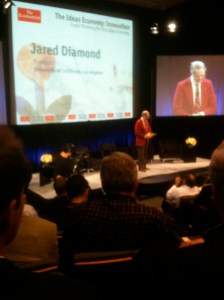
Here is the line-up — from the likes of Jared Diamond (above) and Clay Christensen to Arianna Huffington; from WordPress founder Matt Mullenweg (below) to Pixar’s Ed Catmull.

And even including yours truly: I got to give a 13-minute “Flash of Genius” about … my book.

Matt Mullenweg

My friend Vijay Vaitheeswaran conceived, put together and moderated most of the conference. He did a fantastic job — suave, funny, incisive.

I’ll be decompressing intellectually in several subsequent posts.

Larry Brilliant

Among my personal highlights: I did a “Tea with The Economist” (ie, a short video chat) with Larry Brilliant (above) about the Bhagavad Gita, eradicating smallpox, the worst threats to humanity today and … optimism.

All sessions will be out on video shortly, and I’ll point you to them.

Throughout, the atmosphere was characteristic of The Economist: insightful, thoughfult, intellectual but also humorous, spontaneous, irreverent and quirky. Here, for instance, is our logo, propped up professionally behind Larry as I was interviewing him:


Bookmark and Share