
French & Anglo-Saxon ways of thinking

French thinking at Villandry

Having spent virtually all of my adult life within “Anglo-Saxon” cultures and institutions (not least in the hyper-English milieu of The Economist), I must have adopted Anglo-Saxon ways of thinking.

And what are those?

In this post, I’ll try to describe them, by contrasting the Anglo-Saxon mind with what I consider to be its foil or opposite.

Which is to say: French thinking.

And I’ll do that with just three little examples plucked from life:

  1. gardens
  2. cities
  3. laws

1) French and English gardens

In 1992, I spend my summer in Tours, France — allegedly learning the local language but mostly biking along the Loire and its tributaries with friends, visiting the various chateaux in that area.

I was twenty-two at the time, and gardening was not necessarily foremost in my thoughts. And yet, the gardens of those chateaux left an impression. That’s because I had an intuition that they explained a lot else I was observing in the country

Look at the garden of the Chateau of Villandry, above. Or look at the same castle from another view:

More French thinking

The principle that guides this and all “jardins à la française” is the expression of mastery over nature.

A landscaper imposes, through his reason, absolute and mathematically Cartesian symmetry and order onto what would otherwise be disorder.

It is a top-down notion of order. In fact, these gardens are best viewed from above, which is why almost all the chateaux are laid out so that there is a viewing platform above the jardins (as in the picture).

English landscaping developed largely in response to French landscaping and spread to many non-French parts of Europe.

The difference is striking. Here, for instance, is a view of the Englischer Garten, a huge park in the center of Munich, where I grew up:

Yup, those are sheep, in the middle of Munich.

Munich’s Englischer Garten was conceived during the Enlightenment by an Englishman, and the German landscapers to this day observe its “Anglo-Saxon” landscaping philosophy. Here, for instance, is a recent addition, a theater:

Let’s try to make the philosophy behind this landscaping style explicit:

If the French approach is to display top-down mastery of nature with an imposition of order, the English way is to integrate the human into nature, to adjust to the spontaneous or “bottom-up” order of nature itself.

The best way to enjoy such a garden is in fact “from below” — ie from the ground. You’re assumed to be in the garden, not looking down on it from above.

To give this the subtlety it deserves: English gardening does not deny the ability of man to create order (after all, there still is a landscaper). But the landscaper takes a much more humble approach to nature, choosing to see order in its disorder and incorporating its “accidents”.

Let me use a different phrase: The English landscaper “muddles through“.

2) Paris and London

Now think of the two cultures’ capitals as a “tale of two gardens,” writ large.

The “landscaper” of modern Paris was Baron Haussmann (Alsatian, hence the German name, but French). Between 1852 and 1870, he imposed order on the medieval street warren that Paris had been.

Here is the new Paris as he conceived it:

Haussmann's Paris

Boulevards (in red) as straight as swords now cut through the organically evolved webbing of streets, to clear vistas and let armies parade.

And that’s not enough. Along these straight boulevards, the houses must meet regulations as precise as Cartesian math. They stand in a row like soldiers being mustered:

Now London:

A century before Haussmann (and shortly after Descartes’ death), medieval London was burnt down in the The Great Fire of 1666. To the French, this would have been an opportunity to remake London in a rational and orderly way. There even was an equivalent of Baron Haussmann: It was Sir Christopher Wren, the great architect of many churches, including St Paul’s Cathedral.

What did Sir Christopher do? It was very English. He largely honored the network of streets as it had evolved over time. Using legal jargon, you might say that he respected stare decisis (“stand by things decided”).

Adhering to precedent, he then proceeded to … muddle through.

And that’s what London has been doing since. This is its street grid today:

In fact, that picture does not do its organic beauty/chaos (depending on your point of view) justice. London, unlike Paris, is not one city (even politically). It is many cities and towns that grew together. Each bit retains its own charms and problems, and the connections are haphazard and arbitrary.

London cabbies, in fact, spend years learning what they call “the knowledge” to navigate this maze. And London’s streetscapes are full of surprises, both positive and questionable:

3) Code Napoléon v Common Law

French law is a code. In some ways it goes back to Roman law, but its direct ancestor is the Code Napoléon of 1804.

Napoleon, being not only French (well, sort of) but a product of the Enlightenment, believed in the power of reason to impose order (here meaning justice) from above on the chaos of life, the infinite number of situations that can arise and must be adjudicated. The result was a document. Here is its famous first page:

Legal thinking in France and all other civil-law systems is therefore a process of deduction: You find the general principle in the code, then apply it to the instance in real life.

English law is not a code. In fact, England does not even have a written constitution (as its Anglo-Saxon nephew America does). Sure, there are statutes, laws written by legislators over time. But the core of the system in all Anglo-Saxon countries is the common law.

And what is it? In essence, it is the history of all former cases.

For about a millennium, the English have been considering each new case by comparing it with precedents, a bit as Sir Christopher Wren built St Paul’s on the site of the former church that had burnt down.

Which issues does this case raise? Aha, then it must be like X. But it is different, so it must also be like Y. And so on.

The process is inductive: The Anglo-Saxon mind starts with the particular, searches for a general principle, returns to the particular, adjusts the general principle, and so forth.

Put differently, the English mind muddles through.

Conclusion: Churchill vs Balladur

This post has been muddling through by inducing from particulars to generals. I will leave you with two quotes by former prime ministers that I think say it all:

Edouard Balladur of France:

What is the market? It is the law of the jungle. And what is civilization? It is the struggle against nature.

Winston Churchill:

The English know how to make the best of things. Their so-called muddling through is simply skill at dealing with the inevitable.

Bookmark and Share

My 12-minute “book teaser”

If you’re taking a 12-minute cappuccino break, watch me give this “teaser” about my book at our (The Economist‘s) recent innovation conference in Berkeley.

(You’ll also find most of the other sessions on video now, including those with Arianna Huffington, Jared Diamond, Matt Mullenweg, et cetera.)

I’m not good at “teasers” or “elevator pitches”, especially since I tried to tell a story in my book that would keep you reading for 100,000 words. But I’m constantly being told that I now have to practice condensing that story into two seconds for some occasions (cocktail parties, elevators), two minutes for other occasions, 10 minutes for yet others, and so on.

So, er, I’m practicing. (Even while determined not to give too much away yet.)

Your feedback would be welcome. Do I snare your interest or do you say ‘so what’? Are there howling non sequiturs, or does it make sense? And so forth.

Bookmark and Share

Politicians & their fathers, continued

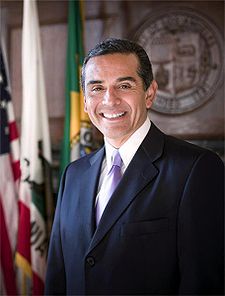
Antonio Villaraigosa

I met Los Angeles mayor Antonio Villaraigosa for the second time the other day, and he did something peculiar — also for the second time, thereby making it notable.

He brought up fathers.

You may recall that I’ve pondered the role of fathers in success when reflecting on Obama and McCain, or Bill Clinton and Gavin Newsom.

The theory, to remind, is that (male?) leaders often have absent fathers.

So here is what Villaraigosa did to make me think about that again:

First time

I first met him last summer, when he was still being talked about as a possible Democratic candidate for governor. He is the first Latino mayor of LA since the 19th century and a wily politician, so he was said to have a chance. On the other hand, he had a new sexy girlfriend who was not his wife and so forth, so perhaps not.

So I went into his office in City Hall. He looked tired, with bags under his eyes. I thought that his face was right out of The Godfather — in a good, soulful way — but his hands were small and soft.

He surprised me by insisting on first talking about me. I didn’t quite know how to handle that. But he wanted to know a whole lot about me — what schools, where from, etc. He said he liked the boots I was wearing. I realized that he was a people politician (in fact, I kept getting distracted by all the photos of him with famous and beautiful people), not an ideas politician.

So we started talking about what I talk about: ideas. I thought it was slow and plodding. Then I realized that he slowed down for me whenever he thought he was saying something sound-bitey, so that I might transcribe it more easily.

But then finally we found a topic that got him relaxed and enthusiastic. Ostensibly, it was his city, LA, which is so fantastic. But here’s the reason why it’s so fantastic:

People don’t care who your father is.

He said that several times. As in: In New York, you need to be from the right family, but here we only care about what you are today.

Or perhaps as in (I imagine his thought bubble): My father left my mom and me when I was young, so screw him.

He did, in fact, say that he had seen his father at most 25 times in his whole life, making it clear with a (perhaps exaggerated) gesture that he couldn’t care less about him.

Second time

I met him again a few weeks ago when my editor was visiting me and I took him around to see interesting people. This time, Villaraigosa looked much better. No bags under his eyes. He was no longer a candidate for governor, so now he was just enjoying himself as mayor (and in his private life).

Again, I got distracted by all the photos of him with famous and beautiful people — they were now on automatic slide show on a large electronic picture frame.

Again, the slow and deliberate sound bites about weighty topics. Again, name-dropping (he also knows some British politicians, and he wanted us to know that).

Then my editor and I said Thank You and left. We were already in the hallway, and Villaraigosa huddled with his handlers for the next meeting.

Suddenly, Villaraigosa ran out and after us, all but screaming:

You know what? Screw it. Let’s do a story on how great LA is. The greatest city in America.

He was beaming with excitement:

I mean, here nobody cares who your father is!

Bookmark and Share

Intelligence and liberalism

Probably Republican

The Hannibal Blog recently introduced you to Satoshi Kanazawa, a controversial evolutionary psychologist.

A willingness to be controversial, when paired with actual research and intelligence, is a trait The Hannibal Blog applauds. Even so, you guys appropriately rang the alarm bells about some of Kanazawa’s more out-there views in the comments under my post.

That said, those views were not the ones that I found interesting (or had even been aware of). So allow me to re-introduce you to some of Kanazawa’s thinking.

1) The Savanna Principle

Evolutionary psychology starts with the premise that our brain, like our liver or eye or gonads, has evolved. This immediately leads to interesting insights, such as The Savanna Principle, a term that Kanazawa coined.

It states that we (Homo sapiens sapiens), having spent most of our evolutionary time in the African savanna, have adapted to its circumstances. We have not had much time (in terms of generations) to adapt to modern life. Therefore

the human brain has difficulty comprehending and dealing with entities and situations that did not exist in the ancestral environment.

(The word difficulty is important: Dealing with modern circumstances is not impossible, merely difficult.)

Thus, humans will see a banana as yellow (= recognizably edible) under all conditions except in a parking lot at night, because sodium vapor light did not exist in the savanna.

Let’s take another easy example. I recently railed against driving while texting or talking on the phone (the former is worse than drunk driving, the latter is as bad). Why are both activities so dangerous (whether or not you use “hands-free” devices)? Well,because

carrying on a conversation with someone who is not present in front of you is evolutionarily novel. Our ancestors never carried on a conversation with anyone who is not present in front of them or whom they could not see during the conversation. We have had the telephone (which allows us to have such conversations) for more than a century now, but it is still evolutionarily novel. Our brain has not adapted to the telephone in the last century. So it is possible that telephone conversations per se, not necessarily cell-phone conversations, are cognitively taxing and distracting because they are evolutionarily novel.

Everyone (legislatures and publics alike) assumed that what was causing the accidents was the manual and mechanical handling of the device, not the conversations per se. After all, drivers have conversations with fellow passengers all the time, with seemingly no effect on safety. [But] drivers who use hands-free devices are just as likely to cause road accidents as those who use hand-held devices.

2) Relevance to intelligence

More recently, Kanazawa has been thinking about how intelligence might have evolved in the Savanna, given that it would have been mostly useless there.

By intelligence he means general intelligence, as opposed to any set of specific adaptations to address specific threats in the Savanna (such as the specific ability to recognize a cheater in a social setting). Put differently, how and why would Homo sapiens have evolved to deal with any novel threat?

Well, it must have evolved since we left the Savanna. Our departure meant that we started encountering one (evolutionarily) novel situation after another, and those of our ancestors who happened, by mutational chance, to be better equipped to think about these new situations would have had a reproductive edge.

But intelligence can be misunderstood. As Kanazawa says:

more intelligent individuals are better than less intelligent individuals at solving problems only if they are evolutionarily novel. More intelligent individuals are not better than less intelligent individuals at solving evolutionarily familiar problems, such as those in the domains of mating, parenting, interpersonal relationships, and wayfinding (finding your way home in a forest), unless the solution involves evolutionarily novel entities. For example, more intelligent individuals are no better than less intelligent individuals at finding and keeping mates, but they may be better at using computer dating devices. More intelligent individuals are no better at finding their way home in a forest, but they may be better at using a map or a satellite navigation device.

3) Relevance to politics

The controversy starts right about now.

One by-product of this recently evolved general intelligence, according to Kanazawa, is an ability to empathize with people to whom we are not genetically related.

In the Savanna we only cared about kith and kin, because we hardly knew anybody else. (We lived in groups of up to about 150 individuals, the so-called Dunbar number.) Modern cities or countries did not exist.

But they exist today, as evolutionary novelties. Does general intelligence help us to deal with the situation?

Yes, says Kanazawa, by making us “liberal”. He uses not the correct and traditional definition but the modern American definition of liberalism

as the genuine concern for the welfare of genetically unrelated others and the willingness to contribute larger proportions of private resources for the welfare of such others. In the modern political and economic context, this willingness usually translates into paying higher proportions of individual incomes in taxes toward the government and its social welfare programs. Liberals usually support such social welfare programs and higher taxes to finance them, and conservatives usually oppose them.

And indeed, he has found a certain correlation between intelligence and liberalism:

And by the way, Kanazawa considers himself conservative.

So, as he says in a follow-up post, this is not to imply that liberals are “smart” and conservatives “dumb” in the conventional sense.

In fact, it may well be that liberals lack, and conservatives have, “common sense” — if by common sense we mean precisely that more pristine and specific intelligence that allowed our ancestors to survive and reproduce in the Savanna.

Bookmark and Share

Is or Ought, true or good

Satoshi Kanazawa

I’ve recently discovered the blog of Satoshi Kanazawa, an evolutionary psychologist at the London School of Economics (LSE), which happens to be one of my alma maters (I got my Masters there).

It is called The Scientific Fundamentalist, and for good reason. As he says here,

From my purist position, everything scientists say, qua scientists, can only be true or false or somewhere in between. No other criteria besides the truth should matter or be applied in evaluating scientific theories or conclusions. They cannot be “racist” or “sexist” or “reactionary” or “offensive” or any other adjective. Even if they are labeled as such, it doesn’t matter. Calling scientific theories “offensive” is like calling them “obese”; it just doesn’t make sense. Many of my own scientific theories and conclusions are deeply offensive to me, but I suspect they are at least partially true. Once scientists begin to worry about anything other than the truth and ask themselves “Might this conclusion or finding be potentially offensive to someone?”, then self-censorship sets in, and they become tempted to shade the truth. What if a scientific conclusion is both offensive and true? What is a scientist to do then? I believe that many scientific truths are highly offensive to most of us, but I also believe that scientists must pursue them at any cost.

Well, in this post, The Hannibal Blog would simply like to endorse and celebrate Kanazawa — both his approach and philosophy and his research and style.

Subscribe to his blog! It will do what I secretly hope The Hannibal Blog occasionally does for you:

  • intrigue you,
  • offend you,
  • delight you,
  • enrage you,
  • enthrall you.

How? Because it does not — as so much of the politically correct piffle out there does — try to achieve one half of the above effects without the other half. It has writerly courage. More specifics to come.

Bookmark and Share

Success vs popularity: genius or slut?

James Patterson

Using the example of James Patterson, an apparently über-successful author of whom I had never heard, Mark Hurst recently made me think once again about my definition of success.

To paraphrase and amplify Mark’s point, would you rather …

  • create something truly yucky — something that you’re secretly ashamed of because you have good taste and know better — which nonetheless becomes a blockbuster?
  • or something that you are proud of, something you consider sublime, even if relatively few people agree or even notice?

As Mark says, this dilemma could appear in any walk of life:

You could be creating websites or software, or writing books, or designing products, or teaching classes, or producing events, or seeing patients. Whatever the case, what would you rather result from that experience: to be popular, or to create something that you yourself would be happy to receive?

If you answer “I’d like to do both” you’re cheating. The conundrum presents itself to all creative types sooner or later precisely because they must, at least sometimes, choose between the two options.

How to sell 14 million books

Which brings us to Patterson, who sold 14 million (!) books last year, as this profile claims. He published 9 books last year, and will publish 9 more this year. In fact, he is a book machine, an assembly line, a conveyor belt.

Literally: He uses “co-authors” to do the actual writing and “manages” the process rather as the boss of, well, an assembly line does.

Patterson is no boor. He himself reads both light and heavy fare, including Joyce. But when it comes to his own books he takes the approach of an advertising man. In fact, he start as an ad man, at J. Walter Thompson. He personally wrote and produced the TV ads for his early books.

He takes a marketing approach to everything from the story and characters to the jacket design, which tends to be

shiny, with big type and bold, colorful lettering — and titles drawn from nursery rhymes (“Kiss the Girls,” “Pop Goes the Weasel,” “The Big Bad Wolf”), with their foreboding sense of innocence interrupted. “Jim was sensitive to the fact that books carry a kind of elitist persona, and he wanted his books to be enticing to people who might not have done so well in school and were inclined to look at books as a headache …  He wanted his jackets to say, ‘Buy me, read me, have fun — this isn’t “Moby Dick.” ’ ”

Take that, Melville.

Patterson also does scientific market research:

Instead of simply going to the biggest book-buying markets, he focused his early tours and advertising efforts on cities where his books were selling best: like a politician aspiring to higher office, he was shoring up his base. From there, he began reaching out to a wider audience, often through unconventional means. When sales figures showed that he and John Grisham were running nearly neck and neck on the East Coast but that Grisham had a big lead out West, Patterson set his second thriller series, “The Women’s Murder Club,” about a group of women who solve murder mysteries, in San Francisco.

In other words, he does not conceive a story and wait for an audience; he finds an audience and tailors a story for it.

In this way, he practically took over Little, Brown, once a respected literary publishing house, where he now has a dedicated staff that answers only to him. A former boss of Little, Brown

says she was continually surprised by the success of Patterson’s books. To her, they lacked the nuance and originality of other blockbuster genre writers …

Then again, she is the former boss.

Patterson’s style, you ask? The profile describes it as

light on atmospherics and heavy on action, conveyed by simple, colloquial sentences. “I don’t believe in showing off,” Patterson says of his writing. “Showing off can get in the way of a good story.” Patterson’s chapters are very short, which creates a lot of half-blank pages; his books are, in a very literal sense, page-turners. He avoids description, back story and scene setting whenever possible, preferring to hurl readers into the action and establish his characters with a minimum of telegraphic details.

Does Patterson mind that he is not considered, you know, literary?

“Thousands of people don’t like what I do,” Patterson told me, shrugging off his detractors. “Fortunately, millions do.” For all of his commercial success, though, Patterson seemed bothered by the fact that he has not been given his due — that unlike King or even Grisham, who have managed to transcend their genres, he continues to be dismissed as an airport author or, worse, a marketing genius who has cynically maneuvered his way to best-sellerdom by writing remedial novels that pander to the public’s basest instincts. “Caricature assassination,” Patterson called it.

How, then does he, explain his success? He makes his books

accessible and engaging. “A brand is just a connection between something and a bunch of people,” Patterson told me. “Crest toothpaste: I always used it, it tastes O.K., so I don’t have any particular reason to switch. Here the connection is that James Patterson writes books that bubble along with heroes I can get interested in. That’s it.”

Now, as a bonus for those of you who are not only reading a blog but writing your own:

“I have a saying,” Patterson told me. “If you want to write for yourself, get a diary. If you want to write for a few friends, get a blog. But if you want to write for a lot of people, think about them a little bit. What do they like? What are their needs? A lot of people in this country go through their days numb. They need to be entertained. They need to feel something.”

And isn’t that interesting? I once wrote that the first rule of good writing is not to care about your readers, but that it needs to be tempered with the second rule of good writing, which is to have empathy.

Patterson, it might seem, proves instead that empathy is all.

Oh, wait. That gets back to the dilemma. Are we talking about good writing or popular writing, and do we care?

Bookmark and Share

America’s veil of fear

A reader of The Economist, Tim Rooks, apparently an American now living in Berlin, just sent a letter in response to one of my recent pieces.

(The piece was about California’s prison overcrowding, itself an aspect of America’s incarceration rate, which is the highest in the world, surpassed only by the Soviet Gulag.)

An excerpt from the letter:

… since leaving the United States, I feel as if a veil of fear has been lifted. I am freer and safer than ever…

This caught my interest because the premise of my thread on America is that, like Mr Rooks, I often feel less free and safe in America than in any of the other places I have lived. And this, of course, is ironic, since many Americans claim or like to pretend that they have some special relationship with liberty.

It is also interesting because Rooks and I both seem simultaneously to be insiders and outsiders in America, and that tends to be a good vantage point for seeing that which is, as it were, hiding in plain view. (I, for instance, started my thread with two views from Hong Kong, here and here.)

Compare, for instance, what Jonah Lehrer says about outsiders:

Bookmark and Share

Official: Google does NOT make us stupid

Remember when The Pew Internet & American Life Project asked me to participate in the latest iteration of their “expert” surveys on “the future of the internet”?

Well, the full report is now out, and you can see the aggregate answers of the other participants and their quotes. There were 895 respondents in total.

Interesting which bits of it are being picked up by others.

Here is a slideshow summarizing the results:


Bookmark and Share

Not seeing the obvious

Apparently, pre-schoolers and adults were asked whether this bus is traveling left or right.

Left … or right?

Most of the adults had no answer.

90% of the preschoolers had the correct answer (in the comments).

Strange that we lose the ability to see the obvious as we know more.

Bookmark and Share

The 4th (and final?) coming of Steve Jobs

As you regular readers of The Hannibal Blog know, I am fascinated by Steve Jobs. He is a main character in one chapter of my forthcoming book.

He is a man who is hard to like, impossible to hate and easy to admire. Complex, in a word.

And he is a man who has both lived and reflected on Kipling’s two impostors — ie, triumph and disaster. Oh, what ups and downs Jobs has known.

Now he has unveiled what may be the fourth device in his career (the first being the 1984 Mac, the second the iPod, and the third the iPhone) that fundamentally changes the way we live. It’s called the iPad.

This is not a review

Every tech and media blogger and journalist is right now weighing in on the iPad as a device, so I will not. We put it on the cover of The Economist this week, and my colleague Tom Standage adds context on his blog.

So let me just add some disparate and quirky observations.

1. Nobody imagines (and thus inspires) as Steve Jobs does

My Chinese mother-in-law, who only gave up dial-up internet when it ceased being offered as an option, wrote my wife the following email:

Subject: iPad

Is this the one I’ve been waiting for?

Now this is the Confucian equivalent of a gyrating pole dance. Steve Jobs has hereby cleared the highest hurdle in the excitement-generation industry.

How does he do this?

Jobs has always known how to imagine on our behalf. The truth is that people don’t know what they want (hence Henry Ford’s famous quip that if he had asked his customers what they wanted, they would have said ‘A faster horse’.) Jobs has the arrogance to understand that and to believe that he knows, and he tends to be right.

2. Nobody feints as Steve Jobs does

Two years ago, when Amazon brought out its Kindle eBook reader, Steve Jobs dropped all sorts of disparaging comments in such a way that he could be sure journalists would repeat the narrative on his behalf. For example, he said that

It doesn’t matter how good or bad the product is, the fact is that people don’t read anymore. Forty percent of the people in the U.S. read one book or less last year. The whole conception is flawed at the top because people don’t read anymore.

It was catchy because it rang true and caused many of us literati to hyperventilate about this dreadful trend (ie, people no longer reading).

But some of us guessed even then that Jobs in fact believed the exact opposite. And now we know. At the time he said it, he was 80% of the way into developing … his own eBook reader! For that’s what the iPad is, in part. It is Steve Jobs’ stab at reinventing buying and reading books as he once reinvented buying and listening to music.

Let us all pay extra attention to whatever he disparages next.

3. Even Steve Jobs feels his mortality

The man has been facing death for years now. He had pancreatic cancer. He had a liver transplant. He looks gaunt.

Could it be that this notorious perfectionist broke his own rules and accelerated the release of the iPad, launching it before it is really ready so that he could still be there for its birth, not only as father but also as midwife?

At the moment, the iPad is really a large iPod Touch — you can use only one app at a time, for example. Its trajectory, of course, points toward a time when it will indeed become a new “interface” for day-to-day computing. But I feel there is something half-baked about the release as it stands, by Jobs’ previous standards.

I also could not help but notice that Apple’s promotional video for the iPad does something uncharacteristic: It does not feature Steve Jobs, but instead highlights his lieutenants. They have, of course, been there all along, as ingredients of Apple’s secret sauce. But Jobs has never really displayed them, lest anybody might get the idea that he were grooming successors. The corporate message used to be that Jobs was Apple, and Jobs was forever.

Put differently, this may have been the beginning of a Good Bye. Viewed thus, it is especially moving.

Bookmark and Share