Podcast about my book

Abhishek and I are talking for half an hour in this podcast about my book. The Indicast, if you don’t know it, is an up-and-coming podcast show in India.

We’re really having fun and getting side-tracked a bit, so it’s not until 16 minutes in that I actually summarize the book’s plot. The sound quality is a bit grainy, because I’m talking from California, and Abhishek from Mumbai.

Click play:


Bookmark and Share

Mixed metaphors

I’ve weighed in a number of times on various style crimes in the English language, starting with my rant on this grammar felony. Now Abhishek, India’s up-and-coming podcaster, tells me that he’d like more on style and language on this blog. Well, Abhishek, this one’s for you.

We’re in the middle of a financial meltdown, you may have noticed. Well, meltdown is a metaphor, from the nuclear industry. It’s fine to use metaphors from time to time. But let’s have a look at two articles published in the last hour by esteemed organizations, the New York Times and the Associated Press, about today’s market drop (another metaphor).

First, the two opening paragraphs of the NYT article:

Stocks fell by nearly 9 percent on Monday — the worst single-day drop in two decades — after the government’s bailout plan, touted by its supporters as a balm for the current market stress, failed to pass the House of Representatives, setting off a fresh wave of anxious selling.

In yet another day that has shaken the embattled canyons of Wall Street, the Dow Jones industrials fell 777.68 points after it became clear that the legislation could not muster the support it needed to pass the House.

You notice I had some fun here by giving colors to each kind of metaphor. This was actually quite hard, because I ran out of colors of sufficient contrast. And that’s exactly my point.

In a passage of 85 words, I counted nine different kinds of metaphors, and I was being conservative. That things should be falling and dropping and otherwise succumbing to gravity when prices are going down seems obvious. That bailout nowadays refers more to Wall Street than to ships in distress I can accept. But….

… do we really need–simultaneously!–to imagine ointments (balm) for wounds, in this case stress, as well as waves, even though these do not go on to deluge anything, but rather shake things? In fact, it turns out that the things being shaken are canyons, which makes us wait for some quaking or perhaps erosion. Instead, we discover that the canyons are embattled (although it is not clear by whom). Just as I settle in for more siege and war images, I am asked to go back to falling, and then to take a side trip to mustering, with an image of congressmen standing at attention.

Ouch. My head is spinning. If the writer just wants me to know that this is all really bad, well, I get it. But do I need word torture as well?

Surely, this one slipped through the editors. The Associate Press, in its opening paragraph, probably does it better. Let’s see:

Wall Street’s worst fears came to pass Monday, when the government’s financial bailout plan failed in Congress and stocks plunged precipitouslyhurtling the Dow Jones industrials down nearly 780 points in their largest one-day point drop ever. Credit markets, whose turmoil helped feed the stock market’s angst, froze up further amid the growing belief that the country is headed into a spreading credit and economic crisis.

Oh well. So we have the bailout, then a whole lot of plunging and dropping with some hurtling (not the same thing) thrown in. Fine. But now we also get turmoil and then, instead of waves and canyons, feeding! Of angst, no less, which I recall means fear in German. This fear is apparently what caused a temperature drop because the markets froze. And this in September. While this was going on various things were either growing or spreading.

Pulitzers to all involved.


Bookmark and Share

Editors are human

This is an old-ish piece, from 2001, but it gives a rare peek into the book world from the … editor‘s point of view. In it, Geoff Shandler at Little, Brown, keeps a diary for one week. He gets outbid, he has health problems, he sees the promise and problems in books, he sits through meetings and gets outbid again. He is, in short, refreshingly human. Authors forget that.

A few gems:

Public mention is, for a book editor, like sunlight to a vampire. We don’t want our names on the jackets. We don’t want to go on television. If we’ve been noticed, we’ve failed….

… my least favorite task: beg other writers for blurbs.

(This is becoming an anti-blurb theme.)

Autobiographies are popular, many of them proving that while life is amazing, most life stories are not….

A lot of people go into book publishing because they think they’ll get to read all day. What they don’t realize is that so much of what you read is junk….

A bad review hurts, but a sloppy review infuriates…


Bookmark and Share

“How” books vs “Why” books

This is apparently a widespread distinction in the book industry, at least in non-fiction. I actually think it’s useful.

My book is definitely a Why book.

I don’t think much of How books. I know that some sell well, just as junk food sells well, but neither genre is good for you. How books are like slot machines: they make a fake promise of sudden insight or wealth to the weak-willed and vulnerable, and then don’t deliver. They can’t deliver. The world is too complex for one How book or even a thousand. The best we can do is to try to understand Why and then use our instinct and experience.

A genre closely related to the How books is the List book (or List magazine-article). The formula is simple: If you have nothing to say, no story to tell, no central insight, just make a list! Ten steps to this, seven habits of that, one hundred answers to this, and so forth. In magazines, the one hundred most powerful women, the fifty richest men, the twenty greatest innovators, etc. It’s a mediocre writer’s dream: You don’t actually have to go out and find a story, you just sit around and rank some celebrities or quirky one-line teasers and let the audience debate.

As with everything, there are exceptions that prove the rule. The 48 Laws of Power, by Robert Greene, is an intelligent book that is also a list and appears to be a How book. But it’s not. It’s really a Why book, cleverly disguised as a List/Why book.

But my basic point stands. Write Why books. Read Why books. That is challenging and rewarding enough for a few lifetimes.


Bookmark and Share

The end of book publishing? Part III

Just as I was running the risk of ecstatic optimism–my book is coming along great and I’m writing it much faster than I had expected–a long but worthwhile article in New York Magazine comes along to remind me that I should really be … dejected.

I have opined on the end of the book business before. In that post, I struggled with the question of whether or not anybody still … reads.

Now New York Magazine cheers us up by asking, among other things, whether or not anybody still sells (book stores), pays (book publishers) or markets (ditto). I’ve pulled out the choicest quotes:

Lately, the whole, hoary concept of paying writers advances against royalties has come under question… [The] money has to come from somewhere, so publishers have cracked down on their non-star writers. The advances you don’t hear about have been dropping precipitously.

(Fortunately, I’ve already got my advance.) Next, publicity:

Traditional marketing is useless. “Media doesn’t matter, reviews don’t matter, blurbs don’t matter,” says one powerful agent.

(I wonder if that “powerful agent” was this one.)

But that’s not enough. Borders Group, which controls about 12% of the entire book-selling market all by itself, is apparently “on death watch”. And then Amazon, the industry agrees, is poised to exert total, Big-Brotherish  domination of the market.

Oh vey, oh vey, oh vey…


Bookmark and Share

Finding my third voice

My first follow-up to my recent brainstorm on the pros and cons of blogging would be to list one clear benefit: It has already helped me to find my “voice”.

What is voice? I’m not talking about anything to do with my vocal cords. I’m talking about that subtle quality of tone that a writer has and needs.

I suppose it was inevitable that, after eleven years at The Economist, I would internalize its voice and default to writing in it. Cosmopolitan and British in spelling, humor, irony and worldview. Witty, incisive and subtle at its best; snide-sounding when it goes awry. Not necessarily my voice, but by habit and daily routine my first voice.

When I wrote my book proposal, that turned out to be inadequate. That first voice was only masquerading as my authentic voice, which in fact I still had to find, or re-discover, in order to take the reader through my 200 pages. I had assumed that it would be a matter of snapping my metaphorical finger and, voilà, suddenly I’m writing in my own voice. Instead, it took a while longer to sound genuinely like myself and nobody else.

Where does the blog come in? I haven’t been blogging long. But already I’ve noticed that a blogger’s voice is by default ultra-casual, ultra-personal, occasionally sloppy, but always from the gut. It is not the right voice for an entire book. But it represents an antipode to my usual pole, The Economist. It is a natural second voice.

So sometimes I’m using that second voice as a sort of hooligan to rough up my first voice, a sort of Jeeves butler who needs to loosen up a bit, in order to find my third voice, which is the ideal tone for a book. After a day of writing for The Economist, I might unwind with a blog post, then forget about it and settle into a pleasant evening of writing in a tone that is genuine and relaxed but still disciplined and clean. In short, what I’ve wanted all along.
Bookmark and Share

It’s the cliché, stupid

Here at The Economist, we correspondents have just received an order from above:

… a formal ban on “It’s the XXXX, stupid” … I think the phrase has been overdone, especially in election stories.

Can we also try, wherever possible, to avoid using “top”, as in “top officials say” or “America’s top companies”: “leading” is much better.

This is great advice for everybody, not just us. It’s one of those constant updates to Orwell’s first rule of good writing.


Bookmark and Share

The schizophrenic blogger

That’s me, at least for the time being. Which is to say, I’m in two minds about blogging about my book, depending on whom I’ve asked for advice last.

The “pros”:

On one side, there is an army of tech-savvy, media-savvy, modern, sophisticated, worldly people who say to me: Blog! Bloooog! For book authors, obscurity is the enemy, not piracy, theft or plagiarism. So blog, build a community, learn from that community, and then let the community help you when the time comes to launch.

One person whose example sticks out in my mind, as I’ve mentioned before, is Chris Anderson. His first book, The Long Tail, began as an article in Wired (of which Chris is the editor), then became a book-deal, then a blog, and then, well, the book.

I ran into Chris the other day and asked him if he had any regrets at all, and Chris said Nope, blogging about the book has been entirely for the better. He’s actually learned a lot from his blog’s audience (“crowdsourcing” is the fancy new term for that), and it built buzz for the book’s launch.

Intellectually, Chris has also thought about giving entire books away, free, on blogs or otherwise, and this is becoming something of a micro-trend.

The book, it should be said, did rather well. On the other hand, I should also say that I personally, having read the original article and the blog (and finding Chris’s idea profound and spot-on), did feel that I didn’t need to read the book when it came out. I was comfortable that I already knew the ideas behind it very well.

Chris has a lot of support. Tim Sullivan, who is not my editor but an editor of books, at Basic Books as of this week, told me that:

I’m all for divulging in blog-length entries. You can really work through some issues, and I think that it encourages sales rather than depressing them (in most cases). I also think you end up with a better book, in the end, if you can generate involvement from a group of interested outsiders

Charlene Li and Josh Bernoff (left) wrote their new book, Groundswell, using the blog to test and refine ideas and seem to have loved the process.

Jeff Howe (right) has been blogging his book Crowdsourcing, and using the blog in part, well, to crowdsource. (Meaning: to make “open calls” on the anonymous audience to contribute knowledge, in the hope that the best-qualified people may be hiding in the crowd.)

The “cons”:

My mom is a con. Now, it’s no fair poking fun at moms–they are the people whose intentions toward us are purest. So I won’t. I take her concerns seriously. And she has support: Virtually all of the, ahem, “older” people I know react with dread: Are you crazy? Somebody will steal your best ideas! You undermine the element of surprise! Don’t do it! If you must blog, don’t give anything good away.

Then, there is…

Everybody else:

That category, obviously, includes a lot of people. I’m in it myself. Among my colleagues at The Economist, for instance, there is Tom Standage, author of several books, the latest of which is A History of the World in Six Glasses (right). He is one of the most tech-savvy and media-savvy people in the world, and yet he resides slightly toward my mom’s end of the spectrum. He puts up a “teaser” about his book and some updates about the process–launch, book tour and such–but otherwise leaves it to the book itself to make the splash. I take his advice very seriously, especially since his genre of book and style of writing is much closer to mine than the tech-centered books above.

There is also Edward Lucas, who had a blog for many years before he sold his idea for a book on Russia, the New Cold War (left).

Ed says that yes, he did crowdsource. Exactly once, in fact. He had to fact-check a detail during pre-launch production, and put it out there. Within an hour, several people got back to him with the answer.

But beyond that, he says he did not give away much from the book on the blog, which he uses mainly as a personalized and running anthology of The Economist’s Russia coverage. When he tried to have discussion boards on individual chapters, the results were disappointing–“mostly Russians posting obscenities.” He thought about putting the introduction online, and maybe a few chapters, but then decided against it. “The book must promise that it gives you something you can get nowhere else,” he said to me.

And on and on. Everybody has a different view. Basically, nobody knows.

And that leaves me… schizophrenic. Which is not a good thing for a blogger. It’s like blogging with one arm tied behind your back–possible, but tedious.

Within the coming weeks, I will sort out my thoughts on this and decide one way or the other. You’ll know when that happens, because the blog will show it.


Bookmark and Share

Reading by deleting

In the old days, I would have researched my book by going to a library and pulling journals and books from dusty stacks, then reading them and writing down, on index cards, the passages that I might want to quote, or perhaps photocopying the pages.

These days, I’m finding a lot of journal articles and book passages–especially the classics–online. And in the past year, I’ve increasingly found myself doing something very different (without even consciously deciding to do so):

I download the PDF of some 100-page journal article, copy and paste it into a word document, and then read the article while simultaneously deleting everything I know I won’t need.

I know this sounds bizarre, but I really like it:

  • it makes me read much more actively, since I’m deciding for every paragraph and sentence how it does or does not fit into my themes. So I actually absorb the passages that I’m deleting, as well as those that I’m keeping.
  • it gives me this wonderful sense of progress. I watch the document’s word count go down, and down, and down, and I know I must be doing well.
  • and finally, I end up with exactly the same passages that, in the past, I would have typed in for citation at a later point. So I’ve reversed the process.

It reminds me of what I read somewhere about Michelangelo (I think): Somebody asked him how he sculpts these beautiful statues. Easy, he said: I look at the block of marble, see the statue inside, and then just chip away all the rest.


Bookmark and Share

The trouble with titles, continued

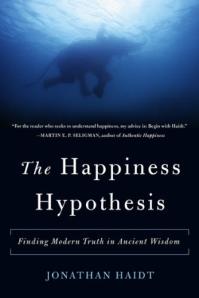
I’m just finishing Jonathan Haidt’s The Happiness Hypothesis, which Baltimore Bookworm already does a great job of summarizing.

Naturally, I’m especially interested in what Haidt has to say, for instance, about the uses of adversity in life (he gives an entire chapter to it), since that fits one of the impostors in my book.

But, since I can’t help but think about book titles these days, which you may have noticed here and here, I found myself lamenting the title that Haidt’s publishers forced on him. The book is not just about happiness, and hypothesis, no doubt meant to sound mysterious, is too academic to hit me in the gut. Instead, it occurred to me, there is a much more obvious title that Haidt’s publisher, Basic Books, could have chosen.

Haidt gives us, above all, a great extended metaphor for our psyche as consisting of a huge elephant  and a little rider on top. Hence the cover image you see here. The elephant is that part of our brain/mind that we’re hardly aware of but that is actually in charge most of the time. The little rider is our intellectual brain/mind, which evolved much later and which does its best to drive the elephant but most often just ends up having to go where the beast goes. In all those cases, the rider’s main skill is to confabulate (Haidt’s word) a story to explain to himself why he, the rider, really wanted to go where the elephant went. You see, he couldn’t possibly admit to himself that he, as mahout, is not in control. In other words, we are great at fooling ourselves. We do things for reasons we barely understand, and then retroactively concoct a logic that makes the action sound plausible, to ourselves and society.

So, if the metaphor was good enough for the cover image, why not for the title? In my opinion, the book should have been called:

The elephant and his rider: What really drives you, and why you lie to yourself about it.

(And, because this is the Hannibal Blog, one more reason why I like the cover image: This is how you must imagine Hannibal’s mahouts riding their elephants across the mighty Rhone river, while under attack from Gauls on the far side. Most of the mahouts drowned. But the elephants, natural  snorkelers that they are, made it across. Having crossed the stream thus, Hannibal was able to take them onwards to the Alps, and then…. well, you know. More about his elephants here.)
Bookmark and Share