“I sense an obsession…”

So I’m haggling with an editor of mine about the word count of the two pieces I am writing for the next issue of The Economist. Writers always want more words; editors want fewer words (they’d rather run more articles).

In this case, I lobbied passionately for one of the ideas, leading the editor, who happens to be the same one I’ve previously highlighted for her British humor, to comment that

I sense an obsession, and feel it may be good to indulge it.

With that, she upped my word count by 20%.

This is another instance not only of charm and British humor but also of good editing. Even if you are a writer editing yourself, it is good advice:

Sense your obsession, then indulge it. It may be infectious.

Bookmark and Share

Success vs popularity: genius or slut?

James Patterson

Using the example of James Patterson, an apparently über-successful author of whom I had never heard, Mark Hurst recently made me think once again about my definition of success.

To paraphrase and amplify Mark’s point, would you rather …

  • create something truly yucky — something that you’re secretly ashamed of because you have good taste and know better — which nonetheless becomes a blockbuster?
  • or something that you are proud of, something you consider sublime, even if relatively few people agree or even notice?

As Mark says, this dilemma could appear in any walk of life:

You could be creating websites or software, or writing books, or designing products, or teaching classes, or producing events, or seeing patients. Whatever the case, what would you rather result from that experience: to be popular, or to create something that you yourself would be happy to receive?

If you answer “I’d like to do both” you’re cheating. The conundrum presents itself to all creative types sooner or later precisely because they must, at least sometimes, choose between the two options.

How to sell 14 million books

Which brings us to Patterson, who sold 14 million (!) books last year, as this profile claims. He published 9 books last year, and will publish 9 more this year. In fact, he is a book machine, an assembly line, a conveyor belt.

Literally: He uses “co-authors” to do the actual writing and “manages” the process rather as the boss of, well, an assembly line does.

Patterson is no boor. He himself reads both light and heavy fare, including Joyce. But when it comes to his own books he takes the approach of an advertising man. In fact, he start as an ad man, at J. Walter Thompson. He personally wrote and produced the TV ads for his early books.

He takes a marketing approach to everything from the story and characters to the jacket design, which tends to be

shiny, with big type and bold, colorful lettering — and titles drawn from nursery rhymes (“Kiss the Girls,” “Pop Goes the Weasel,” “The Big Bad Wolf”), with their foreboding sense of innocence interrupted. “Jim was sensitive to the fact that books carry a kind of elitist persona, and he wanted his books to be enticing to people who might not have done so well in school and were inclined to look at books as a headache …  He wanted his jackets to say, ‘Buy me, read me, have fun — this isn’t “Moby Dick.” ’ ”

Take that, Melville.

Patterson also does scientific market research:

Instead of simply going to the biggest book-buying markets, he focused his early tours and advertising efforts on cities where his books were selling best: like a politician aspiring to higher office, he was shoring up his base. From there, he began reaching out to a wider audience, often through unconventional means. When sales figures showed that he and John Grisham were running nearly neck and neck on the East Coast but that Grisham had a big lead out West, Patterson set his second thriller series, “The Women’s Murder Club,” about a group of women who solve murder mysteries, in San Francisco.

In other words, he does not conceive a story and wait for an audience; he finds an audience and tailors a story for it.

In this way, he practically took over Little, Brown, once a respected literary publishing house, where he now has a dedicated staff that answers only to him. A former boss of Little, Brown

says she was continually surprised by the success of Patterson’s books. To her, they lacked the nuance and originality of other blockbuster genre writers …

Then again, she is the former boss.

Patterson’s style, you ask? The profile describes it as

light on atmospherics and heavy on action, conveyed by simple, colloquial sentences. “I don’t believe in showing off,” Patterson says of his writing. “Showing off can get in the way of a good story.” Patterson’s chapters are very short, which creates a lot of half-blank pages; his books are, in a very literal sense, page-turners. He avoids description, back story and scene setting whenever possible, preferring to hurl readers into the action and establish his characters with a minimum of telegraphic details.

Does Patterson mind that he is not considered, you know, literary?

“Thousands of people don’t like what I do,” Patterson told me, shrugging off his detractors. “Fortunately, millions do.” For all of his commercial success, though, Patterson seemed bothered by the fact that he has not been given his due — that unlike King or even Grisham, who have managed to transcend their genres, he continues to be dismissed as an airport author or, worse, a marketing genius who has cynically maneuvered his way to best-sellerdom by writing remedial novels that pander to the public’s basest instincts. “Caricature assassination,” Patterson called it.

How, then does he, explain his success? He makes his books

accessible and engaging. “A brand is just a connection between something and a bunch of people,” Patterson told me. “Crest toothpaste: I always used it, it tastes O.K., so I don’t have any particular reason to switch. Here the connection is that James Patterson writes books that bubble along with heroes I can get interested in. That’s it.”

Now, as a bonus for those of you who are not only reading a blog but writing your own:

“I have a saying,” Patterson told me. “If you want to write for yourself, get a diary. If you want to write for a few friends, get a blog. But if you want to write for a lot of people, think about them a little bit. What do they like? What are their needs? A lot of people in this country go through their days numb. They need to be entertained. They need to feel something.”

And isn’t that interesting? I once wrote that the first rule of good writing is not to care about your readers, but that it needs to be tempered with the second rule of good writing, which is to have empathy.

Patterson, it might seem, proves instead that empathy is all.

Oh, wait. That gets back to the dilemma. Are we talking about good writing or popular writing, and do we care?


Bookmark and Share

Better writing through forced retelling

I once wrote a tongue-in-cheek post called “How I Write“. (Answer: In the Lotus position.)

Well, it turns out that there is a more serious project by that title going on in the English Department at Stanford, where successful writers talk about how they write. One of them is Robert Sapolsky, the same genius neuroscientist I mentioned in the previous post.

Of note in the long transcript is the crucial importance of rewriting — editing yourself. Compare what Sapolsky says below to how Khaled Hosseini, author of the Kiterunner (which is also published by Riverhead, as my book will be), talks about rewriting in successive drafts.

Here goes Sapolsky (emphasis is mine):

… I was not particularly into writing, and it was not until after I finished college—right after, a week after graduation—I went off to Africa for a year and a half to begin to get my field work started, which I have been doing ever since for twenty-five years and it was fairly isolated site, where a lot of the time I was by myself. I would go 8 to 10 hours a day without speaking to anyone, I would get a mail drop about once every two weeks or so, there was no electricity, there was no radio, there was no anything, and I suddenly got unbelievably, frantically dependent on mail. So as a result you wind up sending letters to every human that you have known in your life in hopes that they would write back to you. …  So you would write to somebody about it, and then you would write to the next person about it, and you would realize that before the end of the day, you had just written 25 versions of it, each of which was a page and a half long. … I would get incredibly bored with the damn thing and would thus start editing and make it more concise, and all of that, and you could sort of see it shrinking until it was half an aerogram, and then I would have to come up with something else to say. So I think just sort of in passing it kind of forced me to start editing.

Interviewer: And so, yeah, you started editing and went through a process of revision actually forced by duplication…

RS: Yes.

Interviewer: …rather than the need to get it right. Just the need to do it again

RS: And the need to get it shorter and get out of there….

Another thing of note to me — an avowed generalist and never a specialist (not even in the subject matter of my own book) — is how Sapolsky explains his incredible skill at translating complex science into storytelling for non-scientists:

Umm…well this is going to sound silly, but I was actually not terribly well-trained as a scientist in college; I was much more of the social science type, so I actually never took any chemistry or physics in college and don’t have a very good fundamental grounding. So I am easily panicked in my science and I think thus I can easily imagine more readily than most people in my position how somebody else can be. …

Bookmark and Share

Emphasis & beauty: More … or less?

Today, two questions for you to ponder:

  1. To emphasize something (an idea, a word, an image, a sensation, anything), should you add or remove?
  2. To make something more beautiful, do you need to add or remove?

So this is a post about adding and removing.

I come at this, naturally, from the perspective of a writer. And as you might remember from my post about “color in writing,” I like to use art as an analogy for writing. Of course, I could also use sound, or smell, or touch or taste — but that is harder to do on a blog. So let’s think about words as visual stimuli.

I. Zen writing or Thai writing

Look at those two temple scenes above (both from Wikipedia). I’ve been to both temples. Both are Buddhist. One is in Kyoto, Japan, the other in Chiang Mai, Thailand. Both cities are among the most beautiful I’ve ever seen.

All of that is beside the point. If you’re like me, you will immediately focus your glance on one object: the pile of sand (or was it pebbles?) in front of the Kyoto temple. You will then scan the Thai temple for something to focus on … and give up, returning to the pile of sand.

Which style, the Zen or the Thai, is better at emphasis?

The Zen, of course. And it does that by removing details, the better to show one stunning detail.

The Thai style, by contrast, is not interested in emphasis. It is interested in sensual barrage.

So, although both are nominally Buddhist, you realize that the two styles present two separate conceptions not only of aesthetics but also of religious experience. If you are like me:

  • the Zen experience leaves you serene,
  • the Thai experience leaves you stimulated.

(Incidentally, you will generally find the same contrast between Japanese and Thai food.)

Is one “better” than the other? That’s not a fair question. But life isn’t fair, so I will answer it. The Zen aesthetic is superior.

Now, let’s say you are a designer of temples (= writer). You better know at the outset which experience you’re trying to create. If you’re trying to make people serene, you better not incorporate any “advice” from the Thai guys; if you’re trying to stimulate, don’t listen to the Japanese.

Put differently: author, know thyself.

II. “Baroque” writing or “Baroque” writing

Let’s take another example. The caricature of Baroque and Rococo art is that they are overly ornate — Thai, rather than Zen, if you will.

This abbey in Ottobeuren, Bavaria, near where I grew up, is an example:

Do you see the wound of Jesus on the ceiling?

Didn’t think so.

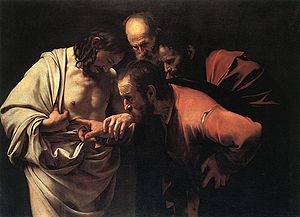
Now let’s try this famous painting by Caravaggio, also nominally “Baroque”:

Do you see the wound of Jesus? Of course you do. You see nothing else.

Which is “better”? Again, it is not a fair question, and let me answer it anyway. The Caravaggio is better. It is superb, in fact, one of the best paintings in art history. Ottobeuren is kitsch (which doesn’t prevent hordes of American tourists from visiting it).

But in the interests of fairness, I must qualify that the intent of the two artists was different:

  • The purpose of Ottobeuren is to overwhelm you when you come in.
  • Caravaggio’s purpose is to focus your attention on one action — with light, detail and gaze (ie, that of the disciples) all subservient to that purpose — so that you contemplate a story around that action.

What would Caravaggio have done if his patron had asked him to put, oh, a little angel or curlicue in the upper right hand corner, to “make better use of that space”? Caravaggio would have ignored him.

III. Microsoft or Apple

Let me sign off on this little meditation with the famous spoof of Microsoft “improving” Apple’s iPod packaging. As you watch and smirk, think of your Powerpoint presentation, your corporate memo, your essay, your book or whatever: Are you going to commit, with courage, to the point you want to make? Well, then cut the crap. Get Zen. Put the finger in it.


Bookmark and Share

Manuscript, Round Three, with “lessons”

And it’s off. Last night I sent the third draft of my book manuscript to my editor at Riverhead.

I’m pleased.

In this draft, I addressed the two issues that my editor raised a month ago:

  1. I made the tone consistent throughout the whole book. Neither too formal nor too informal; sophisticated but simple; myth-like in the appropriate places, accessibly modern in the other parts; personal but intellectual.
  2. I clarified “lessons” without falling off the cliff of cliché.

Since my editor “bought” my book idea two years ago, we have been playing a little game.

He has been pushing me to be more explicit about the lessons about success and failure that arise from the biographical stories I tell.

I have been coy, feeling that “lessons” are always corny and banal, and that what I’m really doing is inviting readers to “meditate” along with me on timeless stories in which they recognize themselves.

Well, I think I have succeeded at merging those two instincts. Can’t wait to hear if my editor agrees. 😉

Bookmark and Share

Bad writing in the mainstream press

[picapp align=”none” wrap=”false” link=”term=michael+kinsley&iid=1786394″ src=”1/e/8/a/Reporters_In_CIA_d2be.jpg?adImageId=8903306&imageId=1786394″ width=”234″ height=”309″ /]
Michael Kinsley, a witty and incisive journalist formerly of Crossfire and Slate, has an amusing critique in The Atlantic of the awful writing that dominates so much of America’s “mainstream media.” My only regret is that he was so gentle, by Kinsley standards.

I have long felt the same way, especially since I taught a course at Berkeley’s Graduate School of Journalism, where a lot of the students in my class were already “spoiled” by the same conventions that Kinsley here lampoons. And yet, I could not dissuade my students from using those conventions. So they produced over-long and corny writing that you might find, well, in the New York Times.

What are those conventions? First, says Kinsley, grandiose verbiage:

Once upon a time, this unnecessary stuff was considered an advance over dry news reporting: don’t just tell the story; tell the reader what it means. But providing “context,” as it was known, has become an invitation to hype. In this case, it’s the lowest form of hype—it’s horse-race hype—which actually diminishes a story rather than enhancing it.

Next, the convention of banal, pointless and stupid quotes from “experts”, which repetitively restate what the article’s author has already stated, and where identifying the speaker takes up more words than are in the (unnecessary) quote. Example:

“Now is the chance to fix our health care system and improve the lives of millions of Americans,” Representative Louise M. Slaughter, Democrat of New York and chairwoman of the Rules Committee, said as she opened the daylong proceedings. (Quote: 18 words; identification: 21 words.)

Why? Because in this American convention,

it’s not [the reporter’s] job to have a view. In fact, it’s her job to not have a view. Even though it’s her story and her judgment, she must find someone else—an expert or an observer—to repeat and endorse her conclusion. These quotes then magically turn an opinionated story into an objective one.

Compare this with our view on quotes at The Economist:

…all meaningless and trivial quotes should be excised … I cannot abide the constant oscillation between (a) serious reporting, and (b) meaningless quotes by non-entities. All I want is the story, clear and concise and preferably with a bit of style. As soon as I get to “Joe Bloggs, an accountant, says ‘these are big numbers’”, I turn over the page… In general, our rule with quotes should be that either the singer or the song should be interesting.

Back to Kinsley. The next stupid convention is the equivalent of what the software industry calls “legacy code”, meaning yet more verbiage

written to accommodate readers who have just emerged from a coma or a coal mine. Who needs to be told that reforming health care (three words) involves “a sweeping overhaul of the nation’s health care system” (nine words)? … Anybody who doesn’t know these things already is unlikely to care. (Is, in fact, unlikely to be reading the article.)

Next, what I (as opposed to Kinsley) call “fake color“, the obligatory “anecdotal lede”, whether it is germane and riveting or not. As Kinsley puts it, these are

those you’ll-never-guess-what-this-is-about, faux-mystery narrative leads about Martha Lewis, a 57-year-old retired nurse, who was sitting in her living room one day last month watching Oprah when the FedEx delivery man rang her doorbell with an innocent-looking envelope … and so on.

Kinsley’s conclusion: Cut out the crap. You might be better.

Bookmark and Share

“Density” he said, and died

David Halberstam

Strange how a voice can simultaneously inspire and haunt you.

As I go through the comments by my editor (at Riverhead, not The Economist) and write a new draft of my manuscript, I am constantly hearing the deep, deep voice of David Halberstam in my head, a voice, as our (The Economist’s) Obituary put it,

as sonorous as gravel shifting underground.

Halberstam was one of the great journalists of our time. He wrote for the New York Times, but perhaps is best known now for his books, above all The Best and the Brightest, about how a room full of smart people got us into a dumb war. His coverage of civil rights, but especially of the Vietnam War, influenced history.

I met Halberstam on April 21st, 2007. It was a Saturday night. Orville Schell, one of my mentors and the dean of Berkeley’s Graduate School of Journalism at the time (where he had invited me to teach), had brought Halberstam to talk to the school. Orville had also booked a table at Chez Panisse for a small group after the talk–he was looking for me in the room to bring me along but I was nowhere to be found (I don’t remember why not), which is one of my great regrets to this day.

Anyway, Halberstam was talking to us about writing and journalism that night. He had that habit that many journalists do, of answering questions with questions. We are inquirers more than opiners.

I was already thinking about writing a book, so naturally I was interested in how he paired journalism and book writing. I wanted to know about his research and writing process, about his approach.

You know your book is getting really good, you know you’re close to finished, Halberstam said at one point, when

you find yourself leaving good stuff on the cutting floor.

Doing so meant that you’ve been putting in so much research and detail and color and anecdote that the book wants to burst. He loved that quality of good writing, which he called

density

That is probably one reason why, all this week, I am hearing his voice say the word density every time I cut good stuff to make my manuscript, well, denser.

But the other reason is that this was Halberstam’s last Saturday night. The following Monday I got an email from Orville announcing that Halberstam, who had survived the jungles of war-torn Vietnam, had died in a car crash on a boring intersection in Silicon Valley, as he was being driven by one of the Journalism School’s students to an interview for the book he was then working on. Just like that.

Bookmark and Share

“The best chapter in the book so far.”

So I’m moving along swimmingly and open Chapter 6 of my manuscript, where I find, above the title, this comment by my editor:

This is the best chapter in the book so far.

Fantastic! He loved the chapter! Everything is great, the book will be a success.

Wait. What was wrong with the previous five chapters? Why weren’t they the best chapters in the book so far?

My god, there is a flaw in the first five chapters. The book will be a failure.

Oh wait, one chapter has to be better than the others.

But which one?

And thus another author goes insane.

Bookmark and Share

WordPress: Plato’s Academy Today

Some of you may have noticed that my thread on Socrates was going strong all through the summer and then, seemingly, stopped. Something similar, you might have thought, occurred with my thread on America.

Well, no, the two threads did not stop. They went into overdrive, albeit in a different form. Indeed, they became a story–what we call a “Christmas Special”–in the new holiday issue of The Economist.

It is called “Socrates in America: Arguing to death“. Please think and smirk as you read it (which also, of course, goes for almost anything you read on The Hannibal Blog).

(A similar, though less pronounced, process led to my other piece in that issue, a sort of polemic against direct democracy. That idea occurred to me after amusing myself, here on The Hannibal Blog, in my thread on freedom, with posts such as this one on James Madison.)

Thank you!

But what am I saying! Nonsense. It was not I, amusing myself. It was we, amusing ourselves.

And that is the point of this post. It is, first, to say Thank You to you, who come here to comment, to teach me, challenge me, tease me.

Those of you who have been readers for a while will see yourselves in my story in The Economist. Cheri will recognize, in the ninth paragraph, the gem that she herself sent to me. Jag will spot, further down, his pun on the Greek word idiotes. Mr Crotchety, who offends the gods by not having his own blog, will see his own worldview–irreverent, humorous, incisive–throughout the piece, since he trained me well in it. Phillip S Phogg, with his deep erudition, subtly worn; Solid Gold Creativity, with her sensitivity and philosophy; Thomas StazykThecriticalline and the Village Gossip, with their almost poetic thought processes;  Peter G, with his outrageous wit; Steve Block with his precision mind; Douglas with his forging inquiry; …. the list goes on and on and on.

Those of you who come sporadically, such as Vincent and Kempton; those of you have come recently, such as Man of Roma, Susan and Dafna; those of you who disappear for a while and resurface months later; and the many, many more who don’t comment at all but just read: all of you have enriched this blog and my mind and my writing.

You are all now co-authors of stories in The Economist and of a book in the making.

Academy 2.0

Which leads me to another insight: Socrates was wrong about one thing, as he himself would gladly concede if he were given a WordPress account: the written word is not inimical to good conversation; text is not necessarily dumb and dead.

What we do here is dialectic, defined as good conversations. What we have here is the Academy that Socrates’ student Plato founded in Athens. Where they ambled in circles and joked and teased and inquired and contested and thought, we do the same thing here on our blogs, minus the ambling.

And there is something new and special about these conversations. I have debated in many settings–the famous “Monday morning meetings” at The Economist in 25 St. James’s Square, London, being a notable one.

When you practice dialectic in those settings, in the flesh, you are always aware who is speaking as well as what is being said. Often this adds an impurity into the mental flow. Are we paying more attention to somebody of higher status or rank, less to somebody who is new? Are we distracted by a twitch, a snort, a sniffle? A curve, accentuated by a fabric, reminiscent of a …

Here there is none of that. With one single exception, I have met none of you in person. (And is that not amazing?) Here, the only thing that matters is what, not who.

Put differently, here in this modern and more pure academy, we all feel safe:

  • safe to contradict ourselves,
  • safe to take intellectual risks,
  • safe to fail and advance,
  • safe from embarrassment.

We exist on our blogs, between which we skip and link and flit like thoughts across neurons, through our words and associations, our minds and thoughts alone.

Here, we are each equal with Socrates.

Bookmark and Share

The manuscript: Round III

And the manuscript is back again. Five months after I received his comments on my first draft, and three months after I sent him my second draft, my editor at Riverhead has now sent me his comments for the third (and perhaps final?) draft.

They’re very good comments, once again. We’re now trying to figure out two things:

  1. How to make the tone consistent throughout the entire 100,000-word story. Right now, as my editor puts it, the book reads “overly serious in some passages, too informal in others.”
  2. How explicit to make the “moral” of each chapter. Not enough, and you sacrifice oomph and clarity. Too much, and you dumb down the story or make it corny and banal.

Both are points that all writers struggle with, I stipulate.

Number 1, in particular, is interesting: In my day job at The Economist, I write short articles in a single day at a time, and always in the same tone and voice. But my book was written over many, many days, and I felt different on each one (and was using my personal voice). Some days, I had my tongue in my cheek; others, I was doing deep thinking.

You see that on this blog, of course. Its tone has changed a lot over the 17 months or so that I’ve been writing it, and each post has its own mood. On a blog, that’s allowed, and even fun.

My book, however, should not be like that. It should have variety, but one steady and reassuring voice. As it turns out, that’s surprisingly hard to achieve.

Bookmark and Share