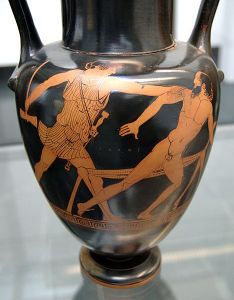
Procrustes was famous for his bed. He invited passers-by to spend the night and to lie* in his bed. The bed was always too short or too long. So Procrustes “adjusted”, not the bed, but the guest as he was sleeping. He either stretched the guest (Procrustes = ‘the stretcher’) or cut off his legs.
Theseus eventually dealt with Procrustes by making him, Procrustes, fit his own bed. So there.
But from this myth we have the great term Procrustean bed. It applies whenever we force something into a size or a result (as with statistics) that is not natural and thus incorrect or inelegant.
I was thinking of the Procrustean bed once again while writing my piece for The Economist this week.
You recall my musings on the subject of a text’s optimal length, and how important it is neither to go under or over it. Well, in most print media, and certainly in The Economist, lengths are fixed in advance. What determines wordcount is the line count in the page layout of the print edition, which is done before the editor even has the “copy” (article) in question.
In my 12 years at The Economist I have, as you might expect, become very good at writing ‘to length’–ie, at delivering copy that fits exactly (thus evading any Procrustean tendencies by editors). Often I even enjoy the discipline of that constraint.
But it increasingly strikes me as bizarre, indeed unsustainable: We invariably cut good stuff out of articles, add unnecessary words to ‘turn lines’, or even entire paragraphs to fill a page when a chart shrinks. Sometimes this means sacrificing color and detail, or even logical connectors. Other times it means adding noise to signal.
And what happens next? People read the print edition, then pulp it. So much for the beautiful page layout.
But the same text survives forever online, where it faces no obvious layout constraints. Thus, all posterity reads a suboptimal text, stretched or amputated as Procrustes’ guests were.
The ancients (Homer, Virgil, etc) did not have this problem. They (or rather, their slaves) wrote on scrolls, which scroll as our web pages do, into infinity if necessary. Perhaps our evolving media habits will take us back to that future.
I’m reading Wolf Hall by Hilary Mantel right now. It’s a historical novel about the efforts by Henry VIII of England and Anne Boleyn to annul Henry’s marriage to Catherine of Aragon, his first wife, so that he and Anne could marry instead and–so it was hoped–produce male heirs.
The rest, you might say, is history. What stood in Henry and Anne’s way was the Catholic Church, ie the pope, so Henry had to “fire” the church and start a new one, the Church of England, whence sprang Anglicanism and its offshoot, Episcopalianism.
The new marriage, however, was not, ahem, ideal and Henry went on to have a few more wives, while Anne, and an awful lot of other people, lost their heads.
In short, it is a fantastic topic, a fantastic story! The sort I love, because it is simultaneously:
grand and important, and
riveting and engrossing.
If it were entertaining but trivial, I probably would not bother, because life is short and I want to spend it on important things. If it were important but boring, I also might not bother, because, well, life is short and I want to minimize my pain.
Anne Boleyn
So by being important and riveting, Mantel’s topic is exactly like the events that I chose as the main storyline in my own forthcoming book, ie the Punic Wars that led to the rise of Rome and the fall of Carthage. And this is one reason why I chose to read Wolf Hall. I wanted to see Mantel’s storytelling.
The other reason is that the book won the Man Booker Prize, one of the most prestigious awards in the English-speaking world. I distrust prizes, but at the same time they do promise to make our lives easier by pre-winnowing some of the wheat from the chaff. Othershave taken their cue from the prize and are heaping more praise. So I started reading.
What a disappointment
I’m half-way through the book now, at page 200-and-something, and boy, is it hard work.
I read, I get confused, I go a few pages back to see if I missed something, discover that I did not, struggle on, get tired, fall asleep, try again the next day.
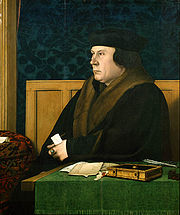
Thomas Cromwell
Here are the problems, as I see them:
Who the heck is speaking? Dialogue is difficult to write and separates great writers from mediocre ones. Mantel tells the story through the eyes of Thomas Cromwell, an influential lawyer and wheeler-dealer behind the scenes. She therefore makes him a default he in the story. The problem is that there are lots of other hes (ie, men), and when several men are talking, we don’t know which he is thinking, talking, doing whatever he is doing. This sounds banal, but it is annoying. It does not help that everybody is named Thomas (that’s not Mantel’s fault, of course).
Who are all the people and why should I care? Mantel assumes that I already know all the characters, the chief ones being Cardinal Thomas Wolsey, Thomas More, Thomas Cranmer, Jane Seymour, the Dukes of Norfolk and Suffolk and so forth. As it happens, I love history and have indeed heard of most of them before, but my knowledge of this era has got rusty. I wanted it to be Mantel’s job to re-introduce me to these people so that I don’t have to make an effort.
What is the historical context, ie the import? Mantel assumes that we already know the interrelationships and geopolitical constellations between the Holy Roman Empire; the papacy; the French, Spanish and English kingdoms; and so forth. As it happens I do, sort of, know about these matters–at least more so than Mantel can expect from most readers–and it still does not suffice.
Thomas Wolsey
So I took time out and resorted to … Wikipedia. Yes, I did. I spent a good hour last night reading all the main characters’ entries, as well as brushing up on why, say, the Archbishop of York had less power than the Archbishop of Canterbury or who the heck a “Lord Chancellor” was again, and other matters that Mantel does not deign to make clear.
Hilary: Is that what you want your readers to do–go to… Wikipedia????
As it happens, it worked and Wikipedia did give me the context I need. But what an indictment of Mantel’s storytelling technique. The whole premise of books like this is that you get the history and the humanity, the importance and the drama, at the same time.
Hilary, you seem to be too busy being ‘literary’–with complex points of view, revisionist interpretations and what not–to hold me by the hand. You were supposed to make it easy for me. You did not.
Virgil, the great poet of the Aeneid, has already appeared on The Hannibal Blog for his amazing capacity to inspire authors ancient, medieval and modern. And he will appear a lot more anon.
But today let me simply relate to you a little anecdote about Virgil’s method of writing. It comes from Lecture I, Minute 45, of this excellent iTunes U course on the Aeneid.
Virgil worked, as all ancient poets (eg Homer) would have done, by speaking verse out loud while a slave or two transcribed his words.
His style was to come up with perhaps 20 or so lines a day, but then to edit, cut, change those lines relentlessly until only about 3 lines were left at the end of the day.
Some ancient literary critic commenting on this self-editing said that Virgil was like
a she-bear licking her cubs.
To those of you who are writers: Isn’t that a great metaphor?
Readers of blogs don’t expect essays. They expect short, bite-sized nibbles, somewhere between the thought fragments on Twitter and the polished articles in a magazine.
Or perhaps 250 words is simply what fits onto one screen on most laptops and browsers, and blog readers don’t expect to have to scroll down.
In any event, I (who have written a 110,000-word book and think nothing of reading 500-page books) have discovered that I find it difficult to get through long blog posts. They tire me out. And I have noticed the irony that when I last opined on length, as opposed to depth, in writing, it took me 1,008 words to praise… brevity!
Polonius, the father of Ophelia and Laertes in Hamlet, did it better, of course:
brevity is the soul of wit,
And tediousness the limbs and outward flourishes.
So I’ll try to keep my posts shorter. This one, as you may have guessed, is exactly 250 words long.
I have been pondering a recent comment by Phillipp S Phogg to the effect that, if I may amplify it, what I write on the Hannibal Blog is sometimes more fun than what I write in The Economist. Or, as he put it:
the very opposite of the blandness (and dare I say, triteness?) which permeates some (but not all, I hasten to add!!) of the Economist’s erudite and worthy pages.
Bland
Trite
Worthy
Ouch. No publication, writer or editor would want to be caught anywhere near those adjectives–especially the devastatingly faint-praising worthy.
Well, one of the minor purposes of this blog (besides the main one, which is to talk about my book once it comes out) is to let those of you who are fans/foes of The Economist speak truth to power in a safe setting.
Furthermore, this is the time for me to admit that I myself occasionally feel as Phillip Phogg does. And that frustrates and saddens me.
It also makes me think deeply about such evergreen writerly topics as style, voice, tone, and storytelling, because that’s what this seems to be about.
The Economist appears to succeed in part because it promises and delivers to its readers analysis that is:
disciplined, not florid;
terse but deep;
occasionally quirky but not self-indulgent.
Permit me to contrast that with, say, The New Yorker, which promises, and mostly delivers, storytelling that is
occasionally quirky and unapologetically self-indulgent.
What that means for me as a writer for The Economist is that I usually do the same research as writers for the New Yorker but then leave most, or even all, the “fun stuff” on the cutting floor to maintain the discipline of, say, a 600-word note.
This is frustrating. As a writer, I often know that I could spin a thrilling yarn out of my experiences during research but as a correspondent for The Economist I know that much of it is inadmissible. (There are exceptions, such a piece I have written about Socrates for our upcoming Christmas issue, which arose out of a thread here on the Hannibal Blog and is almost pure, unadulterated fun.)
One device that writers for the New Yorker (just to stay with that example) have but that we lack is the First Person, ie the “I”. I have said before that I consider the First Person “treacherous” for young writers because it subverts discipline. It is a good idea to learn to write without using “I” and “me”. That said, I have also discovered, on this blog and in my book manuscript, that the First Person makes certain things easier. One of those things is authenticity. Another is fun.
But it goes beyond the First Person and into storytelling. Occasionally, we do great storytelling in the pages of The Economist. But often we don’t, because that is not always the main objective.
But implicit in those elements is detail, also known as color. I have said before that color can be excessive and is best used sparingly, as in a good Rembrandt painting. But sparing does not mean monochrome.
Perhaps, when we fall short at The Economist it is because we overdo the sparing. Perhaps we should do more First Person narrating (which does not necessarily require us to give up our anonymity). Perhaps we should paint in more color.
In the next post, let me try to illustrate what I’ve been talking about in this post by looking at the back story behind one of my pieces in the current issue of The Economist.
But as with everything, there is a way to misunderstand that insight. Yes, there are elements that are common to Homer’s Odyssey and Iliad, to the Grimm stories and to Heidi–elements such as a hero who goes on a quest and meets a wise old man and so forth….
But that does not mean that one single story can summarize a life, a person, a place or a country. The opposite is the case. There must be an infinite number of stories, even if they all have something in common.
The attractive Nigerian novelist Chimamanda Ngozi Adichie gave a great TED talk (below) about exactly this. As a girl in Nigeria she read and loved British and American books and stories and began to write stories herself at the age of 7. But her stories were about … white, blue-eyed girls who played in the snow and ate apples and talked about the weather and whether it might turn nice. Even though she had never left Nigeria!
She eventually realized
how impressionable and vulnerable we are in the face of a story.
Stories had overpowered her own perception of the world. She assumed that stories could not be about brown people eating mangoes in the sun but had to be about white people eating apples in the rain.
Emancipation occurred when she realized that
people like me … could also exist in literature
But that was only the beginning. She understood that many people have only one single story about Africa (= catastrophe), and that she did not fit into that story. She realized that she herself had only one story about Mexico (= illegal immigrants) which proved woefully inadequate. She realized that some people, such as her American college roommate, had only a single story about her, Adichie from Nigeria (= exotic tribal woman), and that she herself simultaneously had only one single story about her own family servant (= pitiful poor boy), which also proved incomplete. She understood that
power is the ability not just to tell the story of another person but to make it the definitive story of that person,
and that
the single story creates stereotypes, and the problem with stereotypes is not that they are untrue but that they are incomplete… It robs people of their dignity.
So consider this a refinement of my views on storytelling. We must be open to many, many, many stories even as we see the common, universal humanity that runs through all of them. Now take 18 minutes and watch:
I’m happy with it. But of course I am again on tenterhooks, and feeling quite vulnerable, as I await the reactions of my editor.
The improvement was dramatic. I am reminded again of what Khaled Hosseini, also a Riverhead author, said about writing and rewriting: the first draft is purely a frame. The book happens in the subsequent drafts.
Still, I can’t help but wonder also about the law of diminishing returns: Would I be able to make such a dramatic improvement again in a third draft? Or is this where the book wants to be? Am I perhaps … done?
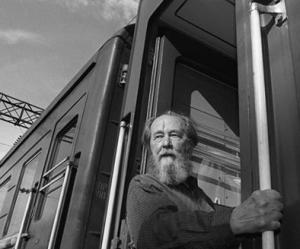
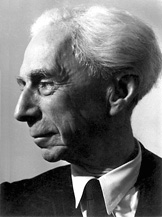
In other words: Aleksandr Solzhenitsyn, John McCain, J.K. Rowling, Hercules, Bertrand Russell and the Dalai Lama.
Answer: They are people whose “lives” or stories I have cut from the second draft of my book manuscript.
Now, I am entirely aware that seeing these people on the same list is bizarre to begin with. What could they possibly have done in the same book–my book-in the first place? Why would I cut them out now? And who might be left?
I’m not at liberty to answer these questions right now, but I will say this:
Good writing and editing is in part about “crucifying your darlings,” as Ed Carr, one of my editors at The Economist, once said to me. And I have decided–boldly and without regret–that my book will be better with fewer lives.
Less is more, in other words. The total word count has stayed the same, but I have gone much deeper into the characters I have chosen, and have done a much better job weaving them together into precisely the narrative about success and failure that I am trying to produce.
I am very happy with the story that’s emerging. This, to me, is the fun part. How absurd that must sound to everybody else.
One of the most important dialogues in all of literature, all of history is the so-called “Melian dialogue.” Its subject is power.
Its author was Thucydides, whom I’ve introduced before. He was a contemporary of Socrates, a general in the Peloponnesian War between Athens and Sparta, and of course the preeminent historian of that war. He is also considered the world’s first Realist.
I’m using that word in the context of International Relations and Political Science, as distinct from Idealism. All later Realists, from Thomas Hobbes to Machiavelli and Henry Kissinger, owe an intellectual debt to Thucydides.
1) Background
The dialogue is supposed to have taken place in 416 BCE, roughly in the middle of the long war between Athens and its allies (mostly the islands and ports around the Aegean) and Sparta and its allies (mostly the land-locked cities of the Peloponnese).
One life time earlier, the Athenians, Spartans and other Greeks together had kicked out several huge Persian invasion armies. This was the beginning of Athens as a superpower. Democratic and idealistic at first, Athens quickly became nakedly self-interested and arrogant and dominated its allies as though they were vassals. That alliance was called the Delian League, but it was really an Athenian Empire. Here is a map of it, before the outbreak of the Peloponnesian War:
If you click through to enlarge the map, you will see the tiny island of Melos in the southern Aegean, just outside the line demarcating the Athenian Empire. Melos was a Spartan colony but otherwise neutral. It was sort of a tiny Switzerland. It wanted to stay out of the troubles.
The premise of the dialogue is simple: The Athenians send a fleet to Melos and flatly demand that Melos bow to Athenian power and become a vassal or else be ethnically cleansed.
The Melians appeal to higher ideals (hence Idealism) such as justice.
In the course of the dialogue, excerpts of which I am about to give you, the Athenians and Melians use all the arguments that Realists and Idealists have been using ever since.
And then, Thucydides ends with one of the most abrupt–but, I believe, intentional and genius–codas in literature. But let’s wait till we get to that.
2) The dialogue
Notes:
You can read the full version here, but I have cut it for ease of use
Glossary: Lacedaemon = Sparta. (Laconia is the area around Sparta, whence “laconic”, since the Spartans didn’t apparently say more than necessary.)
Athenians: … we shall not trouble you with specious pretences … and in return we hope that you, instead of thinking to influence us by saying … that you have done us no wrong, will aim at what is feasible, holding in view the real sentiments of us both; since you know as well as we do that right, as the world goes, is only in question between equals in power, while the strong do what they can and the weak suffer what they must.
Melians: … you should not destroy what is our common protection, the privilege of being allowed in danger to invoke what is fair and right….
Athenians: … We will now proceed to show you that we are come here in the interest of our empire, and that we shall say what we are now going to say, for the preservation of your country; as we would fain exercise that empire over you without trouble, and see you preserved for the good of us both.
Melians: And how, pray, could it turn out as good for us to serve as for you to rule?
Athenians: Because you would have the advantage of submitting before suffering the worst, and we should gain by not destroying you.
Melians: So that you would not consent to our being neutral, friends instead of enemies, but allies of neither side.
Athenians: No; for your hostility cannot so much hurt us as your friendship will be an argument to our subjects of our weakness, and your enmity of our power.
Melians: Is that your subjects’ idea of equity, to put those who have nothing to do with you in the same category with peoples that are most of them your own colonists, and some conquered rebels?
Athenians: As far as right goes they think one has as much of it as the other, and that if any maintain their independence it is because they are strong, and that if we do not molest them it is because we are afraid; so that besides extending our empire we should gain in security by your subjection…
Melians: … if you debar us from talking about justice and invite us to obey your interest, we also must explain ours, and try to persuade you, if the two happen to coincide. How can you avoid making enemies of all existing neutrals who shall look at case from it that one day or another you will attack them? …
Athenians: … it is rather islanders like yourselves, outside our empire, and subjects smarting under the yoke, who would be the most likely to take a rash step and lead themselves and us into obvious danger.
Melians: … it were surely great baseness and cowardice in us who are still free not to try everything that can be tried, before submitting to your yoke.
Athenians: Not if you are well advised, the contest not being an equal one, with honour as the prize and shame as the penalty, but a question of self-preservation and of not resisting those who are far stronger than you are.
Melians: … to submit is to give ourselves over to despair, while action still preserves for us a hope…
Athenians:Hope, danger’s comforter, may be indulged in by those who have abundant resources … [But] you, who are weak … hang on a single turn of the scale…
Melians: You may be sure that we are as well aware as you of the difficulty of contending against your power and fortune, unless the terms be equal. But we trust that the gods may grant us fortune as good as yours, since we are just men fighting against unjust…
Athenians: When you speak of the favour of the gods, we may as fairly hope for that as yourselves; neither our pretensions nor our conduct being in any way contrary to what men believe of the gods, or practise among themselves. Of the gods we believe, and of men we know, that by a necessary law of their nature they rule wherever they can. And it is not as if we were the first to make this law, or to act upon it when made: we found it existing before us, and shall leave it to exist for ever after us; all we do is to make use of it, knowing that you and everybody else, having the same power as we have, would do the same as we do…
Melians: … we now trust to [the Lacedaemonians’] respect for expediency to prevent them from betraying the Melians, their colonists, and thereby losing the confidence of their friends in Hellas and helping their enemies.
Athenians: Then you do not adopt the view that expediency goes with security, while justice and honour cannot be followed without danger; and danger the Lacedaemonians generally court as little as possible.
Melians: But we believe that they would be more likely to face even danger for our sake … as our nearness to Peloponnese makes it easier for them to act, and our common blood ensures our fidelity.
Athenians: Yes, but what an intending ally trusts to is not the goodwill of those who ask his aid, but a decided superiority of power for action; and the Lacedaemonians look to this even more than others. … now is it likely that while we are masters of the sea they will cross over to an island?
Melians: But they would have others to send…
Athenians: … we are struck by the fact that, after saying you would consult for the safety of your country, in all this discussion you have mentioned nothing which men might trust in and think to be saved by. Your strongest arguments depend upon hope and the future, and your actual resources are too scanty, as compared with those arrayed against you, for you to come out victorious. … Think over the matter, therefore, after our withdrawal, and reflect once and again that it is for your country that you are consulting, that you have not more than one, and that upon this one deliberation depends its prosperity or ruin.
With that the Athenians left the Melians to make their decision. Let’s just summarize the dialogue briefly:
A: Cut through the crap: might makes right. Don’t waste our time. M: We have a right to invoke justice!
A: We would prefer to let you live, so submit! M: How exactly would submitting be in our interest?
A: Were you not listening? Because you would live!M: Why can’t we be neutral? We would not bother you.
A: Somebody somewhere might think we are weak. M: If you exterminate us, all other neutrals will hate you.
A: Let us worry about that. M: We are not cowards and we want to stay free.
A: For you it’s not about freedom but survival. M: We still have hope.
A: Hope is for the powerful. And you are not. M: The gods are on our side because our cause is just.
A: The gods are just like you and us: They do what power lets them. M: The Spartans will come to our aid.
A: No, they won’t. They know they would lose at sea. M: We think they would send somebody.
A: Enough of this silly nonsense. You make up your mind. Submit or die.
The Melians decided not to submit and to fight. Thucydides then describes at some length the Athenian siege. Eventually, the Athenians overpower the Melians.
And then, in perhaps the most abrupt final sentence in literature, Thucydides simply informs us that the Athenians
put to death all the grown men whom they took, and sold the women and children for slaves, and subsequently sent out five hundred colonists and inhabited the place themselves.
3) Analysis
Style: Thucydides writes the dialogue (admittedly, with my cutting I have accentuated this) a bit as Hemingway does: This is a staccato back-and-forth, not a treatise. We are not teasing out a subtlety of argumentation here. We simply have two sides who are talking past each other, and one side has power whereas the other does not.
Style: Any modern editor would have forced Thucydides to provide more “color” at the end, to make the true horror of the extermination more vivid. Thucydides has none of that. He wants the atrocity to be a mere afterthought. This is the way the world is, he is saying.
Content: Does Thucydides approve of the Athenians? We have no idea. Probably not. Who cares?, he is saying. This is reality.
As most of you know by now, I am an admirer of British irony and wit, the subtler instances of which I occasionally highlight or dissect, as here, here, and here. At its best, it is a matter of tone, not a matter of telling jokes. And it is best delivered casually.
Today happens to be our weekly deadline day at The Economist, and I am right now (thanks to the London time zone that I am forced to observe in California) finalizing my piece in the next issue with one of our editors, Ann Wroe, who happens to be one of my favorites (and who is a successful book author in her own right).
In the piece, I quoted an American think tank whose name starts (as they all seem to do) with “Center For The…”
Ann changed it to “Centre For The…”. I asked: Do we change words to British spelling even when they are names?
And she replied:
Yes, words are anglicised even within proper names; it either has to look odd to us or odd to them, and we opt for them.










 Hannibal and Me: life lessons from history