What Polybius said about the Tea Party

I’ve been spending the weekend talking to various visitors from Europe, and they are, shall we say, fascinated by the American mood this year.

The country, a superpower that is hard for foreigners to ignore even when they try, seems to have gone loony-potty. A movement is afoot that wraps itself in a historic-sounding name, the Tea Party, then feeds on undistilled anger to rebel against… well, it’s not clear against exactly what.

The Hannibal Blog embraces intellectual contradictions as though they were steps in a Jacob’s ladder toward more humble and refined views. The Tea Party, on the other hand, won’t even acknowledge its contradictions. That’s the wrong way to go on a ladder.

And so we return once again to Polybius (Histories, VI, 57), who so influenced our Founding Fathers (those of the real Tea Party), and who seemed, about 2,150 years ago, to have something to say about America in 2010:

When a state, after warding off many great perils, achieves supremacy and uncontested sovereignty, it is evident that under the influence of long-established prosperity life will become more luxurious, and among the citizens themselves rivalry for office and in other spheres of activity will become fiercer than it should. As these symptoms become more marked, the cravings for office and the sense of humiliation which obscurity imposes, together with the spread of ostentation and extravagance, will usher in a period of general deterioration. The principal authors of this change will be the masses, who at some moments will believe that they have a grievance against the greed of other members of society, and at others are made conceited by the flattery of those who aspire to office. By this stage they will have been roused to fury and their deliberations will constantly be swayed by passion, so that they will no longer consent to obey or even to be the equals of their leaders, but will demand everything of by far the greatest share for themselves. When this happens the constitution will change its name to the one which sounds the most imposing of all, that of freedom and democracy, but its nature to that which is the worst of all, that is the rule of the mob.

Bookmark and Share

Hannibal, Fabius & Scipio in Missouri

Don Antonio Soulard, the Spanish surveyor general of what much later became Missouri, seems to be my kind of man.

I would never have heard of him but for Jim Markovitch, a reader of The Hannibal Blog who gets this week’s fist bump for some ad hoc investigative work while driving around Missouri.

As Jim discovered here and here, Don Antonio journeyed up the Mississippi some time around 1800 and, like so many classically educated types in those days, admired the people who also happen to be the main characters in my book:

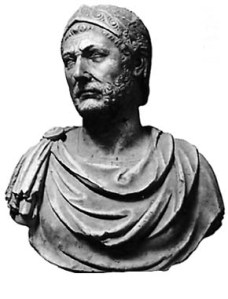
Hannibal (above left),
Fabius (above right) and
Scipio (left).

So Don Antonio named bodies of water after his heroes:

– the Hannibal Creek (now called Bear Creek), site of the eponymous future hometown of Mark Twain;

– the Scipio River (Bay de Charles); and

– the Fabius River (still named that).

And there is of course Carthage, MO, reachable in 5 hours, 34 minutes from Hannibal, according to Jim’s iPhone screen directions. Had Hannibal only had an iPhone when he crossed the Alps!


Bookmark and Share

The Greeks: plus ça change…

Cheri speaks as though from my own heart in lamenting the Greeks. How, oh how, to reconcile their ancient grandeur with their Euro-busting, book-cooking financial profligacy of today?

And then I remembered that passage by Polybius, that great Greek sage, which I reproduce here to cause a smirk rather than offense.

In The Rise of the Roman Empire (VI, 56), he tells us that

among the Greeks… men who hold public office cannot be trusted with the safe-keeping of so much as a single talent, even if they have ten accountants and as many seals and twice as many witnesses, whereas among the Romans their magistrates handle large sums of money and scrupulously perform their duty because they have given their word on oath.

Now, clearly one part of his observation seems, ahem, dated and the other rather au courant. 😉

Bookmark and Share

Carthage’s urns of little bones

When future archeologists, two millennia hence, dig out our civilization — our bombing ranges or nuclear sites, for example — what will they infer about us? Inevitably, their values will be so different from ours that we will seem alien to them. So they will try to refrain from judgment and focus merely on understanding.

We’re in the same situation when we dig out the past. When we dug out Carthage, for example.

We know that the Carthaginians, like their Phoenician ancestors and apparently all Canaanites, sacrificed their first-born sons at times of crisis, apparently to appease gods like Baal and Tanit (roughly Zeus and Juno), Melqart, Astarte, et cetera.

We countenance the story of Abraham and Isaac (Sarah’s first-born though not Abraham’s) in the Bible, allegedly “our” book, largely because Yahweh withdrew his request to sacrifice Isaac at the last moment. But we might just as well contemplate how 1) Abraham had not, up to that point, considered the demand all that  unusual, and 2) how most other situations at the time would indeed have ended with the sacrifice.

We know that the sacrifices were common in Carthage, too, because we found the “tophets”, or furnaces, where the infants were killed. They contain charred, calcified bones of both animals and human children. For a while, we comforted ourselves with theories that they might have burnt stillborn or dead infants, that these were really burial grounds disguised as human-sacrifice altars. But most scholars now believe that they really did, on occasion, kill their own sons, right up to the time of Hannibal.

I just finished Richard Miles’ “Carthage Must Be Destroyed,” a new history of Carthage and a last-minute addition to my bibliography (almost certainly the last, because I’m essentially done).

Admittedly, those of you just getting into ancient history (perhaps through The Hannibal Blog?) might prefer to start with Rome or Greece, but if you’re interested in Carthage, this is as good a history as any. Well-written, not pompous, aimed at normal readers not fellow academics.

Miles deals elegantly with issues like the child sacrifice. He also unifies the entire history of Carthage — from its Phoenician (Tyrian) beginnings to its end in the Roman genocide.

It’s a good book.

Bookmark and Share

French & Anglo-Saxon ways of thinking

French thinking at Villandry

Having spent virtually all of my adult life within “Anglo-Saxon” cultures and institutions (not least in the hyper-English milieu of The Economist), I must have adopted Anglo-Saxon ways of thinking.

And what are those?

In this post, I’ll try to describe them, by contrasting the Anglo-Saxon mind with what I consider to be its foil or opposite.

Which is to say: French thinking.

And I’ll do that with just three little examples plucked from life:

  1. gardens
  2. cities
  3. laws

1) French and English gardens

In 1992, I spend my summer in Tours, France — allegedly learning the local language but mostly biking along the Loire and its tributaries with friends, visiting the various chateaux in that area.

I was twenty-two at the time, and gardening was not necessarily foremost in my thoughts. And yet, the gardens of those chateaux left an impression. That’s because I had an intuition that they explained a lot else I was observing in the country

Look at the garden of the Chateau of Villandry, above. Or look at the same castle from another view:

More French thinking

The principle that guides this and all “jardins à la française” is the expression of mastery over nature.

A landscaper imposes, through his reason, absolute and mathematically Cartesian symmetry and order onto what would otherwise be disorder.

It is a top-down notion of order. In fact, these gardens are best viewed from above, which is why almost all the chateaux are laid out so that there is a viewing platform above the jardins (as in the picture).

English landscaping developed largely in response to French landscaping and spread to many non-French parts of Europe.

The difference is striking. Here, for instance, is a view of the Englischer Garten, a huge park in the center of Munich, where I grew up:

Yup, those are sheep, in the middle of Munich.

Munich’s Englischer Garten was conceived during the Enlightenment by an Englishman, and the German landscapers to this day observe its “Anglo-Saxon” landscaping philosophy. Here, for instance, is a recent addition, a theater:

Let’s try to make the philosophy behind this landscaping style explicit:

If the French approach is to display top-down mastery of nature with an imposition of order, the English way is to integrate the human into nature, to adjust to the spontaneous or “bottom-up” order of nature itself.

The best way to enjoy such a garden is in fact “from below” — ie from the ground. You’re assumed to be in the garden, not looking down on it from above.

To give this the subtlety it deserves: English gardening does not deny the ability of man to create order (after all, there still is a landscaper). But the landscaper takes a much more humble approach to nature, choosing to see order in its disorder and incorporating its “accidents”.

Let me use a different phrase: The English landscaper “muddles through“.

2) Paris and London

Now think of the two cultures’ capitals as a “tale of two gardens,” writ large.

The “landscaper” of modern Paris was Baron Haussmann (Alsatian, hence the German name, but French). Between 1852 and 1870, he imposed order on the medieval street warren that Paris had been.

Here is the new Paris as he conceived it:

Haussmann's Paris

Boulevards (in red) as straight as swords now cut through the organically evolved webbing of streets, to clear vistas and let armies parade.

And that’s not enough. Along these straight boulevards, the houses must meet regulations as precise as Cartesian math. They stand in a row like soldiers being mustered:

Now London:

A century before Haussmann (and shortly after Descartes’ death), medieval London was burnt down in the The Great Fire of 1666. To the French, this would have been an opportunity to remake London in a rational and orderly way. There even was an equivalent of Baron Haussmann: It was Sir Christopher Wren, the great architect of many churches, including St Paul’s Cathedral.

What did Sir Christopher do? It was very English. He largely honored the network of streets as it had evolved over time. Using legal jargon, you might say that he respected stare decisis (“stand by things decided”).

Adhering to precedent, he then proceeded to … muddle through.

And that’s what London has been doing since. This is its street grid today:

In fact, that picture does not do its organic beauty/chaos (depending on your point of view) justice. London, unlike Paris, is not one city (even politically). It is many cities and towns that grew together. Each bit retains its own charms and problems, and the connections are haphazard and arbitrary.

London cabbies, in fact, spend years learning what they call “the knowledge” to navigate this maze. And London’s streetscapes are full of surprises, both positive and questionable:

3) Code Napoléon v Common Law

French law is a code. In some ways it goes back to Roman law, but its direct ancestor is the Code Napoléon of 1804.

Napoleon, being not only French (well, sort of) but a product of the Enlightenment, believed in the power of reason to impose order (here meaning justice) from above on the chaos of life, the infinite number of situations that can arise and must be adjudicated. The result was a document. Here is its famous first page:

Legal thinking in France and all other civil-law systems is therefore a process of deduction: You find the general principle in the code, then apply it to the instance in real life.

English law is not a code. In fact, England does not even have a written constitution (as its Anglo-Saxon nephew America does). Sure, there are statutes, laws written by legislators over time. But the core of the system in all Anglo-Saxon countries is the common law.

And what is it? In essence, it is the history of all former cases.

For about a millennium, the English have been considering each new case by comparing it with precedents, a bit as Sir Christopher Wren built St Paul’s on the site of the former church that had burnt down.

Which issues does this case raise? Aha, then it must be like X. But it is different, so it must also be like Y. And so on.

The process is inductive: The Anglo-Saxon mind starts with the particular, searches for a general principle, returns to the particular, adjusts the general principle, and so forth.

Put differently, the English mind muddles through.

Conclusion: Churchill vs Balladur

This post has been muddling through by inducing from particulars to generals. I will leave you with two quotes by former prime ministers that I think say it all:

Edouard Balladur of France:

What is the market? It is the law of the jungle. And what is civilization? It is the struggle against nature.

Winston Churchill:

The English know how to make the best of things. Their so-called muddling through is simply skill at dealing with the inevitable.

Bookmark and Share

My 12-minute “book teaser”

If you’re taking a 12-minute cappuccino break, watch me give this “teaser” about my book at our (The Economist‘s) recent innovation conference in Berkeley.

(You’ll also find most of the other sessions on video now, including those with Arianna Huffington, Jared Diamond, Matt Mullenweg, et cetera.)

I’m not good at “teasers” or “elevator pitches”, especially since I tried to tell a story in my book that would keep you reading for 100,000 words. But I’m constantly being told that I now have to practice condensing that story into two seconds for some occasions (cocktail parties, elevators), two minutes for other occasions, 10 minutes for yet others, and so on.

So, er, I’m practicing. (Even while determined not to give too much away yet.)

Your feedback would be welcome. Do I snare your interest or do you say ‘so what’? Are there howling non sequiturs, or does it make sense? And so forth.

Bookmark and Share

Arjuna, our inner hero

Here I am playing with Arjuna, the greatest hero of the East, in the form of a wayang puppet I bought in Solo, Java.

Wayang is an ancient Indonesian theater tradition in which the shadows of puppets are cast onto a screen. Solo is its historical center, so a few years ago I went there to watch. Here is what a play looks like from the audience side:

And what story do the Javanese, nominally Muslim today, most like to perform?

The story of Arjuna and his brothers, the five Pandavas, pictured above. It doesn’t matter that this epic, the Mahabharata, is what we would consider a “Hindu” story. It is for Asia what the Iliad and Odyssey and other Greek myths are for us in the West.

This makes Arjuna the Achilles, the Hercules, the Odysseus, the Theseus, the Jason and the Aeneas of the East.

And what does that say about the East’s view of heroism, which I have been exploring in this thread?

1) Arjuna as warrior

At first blush (and deceptively, as you will see), Arjuna’s heroism looks familiar to us in the West.

He was a great fighter, an ambidextrous and precise archer, indeed an Indian Apollo with arrows. He practiced in the dark, the better to hit his victims during the day time. He won the hand of his wife, Draupadi, in an archery contest remarkably similar to the one Odysseus won against the suitors at Ithaca to regain his wife Penelope.

Arjuna was also the biggest hero in the biggest war of mythological India. What Achilles was to the Greeks at Troy, Arjuna was to the Pandavas at Kurukshetra (Kuru’s Field) in northern India.

The Pandavas were leading a huge army in a righteous cause against their own cousins, the Kauravas, also with a huge army. The Kauravas had stolen a kingdom from the Pandavas in a rigged game of dice, humiliating Draupadi in the process. The Pandavas went into exile, but then came back, seeing their duty as fighting to reclaim their kingdom and honor.

For eighteen days, battle raged. Millions died and fewer than a dozen men survived. Blood turned the field of Kuru into red mud. Arjuna and his brothers shot so many arrows into one of their enemies that the man fell from his chariot and landed not on the ground but on the arrows sticking out from his body like the quills on a porcupine.

But Arjuna also lost his own loved ones. His sons and nephews died in the battle, just as the Greek and Trojan heroes lost their friends and family.

2) Arjuna’s fear and duty

But the part of the story that is most famous — rather as the brief episode of Achilles’ wrath in Homer’s Iliad is the best known part of the story of the Trojan War — is a poem embedded into the Mahabharata just before the fighting began. And that is the Bhagavad Gita, or song of God. (Try one of these translations.)

On the eve of the battle, with the two armies already lined up against each other, Arjuna and his charioteer steered their war chariot into the space between the two armies to contemplate what was about to happen. The charioteer was Arjuna’s friend and adviser, Krishna.

As Arjuna gazed from his chariot at the two armies, he suddenly lost his will to fight. He was afraid. Afraid not only of losing his own life, but also for the lives of his “fathers, grandfathers, teachers, uncles, brothers, sons, grandsons, fathers-in-law, and friends.” Because this was a war within a family. He had loved ones in both armies.

Compare Arjuna’s fear to Aeneas’ despair in Virgil’s Aeneid:

As I see my own kinsmen, gathered here, eager to fight, my legs weaken, my mouth dries, my body trembles, my hair stands on end, my skin burns.

Arjuna dropped his bow and arrows and collapsed on the floor of his chariot, sobbing.

***

And now Krishna began to talk to Arjuna. Gently but firmly, he reminded Arjuna of his duty. The Sanskrit term here is dharma, and it seems (in this context) pretty close to Aeneas’ Roman virtue of pietas (“piety” derives from it but has come to mean something different).

3) Arjuna’s mind

What follows in the Gita is history’s most fascinating dialogue about how to yoke (as in yoga) the human mind into harmony with its situation.

Arjuna tells Krishna (as we all might say every day about our own minds) that his mind is

restless, unsteady, turbulent, wild, stubborn; truly, it seems to me as hard to master as the wind.

Krishna in turn teaches Arjuna how to make his mind calm, as a coach might try to get an athlete into “the zone”. (As it happens, Krishna’s advice is the same as Patanjali’s, which is why those two texts together are considered the foundation of Yoga.)

What, in a nutshell, does Krishna tell Arjuna?

To “let go”. To let go his fears of what might happen the next day, to let go the worries, the anxiety, and also the hopes and anger, and all the rest of it. In fact, Krishna wants Arjuna to

let go of all results, whether good or bad, and [to be] focused on the action alone… [to] act without any thought of results, open to success or failure. This equanimity is yoga.

4) Arjuna in your mind, my mind

And this is the essence of Arjuna’s heroism: He shows us, with the help of his divine “inner voice” of Krishna, how to make our minds calm so that we can go on with life whenever it seems to overwhelm us.

Arjuna’s heroism is, like Aeneas’ but more so, an inner victory.

In fact, this applies at an even higher level. Here is how Mohandas Gandhi explained why he, a proponent of non-violence, saw truth in this story of war:

Under the guise of physical warfare it described the duel that perpetually went on in the hearts of mankind, and that physical warfare was brought in merely to make the description of the internal duel more alluring.

Arjuna, it turns out, is meant to be a part of my mind and your mind and everybody’s mind. It is the clearest and best state of mind, called buddhi (as in: Buddha).

His brothers correspond to other positive states of mind (the ancient Indians were very precise on the subject), And all five were married to Draupadi, whom yogis understand to be Kundalini, the coiled feminine energy at the base of the spine. Freud called it libido, the Greeks called it Eros.

The Kauravas, the evil cousins, are the negative states of mind — anger, hatred, greed, vanity, envy, arrogance, fear and so forth.

So there it is:

  • Kurukshetra is the battlefield of our own minds, every day.
  • Arjuna’s struggle is our daily struggle to let the noble in us prevail over the base, the serene over the angry, the courageous over the fearful.
  • Arjuna is the hero in us.
Bookmark and Share

Alexander meets a yogi: Who’s the hero?

Alexander the Great was busy conquering the known world once, when he saw, on the banks of the Indus river in today’s Pakistan, a naked guy sitting in the Lotus position and contemplating the dirt.

“Gymnosophists” (gumnos = naked, sophistes = philosopher) the Greeks called these men. We would call them yogis — as in: Patanjali, say.

“What are you doing?”, asked Alexander.

“Experiencing nothingness,” answered the yogi. “What are you doing?”

“Conquering the world,” said Alexander.

Then both men laughed, each thinking that the other must be a fool.

“Why is he conquering the world?”, thought the yogi. “It’s pointless.”

“Why is he sitting around doing nothing?”, thought Alexander. “What a waste of a life.”

Devdutt Pattanaik

Thus Devdutt Pattanaik tells the story in the TED talk at the end of this post. (Thank you to Thomas for the link. Was it Thomas?)

Devdutt used to be successful and bored (the two can go together) in the pharma industry until he decided instead to make a living out of his passion, which is comparative mythology, by applying myths and storytelling to business. Wow. That’s exactly what The Hannibal Blog (at least in part) tries to do.

But let’s get back to this specific little anecdote (which echoes another such encounter Alexander was said to have had). It makes a perfect transition in my thread on heroes and heroism from the Greek and Roman heroes of antiquity to the Eastern heroes of antiquity.

As Devdutt says, Alexander grew up with the stories of Hercules, Theseus and Jason, which told him:

  • you live only once, so make it count, and
  • make it count by being spectacular!

The yogi grew up on up on different stories — the Mahabharata (which I love) and Ramayana and so forth. His heroes, such as Krishna and Rama, were not distinct individuals who lived once and made it count, but different lifetimes of the same hero.

The yogi’s stories told him that:

  • you get to live — nay, must live — infinite lives, until you get the point, so
  • stop wasting your time by conquering things that have been and will be conquered countless times, and try to see the point.

To approach this in a slightly different way:

In my last post on Aeneas, I argued that he was “the first western hero whose internal journey is as important as his external journey.” Well, I put the word western in there for a reason: Because I was already thinking of Arjuna, to whom I must turn in a separate post.

Now watch Devdutt:

Bookmark and Share

A tale of two cases: Dumas vs Sipple

Alexandre Dumas pere

I promised in the previous post to follow with two examples of the fascinating differences in American and European law (not to mention culture) when it comes to privacy and its component values, such as liberty, dignity, and honor.

Of the many cases in James Q Whitman’s excellent research into those two traditions, these two caught my attention:

  1. The 1867 case of Alexandre Dumas pere, which expresses perfectly the French (and thus continental European) philosophy on the matter of privacy, and
  2. the case of Oliver Sipple, a gay man who saved President Gerald Ford’s life in an assassination attempt in 1976, which expresses the American philosophy

1) Dumas

Alexandre Dumas père was the author of The Count of Monte Cristo and The Three Musketeers and other books. In his sixties, he had a steamy affair (as one did) with an actress and horsewoman from Texas who was almost half his age and (in)famous for mounting stages scantily clad by the standards of the time.

Dumas and his lover posed for several risqué photos. Nobody on Facebook today would bat an eyelid, but the babe was in her underwear, and even the old man was in states of relative undress. Dumas sold the rights to those photos to the photographer, as he later admitted in court. The photographer then published some of these photos.

Dumas, probably thinking of his musketeers who would have demanded a duel on the spot, sued. And — this is the interesting bit — the French courts sided with him.

In its decision, the court cited Dumas’ “right to privacy” which superseded the photographer’s property rights, even though Dumas had explicitly sold him those rights. Dumas, Whitman quotes the court as opining, had

forgotten to take care for his dignity, and [publication of the photos sufficed to] remind him that private life must be walled off in the interest of individuals, and often in the interest of good morals as well.

So there we have it: The French legal culture, following its ancient traditions, saw:

  • the honor of a high-status individual as the highest value at stake,
  • the “media” as the primary threat,
  • and commercial transactions in the marketplace as a vulgar aspect of liberty inferior to the dignity of the people involved.

2) Sipple

In 1975, President Gerald Ford came out of the St. Francis Hotel in San Francisco. A crowd had formed, and a woman, for whatever reasons, raised a gun to shoot the president. Oliver Sipple, a US Marine and Vietnam veteran, saw this and tackled the woman, so that the shot missed the president.

So he became a “hero“.

America’s press declared him so, and followed up with its usual fare, digging up every morsel of Sipple’s private life for the public. This was unfortunate, because Sipple was gay and, although he was living out of the closet in San Francisco, his family in the Midwest had no idea. Sipple wanted his homosexuality kept out of the papers and sued.

By now it should be clear how a continental European court would have ruled. But the American court gave priority to freedom of the press and of speech. Sipple eventually committed suicide.

So (referring back to the previous post) there again we have it: The American legal culture, following its ancient traditions, regarded:

  • liberty, defined as freedom from state tyranny as opposed to public humiliation, as the highest value,
  • an individual’s home as the only locus legitimately walled off from the public, and
  • public spaces and activities (such as San Francisco’s gay scene, or even the venue of an assassination attempt) as fair game.
Bookmark and Share

Privacy law: US “liberty” vs European “dignity”

These naked Germans are enjoying themselves in the middle of Berlin. I’ve been just as gleefully naked in Munich, Berlin and various other European places. To Germans and other continental Europeans this is a) fun and b) part of freedom. The word for public nudity, in fact, is Freikörperkultur (‘free body culture’), often abbreviated to FKK.

To Americans, of course, this tends to be awkward if not shocking:

“Don’t these Europeans have a sense of privacy?”

Then there is, for example, Monica Lewinsky and that whole thing with the president of the United States. A special prosecutor — nay, all of America — parsed every word of the country’s head of state, demanding to know exactly what these two had been up to in which closet — from “distinguishing characteristics” to stains on dresses and all the rest.

To Americans this was part of freedom — the free press and the right to hold government accountable.

To continental Europeans, by contrast, this was amusing at first, then awkward, then distasteful and finally undignified:

“Don’t these Americans have a sense of privacy?”

The Two Western Cultures of Privacy

So there you have it: two western cultures of privacy, each (being “Western”) deceptively familiar and yet incomprehensible to the other. Here are some questions, which fit perfectly into two of my threads here on The Hannibal Blog: the thread on America and the one on freedom.

  • What is privacy? What is to be kept private from whom, when, where and why?
  • And how does that interrelate with freedom and dignity?

James Q. Whitman

James Q. Whitman, a professor of comparative law at Yale, has written a profound article about exactly this. It is called “The Two Western Cultures of Privacy: Dignity Versus Liberty.” I recommend it. Here is the PDF.

For the rest of this post, I’ll try to describe the Atlantic culture clash and then the possible historical causes as Whitman sees them. In the next post, I’ll talk about two cases that are great examples of the two cultures. But first — and before you jump into the comments with your counterexamples (there are many) — note that Whitman himself admits that this is a matter of nuance:

The issue is not whether there is an absolute difference. Comparative law is the study of relative differences.

I. The clash

The conventional wisdom — with which I mostly but not totally agree — is that continental Europe has much stronger privacy laws than America does. In a long list of areas, Europe circumscribes what information can be circulated about people, whereas America hardly does so at all:

  • consumer data
  • credit reporting
  • workplace privacy
  • “discovery” in civil litigation (ie, rummaging around in the records of your opponents in a lawsuit)
  • the dissemination of nude images on the Internet
  • and so on.

As Whitman says,

I have seen Europeans grow visibly angry, for example, when they learn about routine American practices like credit reporting. How, they ask, can merchants be permitted access to the entire credit history of customers who have never defaulted on their debts? Is it not obvious that this is a violation of privacy and personhood, which must be prohibited by law?

By contrast, privacy is explicitly enshrined in European law (both national and EU law). For example, Article 8 of the European Convention on Human Rights protects “the right to respect for private and family life,” and the European Union’s Charter of Fundamental Rights features articles on “Respect for Private and Family Life” and “Protection of Personal Data.”

But Americans can counter with a different list to prove that it is actually Europe which allows the compromising of privacy:

  • those “private parts”! (= nudity)
  • baby names: Several EU governments restrict what parents can name their children!
  • Official ID cards/registration: In Germany, for instance, you have to register with the local police when you move to a new place.
  • Court-room use of evidence that Americans would consider illegally seized
  • phone tapping, which apparently happens much more often in Europe than in the US

So the question is: What’s going on here? How did these differences come about? As Whitman puts it,

Why is it that French people won’t talk about their salaries, but will take off their bikini tops? Why is it that Americans comply with court discovery orders that open essentially all of their documents for inspection, but refuse to carry identity cards? Why is it that Europeans tolerate state meddling in their choice of baby names? Why is it that Americans submit to extensive credit reporting without rebelling?

II. Causes: Liberty versus Dignity

Let’s first try to analyze the two cultures of privacy in terms of what each thinks must be kept private from whom and for what purpose.

a) Europe (= dignity)

European privacy laws aim to protect a person’s dignity. In practice, this means protecting the individual’s control over the use of his

  • image,
  • name,
  • reputation, or
  • information

So dignity is implicitly defined as control over one’s public image. You have a right not to be humiliated or embarrassed in public.

And who is the enemy/threat? Who would typically do the humiliating? Well, the press, or its new-media descendants today. Let’s just call them all the paparazzi.

b) America (= liberty)

American privacy laws, by contrast, aim to protect a person’s liberty. The word liberty is here defined in the traditional American (and quite narrow) sense of freedom from government tyranny. (Freedom can have many, many meanings: see here, here and here. ;))

Who is the enemy/threat in this culture?

Well, certainly not the press, whose freedom of speech is one of the things most in need of protection, even when that means that individuals (Lewinsky, Clinton) are being humiliated in public.

Instead, the enemy/threat is the state.

The locus of maximum protection, moreover, is not the public sphere (as in Europe) but the private sanctum of an individual’s home. The government must, to the greatest extent possible, be kept out of it. The police must (in most cases) not break in and search it. (This is true in Europe, too, of course, but the relative emphasis is stronger in America.)

In this culture, the right to privacy decreases as an individual moves further (physically or metaphorically) from his home. Once you’re in the workplace, in the subway, on the street, at the beach or otherwise in public, you’ve “asked for it.” Clinton, Lewinsky: you’re fair game!

Whitman puts the mutual incomprehension this way:

When Americans seem to continental Europeans to violate norms of privacy, it is because they seem to display an embarrassing lack of concern for public dignity—whether the issue is the public indignity inflicted upon Monica Lewinsky by the media, or the self-inflicted indignity of an American who boasts about his salary.

Conversely, when continental Europeans seem to Americans to violate norms of privacy, it is because they seem to show a supine lack of resistance to invasions of the realm of private sovereignty whose main citadel is the home—whether the issue is wiretapping or baby names.

Examples

Let’s take another look at the example of public nudity:

Europeans assume that you have a right to both nudity and dignity in public. So, for instance, the paparazzi (or neighbors) do not have a right to take a picture of you and then put it on the internet, because you must remain in control of your public image. It’s not even OK for others to stare at you. (I’ve gotten in trouble over that.)

This concept of private public nudity is entirely alien to American law. In fact, it sounds oxymoronic (perhaps even just moronic) to Americans. They assume that once you have left the sanctum of your home and entered a public space, and indeed metaphorically shed the “walls” of your mobile “home” in the form of clothes, you can no longer expect privacy. You have, as it were, asked for it.

Just one illustration: The US Supreme Court’s 1995 decision in Vernonia School District v. Acton.

The question before the court was whether high school athletes could be subjected to mandatory drug testing. Yes, they could, said the court, because — and this is the logic that confounds Europeans to the point of making them guffaw — athletes regularly shower together (naked, we assume), and by voluntarily exposing themselves, these athletes can therefore expect less privacy, which means it is OK to test their piss.

(This might also shed light on the debate we had when I proposed “shaming” people who text and drive by snapping pictures of them and publishing them on the web. It seems that we are “free” to implement my idea in America, but not in Europe, where this might compromise the dignity of the drivers.)

III. History

So where do these fascinating differences come from? The conventional answer is that Europe after the Fascist horror of the 1930s and 40s, and in particular Germany after the Nazis, corrected for the sheer indignity of those crimes against humanity by elevating human dignity to the highest value.

I happen to believe this is largely correct (Whitman does not, and in my opinion this part of his thesis is the weakest). For example, Germany’s constitution, written in 1949, explicitly starts with the phrase

Die Würde des Menschen ist unantastbar (The dignity of each human being is untouchable)

I pointed to this in my post on the different views of healthcare in America and Europe, and alluded to it in my post on the different attitudes toward prisoners. (European law protects the rights of prison inmates “to a degree almost unimaginable for Americans,” as Whitman puts it. The European in me is shocked by the prison conditions in America.)

But Whitman traces the origins of the differences between America and Europe several centuries further back, and this is the most fascinating part of his argument. So here, in brief, are the histories of privacy law in Europe (France and Germany) and America:

1) Europe

In Europe, the concept of dignity “descends” from that of honor and the so-called law of “insult” that accumulated over the centuries around it.

In a nutshell, what we are talking about here are a bunch of toffs dueling, as in the picture above. It was aristocrats and other high-status individuals who protected their honor (ie, their “public image”), both from the prying eyes of the press and from insult by others. Gradually, society lost its taste for cleaning up the gore after duels and encouraged the toffs to meet in court instead.

What Europe’s various revolutions, starting with the French one in 1789, did over time was to elevate more and more low-class individuals to the same “royal treatment.” Eventually, after World War II, all Europeans became entitled to it, just as all adult French and Germans, of whatever status, could now expect to be addressed by other adults as vous or Sie.

France

France and Germany, took subtly different paths to get to the same place: In France, the main body of law was written during the 19th century in response to famous artists and writers doing sexy things of a questionable nature. (I know this comes as a shock.) I’ll highlight one such case, involving the author of The Three Musketeers, in the next post. In most cases, whenever the dignity of a prominent individual was threatened after sexy photos of him or her were published, even when that individual had expressly sold the right to those photos (!), the courts opted to preserve dignity.

Germany

In Germany, also during the 19th century, the individuals whose cases drove the law forward were not so much lascivious artists but brooding philosophers. (Again, I know this comes as a shock.)

Influenced by Hegel, Kant and their ilk, the German lawyers wanted to prove the pre-eminence of free will. They went all the way back to ancient Rome and the law of my hero Scipio to re-interpret the Roman law of “insult” (injuria). From this, they constructed the concept of Persönlichkeit (personality or personhood), which is often used in the same contexts that Americans use liberty but with a twist.

In a nustshell: To be free meant, as Whitman puts it,

to exercise free will, and the defining characteristic of creatures with free will was that they were unpredictably individual, creatures whom no science of mechanics or biology could ever capture in their full richness…  The purpose of “freedom” was to allow each individual fully to realize his potential as an individual: to give full expression to his peculiar capacities and powers.

(Sounds a lot like Abe Maslow’s self-actualization, don’t you think?)

In any case, both the French and the German legal traditions put much less emphasis on the sordid American obsessions with consumer sovereignty and commercial freedom (credit reporting, for example) and much more emphasis on creativity and the presentation of self, of Persönlichkeit in all its eccentric splendor.

2) America

America, by contrast, embarked on the journey of privacy law with the Bill of Rights. And it focused on limiting state power. The Fourth Amendment specifically establishes the right against unlawful searches and seizures as the main expression of privacy.

Searching and seizing is usually done in one’s home, so right from the start, the concept of privacy resided there.

Of course, there have been American lawyers over the years who have tried to make American law more “European”. The main attempt was “The Right to Privacy” by Samuel Warren and Louis Brandeis in 1890. But these attempts never went far.

Property rights and/or freedom of speech almost always prevail in American courts over appeals to privacy and dignity. Whitman cites, for example, the Supreme Court’s decision in Cox Broadcasting Corp. v. Cohn and Florida Star v. B.J.F. In these cases, the media published the names of rape victims. In both cases the Supreme Court found that the First Amendment protected media outlets against suit. European courts would have been concerned with protecting the rape victims. Ironically, because those victims might once have been aristocratic toffs.

Bookmark and Share