The unexpected page-turner: Virgil

Virgil

Of late, I’ve been worrying that I’m losing it. Specifically, my ability to concentrate and … to read. (To read, you must concentrate on what you’re reading.)

I read so much all day on screens large and small that I find myself struggling to read words on paper when they are bound into packets of a certain thickness, otherwise known as books. Perhaps that is why I struggle to appreciate tomes that others are still capable of savoring.

You will appreciate that this is an odd confession from an aspiring author. Soon, in my fantasies, I will persuade all of you to read my book, once it is published. If you’re still able, that is.

So I’ve been starting and dropping books. It’s so easy nowadays — one click on Amazon, a few seconds on the Kindle. But they can’t hold my attention anymore.

And then, I returned to an old book: Virgil’s Aeneid.

Perhaps Cheri reminded me to pick it up again when she did. Perhaps I was just looking for an excuse.

And oh, what a surprise. The pages turn themselves. The pace is fast but light, the action non-stop, the tension immediate, the storytelling riveting. My concentration is complete, my effort nil.

I am reading Robert Fitzgerald’s translation, which preserves the rhythm of Virgil’s Latin. I mentioned the other day how Virgil paid attention to his words, like “a she-bear licking his cubs.” Well, this is the result. Not a word is amiss or extraneous. The poem has speed.

Perhaps I need to get my head examined. Perhaps I am an anachronism, two millennia out of date. Or perhaps there is a reason why the Aeneid is a classic. It is so good. It made me remember how to read. If you’re like me, wondering whether “Google has made you dumb” (Nick Carr), pick up Virgil.

Bookmark and Share

Orpheus: First romantic hero

Today, a story about trust — the need for it, and the horrible consequences of losing it. The lesson comes wrapped in the myth of Orpheus.

So far in this evolving thread on heroes and heroism, I’ve looked at the brute archetype of a hero (Hercules), the more refined classical archetype (Theseus), and a more complex and ambiguous hero (Jason). They were all not only Greeks but also Argonauts — ie, they boarded the ship Argo to accompany Jason on his quest to get the Golden Fleece. The main purpose of that ship, besides conveying Jason on his quest, seems to have been precisely that: to establish who did and did not count as a hero.

Therefore it is clear that the Greeks considered Orpheus, also on board, a hero as well. And thereby the pattern of increasing complexity in the idea of heroism continues. Orpheus, I would say, was the first “romantic hero” in the history of storytelling.

Not strong but gifted

Who was Orpheus? A Wunderkind. He had the best singing voice in the world, the best musical ear, the most sublime talent for moving humans (and even animals and trees and rocks) with sound. He may have been the son of Apollo, the god of (among other things) music, and Apollo personally taught Orpheus to play the lyre. Whenever Orpheus filled the air with sound, nature relented and sighed and swooned.

That’s the first sign that he was a romantic hero — he was not known for his strength, as Hercules was, but for a talent.

Nonetheless, he was also brave, or at least bold. But his heroism had a different motivation. Orpheus did something heroic not because he could (Hercules) or because he had a public duty (Theseus) or because he wanted to reclaim a throne and power (Jason) but because he … loved.

He loved a woman named Eurydice and they married and lived in bliss. But one day (her wedding day, in some versions), Eurydice was walking through a meadow when a venomous snake bit her. She died and went to Hades, the underworld of shadows.

Orpheus was inconsolable. He decided that he could not live without Eurydice, so he set out to do something very bold: He went down to Hades, as a living human visiting the dead, to plead with Hades to give Eurydice back.

To get down there, he used his talent. When Cerberus, the huge three-headed dog who guarded the underworld, blocked his path, Orpheus sang so sweetly that Cerberus wagged his tail and let him pass. When Orpheus reached the dark and stinking river Styx, he sang again and Charon, the ferryman, was moved to bring him across.

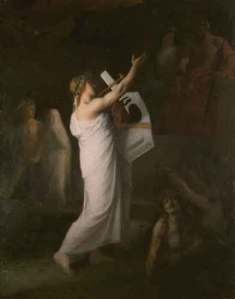
And so he arrived among the ghosts and shadows of the dead, keeping fear at bay by thinking only of his beloved. He appeared before King Hades and his queen, Persephone, and there sang and played his lyre more beautifully than he ever had before (pictured above).

Persephone in particular was moved that a man could love a woman so much, and Hades, also touched, relented. He would give Eurydice back to Orpheus — ie, make her alive again — on one condition.

The difficulty of trusting

That condition was simple: Eurydice would follow behind Orpheus up to the world of the living, but Orpheus was not to turn around to look at her.

So she was called and Orpheus began the long way upwards toward the surface of the earth. He could not hear footsteps behind him, but of course he knew that Eurydice was still a shadow and had no weight yet.

Orpheus kept climbing and looking forward with determination and focus. At last, he saw the first rays of light at the top.

But doubt seized him. What if Eurydice was no longer there? What if she had never been behind him to begin with?

Orpheus forgot himself and … turned.

And as he turned, he got one last glimpse of his beloved. Eurydice had indeed been behind him all this time, just as Hades had promised. But now, because Orpheus had turned, she dissolved back into the darkness. With a look of unbearable sadness in her eyes, she returned to Hades — this time forever.

So Orpheus returned to the world of the living alone. But who calls this living? He was a broken man. His songs and music were henceforth desperate and made animals and plants cry.

Eventually, a group of women (or nymphs or beasts) who could not bear it anymore tore him to pieces and threw his lyre and body parts into a river.

Nymphs (above) saw Orpheus’ head floating downstream, still singing its mournful song of love bereft and trust betrayed. Perhaps his shadow, when it arrived in Hades, found Eurydice’s at last.

Bookmark and Share

Jason and Medea: Noir hero & heroine

You may know it as the story of the Golden Fleece, or of the Argonauts, but it is really the story of Jason and Medea, arguably the most haunting couple of all time.

With that story (even though it appears to be as old as those of Hercules and Theseus), the Greeks, in my opinion, took a leap into complexity, subtlety and even modernity in their depictions of heroes and heroism.

In this thread on heroes so far, I called Hercules the brute and primal archetype of a hero and Theseus the more sophisticated classical archetype. And Jason? He would have to be the first “anti-hero” as you might find him in Film Noir.

Film Noir is that film genre in which a morally ambiguous and complex hero struggles against — and almost fails in — a corrupt world before he encounters a seductive and dangerous femme fatale who simultaneously challenges and saves him. (One convention in Film Noir is that the femme fatale wears a white or blue dress the first time you see her.)

As you read my (admittedly editorialized) re-telling of Jason and Medea’s story below, see if you recognize those noir-ish aspects, and reflect on some of the other issues that have come up in the comments to this thread so far, such as whether heroes have to be “good” or “altruistic” to be heroic.

I. The quest

As usual in the Greek myths (see Theseus), our hero is the son of a king. And as usual, there is some tension surrounding the throne. In this case, Jason’s evil uncle, Pelias, has usurped the throne from his brother and killed all of his nephews so that none can contest the throne in future. He is nervous because an oracle has warned him about a man with one sandal.

Jason is the only nephew who has survived. His mother has smuggled him into the wilderness, where the wise centaur Chiron educates him.

So we have a cast of archetypal characters: the evil oppressor, the young hero, and even the archetypal mentor, in the form of Chiron, who was also the tutor of Achilles and many other heroes.

Chiron and Achilles

Jason grows up to be a handsome young man. It is time for the young hero to set off on his quest, which is to reclaim his father’s throne. (Again, very similar to Hercules’ and Theseus’ quests.)

And we again meet the goddess Hera, whom we last saw when she tormented Hercules because she hated him so much. This time Hera hates Pelias, the evil uncle, and wants to help Jason. She tests him by appearing to him as an old woman, asking to be carried over a gushing stream. (An early appearance of chivalry as a heroic concept in history?) Jason carries her across, but loses one sandal in the river mud.

Jason arrives in Iolcus, the city where Pelias now reigns. Pelias sees that the stranger is wearing only one sandal and knows what’s up.

Pelias throws a banquet for Jason and — in one of these scenes that are so often implausible in the Greek myths — offers to give up his throne if Jason succeeds in stealing the famously valuable hide of a supernatural ram: the Golden Fleece.

Pelias considers the task impossible, and yet, we wonder why he does not simply kill Jason on the spot. In any case, Jason now knows what he must do.

II. The Argo

Jason is in Greece but the Golden Fleece is in barbarian Colchis (modern Georgia), on the other side of the Black Sea. So he must sail treacherous waters and needs an unusual boat. The Argo is built. The goddess Athena herself (in league with Hera, who wants to support this quest) donates for its prow a wooden plank that can foretell the future.

Jason now has to assemble a crew, and not only Hercules and Theseus but all the great Greek heroes become his shipmates. (If you’ve been reading my posts on Hercules and Theseus carefully, you might already have noticed that the implied chronology is impossible. But the Greeks were not worried about technicalities.) The point of this gathering, I believe, is to prove to us that Jason is indeed a hero — that he can assemble the other heroes, that he is their equal by association.

Off they sail, these Argonauts, and encounter the usual heroic adventures and dangers — rocks in the sea bashing passing ships to pieces, and so forth (compare Odysseus). I will skip over these, except for one subplot that may amuse those of you who share my opinion of Hercules.

Hercules is, of course, the strongest Argonaut — the best rower and all that. This means he cannot stay in this story because he would eclipse Jason and take over the whole plot. So we must get rid of him. How, in terms of storytelling, might we narrate him out?

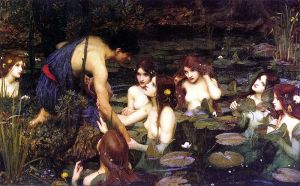
Easy: Hera will drive him mad once again. Here is how: Along the way, the Argo pulls into port and Hercules’ lover (yes, indeed) Hylas goes to fetch water from a spring. Hera makes the nymphs in that spring seduce Hylas by drawing him down, never to be seen again (picture below). Hercules goes mad and runs around the forest smashing things and people (in other words, staying in character), and the Argo is forced — regrettably, you see — to depart without him.
Hylas

III. Medea

So the Argo arrives in Colchis where Jason demands that its king, Aeetes, hand over the Golden Fleece. Aeetes would not dream of it, of course.

But Aeetes has a daughter named Medea. And just as Ariadne, King Minos’ daughter, fell in love with Theseus and helped him to achieve his quest, so Medea now falls in love with Jason (Hera asked Aphrodite to help). Madly in love. So in love that it will get creepy.

Aeetes, like Pelias, gives Jason a dare. He will hand over the fleece provided that Jason harness two fire-breathing bulls to plow a field.

The bulls would kill Jason (whom we may infer to be somewhat hapless and not altogether heroic sui generis). But Medea, who is a sorceress, mixes a salve for Jason (pictured at the very top) so that he becomes invulnerable.

Jason thus succeeds in harnessing the bulls and does plow the field. But when he begins sowing, it turns out that Aeetes has given him dragon teeth instead of seed. Out of each tooth a warrior sprouts, and this impromptu army is about to kill Jason. Again, Medea comes to his rescue, suggesting that he lob a rock at one of them. The newly-sprouted soldiers do not know who threw the rock, and fight and kill one another.

Jason has survived again, but Medea, who is now wholly on his side rather than on her father’s, finds out that Aeetes will renege on on his pledge and refuse to hand over the Fleece. So, at night, she leads Jason to the sacred grove where the fleece is nailed to a tree, guarded by a dragon. Again, it is Medea, not Jason, who overcomes the dragon — she bewitches it and puts it to sleep.

The two of them and the other Argonauts at once set sail and flee. Aeetes, when he wakes up, sets off in hot pursuit.

IV. The first transgression

If you ask me, the story only begins to get interesting from this point onward. For Medea, and later Jason, will now begin to make bad choices. They will transgress, take things too far, become corrupt.

Medea has taken her younger brother Absyrtus with her on the Argo. She now sees Aeetes’ fleet catching up. She has an idea. If she kills Absyrtus and throws him overboard, her father must stop to pick up the body, give his son a decent burial and mourn. She does exactly that. She murders her own brother so that she and her lover can escape.

This is too much, even for the gods and goddesses who were on Jason’s side. The gods send storms to punish the Argo. Athena’s speaking prow tells Jason that they must find the sorceress Circe to be purified of their sin (the same Circe whom Odysseus will later meet).

Circe, as it happens, is Medea’s aunt. She sacrifices to the gods so that Medea and Jason can be forgiven for their sin. Absolved, the Argonauts continue their journey (past the same Sirens and Scylla and Charybdis that Odysseus will have to pass).

V. The second transgression

They finally arrive at Iolcus, where King Pelias is already waiting with a plan to kill Jason. Again, Medea takes charge to save her lover.

She goes alone to Iolcus and claims that she is a witch who can make old people young again. King Pelias hears about this and asks her for a demonstration. Medea requests the oldest ram in the king’s herd, puts it into a caldron, mixes some herbs together and out comes a young lamb. The king is thrilled and wants the same treatment.

Medea tells him that only his own daughters can administer the rejuvenation. So the king’s daughters — Jason’s cousins — boil water in the caldron. Medea gives them herbs, but makes sure they have no magic power. The king enters the caldron, in which his own daughters unwittingly boil him to death.

Once again, this is simply too much. The gods and goddesses are outraged at the gratuitous cruelty of the murder. It would have been one thing for Jason to kill Pelias in open battle. But for Medea to make the king’s own daughters kill their father?!

The people of Iolcus do not want to be ruled by such a king and queen as Jason and Medea. The couple leave Iolcus and go to Corinth.

VI. The relationship turns sour

Medea murders her children

Perhaps because of Medea’s dark side, Jason has fallen out of love with her. And now he wants to marry a different woman, a Greek and the princess of Corinth, Glauce, so that he can become king of Corinth one day.

This is not unheard of — Theseus also dumped Ariadne after she helped him slay the Minotaur. Nor, however, is it heroic. Jason is fickle. He is alive only thanks to Medea, even if she has gone crazy. Our hero gets more complex, more recognizable, more human.

Medea now becomes the archetype for “hell hath no fury like a woman scorned.” She sends a beautiful gown to Glauce as a wedding present, but when Glauce puts it on she goes up in flames. Again, Medea has murdered an innocent.

But Medea is not yet done. She wants to punish Jason by erasing everything he loves. So she kills their two boys, her own children with Jason. In Euripides’ Medea, she rushes offstage with a knife and the children are heard emitting their final, terrifying scream.

Having become vengeance, Medea mounts a chariot and rides off into the clouds.

VII. Death of an anti-hero

And so Jason’s triumphs, above all his capture of the Golden Fleece, were impostors. He was led astray (the literal meaning of se-duced) by the wrong woman. Then he made things worse by breaking his vow to her, thus losing the respect of the gods and goddesses, even of Hera.

He grows old, lonely and bitter. His old ship, the Argo, is rotting on a beach in Corinth. Jason goes there to think about old times. One day, he falls asleep in its shade. The magic prow, put there by Athena, breaks off and kills Jason. So it goes.


Storytelling in leadership

An underlying assumption in my entire thread on storytelling, not to mention the book I’m writing, is that stories are the fundamental thought structures of the human mind.

Storytelling is inevitable, in other words. We do not make sense of the world except by telling stories about it.

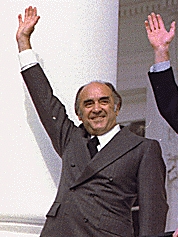
So I was intrigued to see this piece in Foreign Policy by George Akerlof (left), an economist at Berkeley, and Robert Shiller (right) at Yale. (Thanks once again to Jag Bhalla for the link.)

The two argue that stories also influence the optimism and pessimism of, and toward, entire nations and economies.

They give the fascinating example of José López Portillo (left), a Mexican president of the 70s and 80s, who presented his country, Mexico, in the context of an ancient story about the Aztec god Quetzalcóatl (also the title of a novel López Portillo had once written). The god was expected to reappear at a special time to make Mexico great again.

As it happened, this was during the oil shocks of the 70s and oil was being discovered in Mexico. Perhaps Quetzalcóatl’s time was now? It did not go unnoticed that the presidential jets were named Quetzalcóatl and Quetzalcóatl II. The country and foreign investors liked the story, and Mexico’s economy surged.

Until it stopped surging, of course. That’s when a different story took over.

The point, as Akerlof and Shiller put it, is this:

Great leaders are first and foremost creators of stories…

Indeed, the power of stories is such that

We might model the spread of a story in terms of an epidemic. Stories are like viruses. Their spread by word of mouth involves a sort of contagion.


Bookmark and Share

The classic hero story: Theseus

The story of Theseus and the Minotaur (above) is, in my opinion, the classical storyline, the archetypal Ur-Story. I much prefer it to the story of Hercules as I described it recently. It has:

  • unity
  • direction and momentum, propelling us forward
  • complexity, with characters male and female being fleshed out in a way that lets us empathize
  • relevance, collectively and individually, to our own life stories.

It is, in short, far superior to the myth of Hercules as a story.

Part I: Identity

As I interpret the story, it has distinct parts, which we see re-used, like Lego blocks, in our stories today. (If any of the parts remind you of stories, let us know in the comments.)

First, there is the boy who needs to find a) his identity and b) his calling.

Theseus grows up with his mother at the court of Troezen, where his maternal grandfather is king. But he does not know who his father is (ie, he does not yet know his identity).

This he discovers when he lifts a huge boulder and finds under it a sword. The sword was hidden there for him by his father, who is, as Theseus’ mother now reveals, the King of Athens, Aegeus (as in: Aegean Sea). In fact, there will always be some uncertainty about even that, since Theseus mother was visited by both Aegeus and the god Poseidon on the night of Theseus’ conception.

Theseus now sets out to find his father (= his identity, in my reading), which is of course a difficult path. A bit as Hercules had to complete his twelve labors, Theseus has to overcome and kill a series of villains who have been making the road to Athens unsafe. Thereby he delivers a public good. I won’t dwell on each adventure, except one: I’ve already told you about Procrustes, who either stretched or amputated his guests so that they fit into his special bed. Well, Theseus forces him into his own bed, with deadly effect.

Having prevailed (and thus established himself as a promising hero), Theseus arrives in Athens, where nobody yet knows who he is. Only Medea (who will also feature in another hero story, Jason’s), who is the king’s wife, intuits that he is Aegeus’ natural and rightful heir, and thus a threat to her own son. Using her feminine weaponry–guile–she persuades Aegeus that Theseus is dangerous and must be poisoned.

Aegeus reclines at a banquet to see the stranger drink the poisoned wine. But just then Theseus draws his sword, the same sword that Aegeus had hidden long ago for his heir to find, to cut a slab of meat. It is a recognition scene: Aegeus knocks away the poisoned cup and they re-unite. Medea, knowing her game is up, flees.

Part II: Quest

The stage is now set for Theseus, having found his identity, to go on a quest, on the one big task that will define him (in contrast to Hercules, who had twelve tasks but none that was definitive). It so happens that Athens is suffering. Every nine years, the Athenians, having lost a war with Crete, have to send seven maidens and seven boys to Crete as human sacrifice for a monster, half man and half bull, the Minotaur. The Minotaur lives in a labyrinth built be the greatest architect of Greece, Daedalus, and nobody who enters finds his way out again.

Theseus volunteers to be one of the seven youths on the next ship, heeding his “call to action” in the language of the mono-myth theory. The ship sets off with a black sail, and Theseus tells his father that, if he succeeds in slaying the monster and survives, he will return with a white sail.

And how different he is from Hercules even now, as he approaches his biggest task. Hercules occasionally had helpers in his labors, but they were mere stage props in the background. Theseus, on the other hand, is capable of love. He meets Ariadne, the daughter of King Minos of Crete, and they fall for each other.

Without this woman and her love, Theseus would fail. He is vulnerable. He needs an other, a woman, to complete him. And so Ariadne gives him her clew, telling Theseus to unravel its thread as he descends into the labyrinth in order to be able to follow it back out if he should survive his encounter with the Minotaur.

Theseus descends, finds the Minotaur and a ferocious fight ensues. This is his best moment (depicted above), his great act of heroism. He kills the Minotaur, follows Ariadne’s thread back out, and is ready to return home with the news that Athens has been liberated.

Part III: Return

But returns are never easy. Theseus elopes with Ariadne and they sail for Athens. But Theseus, now that the danger is past, falls out of love with her. She has done so much for him, and they have been so close. But now he abandons her on an island (where, in some versions, she will become the wife of Dionysus).

Did the Greeks think he was right to do so? Did they think he was bad? This is beside the point. Theseus, unlike Hercules, is complex. He is human. He gets confused, distracted, unsure.  We can see ourselves in him. He makes mistakes.

He makes a big one, in fact. He promised his father to set a white sail if he succeeded in slaying the Minotaur but evidently forgets and appears on the horizon before Athens with the black sail. Aegeus sees it, assumes that his son has failed and died, and throws himself off a cliff to his death.

But this tragedy marks another rite of passage. Theseus is the heir to the throne, so, having liberated Athens, he now becomes its king.

The story as model

At some later point, we’ll have to take stock of how Theseus (and all subsequent heroes in this thread on Heroes) fits into our debate about heroism. But for now, let’s just think of his story as such: as a story.

It’s all there. A search (for identity), a recognition and reunion (with Aegeus), evil (the Minotaur), a quest and a journey, love and dependency (Ariadne), a peak moment (the slaying), a return, betrayal, tragedy, destiny.

Are these not the parts out of which we build all our stories?

Bookmark and Share

Brute and primal hero: Hercules

Heracles, or more commonly Hercules (the Roman version), is the quintessential and archetypal hero, the one the Greeks considered their greatest and, more importantly, the one my four-year-old daughter names when I ask her who her favorite hero is.

So Hercules must, of necessity, open this thread on heroes and any investigation of heroism.

Which is interesting because I put it to you that the myth of Hercules is one of the worst stories of antiquity when you consider the storytelling per se. We today would consider Hercules a brute, a meathead, a boor. He is one-dimensional as opposed to complex. His story is in essence a repetitive list of triumphs that leaves no room for suspense, surprise or sympathy. (I meant empathy, really, but why not alliterate?).

And yet, Hercules is the one my daughter picks. So there must be something primal there. And that’s what this post wants to establish.

The man and his dilemma

Hera (Juno)

Hercules was, like many other Greco-Roman heroes, half god, half human. His father was Zeus, which meant that Hera, Zeus’s sister and wife, was jealous and would forever hate Hercules (some say that she is the Hera in Hera-cles) and make his life difficult. If there is tension in the story at all, it is this fight among the gods (some goddesses, such as Athena, helped Hercules) and between a goddess and a mortal. We’ll encounter this theme all throughout ancient mythology (Hera also fought against Aeneas, for instance).

Hera is thus how the Greeks, in this story, personified adversity and even what we would call our dark side. If things go wrong, even if Hercules himself does wrong, we will blame Hera. She is the Ur-bitch, you might say.

Just so this is clear, the story starts when Hera sends two venomous snakes into the crib of baby Hercules to kill him off. Poor snakes. Baby Hercules strangles them, one in each cute fist.

And thus you have the only other piece of information you need about Hercules, the thing that he is known for, the only thing we can really say about him: He is …. strong.

Strength is probably the first trait of a hero, as Jens has already pointed out. But strength against or for what?

Combine the malign influence of Hera and this awe-inspiring strength and you get a combustible cocktail.

Indeed, we need an explosion to get started: Hera causes Hercules to go temporarily mad. He rages with blood lust, destroying and killing not just anybody but … his own children! (Ask yourself: Could Hercules be a modern hero? Do heroes have to be “good”?)

This sets up a rather complicated and unconvincing double rationale for what must come next–ie, the ostensible “story”. Hercules has sinned and must atone, by doing certain labors of penance.

But penance did not work for the Greeks as a story line, so there is another, simpler layer: a good old power struggle. Hercules was supposed to have been a prince, but Hera (who else?) had played with Zeus’ mind and given the throne to Hercules’ cousin Eurystheus, a caricature of mediocrity. The deal is that Hercules can get his throne back if he completes the tasks that Eurystheus gives him. (Ask yourself how plausible that is. Why wouldn’t Hercules just bash his cousin’s head in?)

I’ve been dwelling on all this only to show you what a “bad” story this is. It should be entirely clear by now that the ancients were not the least bit interested in the why of Hercules’ labors, and arguably only modestly interested in the how. They were interested in the that. Namely, Hercules accomplished twelve amazing feats because … he could.

The labors

I won’t, as it were, belabor the labors, even though they are the myth, because you know them and, frankly, I consider them rather predictable and thus dull. (Compare any one of them to the fiendish complexity and uncertainty of, say, Jason having to get that fleece.) To jog your memory, here is the list:

  1. Hercules kills a monstrous lion and henceforth wears its skull and fur as hat and cape, which is how we picture him.
  2. He kills the Hydra, a monster with many heads. Every time he cuts off a head, two more grow in its place. (Compare this with the monster that Siegfried confronts in Norse myth).
  3. He captures a golden-horned deer that is the favorite of the goddess Artemis. (I think this task was included to show that Hercules also had Fingerspitzengefühl, finesse. He could not kill the doe, lest he piss off yet another goddess, so he aimed an arrow so carefully that it immobilized the doe without killing her. But ask yourself: Why did he have to use an arrow at all?)
  4. Next: a boar. Hercules runs it down in the snow, where the boar can’t run fast.
  5. He cleans the famous Augean stables. The cattle of King Augeas had been pooping uninterrupted for eternity and the entire Peloponnesus was reeking. Instead of shoveling shit, Hercules diverts two rivers to flush out the mess. (An import from the river cultures in Mesopotamia and Egypt? Meant to show that Hercules could not be humiliated?)
  6. Next, Hercules kills some terrifying birds who shot brass feathers into people.
  7. Next, Hercules carries the Cretan bull to the mainland. (This is the bull that would father, with King Minos’ wife, the Minotaur that Theseus will later deal with, which theoretically locates Hercules in time as slightly older than Theseus. Probably included to establish a link between the two heroes, the greatest, respectively, of the Peloponnesians and the Athenians. Updated and corrected thanks to Bill Frank.)
  8. Next, Hercules deals with the mares of Diomedes, horses that tear apart and devour any guest of their king. Hercules somehow turns the tables and feeds Diomedes himself to his mares, and they lose their appetite.
  9. Next, the belt of Hippolyte, queen of the Amazons. We need some sex in the story and this is it. Hippolyte falls in love with Hercules and wants to give him her belt, but Hera interferes again, making the other Amazons think that Hercules is about to kill their queen, and causing a battle in which Hercules and his men kill the Amazons. (Every time he kills children or women, you see, it’s really Hera’s fault.)
  10. Next, Hercules has to steal some cattle from a three-headed monster named Geryon. What’s interesting here is the location: Geryon is in Spain, and Hercules travels back to Greece via Italy (thus allowing the Romans to link him with their locales). Also, he has to cross the Alps along the way, and this was, in the Roman mind, not done again “at scale” until … Hannibal did it. I digress.
  11. Next, Hercules has to get the apples of the Hesperides, in today’s Morocco. He persuades Atlas, a Titan who is holding up the sky on his shoulders, to fetch the Apples for him, holding the sky (strength!) while Atlas obliges. When Atlas returns, he doesn’t want to take the burden of the sky back. Hercules says “Fine, I’ll keep carrying it, just take it for one second so that I can put a pillow on my shoulders.” As Atlas helps him out, Hercules makes off with the apples. (I think this is included to show that Hercules also had wit, besides strength. But that qualifies?)
  12. Last, Hercules must fetch Cerberus, the three-headed dog who guards the underworld of the dead. This is de rigueur for heroes: Odysseus and Aeneas will also visit Hades and return. I think it is meant to symbolize a brush with death, a transcendence of mortality.

Death and meaning

And that’s it, a smooth ride from one triumph to the next. If there is a twist, it is only in Hercules’ death.

Hercules and his wife crossed a river once and Hercules let a centaur, half man and half horse, carry his wife across (why did Hercules himself not carry her?). The centaur tried to elope with her, so Hercules shot him. As the centaur lay dying, the beast whispered to Hercules’ wife that she should keep his blood and soak Hercules’ clothes in it, which would prevent him from straying with other women. She did as told, but the blood was really venom. And thus she inadvertently killed her husband.

And yet, Hercules, alone among heroes, did not totally die. Zeus, his father, made him immortal and brought him to Mount Olymp. Another indication that Hercules was special.

So what is Hercules to us?

He represents the idea, once universal and now arguably fading, that heroes are somehow beyond morality and the law, beyond ordinary standards, “beyond good and evil”. That happens to be the title of a book  by Nietzsche, and I think Hercules might have fit Nietzsche’s idea of an Übermensch. It is what Dostoyevsky examined in Crime and Punishment: Can the hero be beyond morality? The ancients believed Yes. We have opted for No. Today, we would lock Hercules up or, if he happened to be president, appoint a special prosecutor.

But back to the point: Hercules may have got rid of some nuisances for his fellow men–a boar here, a monster there–but that was not why he did his labors.

Hercules was simply a strong man at a time when nature was ever-threatening and as arbitrary as a jealous woman (Hera), when our frightened ancestors yearned for one among them, whatever else his flaws, to stand by at the gate with a bludgeon and brawn.

Bookmark and Share

New thread: Heroes and heroism

Hercules

I’m announcing a new “thread” on The Hannibal Blog: Heroes.

I’ve already written lots about heroes, of course:

And I’ve discussed how the hero or heroine is an archetype at the heart of almost any story, and thus crucial to storytelling. (This is why the new thread will overlap a lot with that on storytelling.)

Why a new thread on heroes?

Because I think there is a lot to say about them. As always with my threads, I have no idea where we will end up, but I’m quite curious to find out. I have a vague sense that I will discover quite a bit, from you more than from myself, as we get deeper into the thread.

A very tentative outline of future posts in this thread might run as follows:

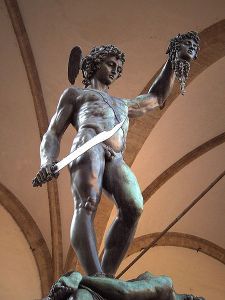
Perseus

First, the classical heroes of antiquity:

  • Hercules
  • Theseus
  • Perseus
  • Jason
  • Achilles
  • Odysseus
  • Aeneas

Then, some non-Western heroes, including my favorite:

  • Arjuna

(For the yogis among you, did you know that the Sanskrit word for hero is vira, as in the yoga poses virasana and virabhadrasana? It is related to Latin vir, man, and thus virile, virtue…)

Then some fictional heroes and heroines from our folk-tales, our movies, modern literature. Then some real-life heroes. And eventually, some anti-heroes, who are really modern heroes. (Albert Camus’ Meursault in The Stranger jumps to mind.)

Feel free to nominate heroes in the comments that you’d like to have discussed.

I’m interested in what makes these various heroes and heroines heroic, what makes them timeless. Why did some heroes enter our collective unconscious, and others not?

About threads

For those of you who are new to The Hannibal Blog, a thread is simply a mini-series of blog posts, not necessarily sequential or coherent, united by a common tag or category on the right. By clicking on the tag of a thread you get a list of all the posts in it, in reverse order.

And threads never really end. So all the previous threads–such as those on the great thinkers, storytelling, Socrates, Hellenism, Carthage, stuff, America, freedom, et cetera–will go on.

Bookmark and Share

Tudor sex and beheadings made complicated

Henry VIII

I’m reading Wolf Hall by Hilary Mantel right now. It’s a historical novel about the efforts by Henry VIII of England and Anne Boleyn to annul Henry’s marriage to Catherine of Aragon, his first wife, so that he and Anne could marry instead and–so it was hoped–produce male heirs.

The rest, you might say, is history. What stood in Henry and Anne’s way was the Catholic Church, ie the pope, so Henry had to “fire” the church and start a new one, the Church of England, whence sprang Anglicanism and its offshoot, Episcopalianism.

The new marriage, however, was not, ahem, ideal and Henry went on to have a few more wives, while Anne, and an awful lot of other people, lost their heads.

In short, it is a fantastic topic, a fantastic story! The sort I love, because it is simultaneously:

  1. grand and important, and
  2. riveting and engrossing.

    If it were entertaining but trivial, I probably would not bother, because life is short and I want to spend it on important things. If it were important but boring, I also might not bother, because, well, life is short and I want to minimize my pain.

    Anne Boleyn

    So by being important and riveting, Mantel’s topic is exactly like the events that I chose as the main storyline in my own forthcoming book, ie the Punic Wars that led to the rise of Rome and the fall of Carthage. And this is one reason why I chose to read Wolf Hall. I wanted to see Mantel’s storytelling.

    The other reason is that the book won the Man Booker Prize, one of the most prestigious awards in the English-speaking world. I distrust prizes, but at the same time they do promise to make our lives easier by pre-winnowing some of the wheat from the chaff. Others have taken their cue from the prize and are heaping more praise. So I started reading.

    What a disappointment

    I’m half-way through the book now, at page 200-and-something, and boy, is it hard work.

    I read, I get confused, I go a few pages back to see if I missed something, discover that I did not, struggle on, get tired, fall asleep, try again the next day.

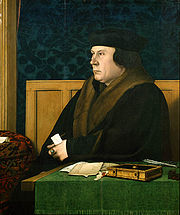
    Thomas Cromwell

    Here are the problems, as I see them:

    1. Who the heck is speaking? Dialogue is difficult to write and separates great writers from mediocre ones. Mantel tells the story through the eyes of Thomas Cromwell, an influential lawyer and wheeler-dealer behind the scenes. She therefore makes him a default he in the story. The problem is that there are lots of other hes (ie, men), and when several men are talking, we don’t know which he is thinking, talking, doing whatever he is doing. This sounds banal, but it is annoying. It does not help that everybody is named Thomas (that’s not Mantel’s fault, of course).
    2. Who are all the people and why should I care? Mantel assumes that I already know all the characters, the chief ones being Cardinal Thomas Wolsey, Thomas More, Thomas Cranmer, Jane Seymour, the Dukes of Norfolk and Suffolk and so forth. As it happens, I love history and have indeed heard of most of them before, but my knowledge of this era has got rusty. I wanted it to be Mantel’s job to re-introduce me to these people so that I don’t have to make an effort.
    3. What is the historical context, ie the import? Mantel assumes that we already know the interrelationships and geopolitical constellations between the Holy Roman Empire; the papacy; the French, Spanish and English kingdoms; and so forth. As it happens I do, sort of, know about these matters–at least more so than Mantel can expect from most readers–and it still does not suffice.

    Thomas Wolsey

    So I took time out and resorted to … Wikipedia. Yes, I did. I spent a good hour last night reading all the main characters’ entries, as well as brushing up on why, say, the Archbishop of York had less power than the Archbishop of Canterbury or who the heck a “Lord Chancellor” was again, and other matters that Mantel does not deign to make clear.

    Hilary: Is that what you want your readers to do–go to… Wikipedia????

    As it happens, it worked and Wikipedia did give me the context I need. But what an indictment of Mantel’s storytelling technique. The whole premise of books like this is that you get the history and the humanity, the importance and the drama, at the same time.

    Hilary, you seem to be too busy being ‘literary’–with complex points of view, revisionist interpretations and what not–to hold me by the hand. You were supposed to make it easy for me. You did not.

    Bookmark and Share

    The Economist: bland, trite and worthy?

    I have been pondering a recent comment by Phillipp S Phogg to the effect that, if I may amplify it, what I write on the Hannibal Blog is sometimes more fun than what I write in The Economist. Or, as he put it:

    the very opposite of the blandness (and dare I say, triteness?) which permeates some (but not all, I hasten to add!!) of the Economist’s erudite and worthy pages.

    • Bland
    • Trite
    • Worthy

    Ouch. No publication, writer or editor would want to be caught anywhere near those adjectives–especially the devastatingly faint-praising worthy.

    Well, one of the minor purposes of this blog (besides the main one, which is to talk about my book once it comes out) is to let those of you who are fans/foes of The Economist speak truth to power in a safe setting.

    Furthermore, this is the time for me to admit that I myself occasionally feel as Phillip Phogg does. And that frustrates and saddens me.

    It also makes me think deeply about such evergreen writerly topics as style, voice, tone, and storytelling, because that’s what this seems to be about.

    The Economist appears to succeed in part because it promises and delivers to its readers analysis that is:

    • disciplined, not florid;
    • terse but deep;
    • occasionally quirky but not self-indulgent.

    Permit me to contrast that with, say, The New Yorker, which promises, and mostly delivers, storytelling that is

    What that means for me as a writer for The Economist is that I usually do the same research as writers for the New Yorker but then leave most, or even all, the “fun stuff” on the cutting floor to maintain the discipline of, say, a 600-word note.

    This is frustrating. As a writer, I often know that I could spin a thrilling yarn out of my experiences during research but as a correspondent for The Economist I know that much of it is inadmissible. (There are exceptions, such a piece I have written about Socrates for our upcoming Christmas issue, which arose out of a thread here on the Hannibal Blog and is almost pure, unadulterated fun.)

    One device that writers for the New Yorker (just to stay with that example) have but that we lack is the First Person, ie the “I”. I have said before that I consider the First Person “treacherous” for young writers because it subverts discipline. It is a good idea to learn to write without using “I” and “me”. That said, I have also discovered, on this blog and in my book manuscript, that the First Person makes certain things easier. One of those things is authenticity. Another is fun.

    But it goes beyond the First Person and into storytelling. Occasionally, we do great storytelling in the pages of The Economist. But often we don’t, because that is not always the main objective.

    I still love Ira Glass’s analysis of good storytelling. It requires, he said:

    • humanity
    • suspense
    • surprise
    • momentum (or “direction”)

    But implicit in those elements is detail, also known as color. I have said before that color can be excessive and is best used sparingly, as in a good Rembrandt painting. But sparing does not mean monochrome.

    Perhaps, when we fall short at The Economist it is because we overdo the sparing. Perhaps we should do more First Person narrating (which does not necessarily require us to give up our anonymity). Perhaps we should paint in more color.

    In the next post, let me try to illustrate what I’ve been talking about in this post by looking at the back story behind one of my pieces in the current issue of The Economist.

    Bookmark and Share

    The danger of the single story

    Adichie

    Adichie

    A big theme in my thread on storytelling, and a premise of my forthcoming book, is that certain stories are universal and timeless–or, as Carl Jung might say, archetypal.

    But as with everything, there is a way to misunderstand that insight. Yes, there are elements that are common to Homer’s Odyssey and Iliad, to the Grimm stories and to Heidi–elements such as a hero who goes on a quest and meets a wise old man and so forth….

    But that does not mean that one single story can summarize a life, a person, a place or a country. The opposite is the case. There must be an infinite number of stories, even if they all have something in common.

    The attractive Nigerian novelist Chimamanda Ngozi Adichie gave a great TED talk (below) about exactly this. As a girl in Nigeria she read and loved British and American books and stories and began to write stories herself at the age of 7. But her stories were about … white, blue-eyed girls who played in the snow and ate apples and talked about the weather and whether it might turn nice. Even though she had never left Nigeria!

    She eventually realized

    how impressionable and vulnerable we are in the face of a story.

    Stories had overpowered her own perception of the world. She assumed that stories could not be about brown people eating mangoes in the sun but had to be about white people eating apples in the rain.

    Emancipation occurred when she realized that

    people like me … could also exist in literature

    But that was only the beginning. She understood that many people have only one single story about Africa (= catastrophe), and that she did not fit into that story. She realized that she herself had only one story about Mexico (= illegal immigrants) which proved woefully inadequate. She realized that some people, such as her American college roommate, had only a single story about her, Adichie from Nigeria (= exotic tribal woman), and that she herself simultaneously had only one single story about her own family servant (= pitiful poor boy), which also proved incomplete. She understood that

    power is the ability not just to tell the story of another person but to make it the definitive story of that person,

    and that

    the single story creates stereotypes, and the problem with stereotypes is not that they are untrue but that they are incomplete… It robs people of their dignity.

    So consider this a refinement of my views on storytelling. We must be open to many, many, many stories even as we see the common, universal humanity that runs through all of them. Now take 18 minutes and watch:


    Bookmark and Share