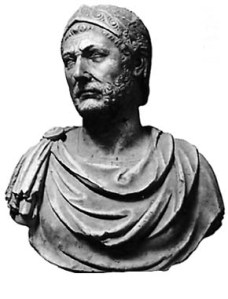
John and Hannibal, respective favorites

There on the left you see John. He baptized people.

And on the right you see Hannibal. He vanquished Romans.

John is not in my book, whereas Hannibal is its main character, but that’s neither here nor there.

I just figured out a rather exciting linguistic connection between their names. (“Exciting”, that is, if you’re a language geek.)

Background:

John comes, via Indo-European Greek and Latin, from either the (Semitic) Hebrew Yochanan or the (equally Semitic) Aramaic Youhanna. That origin is clearer in some other European languages, such as German Johann/Johannes.

And Hannibal is our transliteration of HNB’L, a Punic word. Punic was a Roman mispronunciation of Phoenician. It was the language of Carthage and of Phoenicia, and thus also Semitic.

I’ve already posted about the close family connections between Punic, Hebrew, Arabic, Aramaic and other Semitic languages, by using Hannibal’s family name, Barca, as the example. The relationship is as close as that between, say, Dutch, German and Danish, or between Spanish, Italian and Rumanian.

Favor and the gods

Now to the meaning of the two names:

According to Luke 1, 13, the angel Gabriel visited Zechariah and told him that his old and infertile wife would bear him a son and that “you shall name him John” (ie, Youhanna).

The footnote in my bible says:

The name means “Yahweh has shown favor,” an indication of John’s role in salvation history.

So:

Ba'al

YOU ≡ Yahweh

and

HANNA ≡ Favor

As in: Yahweh’s favor.

In Hannibal’s case,

HANN(I) ≡ Favor

and

BAL ≡ Baal

That’s Baal (or Ba’al) as in the god that Yahweh is so jealous of in the Old Testament, because he’s one of those Semitic deities so popular in Canaan, where both Phoenicians and Jews lived.

So John was favored by one, Hannibal by the other. Name is destiny. 😉

Attack as response to failure

Instantly notorious

Jared Loughner may not be “crazy” or irrational at all. He might instead be utterly typical of people who attack politicians: For most of them, the notoriety that comes with such an attack, whether it ends in assassination or not, is a perceived solution to a specific psychological problem.

And that problem is the feeling of invisibility or anonymity that often follows failure.

This, at least, is the upshot of this story on NPR, which in turn refers to this study from 1999 in the Journal of Forensic Sciences. (Lainey, in a comment under the previous post, linked to a Wired article quoting the same report.)

That study examined the 83 people who had attacked public officials between 1949 and 1999, and found that the attackers

  • almost never had political reasons
  • had often experienced a big failure or reversal in the year before the attack,
  • often felt invisible as a result,
  • didn’t want to be “non-entities” or “nobodies”,
  • and saw the notoriety of being an assassin as the solution.

As one would expect from such a profile, the attackers often did not target one particular politician (as an attacker with political motives would), but first decided to attack, then searched for a target. To quote from the report,

assassins are basically murderers in search of a cause

Failure is, of course, one of the twin topics of my forthcoming book, the other twin being success. This, I must say, is a response to failure that had never occurred to me before. The more one learns about the human psyche, the more mysterious it becomes in its nether depths.

Gabrielle Giffords, American Gracchus

Gaius Gracchus

The Roman republic was 375 years old — more than 1½ times as old as the American republic is today — when, in 133 BCE, something unprecedented and indeed hitherto unimaginable occurred: domestic political violence.

A populist politician had got himself elected tribune by the citizens of Rome, in exactly the sort of democratic process that Rome was proud of. His name was Tiberius Gracchus, and he was ambitious, idealistic and perhaps somewhat naive. (He was also the grandson of my hero, Scipio Africanus, the nemesis of Hannibal.) This elder Gracchus — he had a younger brother named Gaius — then proposed reforms to improve the lot of the people. Many patricians in the Roman Senate did not like that.

It had never, up to this point, mattered that Senators and Tribunes, plebeians and patricians, Optimates and Populares (those were the names of Rome’s political factions) disagreed on matters of policy.

Of course they disagreed! Peaceful disagreement, in which the more persuasive arguments prevailed over time, was what the Roman republic was about. It was the reason Romans loved Rome.

Rome had withstood existential threats — a sack by the Gauls, near-extinction by Hannibal — without ever sacrificing its founding ideals: inside the city walls, there was no place for violence in politics.

But on that day in 133 BCE, a group of senators and their supporters made their way toward a popular assembly in progress. They beat Tiberius Gracchus and his supporters to death.

Yes, Rome was shocked. Of course it was. This incident had to be an outlier. The exception that proved the rule.

But it seems that a taboo had been broken, a precedent set. Something unthinkable had become thinkable: Political violence.

A decade after Tiberius’s murder, Gaius Gracchus (pictured above) followed in his brother’s footsteps. He, too, got himself elected tribune. He, too, intended to launch reforms.

And again, a mob of senators and their supporters came for him. Gaius fled to a grove and killed himself, as the attackers murdered his supporters.

Another outlier, they told themselves. An exception. Never to be repeated.

And yet, it was repeated. Over the next century the Romans — a people always well-armed, often for the right reasons — began flashing blades to intimidate other Romans in any disagreement. The tone of debate changed. The incidents of political violence became more frequent, and worse.

A taboo once toppled is difficult to re-erect.

Marius, Sulla, Pompey, the Caesars….

Violence, or the threat of it, now prevailed in Rome.

Rome would remain a superpower for much longer. But no longer a republic. Not the Rome that the likes of Scipio Africanus had ever fought for. Not the Rome they considered worth preserving and defending.

Texting, dying and killing

Yes, I remain obsessed with proselytizing about the the mortal dangers of distracted driving.

(That mainly means driving while using a cell phone in any way at all).

Today, just in time for New Year’s Eve irresponsibility, AT&T has released this documentary.

Bravo. I hope the whole industry — and society — responds.

Powerful mental image: The text messages, partial or complete, that a driver was typing as he or she died or killed.

Where r

LOL

Yeah

Freedom to, freedom from

Pericles' Funeral Oration

Two years ago, near the beginning of my amateurish exploration of the concept of freedom here on The Hannibal Blog, I dabbled a bit in the nuance between

  • negative and
  • positive

liberty.

As it happens, there is a much, much better treatment of that distinction in this lecture by Hunter Rawlings, a classicist at Cornell (as well as that university’s former president).

We today subscribe largely to the negative concept of freedom. We want to be free from things (intrusion, government, …)

Most of the ancients — such as Pericles, the Athenian statesman who probably summed up classical democracy best in his famous Funeral Oration, pictured above — took nearly the opposite point of view. They wanted to be free to do things (speak in the assembly, sit on juries, fight in the army, co-determine the fate of their polis…)

(One exception in antiquity might be Diogenes, which is perhaps what makes him so interesting to us, or at least to me.)

As Rawlings puts it, neither society, Greek or American, would regard the other as “free”.

The Greco-Romans had a communitarian (and largely tribal) definition of freedom and were concerned about virtue (but hardly at all about property).

Enlightenment thinkers, starting with John Locke, defined freedom in much more individualistic terms and were more concerned about property than virtue.

The mixture of the two strands was at first (in the minds of geniuses such as Madison or Hamilton) tonic. But something has arguably gone wrong in the centuries since then, leading us gradually to stunningly childish and unsophisticated notions about freedom today.

A short excerpt of the lecture is below, but I hope you take time for the full hour, because it is fascinating and touches on all the topics dear to The Hannibal Blog: Greece and Rome, the Founding Fathers, democracy, et cetera.

Incidentally, I discovered the speech through this Greek blog post, which discusses some of my own posts and which Google has only translated for me very imperfectly. Thank you very much!

I’ll leave you with one snippet from Rawlings’ lecture, which is that the ancient Greeks, being so busy with their freedom to participate in the public business, had … no word for boredom! 🙂

Now the excerpt:

The Buddhism of Christmas

1973

Tis the season when my wife and I, as we behold our children reacting to packages and presents arriving in the mail, exchange knowing glances and mumble something about how “Buddhist” Christmas is.

Spouses, as everybody knows, use a sort of shorthand that is unintelligible (and thus usually misleading) to everybody else, so I will translate. It means something like:

Christmas, like all existence but perhaps more so, torments people through the subtle and insidious mechanism the Buddha first described.

Oh, and what was that mechanism?

As is my wont, I will get gratuitously intellectual about all that in a moment, but let’s start with the actual scenario.

Scenario

Christmas is a time when presents show up unannounced. This is otherwise known as stuff. Uncles, aunts, and other acquaintances send the stuff because, well, it’s Christmas and that’s what one does, whether anybody wants stuff or not.

So the packages arrive — in a household that contains children. In fact, the stuff is meant mostly for those children, and the children know it. How do the children react?

1973

Definition of “child”:

I have read enough academic papers to know that one must, whenever a text threatens to get interesting, interrupt with definitions. Herewith:

Child (noun; plural = Children): A human being who is exactly like an adult but has not yet had sufficient time to practice the adult skill of feigning indifference in most situations of ordinary life.

Back to scenario

Where were we? Oh yes, the presents that are arriving at the door. How do the children react, in the first instance and over the next hour or so?

Exactly as both the Buddha and his contemporary Patanjali (my favorite thinker) would have predicted:

  1. Child A, arriving first: A momentary thrill. ‘Here is something that promises to suspend my boredom. No, I wasn’t actually bored, but now I would be if I do not immediately rip this package open.’ Rips package open.
  2. Child B, arriving split second later: Another momentary thrill. Then: ‘But wait. Sibling has got a head start. She can’t have more thrill. It’s my thrill. Must have.’ Attacks package.
  3. A & B: Conflict. Hair pulling. Tears on A. Time Out for B.
  4. A, having played with toy (because it’s already open anyway, so what can you do?), loses interest. Returns to previous activity and temporary balance/bliss.
  5. B, emerging from Time Out, gets his turn with toy. Notices that A has lost interest and returned to previous activity. Also loses interest and returns to balance/bliss with A.
  6. New package arrives. Repeat cycle.

Sanskrit: duhkha and sukha

Both the Buddha and Patanjali in the Yoga Sutras (as far as I’m concerned, original Buddhism and authentic Yoga are exactly the same philosophy), describe our minds as causing us near-permanent discomfort in precisely the way these toys are tormenting my children.

The word both the Buddha and Patanjali use for this mental discomfort is duhkha.

T.K.V. Desikachar, a great yogi, translates duhkha as restricting or squeezing in this excellent book.

This is noteworthy, because duhkha is usually mistranslated as suffering. Thus, you’ve probably heard the first Noble Truth of Buddhism expressed as follows:

All life is suffering.

Well, actually, the Truth says that all life is duhkha. And suffering is a bad translation (with the effect of turning many Westerners off before they’ve even begun to absorb the rest), because, manifestly, not all life is suffering.

Duhkha is more subtle, so let’s investigate as we usually do: by looking into etymology.

Etymology of duhkha

The Sanskrit roots of duhkha relate to its Indo-Germanic nephews German and English as follows:

duh ≡ du(nkel) ≡ da(rk)

and

kha ≡ ka(mmer) ≡ cha(mber)

In other words, duhkha is, or feels like, a dark room, an oppressive space.

Its opposite is sukha, a happy, good or light space.

The goal of Yoga, Buddhism and all other Indian philosophy is to exit the dark room and enter the light room.

Remember that this entire time we are talking about our minds. Our mind constantly shoves us into the dark room (duhkha) by conjuring disturbances (called “fluctuations” in the Yoga Sutras):

  • distraction,
  • fear,
  • anxiety,
  • anger,
  • craving,
  • jealousy,
  • disgust
  • boredom
  • etc etc

This does not have to be very profound. If you’re a child, the arrival of a package suffices.

In the Bhagavad Gita, all these disturbances are represented by the Kauravas, the vicious cousins of my hero Arjuna.

The Kauravas of Christmas

Christmas is — aside from a time for cosiness, festiveness and so forth — an intense agglomeration and onslaught of mental disturbances.

For the kids, each package creates an expectation of thrill, quickly leading to a disappointment (= duhkha).

Or to a pang of jealousy (= duhkha).

Or simply to distraction from the activity the child had just been absorbed in (= duhkha).

And for the adults?

Definition of “adult”

Adult (noun; plural = Adults): A human being who is exactly like a child but has had ample time to practice the skill of feigning indifference in most situations of ordinary life.

Adults don’t run to the package and rip it open. They put it under the tree. And they don’t pull your hair when you’re opening your package.

But they walk around all December with that jingly-jangly music in the stores and those trees in the windows and they feel … that they should — shouldn’t they? — be somewhere special, with someone special, feeling special. And is the person next to me special enough, is all this special enough,….?

So they yearn, and they crave, and they’re lonely, and perhaps they envy or regret, and they’re in the dark chamber of duhkha.

Sukha

But there’s a jail break.

One strand of Buddhism/Yoga invites you to discipline your mind (ie, meditate) for years so that your mind becomes still, thus setting you free.

Another strand, called Zen, guffaws at the hilarious inside joke of it all and simply says: ‘Snap out of it — now!’

That can be easy, it turns out: You put away the packages and the toys, and you tickle the kids, and you all roll around under the tree, in the beautifully light, comfortable room of sukha.

1973

The humanity in a Joad and a Vega

Well, it’s time again for our (The Economist‘s) annual Christmas issue — a double issue (meaning that it is on news kiosks for two weeks instead of the usual one).

My piece in this one is called Migrant farm workers: Fields of Tears.

(The title of this post explains itself if you read the article.)

They even used one of the pictures I took with my dirty, sweaty, unsteady hand while picking grapes in August (I posted about it at the time). So, even though we don’t get bylines at The Economist, I did get a tiny picture credit in the bottom right! 🙂

The back story

In late October, I posted a cryptic and coy entry here, in which I talked about an exchange with one of my editors, after she told me that

The subject-matter is so emotionally strong that it will work better if the tone is flatter.

This was, in fact, the piece we were talking about and editing at the time. So now you can read it and judge for yourself if flattening the tone was the right decision.

Another point worth mentioning is that my first draft was, well, bad. The reason was one that you may find sympatico (during my research, we had a baby, so I had other things on my mind and took a shortcut, writing before I was ready). But a good editor owes it to the writer not to let those half-hearted pieces slip through.

So my editor called me on it. She has a beautifully frank manner, which sugarcoats nothing (and thus makes her praise, whenever it comes, uniquely credible).

Back I went, after my paternity leave, to finish the research (which was harder than it is for most of my pieces). And then I wrote what turned out to be the real piece.

During the frantic copy-editing in the final hours before the pages were printed, I thanked my editor for her intervention:

… you did me the honor of being frank, thus saving me from a bad piece and forcing me to turn it into a decent one. You’re the best editor I’ve ever had. It’s all about trust: the editor has to trust the potential of the writer (and demand that it be reached); and the writer has to trust the judgment and intention of the editor.

She replied with some touching personal comments, and then this summation, which tells you more about The Economist than you would ever understand simply by reading our magazine:

… I also think the genuinely nice atmosphere at the econ–in contrast to many other papers–is important here. People generally believe they’re working together, not against each other.

The smiley face in the margin

To my delight, after another long radio silence since Riverhead officially accepted my manuscript as finished, I just heard from my copy editor. I don’t yet know who that is, although I intend to find out.

I now have a fancy new Word file that contains the entire manuscript, with all the proper formatting. Our only remaining job now is to tidy up typos and such. We’re approaching the very end, in other words.

So it is wonderful, thrilling, relieving to find that this copy editor, whoever he or she is, is a language lover as I am.

Have a look at the little screen shot above.

Did you catch it?

Three friends (Paul Cezanne, Emile Zola and Baptistin Baille) were reading poetry and the classics

to each other.

Well, no, they couldn’t have been doing that. Since there were three of them, they were reading poetry and the classics

to one another.

That’s what I want in a copy editor. Whoever you are, you get that smiley face from me (“Author”) in the margin above. And once I find you, I’ll say Thank You properly.

Patanjali in a lab coat

That modern science is somehow “catching up” with Eastern philosophy (logos uniting with mythos, as it were) is an old idea.

At least 25 years old, if you date it to Fritjof Capra’s The Tao of Physics, a good book then which could be even better if written now.

In my mind, this convergence redounds to, rather than detracts from, both science and Eastern philosophy. (It does, however, make the “Western”, ie monotheistic, religions look ever more outdated.)

I will state the premise thus:

The millennia-old traditions of India and China express in metaphorical language concepts that we are today corroborating in scientific language.

Definitions:

  • By “Indian” traditions I mean Vedantic philosophy and all its offshoots, from Yoga and Ayurveda to Buddhism.
  • By “Chinese” tradition, I mean Taoism and Chinese medicine.

(Zen, for example is thus included, for it is basically the Japanese form of the Chinese version of the Indian tradition of Buddhism.)

This premise yields a rich genre of research and inquiry. Here are three examples:

  1. one from within our bodies,
  2. one from the workings of our minds, and
  3. one from the entire cosmos.

1) In search of qi

A dear friend of mine is a successful Western doctor who is now also certified in Chinese medicine. In our conversations, we spend lots of our time “translating” Eastern concepts such as qi (prana in Sanskrit) into “Western” medical vocabulary.

Usually the medical vocabulary is less beautiful and less elegant but also less threatening to people in the Western mainstream, and hence useful. Qi, for example, is simply the (measurable) bioelectric energy in our bodies.

Once translated, seemingly occult claims by Eastern medicine offer themselves much more readily to scientific experimentation. The needles in acupuncture, for instance, are nothing but tiny antennas, which can receive, re-transmit and amplify electro-magnetic vibrations — in other words, qi. We should be able to measure this.

Ditto for the chakras. I’ve written before about how the chakras correspond to Western psychological concepts such as those of Abe Maslow. But in essence, they are simply the swirls of bioelectric energy you get in the ganglia along our spine where many nerves (ie, many little antennas) converge. Again, we should be able to measure and observe them.

2) The monkey mind of misery

You might recall that I awarded the prize of “greatest thinker” in world history to Patanjali, a contemporary of the Buddha in India and the author of the Yoga Sutras. His insight was that happiness, balance and unity (= yoga, loosely) are products of only one thing:

A still mind.

The rest of the Yoga Sutras are, in effect, an analysis of how things go wrong when our minds wander, and a manual of how to return the mind to stillness. (That’s all Yoga is, really.)

Buddhism and Zen aim to do the exact same thing. Our slightly modish concept of “flow” is also the exact same thing. Total absorption into any one thing = stillness of mind.

The opposite of a still mind is often depicted as a monkey mind in Eastern tradition. It makes us miserable.

Now two boffins at Harvard — Matthew Killingsworth and Daniel Gilbert — have developed an ingenious experiment using (what else?) an iPhone app.

(Thank you to Mr Crotchety for forwarding their article in Science Magazine.)

The app, at random moments, asks people questions such as:

  • How are you feeling right now?
  • What are you doing right now?
  • Are you thinking about something other than what you’re currently doing?
  • If yes, something pleasant, neutral; or unpleasant?

The huge sample of data shows, as Killingsworth and Gilbert put it, that

A human mind is a wandering mind, and a wandering mind is an unhappy mind.

Specifically, our minds (ie, the minds beings sampled) wandered about half the time (46.9%). And it did not matter what people were doing at the time! If they were doing pleasant things, their minds wandered just as much, and not necessarily to pleasant thoughts.

Furthermore, people were less happy whenever their minds wandered, even when they were thinking pleasant thoughts. (Obviously, unpleasant thoughts made them even more miserable than pleasant thoughts, but the point is that any mind-wandering discomforted them.)

And Patanjali said all that in the second sentence. 😉

(However, there is a fascinating twist — a benefit of mind-wandering — that touches on a subject dear to my heart: creativity. I’ll save that for a separate post.)

3) The cosmic parade of ants

In Indian tradition, there was not just one Big Bang. There have been infinitely many. That’s because the universe is born, expands, collapses and is reborn in an eternal cycle.

In metaphorical language,

  • each creation (or Big Bang) is the work of Brahma,
  • each expansion that of Vishnu, and
  • each collapse that of Shiva.

But these three are all part of the same underlying reality (Brahman). Metaphorically, Brahman is inhaling and exhaling, and each breath is its own spacetime, as Einstein might put it.

Because this is hard to grasp, even gods need reminding of it. Hence, for instance, the story of Indra and the Parade of Ants.

Indra

Indra was haughty and summoned a great architect to build a splendid palace. He kept adding requirements so that the architect was never done. Brahma (ie, also Vishnu and Shiva) decided to teach Indra a little lesson and appeared to him as a boy.

Boy: Will you ever complete this palace? After all no Indra has ever completed it before.

Indra: What do you mean, “no Indra”? There were other Indras?

Boy: Oh yes. When twenty-eight Indras have come and gone, only one day and night of Brahma has passed.

And just then, an endless parade of ants filed in and through the palace. Each one, said the boy, was once an Indra.

Our science currently tells us that our universe started (in earth time) 14 billion years ago. But now I read that Roger Penrose, a famous British mathematician, and V. G. Gurzadyan, a physicist, have found patterns in the microwave radiation generated by the Big Bang which suggest that

our universe may “be but one aeon in a (perhaps unending) succession of such aeons.” What we think of as our “universe” may simply be one link in a chain of universes, each beginning with a big bang and ending in a way that sends detectable gravitational waves into the next universe.

The case for Alexander Hamilton (II)

Alexander Hamilton came from a different background than the other Founding Fathers, one that gave him a different worldview and philosophy of governance and freedom.

It is a philosophy that was bitterly contested at the time — and still is today, especially in this “Tea-Party” year. But overall, Hamilton’s vision is the one that prevailed. We today are, to a surprising extent, living in Hamilton’s America. So what was that vision?

  1. In the previous post, I looked at Hamilton as a man, at his character, life and background.
  2. In this post, I try to describe the ideas that such a character, life and background produced, and their timeless (but, as you’ll see, tragic) legacy.

Balance in government

Recall from the previous post that Hamilton, illegitimate and foreign-born, felt like an outsider in America, felt vulnerable as result, and had reason to be pessimistic about human nature, for he had seen, in the West Indies and in revolutionary America, atrocious human acts.

In particular, he had seen how dangerous mobs could be.

Recall also that he was a superb intellect, deeply versed in the classics.

It was therefore natural that he should appreciate an ancient concept, dating all the way back to Polybius and Aristotle: that balance is necessary to preserve liberty.

The government that best reflects human nature, in this view, blends the elements of

  • monarchy,
  • aristocracy (which literally means rule of the best) and
  • democracy.

But they have to stay in balance, because an excess or corruption of any one of these elements will destroy liberty, by becoming, respectively,

  • tyranny,
  • oligarchy or
  • mob rule.

Thus, for example, Aristotle and Polybius considered Carthage and Rome balanced, but Athens during the time of Socrates to be too democratic to be stable. In Hamilton’s own day, the French Revolution might illustrate the point even better: tyranny and oligarchy (the ancien régime) gave way to mob rule (the guillotine), which gave way to another tyranny (Napoleon), without any intervening liberty in more than motto.

In particular, Hamilton and several other important Founding Fathers, especially James Madison, shared with the classical philosophers an admiration of Rome. When they wrote public treatises, such as The Federalist Papers (discussed below), they adopted Roman pen names. Hamilton, for instance, was Publius (after Publius Valerius, the first consul of Republican Rome).
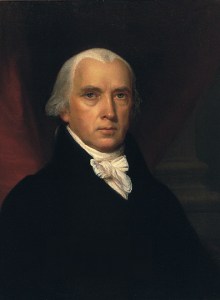
Madison

Early in their careers, Hamilton and Madison were intellectual allies in this respect. They wanted a republic, not a democracy. They feared tyrannical minorities and majorities equally. Thus they became the most important individuals in the creation and passing of America’s Constitution.

Madison had more intellectual input into the actual document, and was the note-taker during the Constitutional Convention. But Hamilton and Madison then collaborated in campaigning for that Constitution to be ratified by the states. (The document, much as we esteem it today, was very controversial and ratification was a close call.)

The Federalist Papers

This meant above all explaining and interpreting the proposed Constitution, which Hamilton and Madison, along with John Jay, later the first Chief Justice, did with one of the most impressive literary achievements in history: The Federalist Papers.
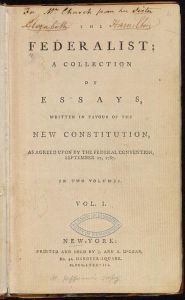
The Federalist Papers are a collection of 85 essays, of which 51 are attributed to Hamilton, 29 to Madison and 5 to Jay (so Hamilton was clearly the main author). The essays amount to about 175,000 words. And they wrote them in the space of only seven months, in their spare time (!), for they were still pursuing their main vocations during office hours — Hamilton as a lawyer.

Here is a measure of how important The Federalist Papers continue to be: By the year 2000, they had been quoted 291 times in Supreme Court opinions, with the frequency of citations rising with the years. (p. 261 in Ron Chernow’s biography of Hamilton)

And in these Federalist Papers, we see Hamiltonian values — meaning the ancient values of balance — on display. Hamilton envisioned:

  • a strong executive, (≈ monarchy)
  • a strong legislature (≈ democracy), and
  • an independent judiciary that could and should, if necessary, overrule the “popular will” if it destroyed liberty. (≈ aristocracy)

Judicial Review (and Prop 8 )

That this last bit is the “aristocratic element” might take a bit of explaining. To be sure, it is not the only aristocratic element in America’s overall structure. The electoral college originally had actual powers to select the president. Members of the upper chamber of the legislature — called the Senate, in direct allusion to Rome — were elected by state legislatures rather than the voters (an idea that many in the Tea Party want to bring back). And so on.

But the judiciary seems to me to be the most important aristocratic check on both potential tyranny and mob rule. In Federalist Nr 78, Hamilton wrote that

no legislative act … contrary to the constitution can be valid.

This sounds simple and obvious now, but it is not actually in the Constitution. In effect, Hamilton said that the Supreme Court (ie, a meritocratic elite) must be able to overturn legislation (ie, the popular will). Hamilton thus prepared the way for a later Supreme Court decision (Marbury v Madison, 1803) that established the concept of judicial review.

And that, of course, is what we have today. If you want to see the inherent and eternal tension that Hamilton foresaw, look, for instance, to the controversy about California’s “Prop 8“:

  • it is a ballot measure (ie, an expression of the popular will),
  • in which a majority voted to restrict a right (marriage) of a minority (gays and lesbians),
  • before a federal court overturned that vote.

Each side in the Prop 8 debate is screaming “tyranny” at the other, but Hamilton’s notion of balance will prevail. Hamilton, in the 18th century, would certainly have been surprised by the context (gay marriage) but not by the principle involved.

Center and periphery: “enumerated” and “implied” powers

That example of Prop 8, in which a federal judge has overturned a state ballot measure, also shows another aspect of Hamilton’s vision: there also had to be a balance between the core and the periphery, between central government and state government.

Recall the previous post again: Hamilton was actively fighting — as George Washington’s chief of staff, mostly — in the Revolutionary War, whereas some of the other Founding Fathers, and specifically Hamilton’s future enemies (I will get to them in a minute), remained in the comfort of their plantations or with the Continental Congress in Philadelphia, with its bustling dinner-party circuit.

What vantage point did that give Hamilton on the fledgling nation?

He saw that the nation was not viable as such. If the United States then has an equivalent today, it would be the United Nations.

America was fighting a professional army and navy (the Brits) with a ragtag force of militiamen who had no uniforms, and often no shoes and weapons. These Americans enlisted for a year at a time, which meant that Washington feared that his entire fighting force might literally disintegrate and vanish at the end of each enlistment period.

The nation, such as it was, had no powers of taxation. At all. So it had no money to pay its soldiers. And it could not issue debt. It relied on the individual states both for money and for soldiers. On occasion, the American troops mutinied, once even marching on Philadelphia and sending Congress to flee from its own soldiers.

This was not an abstract matter for Hamilton or Washington: They were starving and freezing with their soldiers at, for instance, Valley Forge, a miserable plateau in Pennsylvania where the Americans wintered in 1778-9.
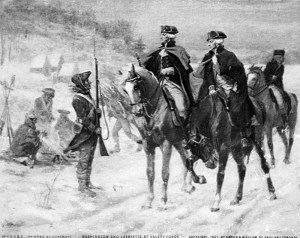
The painting above (of Washington and Lafayette on horseback, with perhaps Hamilton as the rider behind them?) does not really do the misery justice. According to Chernow’s new biography of Washington, the Americans (unlike the soldier in the picture) had no shoes, no coats, sometimes no shirts, and were dying of cold, disease and starvation.

So Hamilton and Washington formed a vision of a strong center, one that could feed and clothe its soldiers and hold the states together. For the center to be strong, it would have to have a professional army, and powers of taxation and borrowing (“Aha,” say the Tea Partiers of 2010…).

When opponents later charged that the Constitution did not explicitly mention the things necessary to build such a strong central government (for example a Central Bank), Hamilton replied that

it is not denied that there are implied as well as express powers.

And thus Hamilton, almost en passant, submitted another evergreen argument into American politics, which you hear debated this year by Tea Partiers parsing “enumerated” and “implied” powers.

But Hamilton was not for a Leviathan (I believe he would be shocked by the bloat of our federal government today). He definitely envisioned the central government, though strong, as sitting atop states that remained otherwise sovereign in their daily affairs. Hence the “federalist” nature of the new country, and the name Hamiltonians called themselves: Federalists.

The federal balance that Hamilton conceived was so stable that Switzerland, in 1848, imported it wholesale and Germany, a century later, in large part.

The first American Capitalist

Alexander Hamilton was the only Founding Father who grasped not just one but both revolutions occurring in his time:

  1. the political revolution in governance and
  2. the industrial revolution.

For background: America was an agrarian society. The colonies were dependent on Britain for manufactures. There were no companies as such (both the legal form and the accounting systems did not exist in any form recognizable to us). Banks as such did not exist. Stock exchanges did not exist.

Hamilton’s enemies, primarily Thomas Jefferson, wanted to keep it that way. To Jefferson, an agrarian America was more “pure” than an industrial America. Here, arguably, likes the origin of America’s schizophrenia regarding “Main Street” versus “Wall Street”. But let’s remember (recall once again the previous post) that the agrarian “purity” of which Jefferson talked was based on slave plantations such as his own in Virginia. It was pre-capitalist, yes, but in a feudal, illiberal, dehumanizing way.

Hamilton, on the other hand, wanted to abolish slavery and looked ahead to a capitalist era. He read Adam Smith’s (then new) Wealth of Nations. He grasped modern concepts of finance. He wanted America to manufacture things, and to finance this new economy with banks and securities.

So he entered the most fruitful period of his career, as the first Treasury Secretary. Washington was president, and the only two other members of the cabinet were Thomas Jefferson as Secretary of State and Henry Knox as Secretary of War. But neither Jefferson nor Knox had much to do, whereas Hamilton became a de facto prime minister to Washington in putting the new country together. Within a few years, Knox had a dozen civilian employees in War, Jefferson had six at State, and Hamilton had … more than 500 at the Treasury. Knox was a jovial nature and didn’t care. But Jefferson was seething.

Hamilton was too busy to care. Within a few years, he created:

  • a central bank,
  • a monetary policy and paper currency to go with it,
  • a stock exchange,
  • a coast guard and customs service to collect the tariffs that were to finance the government (there was no income tax).

In short, he seeded the modern American economy.

The tragic lesson: American inversion of reality

You may agree by now that Hamilton was a genius and that, yes, his vision, more than any other Founding Father’s, created the nation we know. But I personally have learned more from the tragic aspect of his career.

The tragedy has to do with the political inversion of reality that was threatening to undo Hamilton’s career when he died so prematurely in his duel.

And that, too, may be the Founding Fathers’ legacy to us.

What am I talking about?

Opposition to Hamilton and his ideas started early. Some compatriots always found something sinister in his charm and success and genius, in his foreign origins and cosmopolitan attitudes, and in specific opinions such as Hamilton’s abolitionism.

For example, during the struggle in the states to ratify the Constitution, the anti-federalists began posing as populists, even though the most prominent of them were rich slave owners. Patrick Henry of Virginia — the very same Henry who famously said “Give me Liberty or give me Death!” — argued against the Constitution by telling delegates that

They’ll free your niggers.

Others, less blunt than Henry, wrapped their scorn in the emerging meme of the day, which painted Hamilton as a closet monarchist or aristocrat, whereas the (slave-owning) agrarians were the true democrats.

George Washington, who usually kept a dignified distance from the political swamp but reliably sided with Hamilton, wryly observed the irony:

It is a little strange that the men of large property in the South should be more afraid that the Constitution will produce an aristocracy or a monarchy than the genuine, democratical people of the East.

By the “people of the East” he meant the mostly northern farmers, merchants and industrialists in Hamilton’s circles.

Hamilton himself also deployed his irony. In a newspaper piece in 1791, referring to Madison and Jefferson, he wrote (Chernow, p. 307):

As to the negroes, you must be tender upon the subject … Who talk most about liberty and equality …? Is it not those who hold the bill of rights in one hand and a whip for affrighted slaves in the other?

But irony rarely wins in America. Then as now, the most effective political strategy in American politics is relentlessly repetitive attack until reality becomes what the attacker wants it to be. Jefferson was the worst offender, but Madison, Hamilton’s erstwhile soulmate, was just as bad after he split from Hamilton and went over to the “Republican” side.

And let’s reflect on that label the Jeffersonians chose, for a moment. Why call yourself “Republican” if not to imply that your opponents are un-republican? Everything you’ve read in this post so far tells you that Hamilton was a true republican, and yet Jefferson and his cronies now campaigned to make people think the opposite.

And cronies they had plenty. (Both sides did, to be fair). The Fox News of the day was the National Gazette, first published in 1791, a newspaper that served as the mouthpiece for Jeffersonian attacks branding Hamilton as a monarchist, tyrant and what not.

And thus it was that

  • the future presidents Jefferson and Madison, the patrician owners of slaves and plantations, became known and remembered for generations as the folksy democrats who were close to the land and people, whereas
  • Hamilton, the illegitimate quasi-orphan from the Caribbean who had worked his way to success with sheer talent and grit and who wanted to free the slaves, became the elitist aristocrat.

I have, in the paragraphs above, suggested several modern analogs to the issues raised in this post. But I will leave you to ponder this last subject on your own. And I will end, very much as Hamilton might, on that note of pessimism.