The human brain while driving and …

It was only a matter of time, I suppose, until I had to advance from venting about the evils of distracted driving here on The Hannibal Blog to doing so in The Economist. So here it is. My rubric says it all:

Distracted driving is the new drunk driving.

The research and writing process had the usual frustrations (usual for The Economist, I mean): I talked to lots of people, read many tens of thousands of words of academic research, took more than 10,000 words of notes, and then…. reduced it all to 700 words.

Oh well. Out went a whole lot of nuance.

If you ask me to name the most interesting concept from the article, and about the whole topic, it is this:

The human brain cannot process communication (oral or written) with a person who is not physically present without drastically reallocating attention and thus compromising driving safety. This is a biological fact. All those who claim that they can call/text and drive are the modern equivalents of the people you might (if you’re older) recall bragging that “I can hold my liquor” before that started sounding ridiculous.

As Satoshi Kanazawa, an evolutionary biologist and a delightfully belligerent blogger, puts it:

Any communication with parties who are not immediately present is evolutionarily novel, and the human brain is likely to find it cognitively difficult to handle.

Steering a large metal weapon at lethal speeds through crowded surroundings, of course, is also “evolutionarily novel”. So we have a double whammy. Homo sapiens just didn’t do this stuff in the savannah.

And yes, this means that bluetooth (“hands-free”) does zero to reduce the risk.

Anyhoo, here is just a tiny sample of some of the research that, sadly, got little or no exposure in my article for lack of space:

The humanity in a Joad and a Vega

Well, it’s time again for our (The Economist‘s) annual Christmas issue — a double issue (meaning that it is on news kiosks for two weeks instead of the usual one).

My piece in this one is called Migrant farm workers: Fields of Tears.

(The title of this post explains itself if you read the article.)

They even used one of the pictures I took with my dirty, sweaty, unsteady hand while picking grapes in August (I posted about it at the time). So, even though we don’t get bylines at The Economist, I did get a tiny picture credit in the bottom right! 🙂

The back story

In late October, I posted a cryptic and coy entry here, in which I talked about an exchange with one of my editors, after she told me that

The subject-matter is so emotionally strong that it will work better if the tone is flatter.

This was, in fact, the piece we were talking about and editing at the time. So now you can read it and judge for yourself if flattening the tone was the right decision.

Another point worth mentioning is that my first draft was, well, bad. The reason was one that you may find sympatico (during my research, we had a baby, so I had other things on my mind and took a shortcut, writing before I was ready). But a good editor owes it to the writer not to let those half-hearted pieces slip through.

So my editor called me on it. She has a beautifully frank manner, which sugarcoats nothing (and thus makes her praise, whenever it comes, uniquely credible).

Back I went, after my paternity leave, to finish the research (which was harder than it is for most of my pieces). And then I wrote what turned out to be the real piece.

During the frantic copy-editing in the final hours before the pages were printed, I thanked my editor for her intervention:

… you did me the honor of being frank, thus saving me from a bad piece and forcing me to turn it into a decent one. You’re the best editor I’ve ever had. It’s all about trust: the editor has to trust the potential of the writer (and demand that it be reached); and the writer has to trust the judgment and intention of the editor.

She replied with some touching personal comments, and then this summation, which tells you more about The Economist than you would ever understand simply by reading our magazine:

… I also think the genuinely nice atmosphere at the econ–in contrast to many other papers–is important here. People generally believe they’re working together, not against each other.

Hayek & Keynes rap again

Remember that little rap, literally, by Friedrich von Hayek and John Maynard Keynes?

Well, my colleagues at The Economist got them (ie, Hayek and Keynes) to rap again, for one of our conferences. Afterward, our editor, John Micklethwait, (ie, my boss) interviewed them about how they came up with the idea. Video below.

My slightly more serious treatment of the subject, from the “continental” point of view (which produced Hayek, but not Keynes) is here.

Spontaneity and order


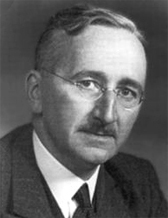
Hayek


Ten years ago, I began a piece in The Economist about Hong Kong with a paragraph that was, in this particular context, intended to be surprising:

FRIEDRICH VON HAYEK and Walter Eucken parted company over the issue of power formation in the private sector. Hayek, a leader of the Austrian school of liberalism, believed that keeping government small was enough to preserve competition. Eucken, who founded the school’s German branch, felt that anyone with excessive power, whether a government or a company, could threaten economic freedom. It is a pity that neither was alive this week to analyse the case of Hong Kong….


Eucken (click for credits)


Our local readers in Hong Kong quite enjoyed this framing of what they considered their “little” hometown business controversies, since they don’t usually see their city connected to the big debates among Western intellectuals.

I, however, was fascinated by precisely those local controversies, for two reasons:

  1. I consider Hong Kong the freest place in the world (and thus worth studying), and
  2. I have a personal connection to that debate between Hayek and Eucken, which I’ll tell you about at the end of this post.

Liberalism vs Libertarianism

What reminded me of all this was a post the other day by one of my colleagues about the two isms, Liberalism and Libertarianism. He concludes that the difference is basically about the precise role of government and

which approach is likeliest to lead to the most freedom.

So, because I’ve been parsing Liberalism here on The Hannibal Blog for a couple of years now, I thought I’d add a “continental” twist for those of you who are connoisseurs of all things liberal.

Between Freiburg and Vienna


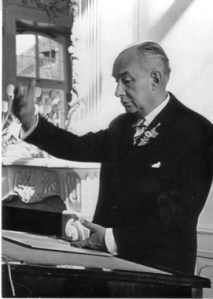
Mises (click for credits)


For a lot of “Anglo-Saxons”, in my experience, the first surprise is that that there is a continental twist at all. Surprise turns into shock when the twist turns out to be specifically Germanic. Could Germans really have much to say about freedom?

Well, yes, a whole lot. The liberal tradition is long and deep in the German-speaking countries. Obviously it suffered a near-death experience during the Nazi years, but then it came roaring back in the post-war years.

More to the point, a lot of what we now tend to think of as “Anglo-Saxon” ideas actually have an intellectual pedigree that goes back to these “Germanic” (mainly German and Austrian) thinkers.

Ludwig von Mises (above) was the first giant of the so-called “Austrian School”, and in turn influenced the even more gigantic Friedrich von Hayek. Hayek in turn influenced Milton Friedman, who in turn influenced Ronald Reagan and Margaret Thatcher, thus re-branding Austrian Liberalism in the minds of many people as an “Anglo-Saxon” thing.


Rüstow


Walter Eucken, on the other hand, founded the so-called “Freiburg School” of Liberalism (after the university town where they hung out), which included liberal thinkers such as Alexander Rüstow (above) and Wilhelm Röpke (below).


Roepke


How spontaneous is order?

The first and most important thing to understand about all these thinkers is that they were friends. They liked each other’s company and liked debating one another. They viewed themselves not on opposing sides of anything, but on the same side: the side of individual freedom (which is what all classical Liberals agree on).

The subtlety that kept them busy (and I deliberately oversimplify) had to do with order. The Latin for order is Ordo, so the Freiburg School eventually even called themselves Ordoliberals.

Order, as opposed to anarchy, is necessary for individuals to be free. The question, however, is whether or not order comes about spontaneously.

Option 1: Yes

If the answer is Yes, as the “Austrians” basically believed, then the conclusion has to be that we simply need to keep government out of the equation entirely.

The “market” (and this could apply to more than material things — ie, ideas, culture, etc) will then “order” itself spontaneously, though competition. The prerequisite is merely the rule of law.

Option 2: Jein

The Ordoliberals did not counter that the answer is No. Instead, I would call their answer Jein (a contraction of Ja and Nein in German). Yes, markets can spontaneously create order. But that order is not always stable. Worse, that order could be of a sort that robs individuals of liberty.

What they had in mind were cartels, tycoons, cabals, and anybody else who amassed an unhealthy amount of power.

So whereas the “Austrians” worried almost exclusively about excessive government power, the Ordoliberals worried about all excessive power, whether in the private or public sector.

This led the Ordoliberals to the conclusion that government must, yes, stay limited, but must also supplement the “spontaneous” ordering of markets with “corrective” ordering. Government had to crack down hard on cartels and monopolies, for example.

My personal interest

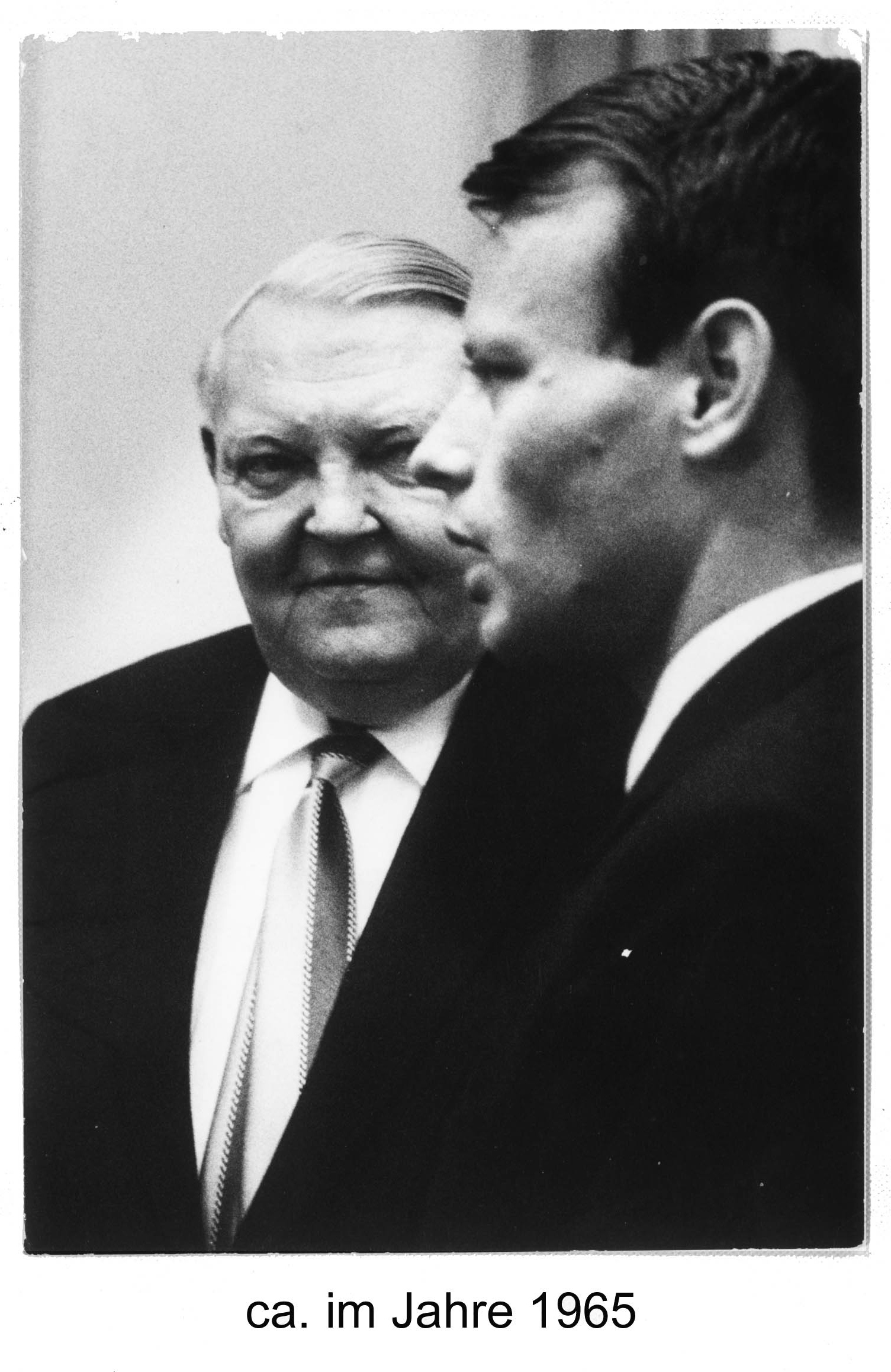
I mentioned a personal connection to the debate. Well, I wrote my Master’s thesis at the London School of Economics about it (or rather, about an obscure aspect of it). My dad had once written his PhD thesis about another obscure aspect of it. And that was probably because his uncle and godfather was somebody by the name of Ludwig Erhard (“Uncle Lulu“). Here they are in the sixties, Lulu on the left, dad on the right:

And if Hayek influenced Ronald Reagan and Margaret Thatcher, and thus “Anglo-Saxon” policy, the Ordoliberals shaped Ludwig Erhard and thus post-war West German policy, for Uncle Lulu was West Germany’s first economics minister and then its second chancellor.

Postscript: Liberal v Libertarian (again)

So back to those two isms.

In essence, I think that Libertarians trace their evolution back to the Austrians featured here, and Liberals to the Ordoliberals.

However, those Austrian and Ordo-Liberals themselves, if we were able to bring them here today, would be puzzled by the debate. They would abhor some of the intellectual excesses committed in both names, and remind us that they were originally almost indistinguishable.

More British humor from The Economist

From time to time, I try to give you glimpses into the most distinctive aspect of our corporate culture at The Economist, which is, of course, humor.

So yesterday I received an email. A colleague had sent it to “All Editorial”, requesting some help with what appears to be a story idea he or she is developing. Here it is:

Dear all,

I’ve noticed a tendency for companies to expect/demand that their employees enjoy their jobs, and give visible signs of so doing–being happy, wacky, fun and funny…

Has anybody else come across examples of this depressing and obnoxious trend? I’d love to hear from you if you have….

Why I am shrinking this blog

I told you in the previous post that, for the first time, I deleted a post (it no longer matters what the post was about) because I came to the conclusion that it was badly written by my standards.

Upon further reflection, that made me realize that I have to “shrink” this blog. Now I’ll explain what I meant by that. (And yes, I savor the irony that I will talking about a “shrinking” a blog in a 2,000-word blog post.)

I) What I consider “badly written”

I write so much that the mechanics — syntax, grammar, flow — are rarely bad anymore. But that’s not what writing is about.

Ultimately, words deserve to be spoken or written only if they communicate what the speaker or writer wants to communicate. And that very much includes not only the substance denoted but also the tone, voice and other bundles of connotation.

We all know that perfect control over the meaning(s) of words, especially written ones, is impossible. That is why Socrates refused ever to write, and always only spoke. Just think of our ongoing debate about the words (and punctuation) in a phrase written 219 years ago:

A well regulated Militia, being necessary to the security of a free State, the right of the people to keep and bear Arms, shall not be infringed.

Did the writer intend that only “a Militia”, and “a well regulated” one at that, was to have the right to bear arms? Or that “the people”, collectively and individually, should have that right, although it might also be, you know, nice if a Militia were around? Who knows?

This conundrum — that writers lose control over their words as soon as they make contact with any audience — led people like Jacques Derrida to suggest that we stop even pretending that we can control meaning: Words mean whatever anybody wants them to mean, so get over it.

I don’t subscribe to that. A good writer should have some control over his words, the way a good rider should be able to rein in his horse. Naturally, horses sometimes go berserk, as do words. But that’s when it’s time to kill a blog post.

That the now-deleted post had to be dispatched became clear not when it led to vigorous debate (as many posts here on The Hannibal Blog do), but when the comments looked to me, the writer, as utter non-sequiturs. I looked at some of them and could only say: “Huh?” How did the commenter read this meaning into this post?

This is when I remembered my Second Secret to Good Writing, which is empathy. Don’t blame your audience. Re-examine your words.

My words had not just evoked an unintended response, but in a few individual cases the opposite of the response intended. That should not happen to a good writer.

And so I decided that the words had to die.

II) Why might this have happened?

1) The issue of quantity

Less than a month ago, I wondered whether there was “a Laffer Curve” of writing — in other words, a point beyond which increasing quantity (of words written) decreases quality.

I was pondering that question because, over the past couple of years, the number of words I produce, and am expected to produce, has inexorably been increasing.

When I started at The Economist in 1997, we were expected to write articles for the weekly (print) issue. And that was it. (Quite enough, I thought.)

I first recall internal discussions about “blogs” in 2006. I might have had something to do with that, because I wrote a Special Report in 2006 about “the new media.” In it, I said that all the new media (including blogs) would collectively transform society, which they clearly have done. But I never said that individual news organizations had to add blogs.

But blogs we began having, even at The Economist. For a while we didn’t really take them seriously. But now we do. And we have more and more of them. And we are expected to “feed” them. So, in addition to the articles we write, we write blog posts.

We also do podcasts, and those often take a surprisingly long time (the logistics, not the actual talk time). And we do video pieces. Those take even more time to set up.

To take this week as an example, I produced two articles, two blog posts and one podcast … in four days (because on Friday I allegedly started a holiday.)

Our heritage, our “print DNA”, means that we will always put the utmost effort into the print-issue articles. So that’s still where the research, fact-checking, deliberation, travel, background reading, interviewing goes. (And real-life logistics have an annoying habit of not aligning perfectly with The Economist’s Greenwich-mean-time deadlines.)

But that doesn’t actually leave all that much time to produce all that other stuff.

Then add a personal blog in support of a forthcoming book, such as The Hannibal Blog.

Yup, now this amounts to a lot of words. Some of those words will not be redacted, honed, polished, and stress-tested as much as they should be. This must mean, from time to time, that some words are less than optimal.

Conclusion: Don’t produce more, perhaps less.

2) The issue of audience expectations

I recall an internal discussion once where the theory was put forth that the web audience is sophisticated. In other words, readers of blogs (whether on The Economist’s web site or WordPress) know that the medium is more intimate, conversational, relaxed, aphoristic and subjective. Blogs are essentially personal diaries, except public and social.

Readers, goes the theory, do not expect a blog post to be balanced, polished and fact-checked. They can discriminate between a blog post and an article.

Not only that, but they like to have that less formal window into the writer’s soul, they like hearing about what happened to him on the way to this-or-that, what he was thinking when so-and-so said something-or-other. It’s like knowing somebody by email and then seeing a handwritten note from him: the handwriting, with its imperfections, says something. Or like meeting a public figure and getting a peek behind the scenes.

Well, that’s the theory. The reality is that audiences get confused. Many readers/listeners/viewers merely see the brand, and do not discriminate among media. The brand could be The Economist or, at micro scale, The Hannibal Blog. But what if the human beings behind the brands straddle their boundaries? When is the writer allowed to speak personally, and when is he expected to be a journalist upholding a 160-year-old brand?

This is not a new issue. Correspondents of The Economist have always gone to dinner parties (OK, rarely) and often moderate panels at conferences, for example. When we’re chatting with our table neighbor, are we allowed to kid around and speak our minds? How about when we’re on a podium?

Blogging (and all its descendants, such as tweeting) is a genie that is out of the bottle and won’t go back in. I’m simply flagging a new tension. And a new need to make explicit to audiences what they should expect in which context.

Here on The Hannibal Blog, by the way, you get me, just me, my quirky, personal musings, which represent nothing else.

Conclusion: Don’t assume that readers let you speak “off-the-record”, be circumspect. If in doubt, say less.

3) The issue of scope

You may have heard people described as coconuts or oranges. Coconuts mix everything together inside, oranges come in neat sections.

Well, most people are coconuts, especially at The Economist. We have many interests, strange hobbies, and what’s interesting is what you get when you mix it all up. One of my favorite colleagues is simultaneously a connoisseur in the subjects of sailing tall boats, all matters Mongolian, Tango and bird watching, and that is only the beginning of a long list.

Should he stick to his beat in writing articles? Should he have a blog for each interest? On The Economist’s web site or on his own? Is it alright if he mixes it all together, the way it is mixed in his own soul?

In my case, for example, I started this blog about two years ago, intending to make it purely about the book I was writing. This was naive. I soon realized that the process of publishing a book takes a lot longer than the writing of it (and I now expect the book to be out next year). So what do you do in the mean time?

I was advised not to publish excerpts, because that would give the book away. So I began blogging about other stuff. All those other interests. Pretty soon, that included the whole dang coconut, even The Economist.

And again, it’s possible that some of you got confused.

I now face the interesting development that The Economist is constantly, almost every week, making available to me new “coconut straws”. Just one example: This summer we started yet another blog, called Johnson. It is about Language. I have not contributed to it yet, but it so happens that Language is one the big threads on The Hannibal Blog. Obviously, I have to rethink that. My future language posts should probably go to Johnson, not The Hannibal Blog.

Conclusion: Reduce this blog’s scope; become an orange; write about fewer and better defined topics. No politics.

4) The issue of fear

When you write you make yourself vulnerable. When you write on a personal blog you are even more vulnerable. Who knows what weirdos show up alongside the intended audience? Who knows who does what with your words?

That can lead to fear, and fear leads to the worst writing. And bad writing, for a writer, equals failure.

The most important prerequisite for being a good writer is therefore an ability to overcome fear and find courage. You must say something interesting, which invariably means that somebody somewhere could take offense (even when the topic might at first blush seem innocuous — no topic stays innocuous if it gets a large enough audience.) And you must say it clearly, which is to say simply and thus strongly.

This gets into one of the big topics in my book, the tension between tactics and strategy. Writing well (ie, with courage and risk) about many topics is like a country fighting a war on many fronts. You will eventually lose. Writing more timidly or carefully about all these topics is like fighting less fiercely on all those fronts. You will — again — eventually lose. So you must choose your topics (your fronts) strategically.

Conclusion: Again, write about fewer topics in each medium, such as this blog.

III) Postscript

I want to end by giving a little shout-out to two bloggers who, in their very different ways, have explicitly or implicitly addressed some of the issues above.

1) “Phil”

First, there is “Phil”. I don’t know what his real name is and I don’t need to know. He has several blogs, indeed he seems to keep switching blogs and starting new ones, to my ongoing confusion. His current “main” blog seems to be here.

Phil once observed, either in a comment here or in a post on his own blog, a phenomenon: Time and again, Phil finds an interesting new blogger, a strong and idiosyncratic voice, and follows that voice. After a while, that blog becomes popular. And then, as its audience grows, the blog becomes … bad.

(Phil, if you can provide the URL to your observation, I would like to link to it.)

So I speculate: Perhaps Phil, by starting new blogs all the time, is conflicted as we all are about gaining an audience. An audience gathers, and he runs away to start a new one. Because he understands, as we all do, that audiences are a threat as a well as a blessing.

2) “Man of Roma”

The other blogger who deserves a shout-out here is Man of Roma. He is a bon vivant and connoisseur of classical wisdom. And this summer he did something very civilized: He simply left (his blog, that is) and enjoyed himself, knowing that the audience that matters, which includes me, will be there whenever he returns.

Bookmark and Share

Contemplating America’s desert civilization

ONE late November night in 1980 I was flying over the state of Utah on my way back to California.

Thus Marc Reisner began his 1986 book Cadillac Desert, quoted to this day in the West’s perennial water wars.

I remembered his lines this week as I myself was flying back from Utah to California, and also looking out of my window at the desert below, baked dead by the July sun.

[This note is cross-posted from my note on The Economist‘s Democracy in America blog.]

As Mr Reisner did then, I looked down and contemplated the barren mountains, mesas and buttes and the endless empty expanses of salt and sand, one of the most inhospitable wastelands in the world.

This is where Brigham Young and his Mormons had decided to make “a Mesopotamia in America”, as Mr Reisner put it. Then, in the early 20th century, the federal Bureau of Reclamation took over their work and dammed the West’s rivers to impose the will of America upon this desert.

There, on the horizon, I espied the result: Lake Mead, America’s largest reservoir, formed as the pathetically small, snaking trickle of the Colorado River runs into the Hoover Dam and backs up.

As Mr Reisner put it:

Thanks to the Bureau—an agency few people know—states such as California, Arizona, and Idaho became populous and wealthy; millions settled in regions where nature, left alone, would have countenanced thousands at best; great valleys and hemispherical basins metamorphosed from desert blond to semitropic green.

The people in the states below my aeroplane are today among the most conservative in America. The tea-party movement thrives here. Big government is the enemy.

How ironic that the people are only on that land because big government first subdued it.

Then again, “subdue” may be a word from another time and worldview. The water wars have never really stopped (Californians will vote on another water bond in November, in the never-ending effort to bring water from where it rains to where the people live). And in the long run, as Mr Reisner might say, the desert may yet subdue the people.

Bookmark and Share

High on freedom and honest debate

I find that a great test of whether your instincts are liberal (as classically and correctly defined to mean freedom-loving) is how you approach the question of legalising marijuana.

In the current issue of The Economist I try to summarize the debate in California about Proposition 19 in November, a ballot measure that would legalize cannabis for those 21 or older.

And in an accompanying podcast, I interview an opponent and a proponent of legalization, both carefully chosen, in an attempt to get beyond mere gut instincts to clarify the arguments for and against. I wonder how you guys would interpret that conversation.

Bookmark and Share

The Laffer curve of writing quality

You’ve probably heard of the Laffer Curve. Economist Arthur Laffer allegedly sketched it on a napkin during a 1974 meeting in Washington that included Dick Cheney and Donald Rumsfeld.

It is a thought experiment intended to show that if you raise the tax rate beyond a certain point you actually end up collecting less tax revenue. (At a tax rate of 100%, for instance, nobody would bother earning income at all anymore.)

Well, the curve just popped into my head as I was contemplating something completely different: The quality of my writing — or of anybody’s writing.

Look at Laffer’s curve above and replace Government Revenue on the Y axis with Writing Quality, and Tax Rate on the X axis with Words Written.

Up to the peak

In general, I have noticed that my writing in the past always improved when I wrote more.

So, at The Economist for example, I noticed ‘being on a roll’ every time I finished a Special Report (those 12,000-word inserts). Then, when I wrote my book in my spare time, I again noticed that all my writing seemed to improve. When I added this blog, my writing seemed to get better again. And so forth.

Why might this be the case?

Perhaps because when you write too little (which applies to most people), you are too timid with your words, too diffident that you actually have something to say. As you write, you discover that you do have something to say, and the words come more easily and fluidly.

Or perhaps you feel less less uptight about your words as you write more of them, and you become looser as a result. Who knows?

So far, the advice for most writers and bloggers would therefore seem to be:

Write more.

Down from the peak

But of late, I’ve also been wondering whether one can write too much.

At The Economist, for example, we’ve been adding all these blogs, not to mention the “multimedia” content. So now we’re expected to “feed” those as well.

Internally, we’ve resolved that readers come to blogs with different expectations of polishedness (as opposed to quality, which should stay high). It’s OK to shoot from the hip.

Still, I wonder about the Laffer Curve. When do I start writing so much and so often that my writing gets worse?

Writing = Vita interrupta

That’s my silly word play on Coitus Interruptus. What I’m trying to say that writing is always and necessarily the second step in a process.

The first step must be:

  • thinking,
  • reporting,
  • experiencing
  • living

Then you interrupt that first step and write about it. But if you write too much, you cannibalize the thinking, reporting, experiencing and living, do you not?

Perhaps then it’s time to

write less.

Bookmark and Share

Olivia on ideas and writing

Olivia Judson

Olivia Judson, a science writer and New York Times blogger, used to be a colleague of mine at The Economist in London when I started there in the late 1990s. She then left and went on to do lots of very interesting things. This always thrilled me vicariously because it offered proof that there is indeed life after and outside of The Economist.

So I enjoyed reading her final blog post, in which she muses about her writing process as she leaves to take a book sabbatical. It’s a good read for any writer, whether the subject is science or not.

(Thanks to Dan Braganca over at the Renaissance Roundtable for the heads-up.)

About her job, Olivia feels rather as I feel about mine:

It’s like owning a pet dragon: I feel lucky to have it, but it needs to be fed high-quality meat at regular intervals . . . and if something goes wrong, there’s a substantial risk of being blasted by fire.

Which is in part why she’s decided to take some time off:

to ensure a supply of good meat in the future [by] reading, reflecting, and replenishing my stash of ideas.

Ahhh. Replenishment. I have my moments of yearning for that, too.

She also talks about how she gets and nurses ideas and writes. And again, I might have used the exact same words for myself:

For me, ideas are capricious. They appear at unpredictable (and sometimes inconvenient) moments — when I’m in the bath, falling asleep, jumping rope, talking to friends. They are also like buses — it’s never clear when the next one will come, or how many will arrive at once. So it’s important to catch them when they do appear: to that end, I have a list. It’s not well-organized — my desk is littered with scraps of paper and post-it notes, covered in scrawls like:….

The only difference for me is that I recently disciplined myself to move my list from scraps of paper to a Google Doc, which I share with my editor and colleagues so that they can see, whenever they please, what my list looks like at a given moment. (However, they never remember actually to look, so perhaps I’ll end up back on paper.)

She also touches on some of the things that I like to talk about here on The Hannibal Blog, such as the issues of length in writing and the risks of investigating and developing story ideas without knowing whether they will work:

having an idea is one thing; developing it is another. Some ideas look great from the bathtub, but turn out to be as flimsy as soap bubbles — they pop when you touch them. Others are so huge they can’t easily be treated in 1,500 words or less, or would take two or three months to prepare. Still others — luckily — are just right. But I don’t usually find out which is which until I begin to investigate them.

Best of luck, Olivia.

Bookmark and Share